
The advantages of entering the UK market are practical rather than promotional: contract law the world already writes into its deals, no minimum investment on the main founder visa route, company formation in days, and a tax system with treaty cover in every major economy. The honest guide is about fit — which sectors carry government backing, which visa route matches your plans, and what structure to settle before capital moves. That is this one.
On This Page

The Investment Case: What the UK Offers Foreign Capital
- Legal certainty: English law and courts are the default forum for international commerce, and property rights are registered, enforceable and insurable.
- Openness: no general screening of foreign ownership outside national-security sectors, and no minimum investment on the Innovator Founder visa route.
- Speed: a UK company can be formed within days; the slow parts are banking, visas and tax structuring — all plannable.
- The counterweights: a 25% main corporation tax rate, SDLT surcharges on residential property for non-residents, and transparency regimes that put ownership on public registers.
Economic Fundamentals
Markets and the Rule of Law
London remains one of the world's two deep capital markets hubs, and the advantage for an investor is less the skyline than the plumbing: sterling and foreign-currency financing on competitive terms, a professional services bench in every specialism, and disputes resolved in courts whose judgments the world enforces. The UK consistently ranks among Europe's leading destinations for foreign direct investment on the government's own annual results — the durable draw is that capital can get in, operate and exit under predictable rules.
Position and Language
The time zone bridges Asian and American trading days; English is the language of the contract as well as the office; and post-Brexit trading arrangements, whatever their politics, are now settled enough to price. For groups structuring European operations, the UK works either as the headquarters that reaches into Europe or as the common-law base alongside an EU entity — a decision that belongs in the structuring conversation, not after it.
Government Backing
The Industrial Strategy
The government's modern industrial strategy concentrates policy support on eight growth-driving sectors — among them advanced manufacturing, clean energy, digital and technology, life sciences, and financial and professional services. The published commitments carry multi-billion-pound funding programmes across R&D, manufacturing and energy; the practical point for an investor is that sector choice now affects grant access, planning priority and the reception a project gets.
Department for Business and Trade
The Department for Business and Trade runs the front door: investor relationship management for significant projects, introductions to regional development bodies, and guidance through regulatory approvals. It is genuinely useful and genuinely not a substitute for advice — DBT promotes the investment; your own advisers protect it.
Where the Growth Sectors Are
- Technology and AI: Europe's largest tech ecosystem by investment raised, anchored in London and Cambridge.
- Life sciences: research universities, NHS-scale data and dedicated funding programmes.
- Clean energy: the heaviest policy tailwind of the decade — offshore wind, nuclear and grid infrastructure.
- Advanced manufacturing: long-horizon funding commitments and established supply chains.
- Financial services and fintech: regulatory sandboxes and open banking made the UK the natural test market.
Technology and Innovation
The UK's technology sector is Europe's largest by most measures of scale and capital raised, and it sits third globally behind the US and China on cumulative valuation-based rankings. For investors the operational point is the talent-and-exit loop: universities feed founders, London feeds capital, and acquirers on both sides of the Atlantic feed liquidity.
Real Estate for Foreign Capital
Property Routes for Investors
UK property remains open to foreign buyers on the same title terms as domestic ones — what differs is the tax and transparency wrapper: the SDLT surcharges on residential purchases, the Register of Overseas Entities for corporate holders, and ATED for enveloped dwellings. Our non-resident property investment guide runs the numbers route by route, and our overseas entities register guide covers the compliance cycle corporate ownership now attracts.
Financial Services and Fintech
Financial services remain one of the economy's largest export engines, and the regulatory architecture is a feature rather than a hurdle for well-run entrants: FCA sandboxes for testing, open banking as standard infrastructure, and an increasingly defined perimeter for digital assets. The firms that struggle are those that arrive with a structure their home regulator designed; the perimeter analysis belongs before incorporation.
Visa Routes for Investors and Founders
The Innovator Founder Route
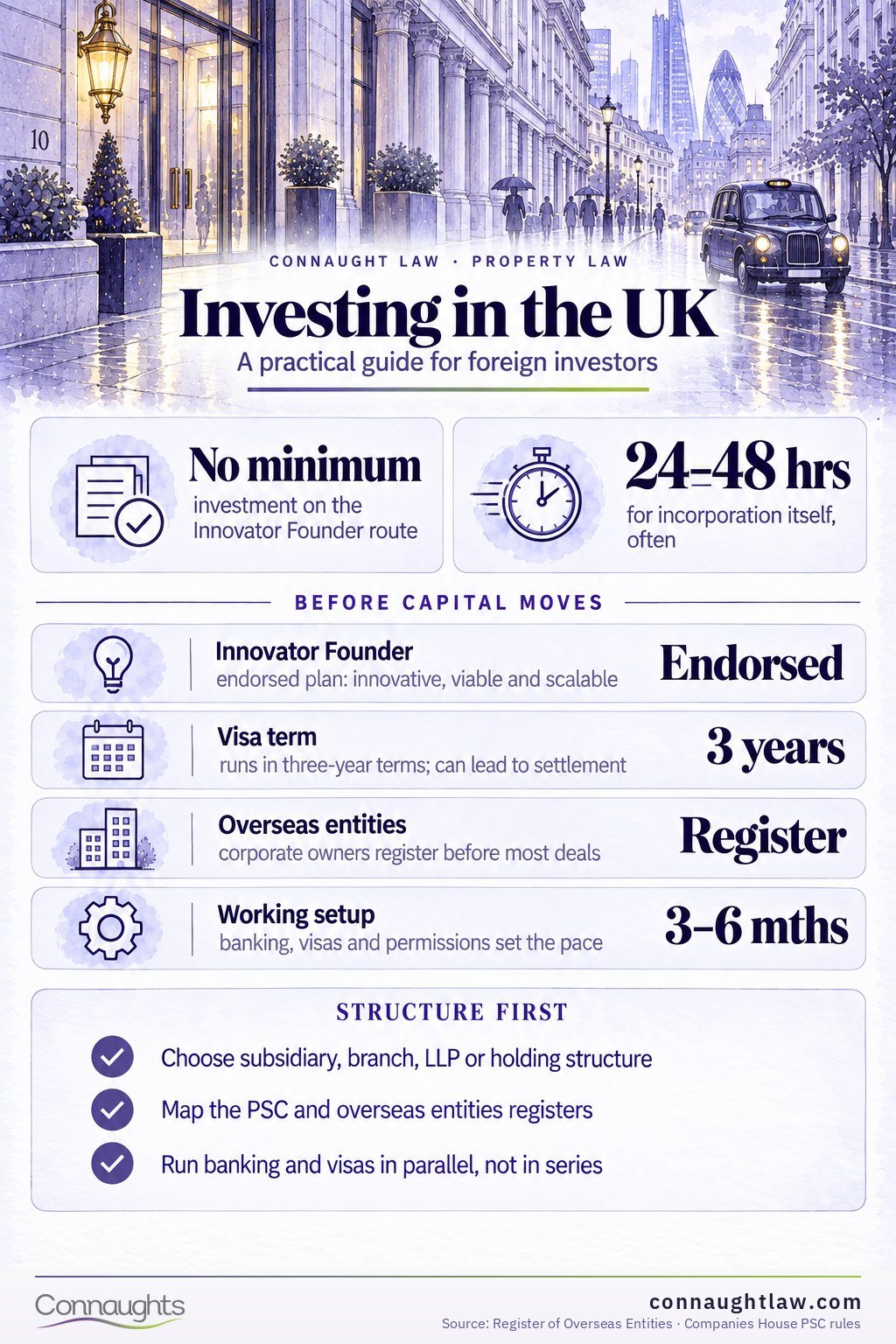
The Innovator Founder visa carries no minimum investment threshold — the old £50,000 floor is gone. What it requires instead is an endorsed business plan that is innovative, viable and scalable, which in practice is a harder test than a bank balance: endorsing bodies reject plans that are merely funded. The route runs in three-year terms and can lead to settlement; current fees and processing times are on gov.uk.
Other Immigration Routes
Not every investor needs the founder route: senior staff transfer under Skilled Worker sponsorship once the UK entity holds a licence, exceptional individuals use Global Talent, and family circumstances sometimes open better paths than business ones. The route decides the timetable and the exit options, so it should be chosen with the corporate structure, not after it — our business immigration team runs both together.
The Tax Position
Corporate Tax Framework
The main corporation tax rate is 25%, with a 19% small profits rate — mid-pack for the G7 rather than a haven, which is the honest framing. The genuine advantages sit in the reliefs and the treaties: R&D expenditure credit at 20% under the merged scheme, the Patent Box taxing qualifying IP profits at 10%, full expensing for plant and machinery, and one of the world's widest double-tax treaty networks cutting withholding on dividends, interest and royalties.
Structuring Before Arrival
The expensive tax mistakes are made before the first pound arrives: the wrong holding jurisdiction, a director tax-resident in the wrong place, property bought in a company that ATED was designed to catch. Residence, permanent establishment and withholding analysis belongs at the structure stage — our tax advisory team does that work alongside the corporate and immigration planning.
Getting Started
Structure and Sequence
- Choose the vehicle: UK subsidiary, branch, LLP or holding structure — each with different tax, filing and liability profiles.
- Map the registers the structure triggers: Companies House PSC rules, and the overseas entities register for property-holding vehicles.
- Sequence realistically: incorporation takes days, bank onboarding and visas take weeks to months — run them in parallel, not in series.
- Budget for compliance as an operating cost: annual filings, transparency updates and tax returns are the price of the open door.
Regional Incentives
Investment zones, freeports and devolved development agencies in Scotland, Wales and Northern Ireland offer relief packages — enhanced capital allowances, business rates relief, employer NIC reductions — that can materially change a location decision for manufacturing and logistics projects. They are location-specific and time-limited, which makes them a genuine input to site selection rather than a footnote after it.
Frequently askedQuestions about investing in the UK
What are the main advantages of entering the UK market?
Legal certainty under English law, open foreign ownership outside national-security sectors, deep capital markets, an English-speaking workforce, a wide tax treaty network, and visa routes without minimum investment thresholds. The trade-off is transparency: UK structures put ownership on public registers.
Is there a minimum investment to move to the UK as an investor?
No universal minimum. The Innovator Founder visa has no investment threshold — it requires an endorsed business plan that is innovative, viable and scalable. The old Tier 1 Investor route closed in 2022; capital alone no longer buys residence.
Which sectors have the strongest government backing?
The industrial strategy concentrates support on eight growth sectors — advanced manufacturing, clean energy, digital and technology, life sciences, and financial and professional services among them — with funding programmes, planning priority and investor support attached.
What taxes should a foreign investor plan for?
Corporation tax at 25% (19% small profits), with R&D credits, the 10% Patent Box and full expensing softening it; SDLT with the 5% additional-property and 2% non-resident surcharges on residential purchases; ATED for company-held dwellings; and treaty-managed withholding taxes.
How long does it take to set up a UK business?
Incorporation itself often completes within 24–48 hours. The realistic critical path is banking, visas and any regulatory permissions — a working establishment typically takes three to six months depending on sector, which is why the steps should run in parallel.
Do foreign companies buying UK property face extra rules?
Yes. Corporate owners must register on the Register of Overseas Entities before most transactions, file annual updates, and — for enveloped dwellings — consider ATED. Individuals face the SDLT surcharges instead. The wrapper decides the tax, so choose it before buying.
Tell us what you plan to acquire, which entity would hold it and where you are tax resident. We will design the structure, the visa route and the compliance calendar as one plan — before funds commit.
Get Expert Advice