
Any overseas company holding UK property is now inside a compliance cycle that never ends: register with Companies House, verify through a UK-regulated agent, file an update statement every year, and — since the 2025 rule changes — account for trust structures and pre-registration history too. Miss a step and the property is frozen for transactions while penalties accrue per property, with interest. This guide sets out the obligations as they stand in 2026.
On This Page

The Register of Overseas Entities: Where Compliance Stands in 2026
- Registration before dealing: an unregistered overseas entity cannot complete most purchases, sales, charges or long leases of UK property.
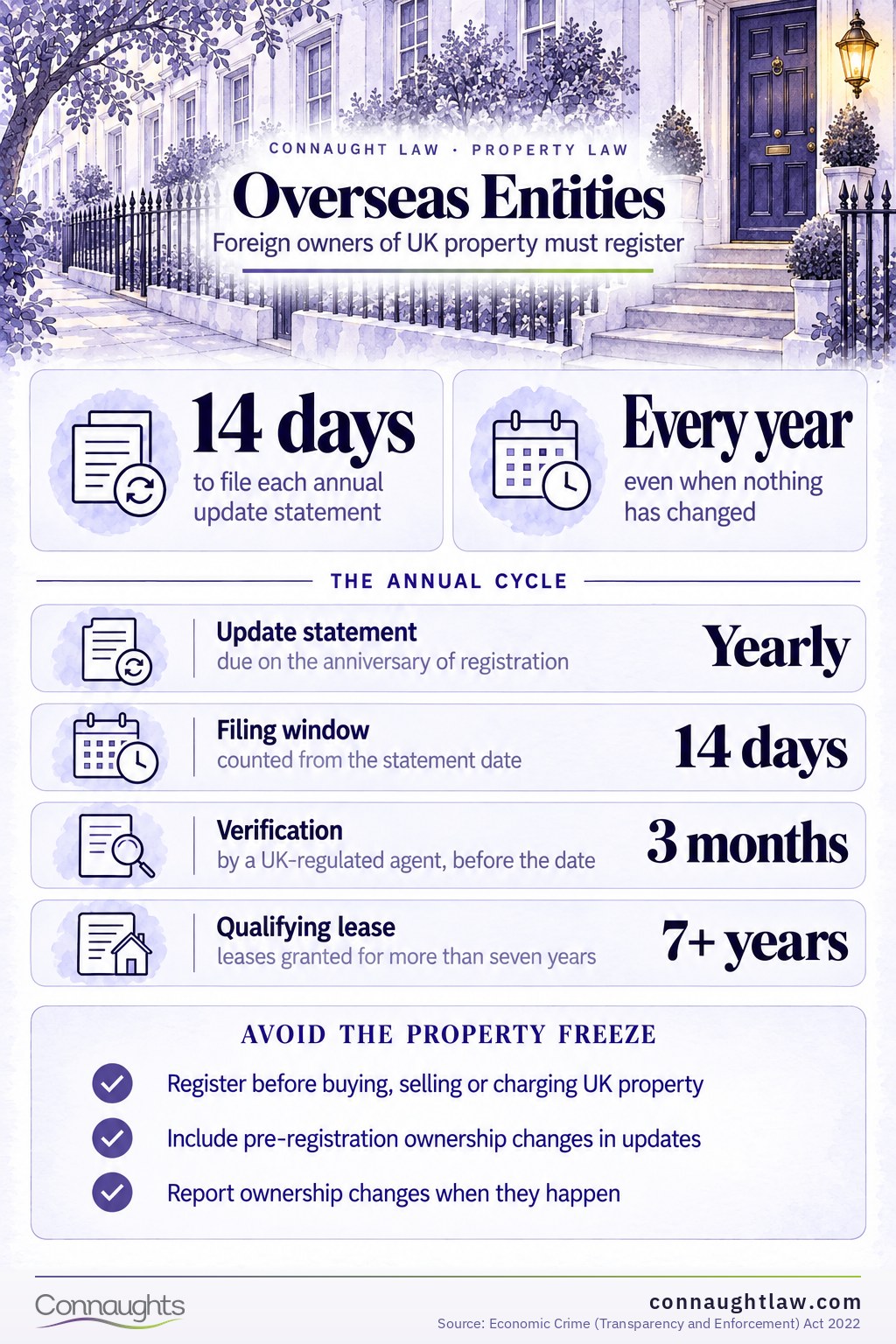
- An update statement every year, filed within 14 days of the statement date, whether or not anything changed.
- Since 1 November 2025, update statements must include pre-registration beneficial ownership changes — the transitional deferral has ended.
- Trust information became publicly accessible from 31 August 2025; protection applications have been open since 28 February 2025.
What the Register Is and Who Must Be On It
Created by the Economic Crime (Transparency and Enforcement) Act 2022 and live since 1 August 2022, the Register of Overseas Entities requires any foreign legal entity owning qualifying UK property to disclose its beneficial owners to Companies House, with the information verified by a UK-regulated agent before filing. The register is public, the obligations are continuing, and Companies House has moved from patient early enforcement to penalties, prosecutions and register annotations.
Qualifying Property and Registration Triggers
The register catches freeholds and leases granted for more than seven years, acquired since 1 January 1999 in England and Wales, 8 December 2014 in Scotland, and 5 September 2022 in Northern Ireland. Registration is the gateway to the Land Registry: without a valid overseas entity ID, dispositions are restricted — the practical freeze that makes this regime self-enforcing. Entities can only leave the register after disposing of all qualifying UK property.
The 2025 Rule Changes
Trust Disclosure and Protection
Public Access and Protection Routes
Trust details filed with the register — previously held by Companies House but shielded from public view — became accessible from 31 August 2025 under the 2025 protection and disclosure regulations. Individuals connected to registrable trusts have been able to apply for protection since 28 February 2025, on evidence of serious risk of violence or intimidation or exceptional vulnerability. Trustees who assumed permanent confidentiality should have their structures reviewed against the disclosure regime, not the assumptions of 2022. Separately, since 30 June 2025 Companies House can annotate register entries — flagging dissolved and non-compliant entities publicly.
Pre-Registration Period Reporting
The regime now reaches backwards. Entities must disclose beneficial ownership changes that occurred in the pre-registration period — between 28 February 2022 and 31 January 2023 or the entity's registration date, whichever came first. The window targets exactly the period when structures were most likely to be rearranged: after the legislation was announced, before the register could see them.
Transitional Timeline
Entities whose update statements fell due between 31 July and 31 October 2025 could defer the pre-registration disclosure to the following year's statement. That transition has closed: every update statement from 1 November 2025 onwards must include the pre-registration information without exception. An entity whose 2025 statement used the deferral should treat the 2026 filing as the heavier one — the historic analysis has to be done, verified and filed this cycle.
Penalties and Enforcement
Civil penalties for registration and update failures run in property-value bands — £10,000 at the lower band, £20,000 mid-band, £50,000 or more for premium properties — and they are charged per property, not per entity. A portfolio of five properties is five penalties. Unpaid amounts accrue interest at 8% a year and can be secured as a charge on the property itself, so the penalty follows the asset a defaulting entity was trying to keep.
Criminal Exposure
Behind the civil regime sit criminal offences: failing to register, failing to file updates, and making false statements carry fines and, for the most serious offences, imprisonment of up to five years for the entity's officers. Verification agents face criminal liability for false certifications, which is why reputable agents interrogate structures rather than rubber-stamp them. The prosecutions Companies House has brought are the signal; the annotation power is the public shaming that precedes them.
The Annual Update Statement
- Due every year on the anniversary of registration or the last statement — earlier filing resets the date; there is no skipping a nil-change year.
- 14 days from the statement date to file; after that the entity is non-compliant and the transaction freeze risk is live.
- Current Companies House fee: £134 per update statement.
- Where information has changed or new beneficial owners are added, verification by a UK-regulated agent is required, completed no more than three months before the statement date.
Staying Compliant
Only UK-supervised agents — solicitors regulated by the SRA, accountants under recognised professional bodies, firms supervised under the money laundering regulations with an agent assurance code — can verify register information. The workable pattern for overseas owners: one professional team holding the entity's register file, a diarised statement date with the verification window worked backwards from it, and a standing instruction that any change in ownership or control is reported when it happens, not remembered at filing time. Our real estate and tax teams run this as one exercise, alongside immigration planning where the owners relocate.
Questions about the register
Who has to register as an overseas entity?
Any non-UK legal entity holding a UK freehold or a lease over seven years acquired since the qualifying dates — 1 January 1999 in England and Wales, 8 December 2014 in Scotland, 5 September 2022 in Northern Ireland. Registration is effectively compulsory: without it, most property transactions cannot complete.
Is the register public?
Yes — beneficial ownership information is publicly searchable at Companies House, and since 31 August 2025 trust information has been accessible too. Individuals at serious risk can apply for protection; assumptions of confidentiality made before 2025 need revisiting.
What is pre-registration period reporting?
Disclosure of beneficial ownership changes between 28 February 2022 and 31 January 2023 (or the entity's registration date if earlier). Since 1 November 2025 every update statement must include it — the transitional deferral for mid-2025 statements has ended.
What are the penalties for non-compliance?
Civil penalties of £10,000 to £50,000-plus per property depending on value, interest at 8% on unpaid amounts, charges secured on the property, transaction restrictions, and criminal offences carrying up to five years' imprisonment for the worst failures.
When is my update statement due and what does it cost?
Every year on the anniversary of registration or your last statement, with 14 days to file and a £134 Companies House fee. A nil-change year still requires a statement; changes require fresh verification within three months before the statement date.
Who can verify our filing?
Only UK-regulated agents supervised under the money laundering regulations — SRA-regulated solicitors, recognised accountants, FCA-supervised firms — holding an agent assurance code where they file directly. Agents carry criminal liability for false verification, so expect real scrutiny of the structure.
Tell us when the entity acquired the property, whether it is registered and when the last update statement was filed. We will tell you what is outstanding — including any pre-registration reporting now due — and clear it before it costs you a transaction.
Get Expert Advice