
Transgender parents in the UK keep their legal relationship with their children through every stage of transition — the law on that point is settled. What has shifted is the wider legal landscape around gender recognition, most visibly the Supreme Court's April 2025 ruling on the meaning of "sex" in the Equality Act 2010. This guide explains what that ruling does and does not change for parents, birth certificates, and disputes over children.
On This Page

Transition Does Not Change Who Your Children's Parent Is
The foundation is statutory and clear: obtaining a Gender Recognition Certificate does not affect your status as the father or mother of a child. Parental responsibility, inheritance through parenthood, and your standing in any children proceedings all continue exactly as before. Everything else in this guide builds on that fixed point.
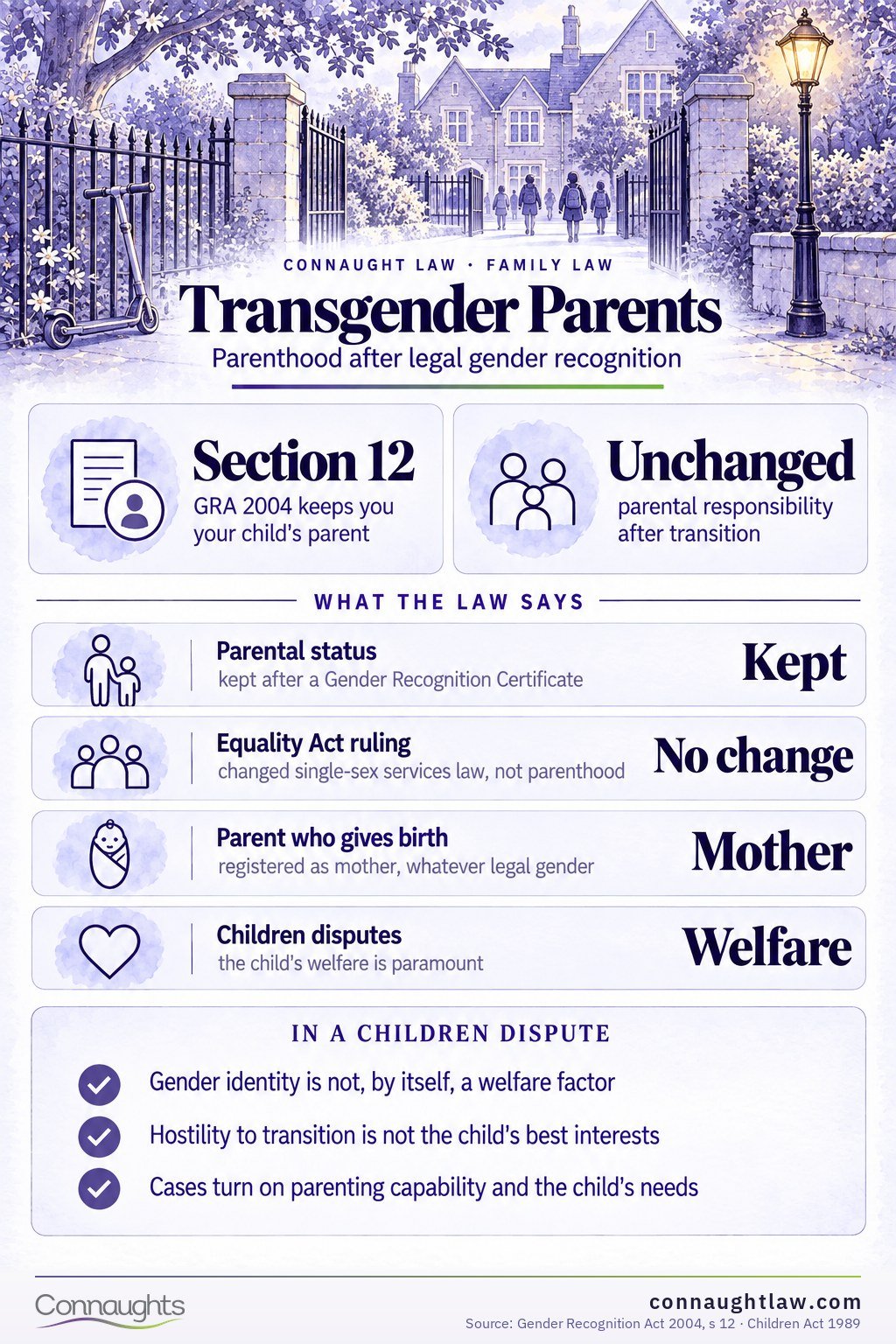
Section 12 of the Gender Recognition Act 2004 preserves a transgender person's status as their child's father or mother after legal gender change. The April 2025 Supreme Court ruling on "sex" in the Equality Act changed single-sex services law — it did not touch parenthood, parental responsibility or family court disputes about children.
The Supreme Court's April 2025 Ruling
In For Women Scotland Ltd v The Scottish Ministers [2025] UKSC 16, the Supreme Court held that "sex", "man" and "woman" in the Equality Act 2010 refer to biological sex, so a Gender Recognition Certificate does not change a person's sex for the purposes of that Act. The decision reshaped the law on single-sex services and associations, and regulators have been revising guidance since.
What the Ruling Means Day to Day
For parenting specifically, the ruling changes less than headlines suggested. It governs how the Equality Act treats sex; it does not amend the Gender Recognition Act's protection of parental status, does not alter birth certificates already issued, and plays no part in the welfare analysis a family court applies to a child's arrangements. Where it can surface is in practical settings — services, facilities, school policies — and parents navigating those settings should take current advice, because guidance is still settling.
The Gender Recognition Act and Parental Status
The Gender Recognition Act 2004 lets an adult obtain legal recognition of their acquired gender through a Gender Recognition Certificate. The Act deliberately walls off parenthood from that change.
Section 12: the Continuity Rule
Section 12 provides that the fact a person's gender has become the acquired gender does not affect their status as the father or mother of a child. The rule works in both directions in time — it applies to children born before and after recognition — so a parent who transitions remains, in law, the same parent they always were.
Birth Registration: the McConnell Case
Freddy McConnell, a transgender man with a Gender Recognition Certificate, gave birth to his son and sought registration as the child's "father". In R (McConnell) v Registrar General [2020] EWCA Civ 559 the Court of Appeal held he must be registered as the child's "mother": in birth-registration law, "mother" records the person who gave birth, whatever their legal gender. The Supreme Court refused permission to appeal, so this remains the law.
What This Means if You Give Birth After Transition
A trans man who gives birth is registered as mother even though every other document — passport, GRC, driving licence — records him as male. Families manage the mismatch in practice with careful document handling, and schools and GPs can be asked to use the parent's actual title day to day. The registration wording affects the register entry, not parental responsibility, which follows from giving birth in any event.
Transition and Disputes About the Children
When separated parents dispute arrangements and one parent has transitioned, the family court applies exactly the same law as in any other case: the child's welfare is paramount. A parent's gender identity is not, by itself, a welfare factor, and courts have repeatedly made clear that prejudice — including a family's or community's hostility to a parent's transition — cannot be dressed up as the child's best interests.
Where Disputes Actually Turn
Contested cases turn on the ordinary questions: each parent's ability to meet the child's needs, the quality of the relationship, stability, and how each adult supports the child's relationship with the other. Where a child is questioning their own gender, courts focus on the child's welfare and the evidence about that child — not on either parent's views in the abstract. Specialist advice matters, because these cases attract strong feelings and weak generalisations in equal measure. Our child arrangements team handles them with both discretion and rigour.
The Welfare Principle Holds the Line
Every children decision runs through the welfare checklist in the Children Act 1989: the child's needs, wishes and feelings in light of age and understanding, the effect of change, any risk of harm, and each parent's capability. Nothing in the 2025 ruling altered that framework. A transgender parent enters proceedings on equal legal footing, and outcomes follow the evidence about the child — as they should. Related reading: our guides to child living arrangements and UK surrogacy law, where parenthood rules raise similar definitional questions.
Frequently askedQuestions about transition, parenthood and the courts
Does getting a Gender Recognition Certificate affect my parental rights?
No. Section 12 of the Gender Recognition Act 2004 expressly preserves your status as your child's father or mother after legal gender change, and parental responsibility continues unaffected. Your standing in any family proceedings is the same as any other parent's.
Did the 2025 Supreme Court ruling change transgender parents' rights?
Not directly. For Women Scotland v Scottish Ministers held that "sex" in the Equality Act 2010 means biological sex, which reshaped single-sex services law. It did not amend the Gender Recognition Act's protection of parental status or how family courts decide children cases.
If a trans man gives birth, is he the father or mother on the birth certificate?
Following McConnell [2020] EWCA Civ 559, the person who gives birth is registered as "mother" regardless of their legal gender. The registration wording does not affect parental responsibility, which arises from giving birth.
Can my ex use my transition against me in a child arrangements case?
Gender identity is not a welfare factor by itself, and courts do not allow hostility to a parent's transition to masquerade as the child's best interests. Cases are decided on parenting capability, the child's needs and the evidence — the same test as every other dispute.
Does transition affect child maintenance or inheritance?
No. Financial responsibility for children follows parenthood, which section 12 preserves, and a child's inheritance rights through a transgender parent continue unchanged. Documents referring to the parent-child relationship remain valid after a Gender Recognition Certificate is issued.
Tell us your situation and what is being argued against you. We will tell you what the law actually says and how to keep the case focused on your child.
Get Expert Advice