
When the other parent breaks a child arrangements order — denying contact, returning the children late, or ignoring the schedule — the family court can enforce it. The route is form C79, and the court's powers run from warnings through unpaid work requirements to committal for contempt. This guide explains what counts as a breach, how the C79 process works, the defences, and when applying to vary the order beats enforcing it.
On This Page

When a Child Arrangements Order Is Ignored
A child arrangements order is a court order, not a suggestion. Every order made since 8 December 2008 carries a warning notice spelling out the consequences of non-compliance, and orders made before then can have one attached using form C78. That notice is what unlocks the court's enforcement powers when the order is broken.
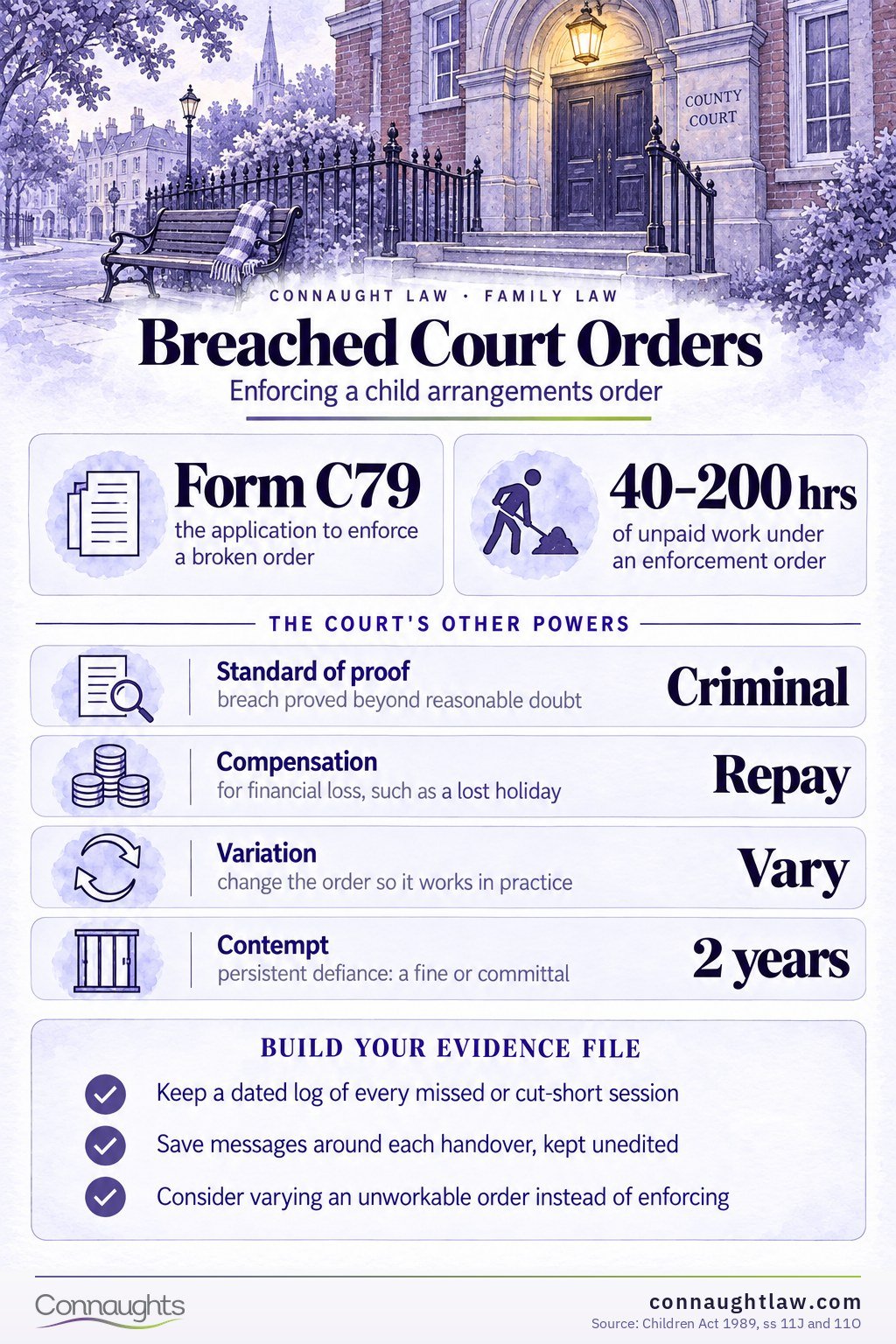
Apply on form C79 to the court that made the order. If a breach is proved beyond reasonable doubt and there is no reasonable excuse, the court can make an enforcement order of 40 to 200 hours of unpaid work, order compensation for financial loss, vary the arrangements, or — for persistent defiance — punish the breach as contempt of court.
What Counts as Breaching the Order
A breach is any failure to do what the order requires without reasonable excuse. The order's own wording governs: what it actually requires — handover times, locations, holiday arrangements, indirect contact — is what can be breached. Minor friction around timings usually is not worth litigating; a pattern of non-compliance is.
Breaches the Courts See Most Often
- Refusing all contact in defiance of the order's schedule
- Repeatedly cutting sessions short, arriving late or missing handovers
- Blocking agreed phone or video contact between visits
- Taking the child away during the other parent's time, or failing to return them
- Breaching conditions attached to the order, such as who may be present
The Form C79 Application
Enforcement starts with form C79, filed at the court that made the order. The fee is £270, set by the 13 July 2026 court-fee uplift, and Help with Fees can reduce or remove it on low income. The court lists the application quickly — the aim is a first hearing within weeks — and Cafcass carries out safeguarding checks before it.
From Application to Hearing
You set out each alleged breach with dates and what the order required; the respondent answers, usually raising any reasonable excuse; Cafcass reports on safeguarding and, where asked, on why contact is failing; the court then decides whether breaches are proved and which of its powers — if any — will actually get the arrangements working. The Cafcass guidance on complying with an order explains its role.
Enforcement Powers Available to the Court
Where a breach is proved to the criminal standard — beyond reasonable doubt — and no reasonable excuse is shown, the court can make an enforcement order under section 11J of the Children Act 1989 imposing between 40 and 200 hours of unpaid work. It can also order compensation for financial loss caused by the breach, such as a lost holiday, under section 11O.
How the Court Escalates
Judges rarely reach for the strongest power first. The usual ladder runs: a warning and a referral to address the underlying problem; variation of the order so it works in practice; a Separated Parents Information Programme or similar activity; an enforcement order with unpaid work; and, for the persistent few, contempt proceedings. Throughout, the child's welfare shapes what the court is willing to do — punishing a parent in a way that harms the child defeats the point.
Contempt of Court for Persistent Breaches
Deliberate, persistent defiance of a court order can be punished as contempt of court. The family court can impose a fine or commit the contemnor to prison for up to two years, though imprisonment of a parent is genuinely a last resort because of what it does to the children the order exists to serve.
What Committal Requires
Committal has strict procedural safeguards: the order must carry a penal or warning notice, the breach must be proved beyond reasonable doubt, and the alleged contemnor is entitled to legal representation. Technical defects in the application regularly sink committal cases, which is one reason specialist advice matters on both sides of one.
The Reasonable Excuse Defence
The court may not make an enforcement order if the person in breach satisfies it — on the balance of probabilities — that they had a reasonable excuse. What is reasonable is judged on the facts, not on labels.
Excuses That Succeed, and Ones That Do Not
Genuine child illness backed by medical evidence, a real and evidenced safety concern, or the other parent's own conduct making compliance impossible can all amount to reasonable excuse. A child "not wanting to go" is treated with care: courts expect a parent to positively encourage contact, so a bare assertion that the child refused rarely succeeds on its own — especially with younger children. Disliking the order is never an excuse; the remedy for an unworkable order is variation, not defiance.
Evidence That Proves a Breach
Enforcement applications are won on records, not recollections. Because the standard of proof for an enforcement order is the criminal standard, precise documentation matters more here than almost anywhere else in private family law.
What to Keep
- A dated log of every missed or cut-short session, with what the order required
- Messages and emails around each handover, kept unedited
- Records of expenses lost to breaches — tickets, bookings, travel costs
- Notes of any explanation offered at the time, however thin
- Anything showing the pattern: a one-off looks very different from a campaign
When Varying the Order Beats Enforcing It
Enforcement assumes the order itself still serves the child. Sometimes it does not — work patterns have changed, the child's school has moved, or the schedule was always too tight. Applying to vary the order is often faster and less inflammatory than proving breaches, and judges respond better to a parent seeking a workable order than to one seeking punishment.
Signs Variation Is the Better Application
Breaches that cluster around one practical pinch-point, a child whose own routine has outgrown the schedule, or safety concerns that have genuinely changed since the order was made all point to variation. Where substance misuse or other welfare issues drive the non-compliance, the court will want those addressed rather than papered over with penalties. Our child contact team can advise which application fits your facts.
Costs and Funding an Enforcement Application
The C79 fee is £270, and each side normally bears its own legal costs, although the court can order a persistently defaulting party to pay costs. Legal aid for enforcement is limited: it generally requires the domestic abuse evidence gateway and a means test, through the same rules as any private children application.
Keeping the Cost Down
Help with Fees (form EX160) can reduce or remove the court fee on low income or certain benefits. If you represent yourself, a McKenzie friend can support you at hearings, and our family law team offers fixed-fee advice on whether an enforcement application is likely to succeed before you commit to one.
Frequently askedQuestions about enforcing an order and defending a breach
What happens if a parent breaches a child arrangements order?
The other parent can apply to enforce it on form C79. If the breach is proved beyond reasonable doubt without reasonable excuse, the court can order 40 to 200 hours of unpaid work, award compensation for financial loss, vary the arrangements, or treat persistent defiance as contempt of court.
How do I report a breach of a child arrangements order?
Breaches of a family court order are reported to the court, not the police — file form C79 at the court that made the order, listing each breach with dates. The £270 fee can be reduced through Help with Fees. Police involvement is only for crimes such as abduction or threats.
What evidence do I need to prove a breach?
A dated log of each missed or shortened session against what the order required, contemporaneous messages, and records of any losses. The criminal standard applies to enforcement orders, so precise, contemporaneous records carry far more weight than a general account written up later.
Can you go to prison for breaching a child arrangements order?
Yes, but rarely. Persistent deliberate breaches can be punished as contempt of court, with committal of up to two years available. Courts treat imprisonment of a parent as a last resort and normally work through warnings, variation, unpaid work and compensation first.
What is a reasonable excuse for breaching an order?
A genuine, evidenced reason compliance was impossible or unsafe — a child's illness confirmed by a doctor, a real safety incident, or the other parent making compliance impossible. The person in breach must prove it on the balance of probabilities. Disagreement with the order is not an excuse.
What is an enforcement order?
An order under section 11J of the Children Act 1989 requiring a person who breached a child arrangements order without reasonable excuse to complete between 40 and 200 hours of unpaid work. It sits alongside the court's powers to order compensation, vary the arrangements and punish contempt.
Tell us what the order says, what has been happening and what records you hold. We will tell you whether enforcement, variation or a defence is the stronger application.
Get Expert Advice