
Director disputes can paralyse a company: boards split over strategy, shareholder-directors clash over dividends, and allegations of duty breaches harden into litigation. This guide explains how UK company law resolves those conflicts — the statutory duties directors owe under the Companies Act 2006, the remedies open to shareholders and the company, and the procedures for removing a director or breaking a deadlock. It sets out the practical routes to resolution, from board processes and negotiated exits to unfair prejudice petitions and, as a last resort, winding up.
On This Page

Resolving director disputes under UK company law
Most director disputes are governed by the Companies Act 2006, the company's articles of association, any shareholders' agreement, and — where a director is also an employee — employment law. The right response depends on what has gone wrong and what outcome the company or the aggrieved party needs. Some conflicts are resolved around the board table; others require a formal remedy such as removal, a court petition, or a negotiated exit at a fair valuation.
Start with the company's constitution and any shareholders' agreement, then use the least drastic effective route: board processes or mediation first, then formal steps such as removal by ordinary resolution, an unfair prejudice petition under section 994, or — where relationships have irretrievably broken down — a just and equitable winding-up petition.
Common causes of director disputes
Understanding why disputes arise helps identify the appropriate legal route. Most fall into a small number of recurring categories, and the same facts can engage several at once.
Strategic and financial disagreements
Strategic disagreements are the most common trigger — directors holding fundamentally different views on growth, investment, or market direction. These become serious when they produce decision paralysis rather than healthy debate. Financial disputes run a close second, typically over dividend policy, capital allocation, and remuneration. Director-shareholders often favour distributions, while others prioritise reinvestment, and the tension sharpens when cash is tight. Where the conflict turns on the rights attaching to different classes of shares, our guide to share class disputes examines the issues in more detail.
Breach of duty and conflicts of interest
The most serious disputes involve alleged breaches of a director's statutory duties: pursuing a personal interest at the company's expense, diverting a corporate opportunity, self-dealing, or failing to disclose a conflict. Because these duties are owed to the company itself, a breach can expose the director to personal liability, an account of profits, or an order to restore company property. Allegations of this kind usually call for prompt legal advice, since they can support both internal action and court proceedings.
Governance and authority disputes
Governance disputes concern who is entitled to decide what: a director acting beyond their authority, taking unilateral decisions that require board approval, or ignoring procedures in the articles or a service contract. These are common in family companies and businesses with informal structures where roles were never clearly defined. Resolving them usually means reviewing the articles, any shareholders' agreement, and service contracts to establish where authority actually lies, then tightening the governance framework to prevent a recurrence.
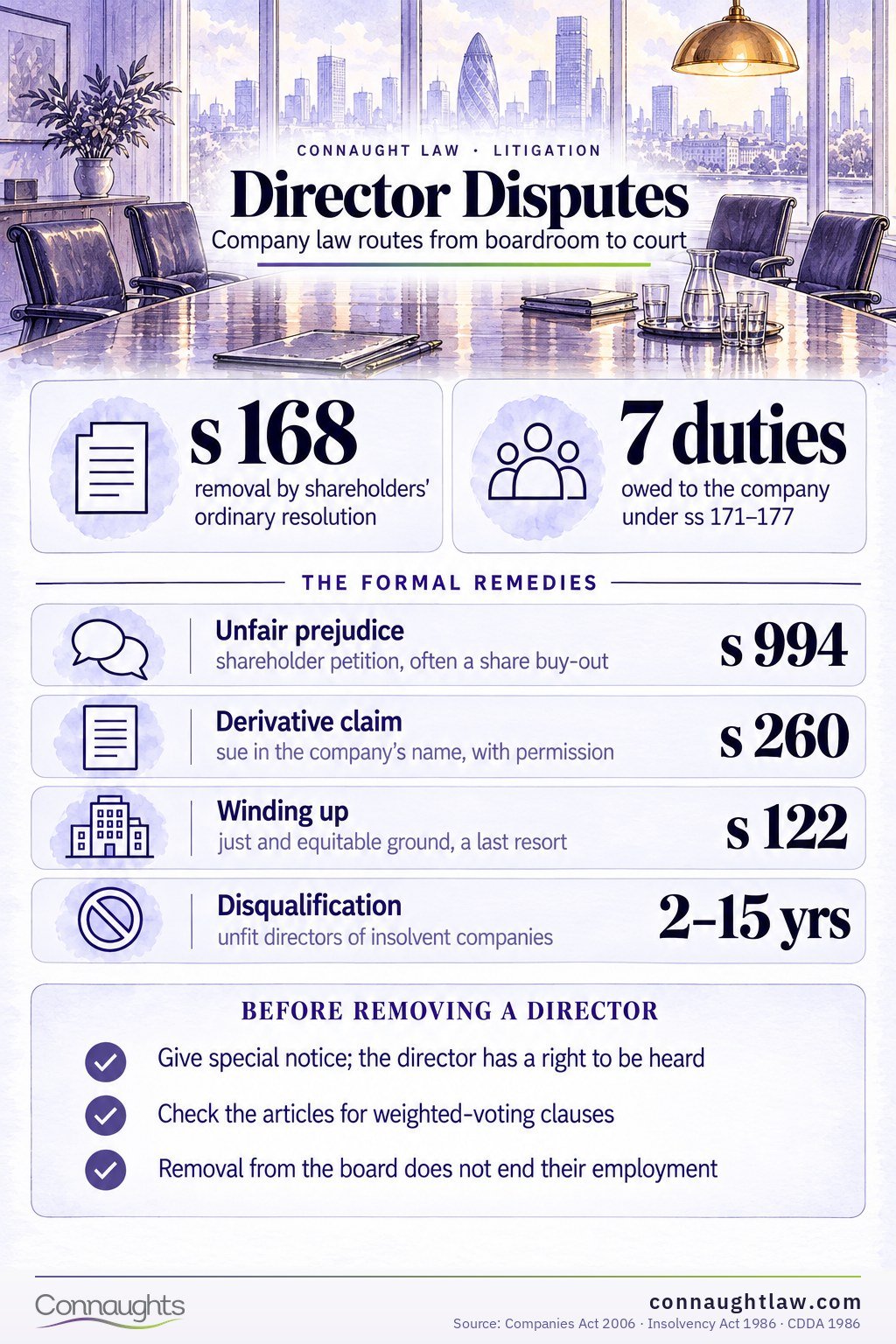
Directors' duties under the Companies Act 2006
Directors' general duties are codified in sections 171 to 177 of the Companies Act 2006. They apply to every director — executive, non-executive, or shadow — and are owed to the company rather than to individual shareholders. When conduct is challenged, it is measured against these standards, so they form the backbone of most breach-of-duty disputes.
Directors’ Statutory Duties
| Duty (Companies Act 2006) | What it requires |
|---|---|
| s171 — Act within powers | Act in line with the company's constitution and use powers only for their proper purpose. |
| s172 — Promote the company's success | Act in good faith to promote the success of the company for its members as a whole, weighing longer-term and stakeholder factors. |
| s173 — Exercise independent judgment | Reach your own decisions rather than simply following others' instructions. |
| s174 — Reasonable care, skill and diligence | Meet the standard of a reasonably diligent director, judged both objectively and against your own knowledge and experience. |
| s175 — Avoid conflicts of interest | Avoid situations where a personal interest conflicts, or may conflict, with the company's — unless properly authorised. |
| s176 — Do not accept benefits from third parties | Do not accept benefits conferred because of your office or anything you do as a director. |
| s177 — Declare an interest in a proposed transaction | Disclose the nature and extent of any interest in a proposed transaction before the company enters into it. |
A separate private member's bill introduced in 2025 would amend section 172 to require directors to weigh environmental and employee interests more explicitly. At the time of writing it has not become law, so the duties above remain the operative framework; directors should treat any wider reform as prospective rather than current.
Legal remedies when a dispute escalates
When internal steps fail, company law offers several formal remedies. They differ in who can bring them, what they achieve, and how disruptive they are. Choosing the right one — and pleading it properly — is where specialist commercial litigation advice matters most, because the remedies overlap and the wrong choice wastes time and costs. Court fees apply to issue any petition or claim; the current figures are published on the gov.uk court fees list.
Unfair prejudice petitions
Conduct of a company's affairs that is unfairly prejudicial to the interests of some or all of its members, giving a shareholder the right to petition the court under section 994 of the Companies Act 2006.
An unfair prejudice petition under section 994 is the most widely used shareholder remedy. It is often available where a shareholder-director is excluded from management, denied information, or where company money is being extracted improperly. If the petition succeeds, section 996 gives the court a broad discretion to grant relief — most commonly an order that the majority buy the petitioner's shares at a fair value. These petitions are particularly potent in quasi-partnership companies, where the court can find unfair prejudice by reference to the parties' legitimate expectations even without a strict breach of the articles.
Derivative claims
A derivative claim, governed by sections 260 to 264 of the Companies Act 2006, lets a shareholder sue in the company's name for a wrong done to the company — typically a director's negligence, default, or breach of duty. Because the cause of action belongs to the company, the claimant must first obtain the court's permission to continue. At that permission stage the court applies the criteria in section 263, refusing to let the claim proceed where a director acting in good faith to promote the company's success would not pursue it, or where the conduct has been authorised or ratified.
Just and equitable winding up
Where trust between the participants has completely broken down, a shareholder may petition to wind up the company on the just and equitable ground under section 122(1)(g) of the Insolvency Act 1986. This is a remedy of last resort: it ends the company, so the courts expect a petitioner to consider a buy-out first, and an unfair prejudice petition is usually preferable where a fair exit can be achieved. Winding up also engages wider corporate insolvency considerations, including the position of creditors and directors' conduct in the run-up to any insolvency.
Director disqualification
Serious misconduct can lead to disqualification under the Company Directors Disqualification Act 1986. Under section 6, the court must disqualify a director of an insolvent company whose conduct makes them unfit to be concerned in managing a company, for a minimum of two years and a maximum of fifteen. A disqualification order bars a person from acting as a director, or being involved in the promotion, formation, or management of a company, for the period ordered. Because the consequences are severe, directors facing proceedings should take specialist advice early.
Removing a director
Shareholders can remove a director by ordinary resolution — a simple majority of votes cast — under section 168 of the Companies Act 2006. Special notice of the resolution is required, and section 169 gives the director a right to make written representations to members and to be heard at the meeting before the vote. These procedural protections must be observed; skipping them can render a removal vulnerable to challenge.
The statutory power of removal can be defeated in practice. In Bushell v Faith, the court upheld a clause in the articles giving a director extra votes on a resolution to remove them, effectively entrenching their position. Always check the articles and any shareholders' agreement for weighted-voting or protective provisions before relying on section 168.
Removal is rarely as simple as passing a resolution. A director who is also an employee retains employment-law protections, so removal from the board does not by itself end their employment or extinguish claims for notice or unfair dismissal. Service contracts may trigger compensation on removal, and a shareholders' agreement may require an enhanced majority or restrict removal altogether. A poorly handled removal can itself found an unfair prejudice petition, so the mechanics need to be worked through before any meeting is convened.
Board deadlock and emergency measures
Deadlock arises when directors or shareholders split evenly and neither side can carry a decision — a frequent problem in companies with two equal owner-managers. Left unresolved, it can halt the business entirely, so the priority is to find a route that either restores decision-making or delivers a clean exit.
Breaking a deadlock
Well-drafted articles anticipate deadlock through a chair's casting vote, enhanced majorities, or a contractual dispute-resolution procedure. Where the constitution is silent, the parties must fall back on external mechanisms.
- Invoke any dispute-resolution or buy-sell procedure in the shareholders' agreement.
- Appoint an independent director or agree a casting vote to unblock decisions.
- Negotiate a voluntary exit through a share purchase at an agreed valuation.
- Petition under section 994 for a buy-out order where conduct is unfairly prejudicial.
- Petition to wind up on the just and equitable ground if the relationship is beyond repair.
Mediation and arbitration
Mediation and arbitration offer confidential alternatives to public litigation and can preserve working relationships. Mediation uses a neutral facilitator to help the parties reach their own settlement, which becomes a binding contract; it suits disputes where an ongoing relationship matters. Arbitration produces a binding award from an independent tribunal and can be faster and more private than court. Many shareholders' agreements provide for one or both, and the Arbitration Act 2025 — in force from 1 August 2025 — modernised the framework and strengthened enforcement of awards.
Emergency injunctions
Where a dispute threatens immediate harm — assets being dissipated, or a director acting in clear breach of duty — the court can grant an urgent injunction to freeze assets or restrain specific conduct pending trial. Emergency applications demand full and frank disclosure of the relevant facts and usually an undertaking in damages, and the court scrutinises them closely to prevent abuse. They are powerful but exacting, and the evidence needs careful preparation before any application is made.
Preventing disputes through governance
The most cost-effective strategy is to prevent disputes before they start. A well-drafted shareholders' agreement should address the scenarios most likely to cause conflict: strategic deadlock, dividend policy, director appointment and removal, and — critically — buy-sell provisions giving a clear exit when relationships break down. Because such an agreement is a contract, disagreements about its terms are ultimately contractual disputes, and clear drafting is what keeps them out of court.
Sound governance reinforces the agreement. Clear delegation of authority, a conflicts-of-interest policy with proper disclosure and authorisation, regular board reviews, and accurate minutes recording decisions and any dissent all reduce the scope for argument. They also create a contemporaneous record that evidences compliance with directors' duties if a dispute later reaches litigation or a regulator.
Frequently askedQuestions about director disputes and company law remedies
Tell us who is in dispute, what the articles and any shareholders’ agreement say, and what has already been tried. We’ll tell you which remedy actually fits and what the realistic alternatives to litigation are.
Get Expert Advice