
Corporate insolvency law governs what happens when a company can no longer meet its financial obligations. It offers two broad paths: rescue, which aims to preserve the business or improve returns to creditors, and liquidation, which winds the company down. The framework rests on the Insolvency Act 1986, reshaped by the permanent reforms introduced by the Corporate Insolvency and Governance Act 2020. This guide explains how insolvency is tested, the main procedures available in 2026, the tools for business rescue, and the personal responsibilities directors carry as a company approaches or enters insolvency.
On This Page
Corporate Insolvency in 2026: Rescue Routes, Liquidation and Director Duties
The choice of procedure shapes everything that follows: whether the business survives, how much creditors recover, and what exposure directors face. Selecting the wrong route, or leaving it too late, can close off rescue options that early action would have preserved. The sections below set out each procedure in turn, the statutory basis for it, and the practical thresholds that determine when it applies.
How insolvency is tested
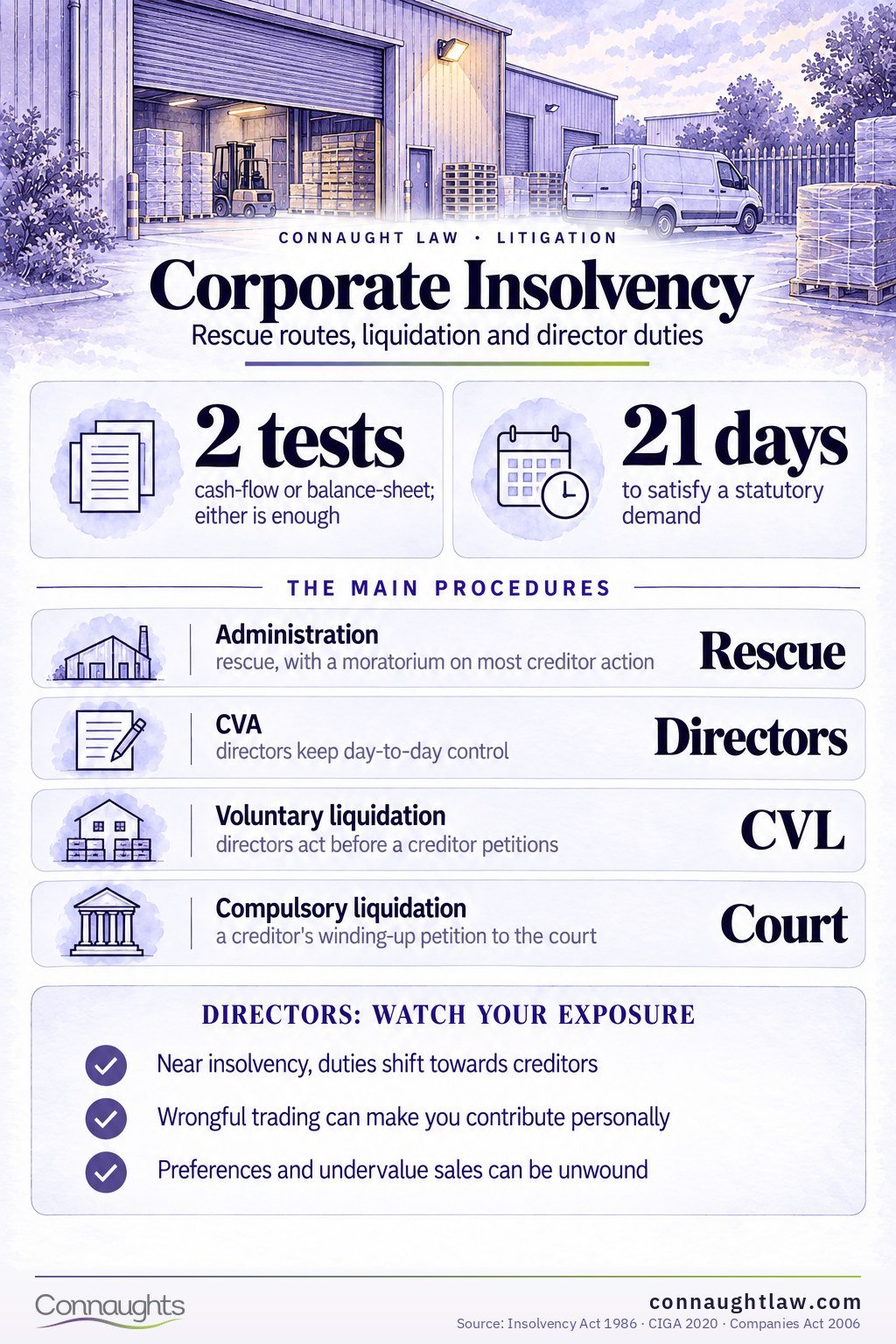
Insolvency is not a matter of opinion. Section 123 of the Insolvency Act 1986 sets two objective tests, and a company that satisfies either is treated as unable to pay its debts. Establishing which test is met matters, because it determines when creditors can act, when directors must change their focus, and when rescue procedures become available.
A company is insolvent when it cannot pay its debts as they fall due (the cash-flow test) or when its liabilities exceed its assets, taking account of contingent and prospective obligations (the balance-sheet test). Meeting either test is enough.
The cash-flow test
The cash-flow test asks whether a company can pay its debts as they fall due. It looks at present and reasonably near-term liabilities rather than a single missed payment, so temporary tightness is not automatically insolvency. This is the test most often engaged when a supplier or lender presses for payment, and it is the practical trigger for creditor enforcement action such as a statutory demand or winding-up petition.
The balance-sheet test
The balance-sheet test looks at whether the value of a company's assets is less than its liabilities, including contingent and prospective obligations. Contingent liabilities are those that may crystallise on a future event, such as a guarantee or an unresolved claim. Because it captures obligations that have not yet fallen due, the balance-sheet test can identify insolvency well before the company actually runs out of cash, and it is central to assessing director exposure discussed below.
The insolvency landscape in 2026
Company failures rose sharply through 2023 and 2024 to their highest volumes since the 2008–09 recession, before easing during 2026. The Insolvency Service official statistics show that in May 2026 there were 1,868 registered company insolvencies in England and Wales, down 16% on May 2025 and down 10% on the previous month. The direction of travel matters more than any single month, and the trend through 2026 has been gently downward from the recent peak.
The proportions between procedures are more stable than the totals, and they reveal how insolvency actually plays out in practice. Creditors' voluntary liquidation remains overwhelmingly dominant, while formal rescue procedures account for a small minority of cases.
- Creditors' voluntary liquidations: 1,423 cases, about 76% of the total.
- Compulsory liquidations: 285 cases, about 15%.
- Administrations: 135 cases, about 7%.
- Company Voluntary Arrangements: 25 cases, about 1%.
Rate matters as much as raw numbers. Across the twelve months to May 2026 the insolvency rate was 50.9 per 10,000 active companies, roughly one company in 196, down from 53.0 in the preceding year. Elevated though that is by recent standards, it remains far below the 2008–09 peak of 113.1 per 10,000. The picture, then, is of pressure that has eased but not disappeared.
Administration and pre-pack sales
Administration is the principal rescue procedure. It places the company under the control of a licensed insolvency practitioner and imposes a statutory moratorium that halts most creditor action, giving the business breathing space. It is governed by Schedule B1 to the Insolvency Act 1986, and an administrator may be appointed by the court, by the company or its directors, or by a qualifying floating-charge holder.
Statutory objectives and ranking
An administrator must pursue a defined hierarchy of objectives. The primary aim is to rescue the company as a going concern. If that is not reasonably practicable, the administrator seeks a better result for creditors as a whole than immediate winding up would achieve. Only if neither is possible does the administrator realise assets to pay secured or preferential creditors. Where rescue fails, administration frequently converts into liquidation to complete the wind-down and distribute what remains.
Pre-pack sales and the connected-party evaluator
A pre-pack is a sale of the business and assets negotiated before the administrator is appointed and completed immediately afterwards, preserving value, goodwill and jobs that a drawn-out process might erode.
Pre-packs are efficient but attract scrutiny where the buyer is connected to the failed company, such as its existing directors. Since 30 April 2021, a substantial sale to a connected party within the first eight weeks of administration cannot proceed without either creditor approval or an independent written opinion from a qualified evaluator. That regime is set out in the Administration (Restrictions on Disposal etc. to Connected Persons) Regulations 2021, and it exists to give creditors confidence that a connected sale reflects genuine market value rather than a soft exit for insiders.
Liquidation procedures
Liquidation brings a company's existence to an end. A liquidator collects and sells the assets, distributes the proceeds in the statutory order of priority, and dissolves the company. There are three routes, distinguished by who initiates the process and whether the company is solvent.
The table below summarises the practical differences between the two terminal routes and the solvent alternative.
Liquidation Routes Compared
| Route | Initiated by | When used |
|---|---|---|
| Creditors' voluntary liquidation (CVL) | The company's own directors and shareholders | Insolvent company; directors decide to wind up before a creditor forces the issue |
| Compulsory liquidation | A creditor (or other party) by court petition | Insolvent company wound up by court order, often after an unpaid debt |
| Members' voluntary liquidation (MVL) | The shareholders | Solvent company being closed down in an orderly, tax-efficient way |
Creditors' voluntary liquidation
CVL is the most common insolvency procedure by a wide margin. The directors resolve that the company is insolvent, shareholders pass a winding-up resolution, and creditors appoint a liquidator. Because directors act before a creditor petitions the court, a CVL usually gives them more control over timing and process than a compulsory winding up, while still bringing the company to a proper end. Timescales vary from a few months to several years depending on the assets and any claims to investigate.
Compulsory liquidation and winding-up petitions
Compulsory liquidation begins when a creditor presents a winding-up petition to the court. A creditor commonly first serves a statutory demand, and the company is presumed unable to pay its debts if it fails to satisfy a demand for a sum exceeding £750 within 21 days. Petitioning the court carries a fee and a deposit; because these change, confirm current amounts on the gov.uk court fees page rather than relying on a quoted figure. A winding-up petition is a serious escalation, and a company facing one should take advice from commercial litigation solicitors without delay.
The temporary £10,000 minimum debt and other pandemic-era restrictions on winding-up petitions expired on 31 March 2022. The ordinary £750 statutory-demand threshold once again applies.
Members' voluntary liquidation
MVL is not an insolvency procedure at all. It is used to close a solvent company in an orderly way, typically on retirement or group reorganisation. The directors must make a statutory declaration of solvency confirming the company can pay its debts in full, with interest, within twelve months. A false declaration carries personal liability, so accurate figures and, where useful, corporate and tax advice matter before the declaration is signed.
Company Voluntary Arrangements
A Company Voluntary Arrangement is a rescue tool, not a terminal one. Under Part 1 of the Insolvency Act 1986, the company proposes a binding agreement to its creditors, usually to pay a proportion of its debts over an agreed period or on revised terms. Crucially, the existing directors retain day-to-day control of the business, with a licensed insolvency practitioner acting as supervisor rather than taking over management.
Approval thresholds and suitability
A CVA takes effect only if creditors representing at least 75% by value of those voting approve it, subject to a connected-creditor safeguard. Once approved, it binds unsecured creditors who were entitled to vote, including any who voted against. A CVA suits a fundamentally viable business burdened by legacy debt or onerous contracts, where continued trading will produce a better return than liquidation. It is less suitable where the underlying business model is no longer sound, since a CVA restructures debt but does not, by itself, fix operations.
CIGA 2020 permanent rescue measures
The Corporate Insolvency and Governance Act 2020 introduced both temporary pandemic measures and three permanent reforms. The permanent measures remain fully in force and have become established features of the rescue landscape. They sit alongside, rather than replace, administration and the CVA.
The Act's temporary reliefs, including the suspension of wrongful trading liability that ended on 30 June 2021 and the restrictions on winding-up petitions, have all lapsed. Only the three permanent measures below survive.
The standalone moratorium
The standalone moratorium, in Part A1 of the Insolvency Act 1986, gives a financially distressed but viable company an initial period of protection from most creditor action while it seeks a rescue, overseen by a monitor who must be a licensed insolvency practitioner. Unlike administration, directors stay in control of the business. Take-up has been modest, partly because certain financial-services debts must still be paid during the moratorium, which limits its usefulness where bank debt dominates.
The restructuring plan
The restructuring plan sits in Part 26A of the Companies Act 2006. It resembles a scheme of arrangement but adds a powerful feature: cross-class cram down. Provided statutory conditions are met, the court can sanction a plan even if one or more classes of creditor vote against it, so long as no dissenting class is left worse off than in the relevant alternative, usually liquidation or administration. This makes it a significant tool for larger, complex restructurings, though the court process makes it markedly more expensive than a CVA.
Termination-clause protection
The Act also restricts so-called ipso facto clauses. A supplier of goods or services generally cannot terminate a contract, or invoke a pre-agreed right to do so, simply because the company has entered an insolvency or restructuring procedure. This protection helps a business keep essential supplies flowing while it pursues rescue, removing a lever that suppliers previously used to extract better terms from a company at its most vulnerable.
Director liability and challengeable transactions
As a company nears insolvency, directors' duties shift. Their focus must move from the interests of shareholders towards those of creditors as a whole. Getting this wrong can convert limited liability into personal exposure, and the office-holder appointed in an insolvency has statutory powers to investigate and claw back value. Disagreement among the board about the right course is common at this stage; where it becomes entrenched, our guide to director disputes explains the options.
- Wrongful trading (s214): continuing to trade when there was no reasonable prospect of avoiding insolvent liquidation.
- Fraudulent trading (s213): carrying on business with intent to defraud creditors.
- Misfeasance (s212): breach of duty or misapplication of company property.
- Preferences (s239) and transactions at undervalue (s238): value that can be unwound.
Wrongful trading, fraudulent trading and misfeasance
Under section 214 of the Insolvency Act 1986, a director may be ordered to contribute to the company's assets if they allowed it to keep trading once they knew, or ought to have concluded, that insolvent liquidation was unavoidable. The test is what a reasonably diligent director would have done. Section 213 addresses the more serious case of trading with intent to defraud creditors, and can carry criminal as well as civil consequences. Section 212 provides a summary remedy for misfeasance, allowing recovery where a director has breached duty or misapplied company property.
Preferences and transactions at undervalue
An office-holder can also challenge certain dealings from before the insolvency. A preference under section 239 arises where the company put a particular creditor in a better position than they would otherwise have held, influenced by a desire to prefer them. A transaction at an undervalue under section 238 is a gift or a sale for significantly less than the asset was worth. Both can be reversed by the court, restoring value for the general body of creditors. Disputes over asset transfers between shareholders, including share class disputes, frequently surface in this context.
Frequently askedQuestions about insolvency procedures and director duties
Tell us what the company owes, to whom, and how long the cash will last. We’ll tell you which rescue routes are still open and where your personal exposure as a director sits.
Get Expert Advice