
Estimate your lease extension premium in seconds — the price of adding 90 years to your lease at a peppercorn ground rent under the statutory route. Enter your unexpired term, ground rent and flat value below; the notes that follow explain how the premium is built, why the 80-year mark changes everything, and where the pending leasehold reforms actually stand.
· Regulated by the Solicitors Regulation Authority · Legal 500 · Lexcel
Calculator & Premium Guide
The Calculator
Enter your lease details for an instant estimate of the statutory premium for a 90-year extension at a peppercorn rent, including marriage value where your term is below 80 years.
£0
Your Lease Premium BreakdownThe premium is only part of the picture — timing, notices and costs decide the rest. See our lease extension service or get a formal valuation and fixed-fee quote from our leasehold team.
Marriage Value & the 80-Year Rule
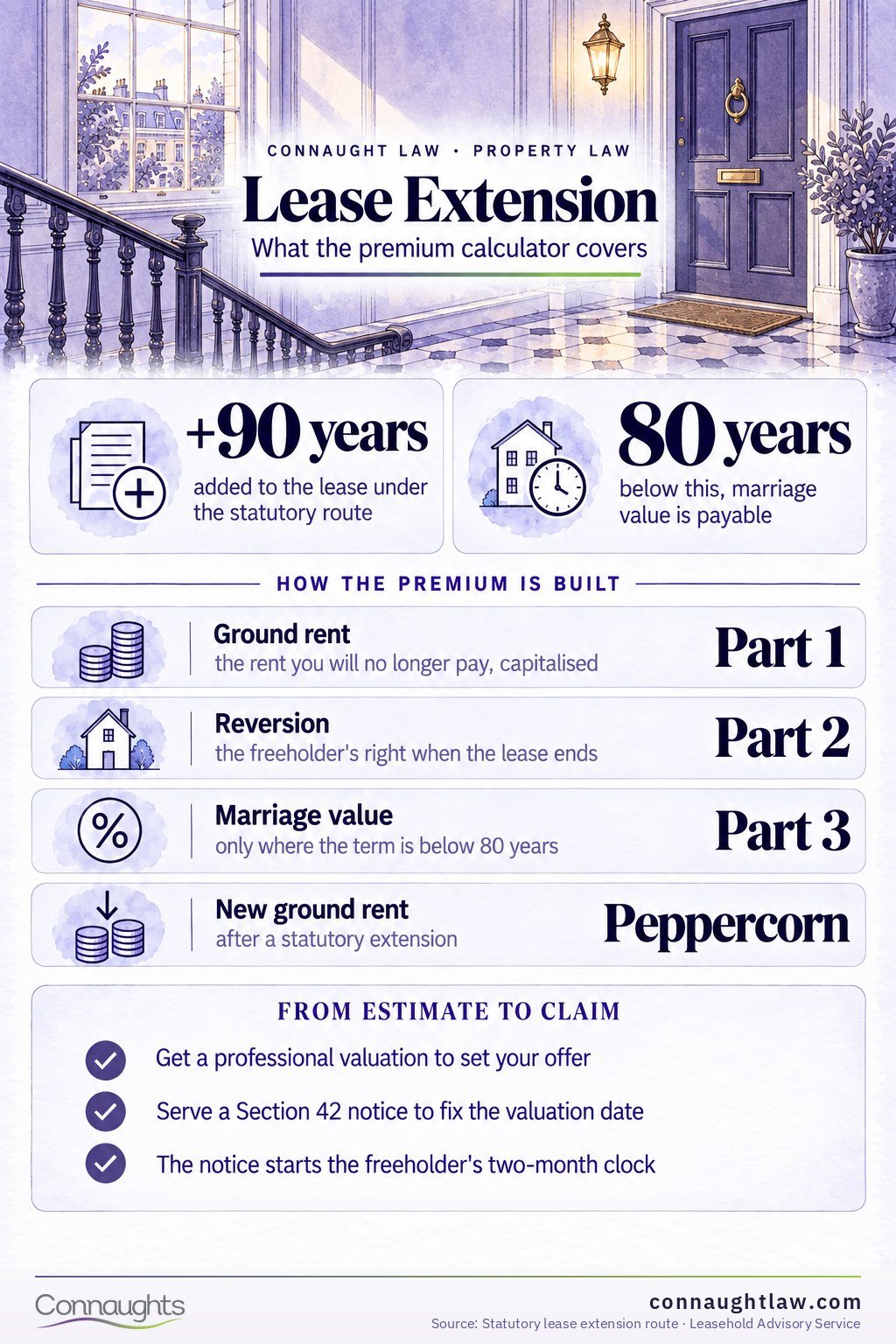
Marriage value is the uplift created when a short lease is extended — the extended flat is worth more than the short-lease flat and the freeholder's interests combined, and under current law the freeholder takes half of that uplift once the unexpired term drops below 80 years. The calculation works from relativity: what your short lease is worth as a percentage of the freehold value. It's why premiums jump at the 80-year cliff, why "just below 80" is the most expensive place to hesitate, and why our statutory lease extension guide treats the date you serve notice as a valuation decision, not paperwork.
Leasehold Reform: Where the Law Stands
The honest position: the 2024 Act legislated 990-year extensions and the abolition of marriage value, but those provisions are not in force — valuation rules are still to be consulted on, and no implementation date exists. Today's claims run under the current law this calculator models. Whether waiting could save you money depends almost entirely on which side of 80 years you sit; our Leasehold and Freehold Reform Act guide tracks the reforms, and the wait-or-act arithmetic is exactly what our lease extension team does with clients daily.
What the Calculator Can't Know
Three things move real premiums that no online tool can see: relativity, which valuers and tribunals genuinely argue over, especially for shorter terms; escalating ground rents — doubling or RPI-linked rents capitalise to far more than a flat figure, so if your rent reviews upward, expect the true premium higher than shown; and negotiation itself, because most premiums settle between the leaseholder's number and the freeholder's. That's not a defect of calculators — it's why the statutory process runs on professional valuations, and why ours comes with one.
Costs Beyond the Premium
Budget past the premium: your own valuer and solicitor, and — a quirk of the statutory scheme — the freeholder's reasonable valuation and legal costs, which the leaseholder pays. What you don't pay for is the freeholder's negotiation posturing or tribunal advocacy. We quote our side as a fixed fee and police theirs for reasonableness; the Leasehold Advisory Service is a useful independent reference on the whole framework.
From Estimate to Statutory Claim
The route from this number to a completed extension: a professional valuation setting your offer, the Section 42 notice that fixes the valuation date and starts the freeholder's two-month clock, negotiation with the tribunal as backstop, and completion of the new lease. Since 2025 you no longer need two years' ownership first — and if you're selling, the claim's benefit can be assigned to your buyer so a short lease doesn't kill the sale. Our lease extension service runs it end to end.
Why Connaught Law
Calculator, formal valuation, Section 42 notice, negotiation, new lease — one team, fixed fees for the defined stages.
Near the threshold, serving notice fixes your valuation date. We move at the speed that saves you money.
Your claim is run by our experienced property team, not passed down — with direct access to the person handling it.
If the reform timetable genuinely favours waiting for your lease, we'll say so — and show you the arithmetic.
Fee structures are set out on our fees page — fixed fees for statutory lease extension work, agreed before we start.
Frequently Asked Questions
How accurate is this lease extension calculator?
It runs the same statutory valuation model professionals use — capitalised ground rent, deferred reversion and marriage value with industry-average relativity — so the range is a genuine planning figure. Real premiums move with relativity arguments, escalating ground rents and negotiation, which is why every statutory claim starts with a specialist valuation. Use the range to plan; use a valuer to act.
Is there an official HMRC or government lease extension calculator?
No — neither HMRC nor the government publishes an official lease extension calculator, which surprises many people searching for one. HMRC deals with tax, not lease premiums. The government-funded Leasehold Advisory Service explains the process, and premiums themselves come from the statutory valuation method this calculator models.
How is marriage value calculated?
Take the flat's value with the extended lease; subtract what the short lease is worth today (relativity × freehold value) and the freeholder's current interests (capitalised ground rent plus deferred reversion). What remains is the uplift the extension creates — the marriage value — and under current law the freeholder receives half of it where the term is below 80 years. The calculator shows the figure on its own row.
Should I extend now or wait for the leasehold reforms?
Depends on your lease. The premium-cutting reforms — 990-year terms, marriage value abolition — are law but not in force, with no date. Comfortably above 80 years and not selling? Waiting may be rational. Below or near 80, every month of delay risks costing more than reform might ever save, and serving notice locks your valuation date. We'll give you the honest arithmetic for your numbers.
Premiums only rise as leases shorten. Send us your figures — we'll confirm the estimate with a formal valuation and serve the notice that stops the clock.
Get a Formal Valuation