
Collective enfranchisement lets the leaseholders of a block compel the freeholder to sell them the building — half the flats participating, a section 13 notice, and the freehold changes hands at a price the tribunal will fix if negotiation fails. The right is powerful and the reporting around it is muddled: much of what is written as "already changed" remains uncommenced. This guide gives the position actually in force in 2026.
On This Page

The 1993 Act Right: Taking the Freehold Together
Searchers keep asking whether collective enfranchisement still carries a two-year ownership requirement. It never did: participation in a collective claim under the 1993 Act has no minimum ownership period, and never has. The two-year rule that existed — and was abolished on 31 January 2025 — applied to individual lease extensions and house enfranchisement. A flat owner can join a collective claim on the day they complete, before the reforms and after them.
What Collective Enfranchisement Is
Under the Leasehold Reform, Housing and Urban Development Act 1993, qualifying leaseholders acting together can require the freeholder to sell them the freehold of their building — usually through a nominee company the participants own. The freeholder cannot refuse a valid claim; only the price and terms are negotiable, with the First-tier Tribunal as backstop. Once the company holds the freehold, participants typically grant themselves 999-year leases at a peppercorn and run the building's management, insurance and repairs themselves.
Enfranchisement or Right to Manage
- Right to manage transfers the management functions only: the freeholder keeps the freehold, the ground rent and the reversion.
- Enfranchisement transfers the building: participants control management AND can grant themselves 999-year peppercorn leases, ending premium and ground rent questions permanently.
- RTM is cheaper and faster — no premium — and since 3 March 2025 it reaches buildings up to 50% non-residential.
- The honest sequencing for many blocks: RTM now for control, enfranchisement later for ownership, funded at the participants' pace.
What the Reforms Have Actually Changed
Costs: Who Pays Today
In Force and Not in Force
Commenced: the two-year rule for individual claims went on 31 January 2025, and right to manage reached 50% mixed-use buildings on 3 March 2025. Not commenced for collective enfranchisement: the 50% non-residential limit (still 25% today), the each-side-bears-own-costs rule (participants still pay the freeholder's reasonable costs), and the entire cheaper-valuation package. Anything telling you those are in force is describing the statute book, not the law that applies to your claim.
Marriage Value: Still Payable
Marriage value remains part of the premium for every lease under 80 years in a claim today. The 2024 Act abolishes it on paper; the freeholders' High Court challenge failed in October 2025; the Court of Appeal has since allowed a further round; and the valuation provisions still await secondary legislation, with realistic commencement in 2027–28. Blocks with leases sliding toward 80 years should treat that line as the deadline it is — priced on today's rules, not tomorrow's promises.
Who and What Qualifies
- A self-contained building or part, with at least two flats.
- At least two-thirds of the flats held by qualifying tenants — long leases originally granted for more than 21 years.
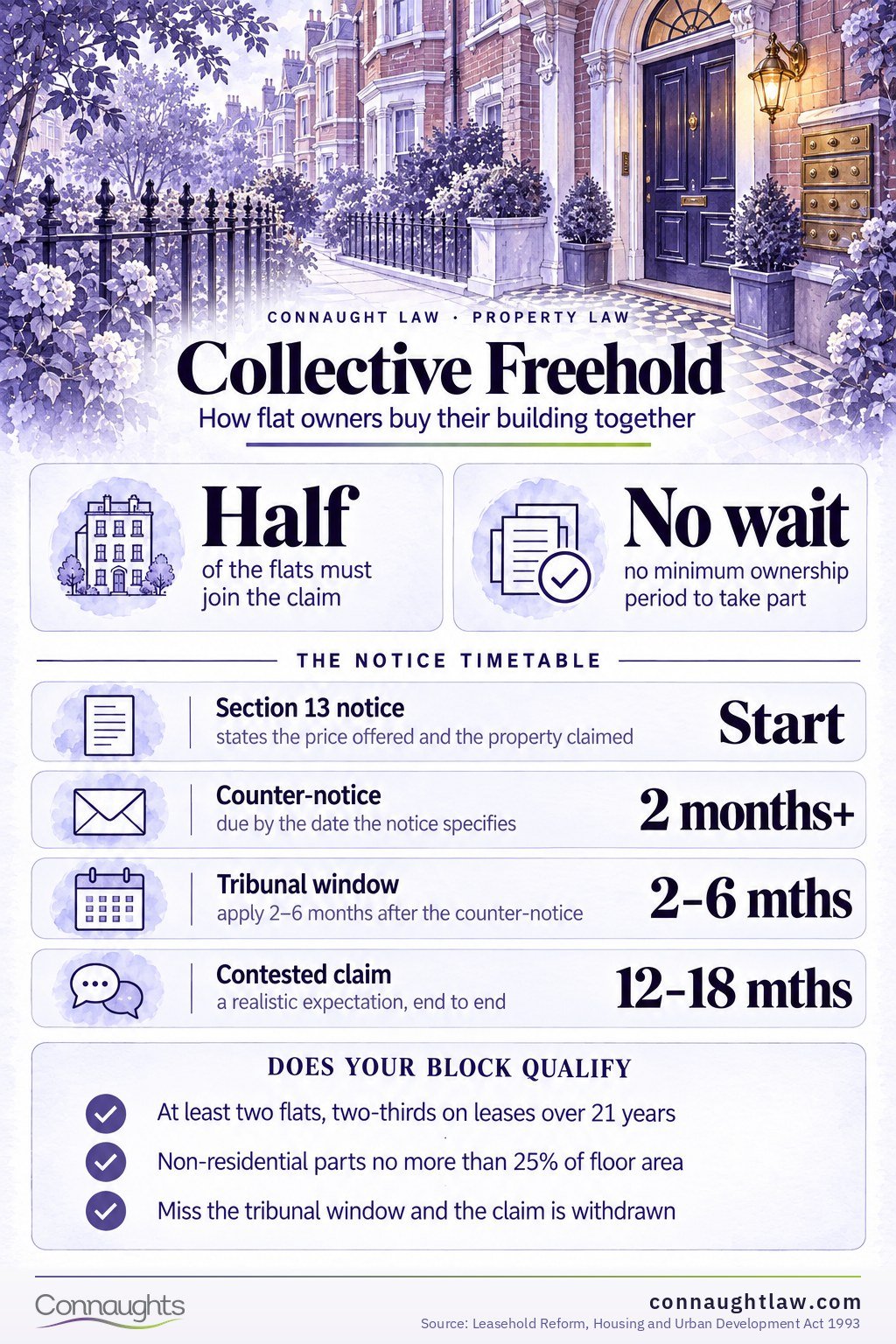
- Participation by at least half the flats in the building; in a two-flat building, both must join.
- Non-residential parts — shops, offices — must not exceed 25% of the internal floor area under the rules currently in force.
- No ownership period, no residence test: buy-to-let and overseas owners count.
Mixed-Use Buildings: The 25% Line
The floor-area assessment decides marginal buildings, and it is measured — common parts excluded — rather than guessed. A block over the 25% non-residential limit cannot claim today, though the 2024 Act's uncommenced 50% threshold would bring many such buildings in when it arrives. Mixed-use blocks near the line should get the measurement done professionally before spending anything else: it is the cheapest go/no-go answer in the whole process.
The Process: Section 13 to Completion
Serving the Initial Notice
Preparation does most of the work: recruiting participants, a participation agreement binding everyone to the costs and the timetable, a specialist valuation, and a nominee company to hold the freehold. The section 13 notice then states the price offered and the property claimed — accuracy matters, because defects are the freeholder's cheapest defence.
The Notice Timetable
- Section 13 notice served; the freeholder's counter-notice is due by the date specified, at least two months out.
- Terms in dispute go to the First-tier Tribunal on an application made between two and six months after the counter-notice — miss the window and the claim is deemed withdrawn.
- Agreed or determined terms move to contract and transfer, typically two to four months.
- Twelve to eighteen months end to end is a realistic expectation for a contested claim.
What a Claim Costs
Professional Fees and the Premium
Collective Claim Cost Heads
| Component | Typical Range | Notes |
|---|---|---|
| Premium | Building-specific | The dominant cost — ground rents, reversion, marriage value under 80 years |
| Participants' legal fees | £5,000 – £20,000+ | Scales with building size, title complexity and dispute |
| Valuation | £2,500 – £5,000 | Plus tribunal expert work if contested |
| Nominee company | £500 – £1,500 | Formation and participation agreement |
| Freeholder's reasonable costs | Payable by participants | The 2024 Act's own-costs rule is not yet in force |
The premium dwarfs everything else, and non-participants make it heavier per head: the participating flats fund the purchase of the whole freehold, including the value attributable to the flats that stayed out. A participation agreement settled before the notice — covering shares, dropouts and decision-making — is what keeps a two-year project from failing on its own internal politics.
Where Reform Goes Next
Cheaper Claims, On No Timetable
The reform package — marriage value abolished, standardised capitalisation rates, the 50% commercial threshold, own-costs rules — sits in the Leasehold and Freehold Reform Act 2024 awaiting commencement, with the Law Commission's enfranchisement project behind it and a draft Commonhold Bill signalling the longer-term direction. The pattern of the last century and a half of housing law is instructive: rights arrive, valuations follow slowly. Blocks with long leases can afford to watch; blocks with leases near 80 years cannot.
What Freehold Ownership Delivers
- 999-year leases at a peppercorn, granted by the participants to themselves — lease length and ground rent solved permanently.
- Control of management, insurance and maintenance, with service charges answering to the residents who pay them.
- No more consent fees or freeholder gatekeeping on alterations and sales.
- Marketability: buyers and lenders price a share of freehold above an ageing lease. House owners have the individual equivalent — our house freehold guide covers it, and flat owners who cannot raise participation can fall back on the statutory lease extension.
Questions about collective enfranchisement
What is collective enfranchisement?
The statutory right of flat leaseholders, acting together, to compel the freeholder to sell them the building's freehold at a price the tribunal will fix if negotiation fails. Participants then typically grant themselves 999-year peppercorn leases and run the building.
Is there a two-year ownership requirement?
No — and for collective claims there never was. The two-year rule applied to individual lease extensions and house claims, and even that was abolished on 31 January 2025. Any flat owner with a qualifying long lease can participate from the day of completion.
How many flats have to take part?
At least half the flats in the building — both, in a two-flat building — and at least two-thirds of all flats must be held by qualifying long leaseholders. Non-participants keep their leases; the participants fund and own the freehold.
Can a building with shops on the ground floor claim?
Yes, if the non-residential parts do not exceed 25% of the internal floor area — the rule still in force. The 2024 Act's 50% threshold for collective claims has not commenced, so marginal mixed-use buildings need the measurement done before anything else.
How much does collective enfranchisement cost?
The premium dominates and is building-specific — ground rents, reversion, and marriage value on leases under 80 years — with legal, valuation and company costs on top, plus the freeholder's reasonable costs under the current regime. A specialist valuation is the essential first spend.
How long does a claim take?
Twelve to eighteen months is realistic: preparation and recruitment, the section 13 notice, a counter-notice at two months minimum, the two-to-six-month tribunal window if terms are disputed, then completion. The deadlines are strict — a missed tribunal window kills the claim.
Tell us the number of flats, the commercial floor space and the lease lengths. We will confirm the building qualifies, structure the participation agreement and run the section 13 claim to transfer.
Get Expert Advice