
ATED is the annual price of holding a home worth over £500,000 inside a company: between £4,600 and £303,450 for 2026-27, payable every April, with a return due even when a relief wipes the charge to nil. This guide covers who is caught, the current bands, the eleven reliefs, the valuation rules ahead of the 2027 revaluation, what happened to ATED-related capital gains tax, and the real arithmetic of de-enveloping.
On This Page

ATED: The Annual Price of the Corporate Wrapper
Introduced in 2013 to make "enveloping" residential property in companies unattractive, ATED taxes the wrapper itself: a fixed annual charge, banded by the property's value, owed by the company simply for owning it. Together with the 17% flat SDLT rate on corporate purchases over £500,000, it has largely done its job — most structures that remain enveloped today are there for a reason a relief recognises, or by inertia that this charge prices annually.
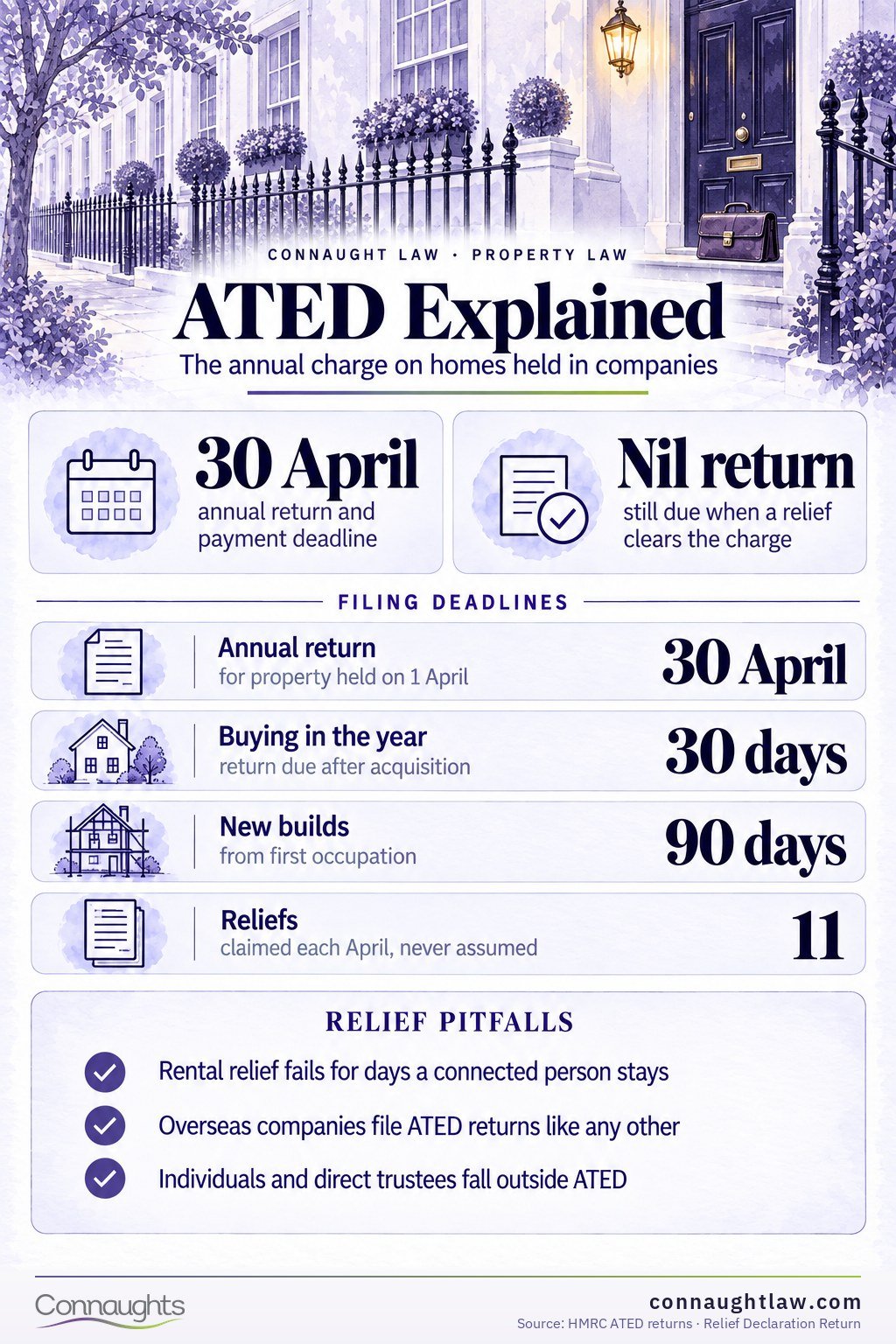
- Annual return and payment between 1 and 30 April for property held on 1 April.
- Buy during the year: return within 30 days of acquisition.
- New builds: within 90 days of first occupation or deemed dwelling date.
- A return is due even at nil charge — reliefs are claimed, never assumed.
- Late filing penalties run up to £1,600 per return, plus interest on unpaid tax.
What ATED Is and Why It Exists
ATED applies to UK residential property worth more than £500,000 held by a "non-natural person". It was designed to remove the tax shelter once offered by corporate ownership — SDLT avoided on share sales, gains and inheritance tax planned around — by making the envelope itself expensive to keep. The design is blunt deliberately: the charge is annual, automatic and indifferent to whether the structure saves any tax at all.
Who Counts as a Non-Natural Person
UK companies; non-UK companies holding UK residential property; partnerships with any corporate member; and collective investment schemes. Individuals, however wealthy, are outside ATED entirely — as are trustees holding directly without a corporate layer. The commonest surprise remains the overseas company set up decades ago for privacy: it files ATED returns like any other.
The Charges for 2026-27
Reading the Bands
ATED Bands and Charges
| Property Value | 2026-27 Charge |
|---|---|
| £500,001 – £1m | £4,600 |
| £1m – £2m | £9,450 |
| £2m – £5m | £32,200 |
| £5m – £10m | £75,450 |
| £10m – £20m | £151,450 |
| Over £20m | £303,450 |
Reliefs and Exemptions
- Property rental business — the workhorse: genuinely let to unconnected third parties on commercial terms.
- Property development and property trading — stock in a genuine business.
- Employee and farmhouse occupation, on qualifying terms.
- Public access (heritage opening), financial institutions in lending businesses, social housing providers, and Homes for Ukraine sponsorship.
- Full exemptions for charities holding for charitable purposes and public bodies.
Claiming Relief Correctly
Every relief is claimed through a Relief Declaration Return, annually, in the April window — relief in substance with no return in the system still generates penalties. The classic failure is the rental-business relief lost for periods a connected person occupied the property: relief days and non-relief days are counted separately, and one family stay converts a nil year into a charged one, apportioned by day.
Valuations: The 2022 Date and the 2027 Reset
Revaluation Rules
The current cycle runs on 1 April 2022 values (or acquisition cost for later purchases) and applies through 2027-28. The next fixed revaluation date is 1 April 2027, feeding the charges from 2028-29 — properties that have climbed near a band boundary since 2022 should budget for the step now. Interim events also re-set values: part-disposals or additional acquisitions over £40,000, and substantial alterations. Valuations are self-assessed on an open-market basis; HMRC's pre-return banding check exists for genuine borderline cases.
ATED and Capital Gains: The Historic Charge
ATED-related CGT — the 28% charge on gains within the regime — applied only from 6 April 2013 to 5 April 2019 and was then abolished. Since April 2019 corporate gains on UK residential property fall within corporation tax, at up to the 25% main rate, with non-resident companies brought into the same net and required to register and file. The old charge survives only in historic computations for pre-2019 periods.
Where the Old Charge Still Bites
Disposals today can still involve the abolished regime through rebasing and apportionment: a company selling a long-held dwelling computes its gain across eras — pre-2013, the ATED-CGT window, and the post-2019 corporation tax period — with different rules in each. Long-hold envelope disposals are precisely where an hour of tax advice repays itself in avoided restatements.
Calculating the Liability
The mechanics are simple by design: find the band from the applicable valuation, take the year's chargeable amount, and apportion daily for periods of ownership or relief within the year. A property bought mid-January in the £1m–£2m band owes roughly a fifth of £9,450 for the stub period — and a full return within 30 days of completion regardless.
De-Enveloping: Taking the Property Out
Unwinding — typically by liquidating the company and distributing the property — crystallises corporation tax on the deemed disposal at up to 25%, can trigger SDLT where debt or consideration passes, and engages shareholder attribution rules for non-resident owners. Against that, the saving is every future year's ATED and the wrapper's compliance load. The arithmetic usually favours exit for personally-used homes and staying put for genuinely commercial rental portfolios — but it is arithmetic, and it should be done, not assumed.
Company or Personal Ownership?
Side by Side
Ownership Structures Compared
| Factor | Personal | Corporate |
|---|---|---|
| ATED | None | £4,600 – £303,450 a year |
| SDLT on purchase | Standard rates, plus any surcharge | 17% flat above £500,000 |
| Gains | CGT at 18% / 24%, main-home relief available | Corporation tax up to 25%, no main-home relief |
| Inheritance tax | 40% above the nil-rate bands | UK residential value caught despite the wrapper |
| Compliance | Self-assessment | ATED returns, accounts, corporation tax |
The historic advantages of enveloping have been legislated away one by one — IHT protection for offshore structures went in 2017, the CGT gap in 2019 — which is why the honest modern question is rarely "should I envelope?" and usually "why am I still enveloped?" Our private client tax team runs that analysis with the numbers.
Frequently askedQuestions about ATED
What is ATED tax?
An annual charge on companies and other non-natural persons owning UK residential property worth over £500,000 — between £4,600 and £303,450 for 2026-27 depending on the value band, with a return due every April even where a relief reduces the bill to nil.
What are the ATED bands for 2026-27?
Six bands from £500,001 upwards, charging £4,600, £9,450, £32,200, £75,450, £151,450 and £303,450 at the top. The amounts index each year with September CPI; the band comes from the 1 April 2022 value or later acquisition cost.
When is the next ATED revaluation?
1 April 2027, setting the values for 2028-29 onwards. Until then the 2022 valuation date governs, subject to interim resets for £40,000-plus acquisitions or part-disposals and substantial alterations. Properties near a band edge should budget for the 2027 step now.
Does ATED-related capital gains tax still exist?
No — it ran from April 2013 to April 2019 and was abolished. Corporate residential gains now sit in corporation tax at up to 25%, including for non-resident companies. The old regime appears today only in the historic slices of long-held disposals.
Do I still file a return if my property is rented out?
Yes. The rental business relief eliminates the charge but the Relief Declaration Return is still due each April — and the relief fails for any day a connected person occupies the property, converting a nil year into an apportioned charge.
Is it worth de-enveloping?
Run the numbers: exit crystallises corporation tax on the gain and possibly SDLT, against saving every future year's ATED and compliance. Personally-occupied homes usually favour exit; commercial rental structures often stay. The wrong answer is drifting on paying the charge without ever doing the sum.
Tell us what the property is worth, when the company acquired it and how it is used. We will tell you which band applies, whether a relief is available, and what de-enveloping would actually cost.
Get Expert Advice