
Buying commercial property runs on a different rulebook from residential: its own SDLT bands, VAT elections that change the price by 20%, energy standards that were reset in June 2026, and due diligence that interrogates a business asset rather than a home. This guide covers the legal requirements as they actually stand — including the corrected EPC trajectory — the purchase process and searches, the full cost stack, the planning and use-class layer, and how these purchases are financed.
On This Page

Buying Commercial Property: The Legal Landscape in 2026
A commercial purchase is a business decision wearing a conveyancing process. The legal work still proves title and finds problems before money moves, but the questions change: what can this building lawfully be used for, what does its energy rating do to its lettability, is VAT payable on the price, and does the tenant in it help or hurt. Buyers who run the residential playbook miss the three points — VAT, use classes, MEES — where commercial deals are actually won or lost.
The Market Context, Briefly
The current cycle favours industrial and logistics stock, treats well-rated offices and weaker offices as different asset classes, and prices energy efficiency directly into value — a split the June 2026 MEES announcement will deepen. Headline investment forecasts move quarterly and belong to fund managers; what a buyer needs is simpler: in every sector, the compliant building outsells and outlets the non-compliant one.
Legal Requirements That Shape the Purchase
SDLT on Commercial Purchases
- Non-residential rates: nothing to £150,000, 2% from £150,001 to £250,000, 5% above £250,000 — unchanged by the April 2025 residential reforms.
- Leasehold purchases add SDLT on rent: 1% of the net present value above £150,000, 2% above £5 million.
- The 17% flat corporate rate applies to companies buying residential dwellings over £500,000 — it does not touch genuine commercial property, but catches mixed-use deals structured carelessly.
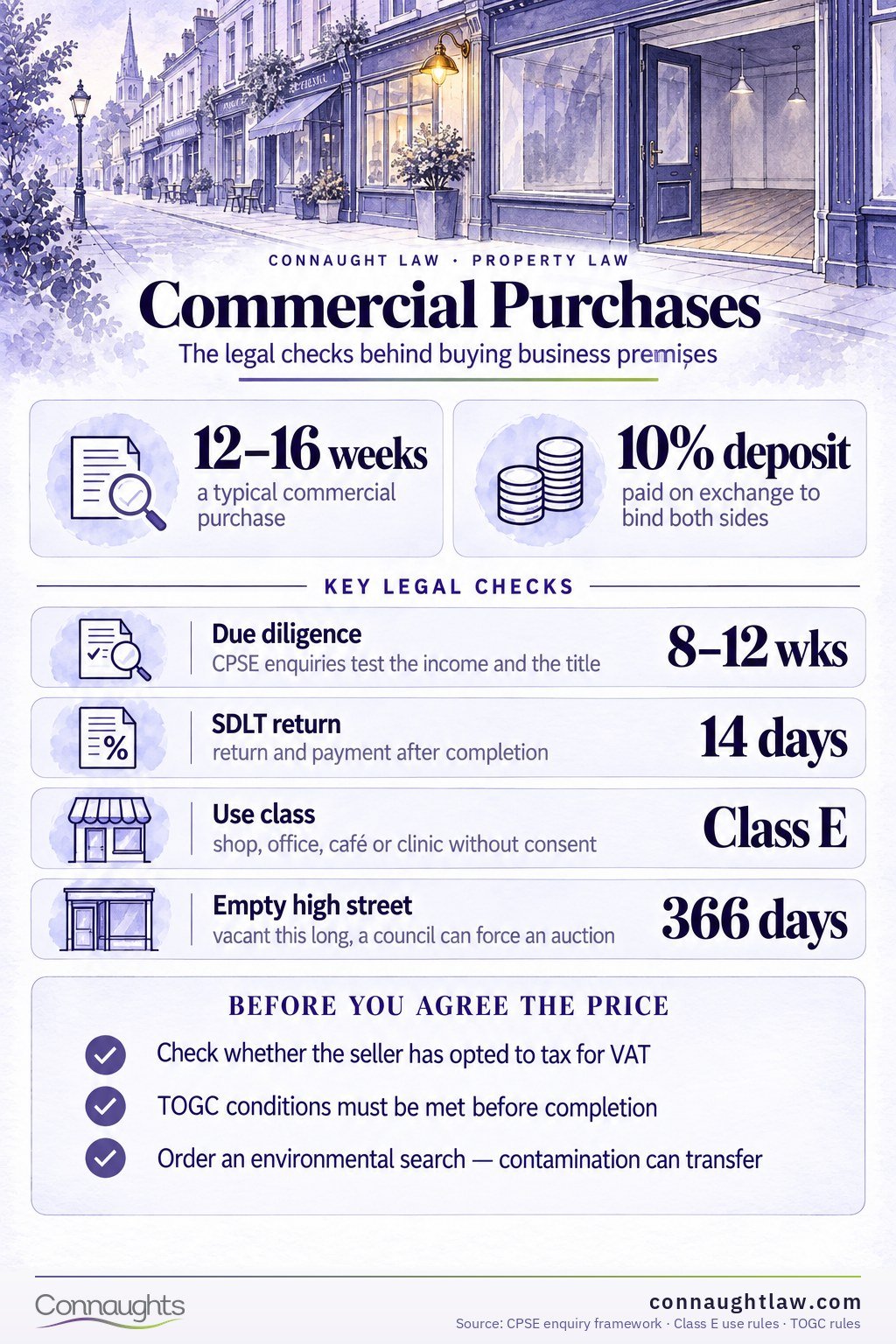
- The return and payment are due within 14 days of completion.
Energy Standards: The June 2026 Reset
The letting floor remains EPC E. On 23 June 2026 the government's interim response dropped the proposed 2027 EPC C step entirely and set EPC B from 2031 for commercial buildings over 1,000 m², with smaller buildings staying at E. A buyer's question is now precise: is this building over the size line, what would B cost it, and who funds the works if the answer is "a lot" — because the market is already pricing that answer.
Biodiversity Net Gain
Development consents require 10% biodiversity net gain, maintained for at least 30 years — mandatory since early 2024. For buyers of development sites this is a viability line-item: the gain is delivered on-site, off-site or through statutory credits, in ascending order of cost. For buyers of standing investments it surfaces as a diligence point on any recent consent the building relies on.
The Purchase Process
Due Diligence
Commercial due diligence runs through the CPSE enquiry framework and interrogates the asset's income as hard as its title: leases and their covenants if tenanted, use rights, compliance documents, and anything the seller's replies leave conveniently vague. Timelines follow complexity — eight to twelve weeks of diligence is normal, and cash deals for clean buildings run materially faster.
The Searches You Need
- Local authority search — planning permissions, enforcement, road schemes.
- Environmental search — contamination liability can transfer with the land.
- Drainage and water; utilities capacity where operations depend on it.
- Highways and access — service yards that touch adopted highway need checking, not assuming.
- Company searches against the seller, and lease reviews where tenants are in place.
Exchange to Completion
Exchange with a 10% deposit binds both sides; completion follows on the contractual date, with SDLT and registration after. Conditional contracts — on planning, on landlord's consent, on vacant possession — are far commoner than in residential work, and the conditions deserve as much drafting attention as the price: a badly drawn planning condition is a dispute with a completion date attached.
Costs and Tax
Beyond the Price
Cost Lines Itemised
- Legal fees scaling with complexity — tenanted and conditional deals cost more to do properly.
- Building survey: from hundreds for a lock-up to five figures for a substantial building.
- Searches: commonly £300–£800 for the commercial set.
- Lender costs: arrangement fees typically 1–2% of the loan, plus valuation and the lender's own lawyers.
- Land Registry fees on the commercial scale, up to £1,105 at the top band.
- SDLT — usually the largest single line after the price itself.
VAT, the Option to Tax and the Capital Goods Scheme
Commercial property is VAT-exempt unless the seller has opted to tax — in which case 20% lands on the price, recoverable only per your own VAT position, and SDLT is charged on the VAT-inclusive amount. New buildings under three years old are standard-rated regardless. Spend £250,000 or more on a property and the Capital Goods Scheme adjusts your VAT recovery over ten years as use changes. Transfers of tenanted buildings can qualify as a TOGC and escape VAT entirely — but only if the conditions are met before completion, which is why the VAT clause is negotiated, never boilerplate.
Planning and Use Classes
Use Classes in Practice
Most commercial premises now sit in Class E, which allows movement between retail, office, café, clinic and light industrial uses without planning permission — genuine flexibility that supports value. The exceptions matter: pubs, hot-food takeaways, cinemas and some others sit outside Class E as sui generis uses, and listed buildings and conditions on old consents can lock a property into narrower use than its class suggests. Verify what the building may lawfully do before pricing what your business will do in it.
High Street Rental Auctions
Since December 2024, councils can force letting auctions of high-street premises vacant for more than 366 days in the previous two years, with leases of at least a year imposed on auction terms. For buyers of vacant high-street stock this rewrites the holding calculation: land-banking an empty shop now carries the risk of a tenant you did not choose on rent you did not set.
Financing the Purchase
Commercial Mortgages Now
Commercial lending typically runs at 60–75% loan-to-value, priced as a margin over base rate that tracks the strength of the covenant, the asset and the income. Owner-occupiers borrow against their trading accounts; investors against the lease. Expect the lender's diligence to duplicate much of yours — and its energy-efficiency questions to sharpen every year between now and 2031.
Alternative Structures
Beyond the mortgage: development finance for value-add projects, vendor financing where sellers take deferred consideration, SIPP and SSAS pension purchases for owner-occupiers, and joint ventures splitting equity and risk. Each brings its own legal architecture, and each changes the SDLT and VAT analysis — structure and tax advice belong in the same meeting, before heads of terms.
Frequently askedQuestions about buying commercial property
How long does a commercial property purchase take?
Twelve to sixteen weeks is typical, with eight to twelve of them in due diligence; clean cash deals run in six to eight, and conditional or tenanted transactions longer. The seller's replies to CPSE enquiries usually set the pace.
What SDLT do I pay on a commercial purchase?
Non-residential rates: nothing to £150,000, 2% to £250,000, 5% above — plus 1% of rent NPV over £150,000 on leasehold deals. These bands were untouched by the April 2025 residential changes, and where the seller has opted to tax, SDLT is calculated on the VAT-inclusive price.
Do I pay VAT when buying commercial property?
Only if the seller opted to tax, or the building is new — then 20%, recoverable according to your own VAT position. Buying a tenanted building as a going concern can escape VAT as a TOGC if the conditions are satisfied before completion. Check the position before agreeing the price.
What are the EPC requirements for commercial property?
EPC E is the letting floor now. The June 2026 announcement dropped the proposed 2027 C milestone and set EPC B from 2031 for buildings over 1,000 m², with smaller buildings staying at E. Price the works gap on larger buildings before you bid, not after.
What extra costs should I budget beyond the price?
Commonly 5–10% on top: SDLT, legal fees, survey, searches around £300–£800, lender arrangement fees of 1–2%, and Land Registry fees up to £1,105. Tenanted and conditional purchases sit at the top of the range because the diligence is genuinely larger.
Can my business buy premises through a pension?
Yes — SIPP and SSAS structures hold commercial property and lease it back to the trading business, with rent flowing into the pension. The rules are strict on valuation and arm's-length terms, and the structure decision belongs before heads of terms, not at exchange.
Tell us the property, the price and whether VAT or a tenant is involved. We will map the SDLT and VAT position, run the diligence that matters for this asset, and keep the conditions honest.
Get Expert Advice