
A commercial lease agreement is usually the largest contract a small business ever signs — and the least negotiated. The lease the landlord's solicitor sends is a first offer drafted for the landlord, yet tenants who would haggle over a van fleet sign it whole. This guide reads the agreement as a lawyer does: the lease types and what each costs, the clauses where the money moves, the security the landlord will ask for, and the 2026 changes to rates, energy standards and the 1954 Act.
On This Page

The Largest Contract Your Business Signs — and the Least Negotiated
Commercial leases carry almost none of the statutory protection that surrounds residential tenancies. Rent, repair, service charge, security — the contract is the law between the parties, and the courts enforce what was signed, not what was fair. That cuts both ways: everything is negotiable before signature, and almost nothing is after.
The headline rent is one of three. The repair standard decides whether you hand back a refurbished building at your own expense; the service charge clause decides whether the landlord's spending becomes your liability without a ceiling. Price all three before agreeing any of them — the rent is usually the only one the agent mentions.
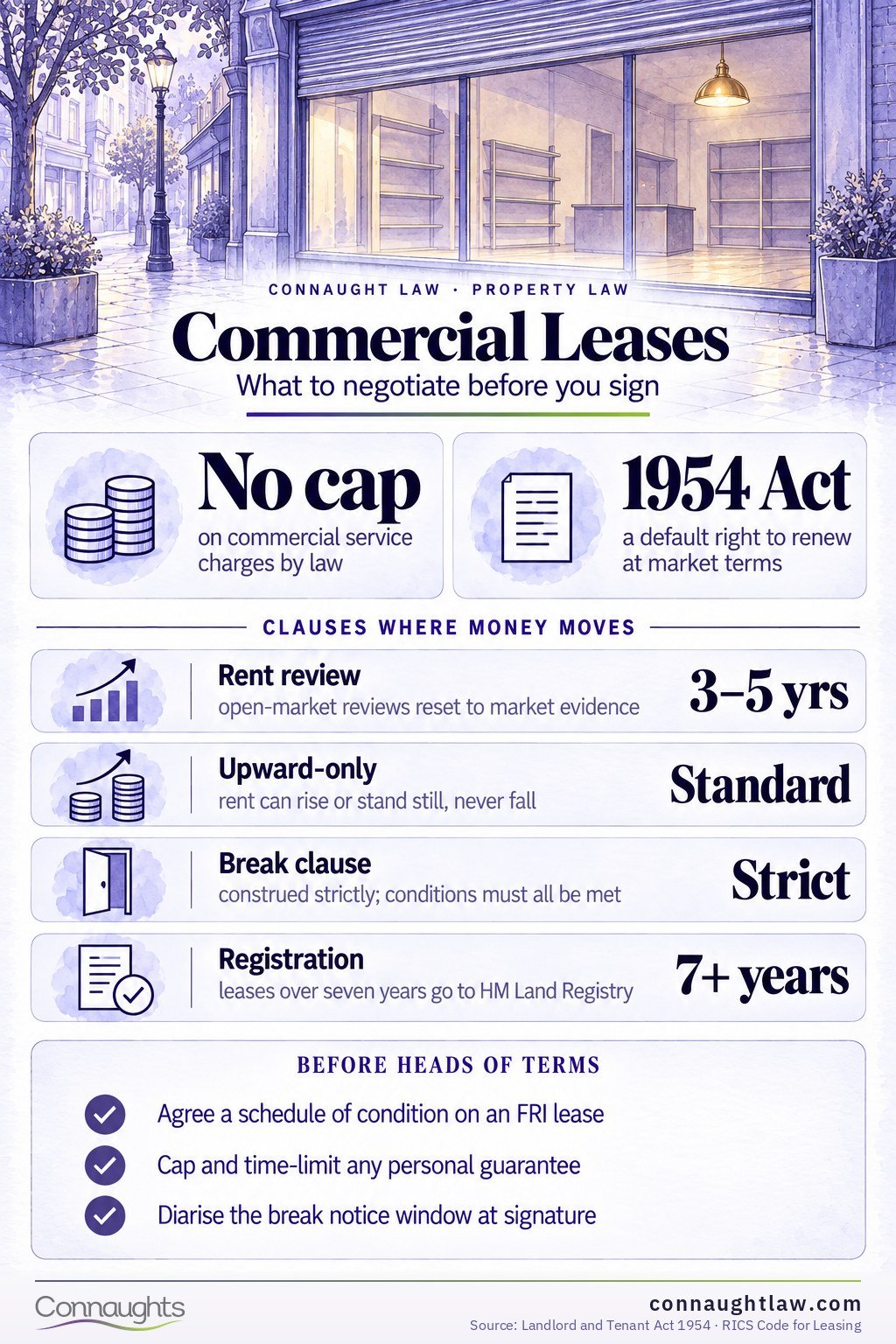
Lease Types: From Full Repairing to All-Inclusive
A full repairing and insuring (FRI) lease puts the whole building's repair and insurance cost on the tenant — the institutional standard, and the reason a schedule of condition matters so much on older premises. An internal repairing lease limits the tenant to the interior, with the structure returning through the service charge. All-inclusive managed space inverts the trade: a higher headline figure, but no service charge volatility and no dilapidations exposure. None of these labels is defined by law; the clauses, not the name on the front page, decide what you have signed.
Turnover Rents and Flexible Space
Retail and hospitality lettings increasingly blend a reduced base rent with a percentage of sales, sharing trading risk between the parties. The drafting points are the definition of turnover — online orders collected in store are the classic fight — the reporting mechanics, and what happens on a break or assignment when the turnover history walks out of the door.
Agreement for Lease: The Contract Before the Lease
An agreement for lease is not a lease — it is a binding contract to grant one later, once conditions are met: landlord's works completed, planning obtained, a superior consent secured. Developers use it to secure tenants before a building exists. The tenant's protections live in the conditions: objective completion standards, a longstop date with a right to walk away, and registration of the agreement as an estate contract so a sale of the building cannot strand it.
Month-to-Month Occupation: Flexibility with a Catch
Genuine month-to-month arrangements take two legal forms, and the difference matters more than the label. A tenancy at will can be ended by either party at any moment and never acquires 1954 Act protection. A periodic tenancy — which is what an occupier "holding over" and paying monthly usually has — needs a notice to quit and can acquire security of tenure. Landlords who let an occupier drift on monthly payments after a contracted-out term expires may find they have granted, by conduct, the protected tenancy they carefully excluded on paper.
Core Terms: Where the Money Moves
Rent review clauses set the trajectory. Open-market reviews reset to market evidence, typically every three to five years; index-linked reviews track RPI or CPI, where caps and collars are negotiable and the compounding basis needs checking. Upward-only review remains the UK market standard — the rent can rise or stand still at review, never fall — so the review clause is worth more attention than the initial figure. The RICS Code for Leasing Business Premises is the benchmark for what fair drafting looks like, and quoting it moves negotiations.
Break Clauses and Conditions Precedent
- Notice served late, or by a method the lease does not permit — breaks are construed strictly, and "substantially right" is wrong.
- Conditions precedent unmet on the break date: rent not cleared, vacant possession not given, covenants not complied with.
- A pound of unpaid interest or an unremoved partition can keep the lease — and years of rent — alive.
- The discipline: diarise the notice window at signature, and take advice months before the break date, not weeks.
What Changed in the Law: 2025 into 2026
In force: right to manage extended to buildings up to 50% commercial (March 2025); Martyn's Law on the statute book (April 2025) with duties phased in after a lead-in period; EPC E as the letting floor. Announced 23 June 2026: the proposed 2027 EPC C step is dropped, and EPC B arrives from 2031 for buildings over 1,000 m². Still consultation: the Law Commission's 1954 Act review — its second paper closed 16 September 2026, with security of tenure staying.
The practical reading for anyone signing now: a lease running past 2031 in a larger building needs the EPC B question answered — current rating, works route, and who pays — inside the lease, because the MEES regime penalises the landlord but the works clauses decide whose money solves it.
Business Rates and the 2026 Revaluation
Rateable values reset on 1 April 2026, based on rental evidence at 1 April 2024 — so occupiers of space whose market rose since the last list should budget for increases before the bill arrives. The same date brings the new multiplier structure: permanently lower multipliers for retail, hospitality and leisure premises with rateable values under £500,000, funded by a higher multiplier on properties at or above that line. Rates are the tenant's cost in almost every lease, so they belong in the total-occupation-cost arithmetic alongside rent and service charge, not as an afterthought.
Service Charges: The Cost Nobody Caps for You
Commercial service charges have no statutory cap — the residential reasonableness regime does not apply. Whatever protection the tenant has must be negotiated into the lease, and the time to do it is before signature, while the landlord still wants the letting.
- A cap or fixed charge, indexed if necessary — the single most valuable clause.
- Exclusion of capital works arising from pre-existing defects and of improvements that outlast your term.
- Annual budgets in advance and certified reconciliations after, with rights to inspect vouchers.
- Apportionment stated as a formula, not "a fair proportion determined by the landlord".
- Conformity with the RICS professional statement on commercial service charges.
- Three years of past accounts requested before signing — the history predicts the future better than the drafting.
Hidden Costs Beyond the Service Charge
The lease carries costs that never appear in the heads of terms: insurance premiums loaded with landlord commissions, uninsured risk allocation, interest on late payments, the landlord's legal and surveyor costs in giving consents, reinstatement of your own fit-out at expiry, and the terminal dilapidations claim on an FRI lease. Each is a drafting point; together they routinely exceed a year's rent over the life of a term.
Deposits, Guarantees and Other Security
Landlords price covenant risk, and a new company with no accounts pays for it in security. A rent deposit deed — commonly several months' rent — should define draw-down triggers narrowly and top-up obligations precisely, and provide for return on assignment or expiry. Personal guarantees deserve the hardest negotiation of all: capped in amount, limited in time, and never given casually by directors who assume the company shield still protects them. On a later assignment, expect an authorised guarantee agreement keeping the outgoing tenant liable for the incoming one's performance — the 1995 Act's price for release from the covenants themselves.
Pitfalls That Cost Real Money
- An FRI lease of aging premises with no schedule of condition — you have promised to hand back a better building than you took.
- A break lost to a condition precedent — the most litigated clause in commercial leasing.
- An unlimited, unexpiring personal guarantee.
- SDLT and registration missed — the return is due within 14 days of completion, and terms over seven years must be registered.
- A user clause or alterations clause that does not fit the business you actually plan to run.
- Contracting out agreed without pricing what renewal rights were worth — and no exit costed, when a negotiated surrender is often the only way out of a term that no longer fits.
Negotiating: The Deal Hardens Early
Term and breaks, rent-free period, review basis and any cap, service charge ceiling, repair standard with schedule of condition, and the security package. Heads of terms are not binding, but they harden: reopening a point conceded there costs goodwill and money in drafting. The cheapest legal advice you will ever buy is the advice taken before heads of terms are signed.
Renewals Under the 1954 Act
A tenant inside the Landlord and Tenant Act 1954 holds a statutory right to a renewal lease on market terms, defeatable only on defined grounds such as redevelopment or persistent arrears — some carrying compensation. Renewal is a negotiation conducted in the shadow of that right: market evidence, interim rent arguments and the PACT arbitration route all feed the outcome, and tenants who open discussions around eighteen months before expiry consistently do better than those who wait for the section 25 notice. The Law Commission review will modernise this machinery, but its June 2025 interim statement confirmed the rights themselves stay.
Frequently askedQuestions about commercial lease agreements
What is the difference between an FRI and an internal repairing lease?
An FRI lease makes the tenant responsible for repairing and insuring the whole premises; an internal repairing lease confines that to the interior, with structural costs returning via the service charge. On older buildings, an FRI obligation without a schedule of condition is a promise to improve at your own cost.
Do commercial tenants have security of tenure?
By default, yes — the 1954 Act gives business tenants a right to renew at market terms unless the landlord proves statutory grounds. The right can be excluded only by the formal contracting-out procedure completed before the lease is granted, and a contracted-out lease should rent at a discount for it.
Is there such a thing as a month-to-month commercial lease?
Yes, in two forms: a tenancy at will, terminable instantly by either side and never protected, and a monthly periodic tenancy, which needs a notice to quit and can acquire 1954 Act security. Occupiers holding over on monthly payments are usually periodic — often to the landlord's surprise.
What is an agreement for lease?
A binding contract to grant a lease in the future once conditions are satisfied — typically completion of landlord's works or planning. The tenant should insist on objective completion standards, a longstop date, and registration of the agreement so a sale of the building cannot defeat it.
Are service charges on commercial leases capped by law?
No. There is no commercial equivalent of the residential reasonableness regime — the lease is the only protection. Negotiate a cap or fixed charge, capital-works exclusions, certified accounts and RICS-conformity before signing; nothing can be added after.
Does SDLT apply to a commercial lease?
Yes — on any premium at the commercial rates and on the net present value of the rent above £150,000, with the return due within 14 days of completion. Leases granted for more than seven years must also be registered at HM Land Registry.
Send us the heads of terms before you agree them, or the draft lease before you sign it. We will tell you which clauses will cost you money, what the market lets you push back on, and where the drafting hides the risk.
Get Expert Advice