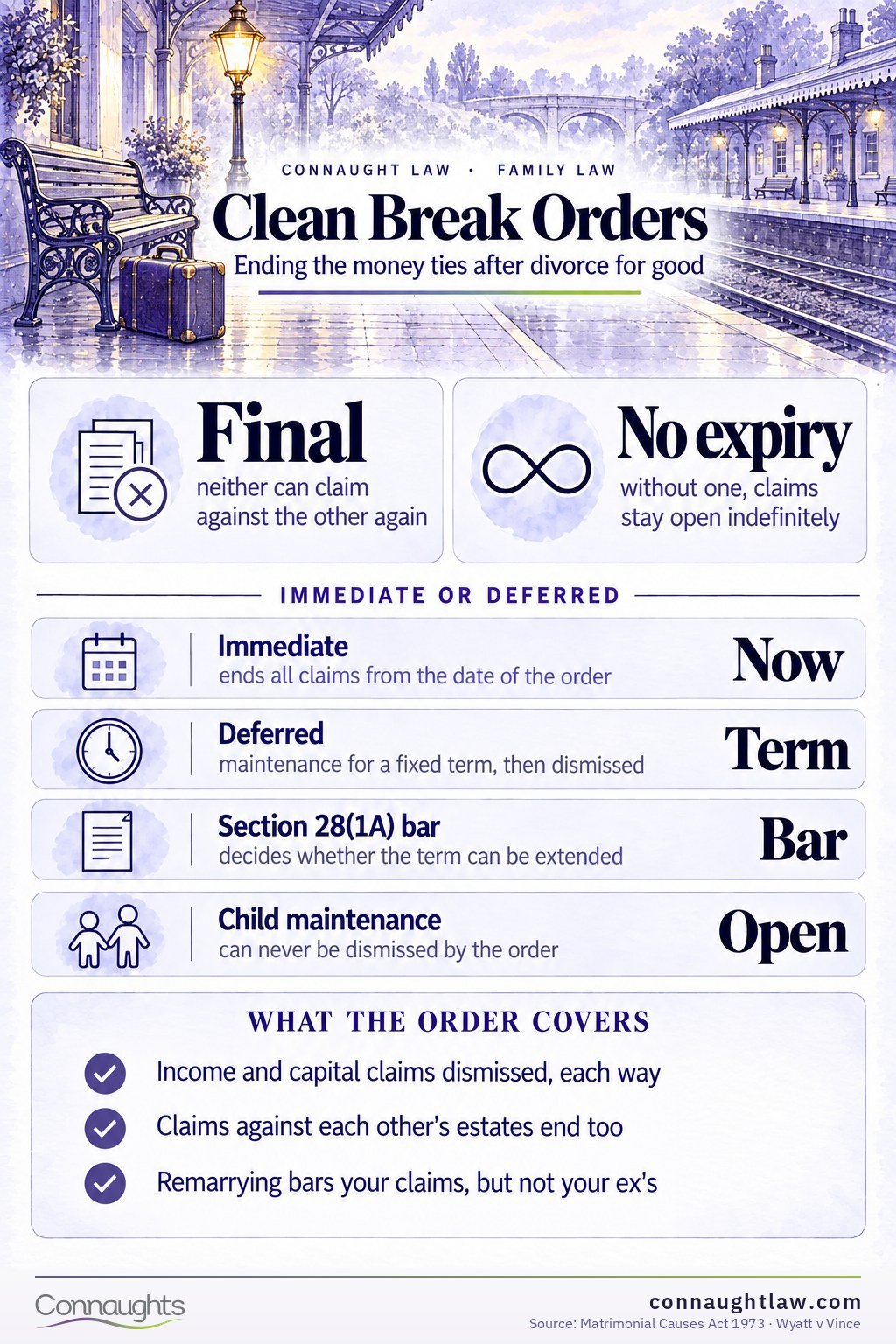
Clean break orders UK divorce law treats as the gold standard ending: a court order that divides what there is and then dismisses every future financial claim between former spouses - capital, income, pensions and claims against each other’s estates. Without one, divorce ends the marriage but not the financial relationship: claims stay open indefinitely, reaching future earnings, inheritances and windfalls, as Wyatt v Vince proved nearly two decades after separation. This guide explains what clean break orders are, immediate and deferred forms, what they can and cannot cover, the application process and 2026 costs, and the real risks of skipping one - even, especially, when there is “nothing to divide”.

Understanding Clean Break Orders in UK Divorce
Parliament built the preference into the statute: section 25A of the Matrimonial Causes Act 1973 requires courts to consider whether financial obligations between spouses can be ended as soon after divorce as is just and reasonable. Where it can be done fairly, finality is the policy - each party leaves with their share and their independence.
The order usually arrives by consent: the couple agree the division, solicitors draft it with a dismissal clause, and a judge approves it on the papers. The same finality is available after contested proceedings - most contested financial cases end in a clean break unless ongoing maintenance is genuinely needed.
The concept covers both directions and all claim types, which surprises people negotiating from apparent strength: dismissing your ex’s claims against you means dismissing yours against them too. That mutuality is why judges scrutinise clean breaks where one party’s future looks precarious - finality must be fair to survive approval.

What Are Clean Break Orders - Complete Definition
A clean break order is a financial order that, alongside dividing assets, dismisses the parties’ claims against each other: for lump sums, property adjustment, spousal maintenance (including the power to revive it), pension orders, and provision from each other’s estates under the Inheritance Act. After it, neither can return for more, whatever changes.
The dismissal is what distinguishes it from an ordinary financial agreement. Divorce alone dismisses nothing: the final order ends the marriage while every financial claim survives it. Informal deals, however amicable and however documented, do not bind the court years later - only an order does.
The estate dismissal deserves emphasis because it works after death: without it, a former spouse who never remarried can claim against your estate under the Inheritance (Provision for Family and Dependants) Act 1975, landing the dispute on your executors and new family. Standard clean break drafting closes that door in both directions.
Clean Break Orders and Child Maintenance
One thing a clean break cannot end: responsibility for children. Child maintenance continues under the statutory scheme regardless of any order, and even agreed child maintenance terms in an order lose exclusivity after a year, when either parent can go to the CMS. The clean break is between adults; children’s claims are never bargained away.
School fees orders and Schedule 1-style provision for children equally survive: the clean break machinery simply does not touch obligations owed to or for children. Parents sometimes read “clean break” as total severance; legally it is severance between the adults only.
Types of Clean Break Orders
An immediate clean break dismisses everything now - the standard outcome where both parties can be self-sufficient: assets divided, pensions shared if needed, claims dismissed. A deferred clean break runs spousal maintenance for a fixed term - retraining years, until children reach school age - then dismisses claims when the term ends, ideally with a bar on extension under section 28(1A).
Pension sharing is fully compatible with a clean break: the share is implemented once, creating independent pension rights, and claims are dismissed. What a clean break rules out is the open-ended joint enterprise - nominal maintenance orders kept alive “just in case”, which modern courts increasingly decline to preserve where independence is realistic.
Term maintenance drafting decides how deferred breaks actually end: an extendable term invites an application to prolong it, while a section 28(1A) bar makes the end date final. Which is right depends on how predictable the recipient’s path to independence is - retraining plans wobble, and bars bind even when they do.
What Should Be Included in a Clean Break Order
The operative parts divide: property transfers or sale terms, lump sums and payment dates, pension sharing annexes, contents and vehicles, responsibility for debts, and any term maintenance. The dismissal parts then close: capital and income claims both ways, section 28(1A) bars, and - almost always - dismissal of Inheritance Act claims against each other’s estates.
Drafting quality is the whole game: an order that divides but fails to dismiss, or dismisses maintenance but not estate claims, is a clean break with the door ajar. Recitals recording the disclosure given and the basis of the deal also matter - they are what defends the order if it is ever attacked.
Pension dismissals carry a technical footnote: dismissing pension claims without first implementing any agreed share is a known drafting failure - the share must be ordered, then other claims dismissed. Similarly, orders should deal expressly with jointly held property and joint debts, since dismissal clauses do not untangle joint legal ownership by themselves.
The Application Process for a Clean Break Order
By consent, the sequence is short: financial disclosure exchanged proportionately (the court reviews a D81 summary of means), the order drafted, both parties sign, and the application is lodged once the conditional order stage of the no-fault divorce is reached. A judge approves it on paper if fair - questions come back only where something looks wrong.
Judges do check: a consent order is not a rubber stamp, and summaries showing one party taking everything, or a needs case with no provision, attract requisitions. Independent legal advice on each side is not mandatory but heavily protective - both of the deal and against it being reopened.
Where the couple divorced years ago without any order, the process is the same but the analysis changes: the court assesses fairness at the date of the application, with delay, intervening wealth and each party’s conduct since all in play. Closing old exposure is almost always possible; the price depends on how the intervening years treated each side.
Practical closing advice: keep the sealed order, the D81 and the disclosure bundle permanently - lenders, pension schemes and probate practitioners ask for clean break orders decades later, and a retrievable copy converts those requests from problems into paperwork. Free procedural orientation is available from Citizens Advice; the drafting belongs with specialists.
Clean Break Order Costs in 2026
The court fee for a consent order is £62 from 13 July 2026. Legal costs depend on complexity: straightforward agreed divisions are widely handled on fixed fees, with costs rising where pensions, businesses or negotiation are involved. Where hourly rates apply, the published solicitors’ guideline hourly rates give the benchmark.
Set the cost against what it closes: every future claim, forever. Contested proceedings started years later by an ex-spouse - defended even successfully - cost multiples of any consent order. As insurance pricing goes, the clean break is the cheapest policy in family law.
Budget also for the disclosure that underpins approval: proportionate exchange - often summary disclosure for modest estates - satisfies the D81 without Form E-scale work, keeping agreed cases lean. What cannot be skipped is honesty: an order approved on a false summary inherits all the fragility of the falsehood.
Mediation slots naturally in front of the order for couples not yet agreed: the mediator’s open financial summary and memorandum of understanding convert directly into consent order instructions, and the £500 voucher applies where children are involved. Solicitor negotiation and private FDRs fill the gap for couples who need more structure - all of them cheaper than the claims the eventual order will dismiss.
Risks of Not Getting a Clean Break Order
Wyatt v Vince is the cautionary tale: a wife permitted by the Supreme Court to pursue financial claims roughly nineteen years after a penniless separation, once her former husband had built a fortune. Claims survive until dismissed - future business success, inheritances, even lottery wins have all been reached in reported cases.
The risk is symmetrical and grows with time: whichever former spouse prospers becomes the target, and the one who “kept things amicable” without an order carries the exposure. Remarriage adds its own trap - a spouse who remarries before applying loses most claims, while their ex’s claims against them continue.
The couples most likely to skip the order - young, short marriage, no assets yet - are precisely those with the longest and most unpredictable financial futures ahead. “Nothing to divide” is the best possible moment to dismiss claims: the order is simple, cheap and uncontroversial, and it stays done.
Timing bars cut both ways after remarriage: the remarried spouse loses most of their own claims but remains exposed to their ex’s - an asymmetry that catches people who assumed their new marriage closed the old book. Only dismissal closes it, and it can still be obtained after remarriage against the party who is free to apply.
Frequently Asked Questions
What is a clean break order in divorce?
A financial court order that divides assets and dismisses all future financial claims between ex-spouses - capital, maintenance, pensions and claims against each other’s estates. It ends the financial relationship the way the final order ends the marriage.
Do I need a clean break order if we have no assets?
Arguably most of all. Claims stay open indefinitely without one, and it is future wealth - careers, businesses, inheritances - that gets claimed against, as Wyatt v Vince showed 19 years on. With nothing to argue about now, the order is quick, cheap and final.
How much does a clean break order cost in 2026?
The court fee is £62 from 13 July 2026. Fixed-fee drafting is widely available for agreed divisions, with costs scaling where pensions or negotiation are involved - and always a fraction of defending a claim years later.
Can a clean break order be overturned?
Rarely and only on narrow grounds: fraudulent non-disclosure (as in Sharland and Gohil), or an immediate, unforeseeable collapse of the order’s basis. Properly disclosed, advised and drafted orders are among the most durable in civil law.
Does a clean break order stop child maintenance?
No. Child maintenance is the child’s entitlement and continues under the CMS scheme regardless. Even agreed child maintenance in an order can be superseded through the CMS after twelve months. The clean break dismisses only the adults’ claims between themselves.
What is the difference between a consent order and a clean break order?
A consent order is any financial order made by agreement; a clean break order is defined by what it contains - dismissal of future claims. Most consent orders include clean break provisions, but an order can divide assets without them, which leaves the door open.
Can I get a clean break if my ex needs maintenance?
Through a deferred clean break: maintenance for a fixed term with a bar on extension, then dismissal. Courts must consider whether independence is achievable; where it genuinely is not, ongoing maintenance can continue - the clean break is a preference, not an absolute.
When should the clean break order be made?
Agree it during the divorce, lodge it at the conditional order stage, and take the final divorce order only once the financial order is sealed. That sequence protects pension rights and avoids the remarriage trap - and gets both finalities done within the same process.
Clean break provisions drafted to close every claim - capital, income, pensions and estates.
Agreed divisions turned into sealed orders efficiently and predictably.
Divorced years ago without an order? Claims can still be dismissed now - before they mature.
To put your settlement beyond challenge - or close the exposure from an old divorce - contact the family law team at Connaught Law for a confidential consultation.