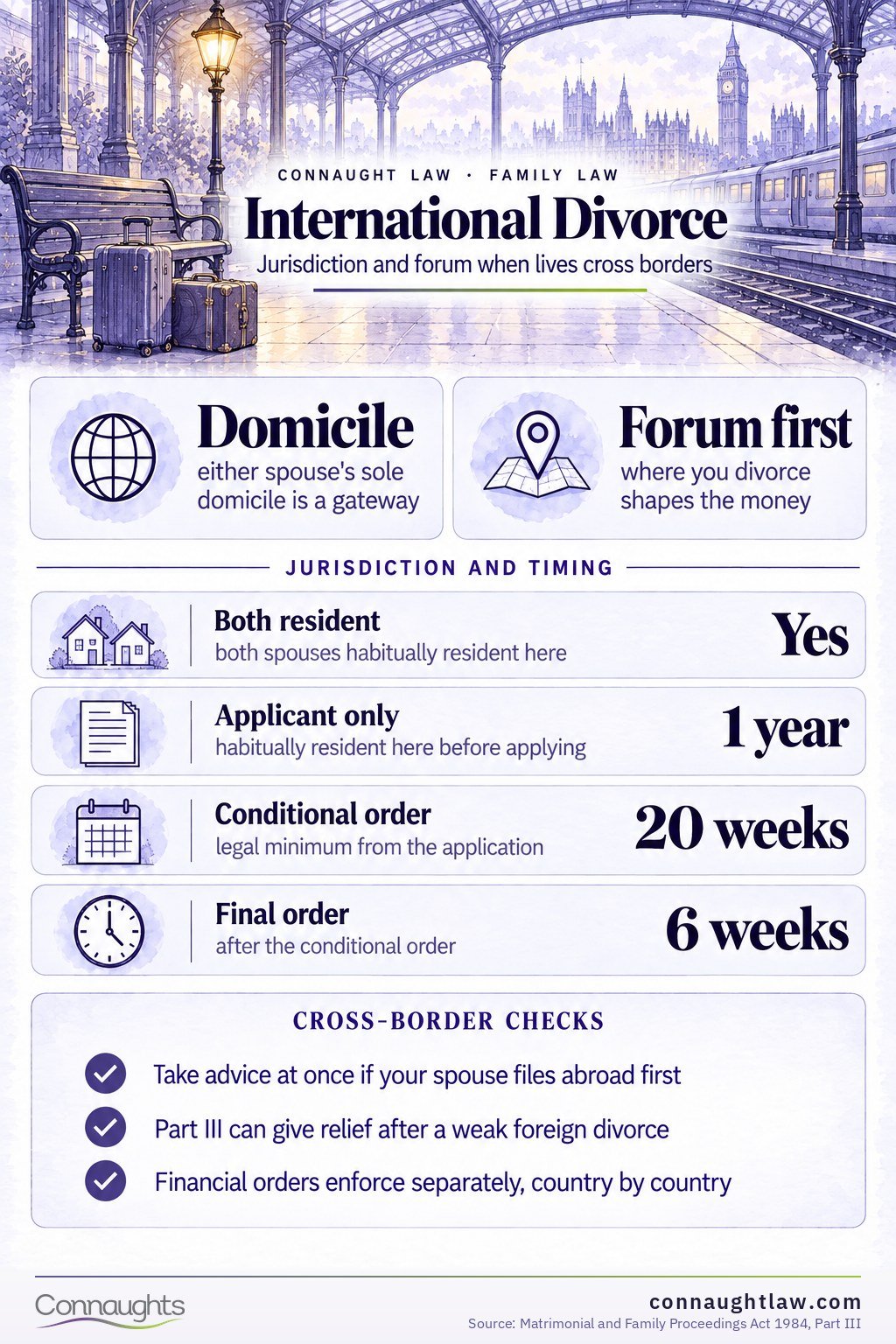
International divorce UK cases turn on two questions that decide everything downstream: which country’s courts can deal with the divorce, and which country’s courts will deal with the money. The answers can move outcomes by millions, because England divides assets more generously to the financially weaker spouse than almost anywhere else. Since Brexit ended the EU first-in-time rule, English courts decide competing jurisdictions on connection rather than speed - and the Supreme Court’s Potanina litigation has reshaped financial claims after a foreign divorce. This guide covers jurisdiction, strategy, serving a spouse abroad, recognition, and Part III financial relief in 2026.

Understanding International Divorce UK in 2026
A divorce becomes international the moment the couple’s life crosses a border: spouses of different nationalities, a marriage celebrated abroad, homes or pensions in two countries, or one spouse who has already moved away. Each element raises the same strategic question - where should this divorce happen?
The question matters because family law is not harmonised. Some jurisdictions enforce prenuptial agreements strictly; England treats them as persuasive but not binding. Some award little or no spousal maintenance; England can order it for years. Some exclude pre-marital or inherited wealth mechanically; England asks what fairness and needs require. Same facts, different country, radically different outcome.
The stakes explain the intensity of jurisdiction litigation among internationally mobile families - and why the biggest reported English cases of recent years, from Russian oligarch disputes to Gulf ruling-family litigation, have been fought substantially about where and whether England should hear the case at all.

What Is International Divorce? More Than One Court in Play
There is no special “international divorce” procedure - an English divorce follows the ordinary no-fault process whoever the spouses are. What changes is the framework around it: whether England has jurisdiction at all, whether another country’s courts are also open, how documents reach a spouse abroad, and whether orders made here will be recognised where the assets and the family actually are.
In practice the divorce itself is rarely the battleground. The fights are about jurisdiction for the financial claims, disclosure of assets held across borders, and enforcement - getting a English pension sharing order or maintenance award to bite on wealth held in another legal system.
Enforcement thinking should start on day one, not after the order. An English pension sharing order works directly only against UK pensions; foreign pensions need offsetting or local implementation. Maintenance is enforceable abroad through the 2007 Hague Convention and reciprocal arrangements, while capital orders may need registering or suing on in the asset’s home country. The best English order is worth what the receiving jurisdiction will do with it.
UK Jurisdiction Requirements for International Divorce
English courts take divorce jurisdiction under the Domicile and Matrimonial Proceedings Act 1973, as amended after Brexit. The gateways are based on habitual residence and domicile: both spouses habitually resident here; both last habitually resident here and one still is; the respondent habitually resident here; the applicant habitually resident for a year (or six months if also domiciled here); or either party domiciled in England and Wales.
Habitual residence means the centre of your settled life - home, work, family, social ties - and it can change quickly on a genuine move. Domicile is stickier: broadly, the country you regard as your permanent home, which can survive years of living elsewhere. The distinction is technical but decisive, and it is explained fully in our guide to habitual residence in UK law.
Same-sex spouses have an additional safety-net gateway: where a same-sex marriage was celebrated in England and Wales and no other country would entertain the divorce because it does not recognise the marriage, English courts can take jurisdiction so the couple are never left married against their will in legal limbo.
Checking Jurisdiction for International Divorce UK Applications
Before issuing, test the gateway honestly: where has each spouse actually lived for the past year, with what continuity and intention? Where is each domiciled, tracing domicile of origin and any acquired domicile of choice? Contemporaneous facts - tenancy agreements, school enrolment, tax residence, GP registration - decide these questions, and courts see through residence engineered for litigation.
Where neither habitual residence nor domicile is straightforward - serial expatriates, diplomatic families, spouses splitting the year between countries - a short jurisdiction opinion before anyone issues is money well spent. It prevents both the wasted costs of an application struck down later and the tactical gift of an easy stay argument to the other side.
Sole Domicile: The Post-Brexit Gateway
Since Brexit, the domicile of just one party grounds jurisdiction without restriction - a gateway that EU law previously limited. An expatriate who kept an English domicile of origin can often divorce here despite years abroad, though jurisdiction founded on sole domicile can invite a forum challenge, and financial enforceability abroad still needs checking before relying on it.
The application itself runs through the standard gov.uk online divorce service once jurisdiction is confirmed - the form asks which gateway you rely on. Getting that answer right matters: a jurisdiction founded incorrectly can unravel orders years later, so international cases justify professional sign-off even where the divorce looks simple.
Brexit and International Divorce: What Actually Changed
Until the end of 2020, competing divorces within the EU were resolved by pure speed: whichever court was seised first won, however thin the connection. That lis pendens rule produced undignified races to issue. For proceedings started since 1 January 2021, English courts instead apply forum non conveniens - a judicial assessment of which country is the more appropriate forum, weighing where the couple lived, where assets and children are, and the parties’ connections.
Recognition changed too. EU states no longer recognise English divorces automatically under Brussels IIa; recognition now depends on the 1970 Hague Divorce Recognition Convention, to which twelve EU states belong, or each country’s national rules. Maintenance enforcement moved from the EU Maintenance Regulation to the 2007 Hague Convention framework - workable, but slower and less seamless.
One EU-era tactic survives in modified form: the Hemain injunction, restraining a spouse from pressing foreign proceedings unconscionably to defeat the English case. Anti-suit relief is exceptional and fact-specific, but its availability underlines the broader post-Brexit point - jurisdiction disputes are now argued on substance, and interim tactics can protect the forum argument while it is decided.
Strategic Country Selection in International Divorce UK Cases
Where both spouses can genuinely invoke more than one jurisdiction, the choice deserves rigorous comparison: how each system treats maintenance, pensions, pre-marital and inherited wealth, trusts and company structures; how strong disclosure powers are; typical costs and speed; and - critically - how enforceable each country’s orders are where the assets sit.
England’s reputation as generous to the financially weaker spouse rests on real features: the sharing principle applied to matrimonial assets, meaningful spousal maintenance, pension sharing, and muscular disclosure backed by adverse inferences. Wealthier spouses correspondingly often prefer jurisdictions with fixed matrimonial property regimes or enforced marital agreements.
Timing and Forum in International Divorce UK Strategy
Forum battles are interim skirmishes with final-outcome consequences. A stay application arguing England is not the appropriate forum must be raised early; conversely, consolidating England’s position - registering the case, progressing disclosure, engaging with children arrangements here - makes a later challenge harder. Individual advice matters more here than any general rule.
Asset protection runs alongside forum strategy. Where dissipation is a real risk - transfers to relatives, restructuring into trusts, movements offshore - freezing injunctions can hold the position worldwide in support of English proceedings, and s.37 Matrimonial Causes Act applications can reverse transactions made to defeat claims. Evidence gathered early, before positions harden, is disproportionately valuable.
Interim maintenance keeps the playing field level while jurisdiction and finance are fought out: maintenance pending suit can fund living costs, and legal services payment orders can fund the litigation itself. English courts use both to prevent a wealthier spouse simply outlasting the other - a protection many competing jurisdictions lack.
Religious divorce needs handling in parallel where it applies: a civil English divorce does not dissolve a religious marriage, and recognition of religious divorces obtained abroad follows the Family Law Act rules above. Couples with dual civil-religious status should sequence both dissolutions deliberately, so that neither spouse ends up free to remarry in one system and bound in the other.
Divorcing a Spouse Living Abroad
Living in different countries does not prevent an English divorce if a jurisdiction gateway is met. The application proceeds online as normal; the practical work is service. Papers can be served abroad by post where the destination allows it, through the Hague Service Convention machinery, or by alternative methods - including email - with the court’s permission.
A spouse abroad who ignores proceedings does not stop them: deemed service, substituted service and, ultimately, dispensing with service keep the case moving, as our guide to a spouse who does not respond to divorce papers explains. Time estimates should build in translation requirements and foreign postal realities.
Documents flow the other way too: foreign marriage certificates, divorce decrees and financial orders generally need certified translations, and some receiving institutions require apostilles. Building the document pack early - certificates, prior orders, any marital agreements in both languages - removes weeks of delay at the stages where momentum matters.
Expect timescales to stretch: service abroad alone can add weeks to months depending on the country, contested forum hearings add more, and financial proceedings with foreign assets routinely run beyond a year. The couples who move fastest are those who front-load the work - certificates, disclosure schedules, pension and property valuations all prepared while the slower procedural steps grind forward in the background.
Financial Relief After an Overseas Divorce: Part III and Potanina
A foreign divorce does not always end English financial claims. Part III of the Matrimonial and Family Proceedings Act 1984 lets a party divorced abroad seek financial relief in England where the foreign outcome left them inadequately provided for and there is sufficient connection with England - typically domicile, a year’s habitual residence, or a home here.
The Potanina v Potanin litigation has dominated this field. The Supreme Court ([2024] UKSC 3) corrected the procedure for obtaining leave, ending the practice that made without-notice grants nearly untouchable; and in Potanina v Potanin (No 2) [2025] EWCA Civ 1136 the Court of Appeal granted the wife leave, holding that an applicant needs something akin to a real prospect of success - more than “not totally without merit”, less than a good arguable case - assessed at the date of the leave hearing.
What Part III Can Realistically Deliver
Part III is a safety net, not a second bite at a fair foreign settlement. Awards reflect the strength of the English connection and what has already been received: a London home and English needs can justify substantial provision, while a case centred abroad may yield nothing. Leave applications are strategic litigation and are priced accordingly - but for spouses left far short by a foreign regime, Part III remains the most important remedy in international family law.
Disclosure is where English proceedings earn their reputation. The court expects full frank disclosure wherever assets sit, and answers evasion with adverse inferences, costs sanctions and, in proper cases, orders against third parties. Cross-border structures - trusts, nominee companies, layered holdings - lengthen the process but rarely defeat it; specialist forensic input is routine in bigger cases.
Costs and Funding in Cross-Border Financial Claims
International financial proceedings cost more than domestic equivalents - translation, foreign law evidence, service formalities and parallel advice in other jurisdictions all add up. Funding options matter accordingly: litigation loans, legal services payment orders against the wealthier spouse, and costs allowances within proceedings can keep an under-resourced spouse properly represented against a better-funded opponent.
Recognition of International Divorces in the UK
Incoming recognition is governed by the Family Law Act 1986: an overseas divorce obtained by proceedings is recognised if effective where obtained and one party was habitually resident, domiciled or a national there. Recognition can be refused for want of proper notice or where recognition would be manifestly contrary to public policy - and “transnational” divorces, and bare talaqs pronounced in England, raise particular difficulty.
Children add the final layer. Jurisdiction over children follows their habitual residence under the 1996 Hague Convention rather than the divorce, so a divorce here does not guarantee children proceedings here. Relocation applications, cross-border contact and abduction protection need planning of their own - see our guide to international child arrangements after divorce.
Outgoing recognition of an English divorce depends on the receiving state. Most countries recognise a properly obtained English decree; within the EU it now runs through the 1970 Hague Convention or national rules. Where remarriage or property registration abroad is planned, obtain confirmation - and any required certificates - before relying on recognition. Guidance for practitioners maintained by Resolution tracks the post-Brexit recognition landscape as it develops.
Frequently Asked Questions
Can I divorce in the UK if I married abroad?
Yes, provided the marriage was valid where celebrated and an English jurisdiction gateway applies - habitual residence or domicile based. You will need the marriage certificate and, if it is not in English, a certified translation. The foreign marriage itself is no obstacle.
Can I divorce in England if my spouse lives abroad?
Yes, if a jurisdiction gateway is met - for example you are habitually resident here for a year, or domiciled here. Papers are served abroad by permitted post, the Hague Service Convention or court-approved alternatives, and a non-engaging spouse cannot stall the process indefinitely.
Which country should I divorce in?
Compare realistically: maintenance generosity, treatment of pre-marital wealth and agreements, disclosure powers, cost, speed and enforceability where the assets are. England is generally favourable to the financially weaker spouse. The comparison is case-specific - take advice in both candidate jurisdictions before anyone issues.
Does being first to issue still matter after Brexit?
The automatic first-in-time rule is gone for cases issued since 2021 - courts now ask which forum is more appropriate. But moving first still shapes the battlefield: it establishes a forum, starts disclosure, and forces the other spouse to litigate a stay rather than choose freely.
Will my foreign divorce be recognised in the UK?
Usually, if it was obtained by proceedings, is effective in that country, and a party was habitually resident, domiciled or a national there. Recognition can fail for lack of notice or public policy - and informal or purely religious divorces are a recurring problem area needing specific advice.
Can I claim money in England after divorcing abroad?
Possibly, under Part III of the MFPA 1984, with the court’s leave. After Potanina, leave requires something like a real prospect of success plus sufficient English connection - domicile, a year’s residence or a home here. Awards top up inadequate foreign provision; they do not re-run a fair settlement.
Are foreign prenuptial agreements binding in an English divorce?
Not automatically. Following Radmacher, a freely made agreement with proper understanding will usually be upheld unless unfair in the circumstances - needs, particularly children’s, can override it. An agreement decisive in one country may carry far less weight here, which feeds the forum question.
How are children dealt with in an international divorce?
Separately from the divorce, under the Children Act and international frameworks including the 1996 Hague Convention - and cross-border arrangements, relocation and abduction risk need their own planning, covered in our guide to international child arrangements after divorce.
Forum analysis and fast, well-founded issue when timing shapes the outcome.
Disclosure, enforcement and Part III claims across multiple legal systems.
Children arrangements, relocation and recognition handled alongside the divorce.
For advice on an international divorce - before either spouse issues anywhere - contact the family law team at Connaught Law for a confidential consultation.