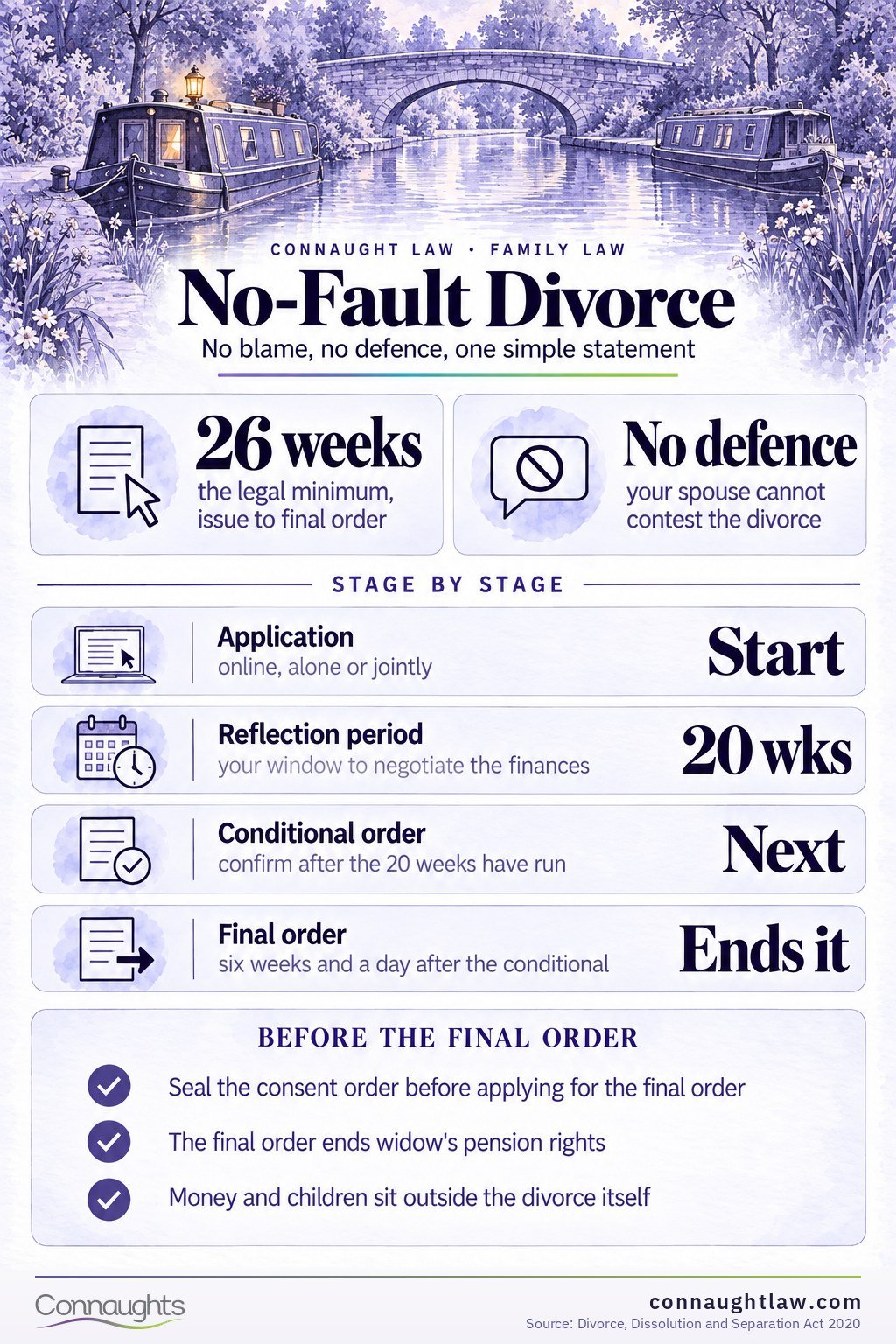
No-fault divorce UK law changed everything in April 2022: you no longer blame your spouse or prove wrongdoing to end a marriage. Under the Divorce, Dissolution and Separation Act 2020, one or both spouses simply state that the marriage has broken down irretrievably, and that statement cannot be contested. The process runs online, takes a minimum of around seven months because of built-in waiting periods, and costs a £628 court fee from 13 July 2026. This guide walks through the process step by step - eligibility, costs, realistic timelines, and why the divorce itself settles nothing about money or children.

Understanding No-Fault Divorce UK 2026
Before April 2022, every divorce needed a reason the law would accept: adultery, unreasonable behaviour, desertion, or years of separation. Couples who had simply grown apart were pushed into blame they did not feel, and a spouse could defend the petition and trap the other in the marriage - as happened in the case of Owens v Owens that catalysed reform.
The Divorce, Dissolution and Separation Act 2020 swept that away for England and Wales. Since 6 April 2022 the only ground is irretrievable breakdown, evidenced by a statement no court will go behind. The same reform renamed the decree nisi and decree absolute as the conditional order and final order, and allowed couples to apply jointly for the first time.
Eligibility rules are unchanged by the reform. You must have been married for at least one year before applying, and the courts of England and Wales must have jurisdiction - typically because one or both spouses are habitually resident here, or domiciled here. Marriages celebrated abroad qualify provided they were legally valid where they took place, with a certified translation of the certificate where needed.

What Is No-Fault Divorce? The 2022 Reform Explained
No-fault divorce means neither spouse accuses the other of anything. The application states that the marriage has broken down irretrievably; the law treats that statement as conclusive. The five old facts - including unreasonable behaviour and the two- and five-year separation routes - were abolished for applications made from 6 April 2022.
The change is more than cosmetic. Under the old law, unreasonable-behaviour particulars poisoned negotiations before they began - the first formal document in the case was a list of accusations. Removing them measurably reduced conflict at the start of proceedings, which matters because the divorce is usually the easiest part of separating: the same couple still has to agree money and children.
Defending a divorce is no longer possible except on narrow technical grounds: the court lacks jurisdiction, the marriage was never valid, or it has already ended. A spouse who ignores the papers cannot stall the process indefinitely either - deemed service, bailiff service and alternative service orders deal with a spouse who does not respond.
Sole and Joint Applications Under No-Fault Divorce UK Rules
Couples can now apply together as joint applicants, which sets a cooperative tone for the negotiations that actually matter - money and children. A joint application can be switched to a sole one if the other applicant stops engaging, but a sole application cannot become joint. Civil partnership dissolution follows the same no-fault framework with the same timeline.
Deciding whether to start at all deserves proper thought: separation, judicial separation and simply waiting all have different legal consequences. Our guide on whether divorce is right for you works through the alternatives honestly.
Judicial separation also survives as a rarely used alternative: it gives formal recognition of separation and access to most financial orders without ending the marriage - relevant to couples with religious objections to divorce, or where preserving pension survivor rights matters more than remarrying. Since 2022 it too operates on a no-fault basis.
The No-Fault Divorce Process UK: Step by Step
Nearly all applications are made online through the gov.uk divorce service, which has largely replaced paper D8 forms. You need your original or certified marriage certificate, your spouse’s current address, and the £628 court fee - or a fee remission via Help with Fees if you are on a low income or benefits.
After the application is issued, the respondent (in a sole application) is served and returns an acknowledgment within 14 days. Then comes the deliberate pause: 20 weeks must pass from issue before you can confirm you want to continue and apply for the conditional order - the reflection period Parliament built in to make divorce considered, not casual.
Service is faster than it used to be: the court emails the divorce papers to the respondent where an email address is provided, with a postal notice as backup. If your spouse cannot be found, the court can order service by alternative methods after searches - or ultimately dispense with service - so an untraceable spouse delays but never prevents a divorce.
Costs orders within the divorce itself are now rare. Under the fault system a petitioner could ask the respondent to pay the costs of the divorce; with no one to blame, each party normally bears their own, and joint applicants agree the split up front. Contested costs arguments survive mainly where a respondent’s conduct of the proceedings - not of the marriage - causes unnecessary expense.
Once a legal advisor or judge grants the conditional order, a further 6 weeks and 1 day must pass before you can apply for the final order, which legally ends the marriage. If the applicant does not apply, the other spouse can - after a further three months. The old terminology still circulates, so our comparison of decree nisi and decree absolute against the new orders translates anything you see elsewhere.
When to Delay the Final Order
Applying for the final order before finances are settled can be a costly mistake, particularly around pensions: a spouse loses widow or widower benefits the moment the marriage ends, and remarriage before making financial claims can bar them entirely - the remarriage trap. Specialist advice on sequencing typically protects far more than it costs.
Couples in religious marriages should sequence one more step. For Jewish couples, section 10A of the Matrimonial Causes Act 1973 lets the court refuse the final order until a get is given; Muslim couples often need a separate religious divorce alongside the civil process, and the civil final order does not dissolve a nikah in the eyes of the community. Handling both tracks together avoids a spouse being religiously married but civilly divorced.
Practical preparation makes the process feel administrative rather than adversarial: gather the marriage certificate, agree who applies or whether to apply jointly, decide how the fee is funded, list assets and debts for early disclosure, and open a channel - directly or through mediators - about interim arrangements for the home, bills and children while the orders progress. Our step-by-step guide to the practical steps to divorce expands each of these.
No-Fault Divorce Costs UK 2026
The court fee is £628 from 13 July 2026, payable on the application - there is no separate fee for the conditional or final order. In a joint application the fee is usually shared by agreement; in a sole application the applicant pays. Help with Fees can reduce the fee to nothing for eligible applicants.
Watch for the small procedural fees that follow mistakes: amending an application or making an interim application within the divorce costs £195 (D11/C2 rate from 13 July 2026), and a fresh application means a fresh £628. Getting names, dates and the marriage certificate details exactly right first time is cheap discipline.
Total cost therefore depends mostly on agreement. A cooperative couple with a consent order can complete everything for the court fees plus modest fixed legal fees. Costs escalate in proportion to conflict - contested financial proceedings, not the divorce, are what produce five-figure bills, which is why investing early in mediation and disclosure is consistently the best money spent.
Legal aid deserves a brief word: it is not available for the divorce or ordinary financial proceedings, but remains available for mediation on low incomes and for court proceedings where there is evidence of domestic abuse - one of several reasons why disclosure of abuse to your solicitor at the first meeting changes the advice materially.
Legal costs sit on top and vary with what you need: many firms offer fixed fees for managing an uncontested divorce application, while advice on finances is priced separately - sensibly so, since that is where the real stakes are. Where hourly billing applies, the published solicitors’ guideline hourly rates show the realistic market range by region and seniority.
Related Court Fees After the Divorce Application
Budget for the orders that actually resolve your affairs: a financial consent order costs £62 to lodge, a contested financial remedy application (Form A) £321, and a child arrangements application (C100) £270 - all at the rates applying from 13 July 2026. Mediation, supported by the £500 government voucher for cases involving children, is usually the cheapest route to agreement.
Free, reliable orientation is available too: the divorce pages maintained by Citizens Advice cover eligibility, Help with Fees and the online service, and are a sound reference to share with a spouse who wants reassurance the process is being run fairly.
Emotional support sits alongside the legal track. Separation consistently ranks among the most stressful life events, and the couples who navigate it best tend to separate the practical decisions from the grief - using counselling or support services for the second, so the first can be handled on its merits rather than in anger.
No-Fault Divorce Timeline UK: How Long It Really Takes
The statutory minimum is roughly 26 weeks: 20 weeks from issue to conditional order eligibility, then 6 weeks and 1 day to final order eligibility. Add court processing at each stage and the practical floor is around seven months for the most efficient cases.
Real-world divorces usually take longer - commonly around a year or more according to Family Court statistics - because couples sensibly wait to resolve finances before applying for the final order, service takes time, and busy courts add queues at the conditional order stage. The timeline is driven far more by financial negotiations than by the divorce mechanics themselves.
The 20-week period is not dead time. Well-run cases use it to exchange financial disclosure, obtain pension valuations - which routinely take six to twelve weeks to arrive - attend mediation, and negotiate the consent order so it is ready for approval as soon as the conditional order is granted. Couples who start the financial work at issue rarely feel the statutory waits at all.
Financial Settlements and No-Fault Divorce
The divorce order ends the marriage - and does nothing else. Financial claims between spouses survive the final order unless they are dismissed by a court order, which is why a financial order matters even in amicable cases: a clean break prevents claims resurfacing years later, as the ex-wife’s claim in Wyatt v Vince showed two decades after separation.
Removing fault changed the atmosphere of financial negotiations, not the law dividing assets. Conduct was almost never relevant to money before 2022 and remains almost never relevant now; needs, sharing and compensation still govern outcomes, with children’s housing needs first. Blame about the marriage ending buys nothing in the settlement.
The final order also has quiet legal side-effects worth knowing. Any existing will remains valid, but gifts to the former spouse and their appointment as executor take effect as if they had died - so wills need reviewing at final order. Joint tenancies, pension nominations and life policies written for the ex-spouse all deserve the same audit.
Children Arrangements Sit Outside the Divorce Too
The divorce application contains no children section. Arrangements for where children live and how time is shared are agreed between parents or resolved separately under the Children Act - the practical steps are covered in our guide to child living arrangements. Child maintenance runs through the CMS or private agreement, independent of the divorce.
A divorce granted in England and Wales is recognised across most of the world, though couples with international lives should confirm recognition where they hold assets or may remarry. Conversely, overseas divorces are usually recognised here if valid where obtained - a point that decides whether a couple needs an English divorce at all.
Where real international elements exist - homes or pensions abroad, a foreign marriage, a spouse living overseas - take advice before applying anywhere. Which country’s court deals with the divorce can change the financial outcome dramatically, and the first properly seised jurisdiction often shapes everything that follows.
For most couples, though, the reformed process delivers exactly what Parliament intended: a divorce that is administrative rather than adversarial, conducted online at a predictable cost, with the couple’s energy directed at the decisions that genuinely shape their futures - the home, the pensions, and the children’s stability.
Frequently Asked Questions
How much does a no-fault divorce cost in the UK in 2026?
The court fee is £628 from 13 July 2026, with Help with Fees remission available. Fixed-fee legal management of the application is widely available; advice on financial settlement is priced separately. A financial consent order adds a £62 court fee.
How long does no-fault divorce take in 2026?
The legal minimum is about 26 weeks - a 20-week reflection period plus 6 weeks and 1 day between orders - so around seven months with processing time. Most divorces take nearer a year because finances are sensibly settled before the final order.
Can my spouse refuse or contest the divorce?
No. Since April 2022 the irretrievable-breakdown statement cannot be disputed. Only jurisdiction or the validity of the marriage can be challenged. A non-engaging spouse is dealt with through deemed, bailiff or alternative service rather than by the divorce failing.
Do we both have to agree to divorce?
No. Either spouse can apply alone; agreement makes a joint application possible but is not required. A joint application can later convert to sole if one applicant stops cooperating, so starting jointly carries no real risk of being stuck.
What the application actually asks is deliberately simple: the parties’ details, the marriage certificate details, confirmation of jurisdiction, and the statement of irretrievable breakdown. There is no box for reasons, no narrative of the marriage, and nothing the other spouse can dispute - a one-page truth replacing what used to be pages of drafted grievance.
What is the difference between conditional order and final order?
The conditional order (formerly decree nisi) confirms you are entitled to divorce; the final order (formerly decree absolute) legally ends the marriage 6 weeks and 1 day later on application. The gap exists mainly so financial orders can be made before the marriage ends.
Should I wait to apply for the final order until finances are agreed?
Usually yes. Ending the marriage first can forfeit pension survivor benefits and complicate claims if either spouse remarries. Most solicitors sequence the consent order for approval at the conditional order stage, then apply for the final order.
Do I need a solicitor for a no-fault divorce?
The application itself is designed for litigants in person and many complete it online without help. Legal advice earns its keep on the financial side - pension sharing, the consent order, and sequencing the final order - where mistakes are expensive and often irreversible.
Does no-fault divorce apply to civil partnerships?
Yes. Civil partnership dissolution follows the same framework: an uncontestable breakdown statement, the 20-week and 6-week waiting periods, conditional and final orders, and the same £628 application fee from 13 July 2026.
Clear pricing for managing your application from issue to final order.
Financial orders and pension advice sequenced so the divorce never costs you the settlement.
Practical arrangements advice that keeps parents negotiating, not litigating.
For advice on divorce, financial settlement or the timing decisions that matter, contact the family law team at Connaught Law for a confidential consultation.