
A spouse who ignores divorce papers cannot stop your divorce — they can only slow it. The no-fault process has no defence to the breakdown itself, and the court has a graduated set of service tools for every kind of silence: re-service, process servers, deemed service, and dispensing with service altogether. This guide explains the acknowledgement stage, each option in order of cost, and how to keep a non-responder from adding months.
On This Page

Silence Cannot Stop a No-Fault Divorce
Under the no-fault regime your spouse has nothing to contest: the breakdown statement is conclusive, and the only thing their silence affects is proof of service. Once the court is satisfied they received — or could not receive — the papers, the divorce proceeds without them, on the standard timetable.
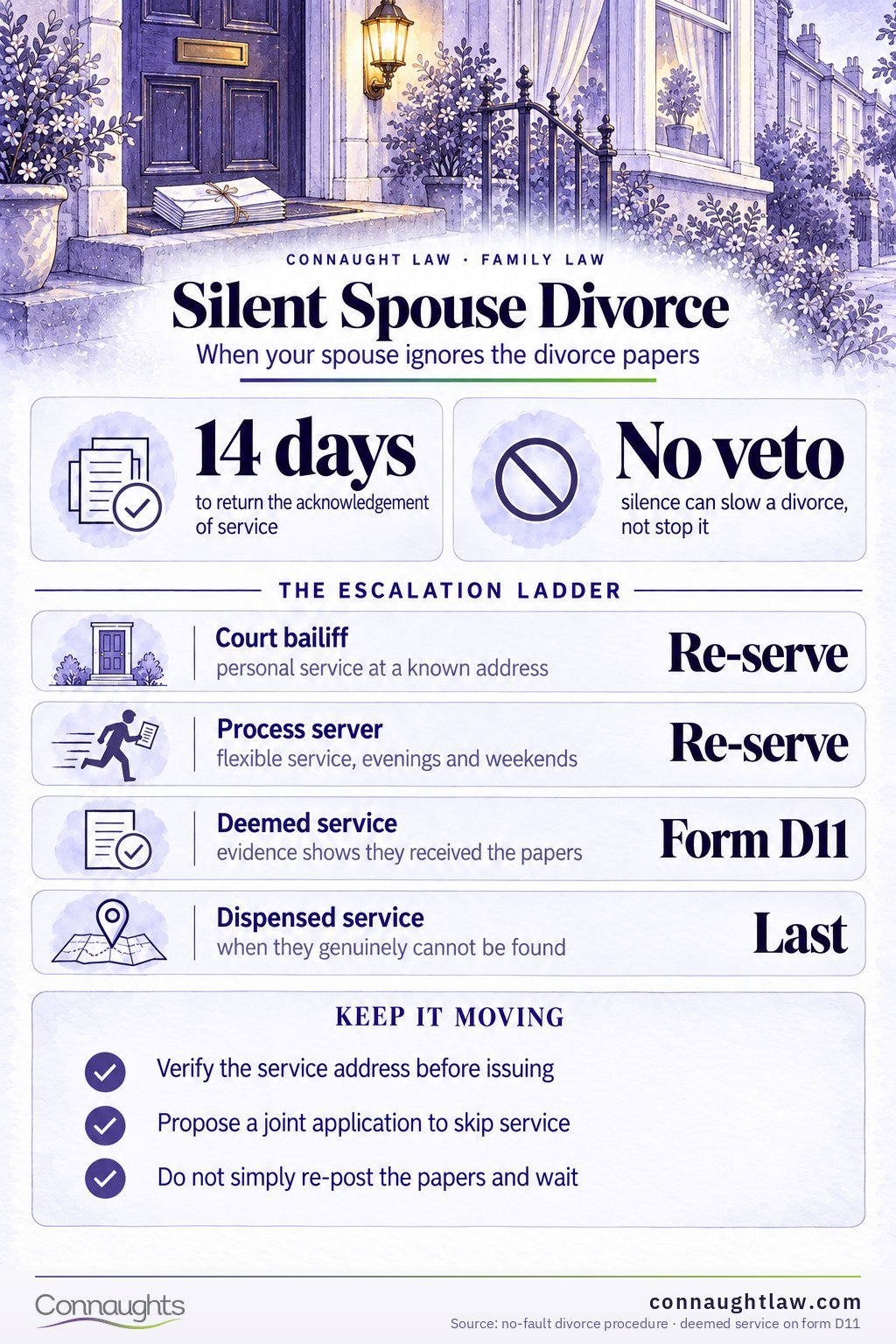
If your spouse does not return the acknowledgement of service within 14 days, the escalation runs: re-service by court bailiff or a private process server; a deemed service application where evidence shows they received the papers; and dispensed service where they genuinely cannot be found. Each step has a modest fee — none lets your spouse veto the divorce.
The Acknowledgement of Service Stage
On a sole application the court serves your spouse, who should respond within 14 days confirming receipt. The acknowledgement is administrative — it does not signal agreement, and disputing the divorce is only possible on jurisdiction or validity grounds. No acknowledgement means the court cannot yet be sure the papers arrived, which is the sole problem the next steps solve.
Why Spouses Go Silent
The reasons range from the emotional (denial, punishment, control) through the practical (moved address, papers unseen, illness) to the strategic but futile (a belief that stalling preserves the marriage or improves the financial outcome — it does neither). Diagnosing which you face shapes the response: a moved spouse needs tracing; a punishing one needs a process server and momentum.
The Options, in Escalation Order
Court Bailiff Re-Service
For a spouse at a known address, the court bailiff can personally serve the papers and certify service. It is inexpensive and effective for straightforward avoidance, though bailiff availability can add weeks in busy courts.
Private Process Server
A professional process server is the fast option: they attempt service flexibly — evenings, weekends, workplaces — trace basic address changes, and provide a statement of service the court accepts. For evasive respondents this is usually the best value step on the ladder.
Deemed Service
Where the evidence shows your spouse actually received the papers — a text acknowledging them, a reply email, a solicitor's letter referencing the application — you can apply (on form D11) for the court to deem service to have happened. It converts proof of knowledge into proof of service without another doorstep attempt.
Dispensed Service
Where your spouse genuinely cannot be found after real efforts — tracing agents, last-known addresses, family enquiries, employer checks — the court can dispense with service entirely and let the divorce proceed. It is the last resort, and the application succeeds on the quality of your search evidence.
Costs and Timelines Compared
The Ladder Priced
Court fees for service applications are modest — the D11 application fee sits far below the £628 divorce fee itself, and bailiff or process-server charges are their own line items; the EX50 family court fees list carries the current figures. The real cost of a non-responder is time: each escalation adds weeks, which is why moving briskly up the ladder beats repeating a failed method.
Choosing the Right Step
Known address plus avoidance points to a process server; documented knowledge of the application points to deemed service; a genuinely missing spouse points to tracing then dispensed service. Skipping diagnosis and simply re-posting the papers is the one reliably wrong answer.
What It Does to the Timeline
The statutory clock — 20 weeks to conditional order, six weeks and a day to final order — runs from issue, so early service problems overlap the reflection period rather than extending it if handled promptly. Handled slowly, a silent spouse can add months. The no-fault process guide sets out the full timetable the service fix plugs back into.
Preventing the Delay in the First Place
Set Expectations Before Filing
Where any channel remains open, telling your spouse the application is coming — directly, through a mediator or via solicitors — markedly improves response rates. A joint application removes the service stage entirely and is worth proposing even to a reluctant spouse; agreement to a joint application is not agreement to anything else.
Get the Address Right First Time
Verify the service address before issuing — electoral roll, workplace, family confirmation — and consider email service details the court can use. If the address is already doubtful at filing, our divorce team will budget for a process server from day one rather than discovering the problem six weeks in. Where the silence extends to money as well, our financial orders guide covers proceeding without cooperation there too; for wider support, Citizens Advice maintains a plain-English overview.
Frequently askedQuestions about a spouse who will not respond
What happens if my spouse doesn't respond to divorce papers?
The divorce still proceeds — you escalate through re-service, a process server, deemed service or dispensed service until the court is satisfied about service. Silence cannot block a no-fault divorce; it only delays it, and prompt escalation keeps the delay to weeks.
Can my spouse refuse to divorce me?
No. Since April 2022 the irretrievable-breakdown statement is conclusive and there is no defence to it — only jurisdiction or the marriage's validity can be disputed. A spouse who will not participate is a service problem, not a legal obstacle.
What is deemed service?
A court order treating the papers as served because the evidence shows your spouse actually received them — a message referring to the application, a reply, a solicitor's acknowledgement. You apply on form D11 with that evidence; no further delivery attempt is needed.
What if I cannot find my spouse at all?
Evidence a genuine search — tracing agents, last addresses, family, employer — then apply to dispense with service. If the court is satisfied your spouse cannot reasonably be found, the divorce proceeds without service. The application stands or falls on your search evidence.
Does a non-responding spouse make the divorce cost more?
Somewhat: process server charges and modest application fees sit on top of the £628 divorce fee. The larger cost is time. Diagnosing the silence early and choosing the right escalation step first usually keeps both within sensible bounds.
Is it better to be the applicant or the respondent?
Legally it makes little difference under no-fault divorce — there is no blame either way and costs orders are rare. The applicant controls the timetable, which matters mainly where a respondent is slow; joint applications dissolve the distinction entirely.
Tell us what you know about your spouse's whereabouts and any contact since filing. We will pick the right escalation step and get your divorce moving again this week.
Get Expert Advice