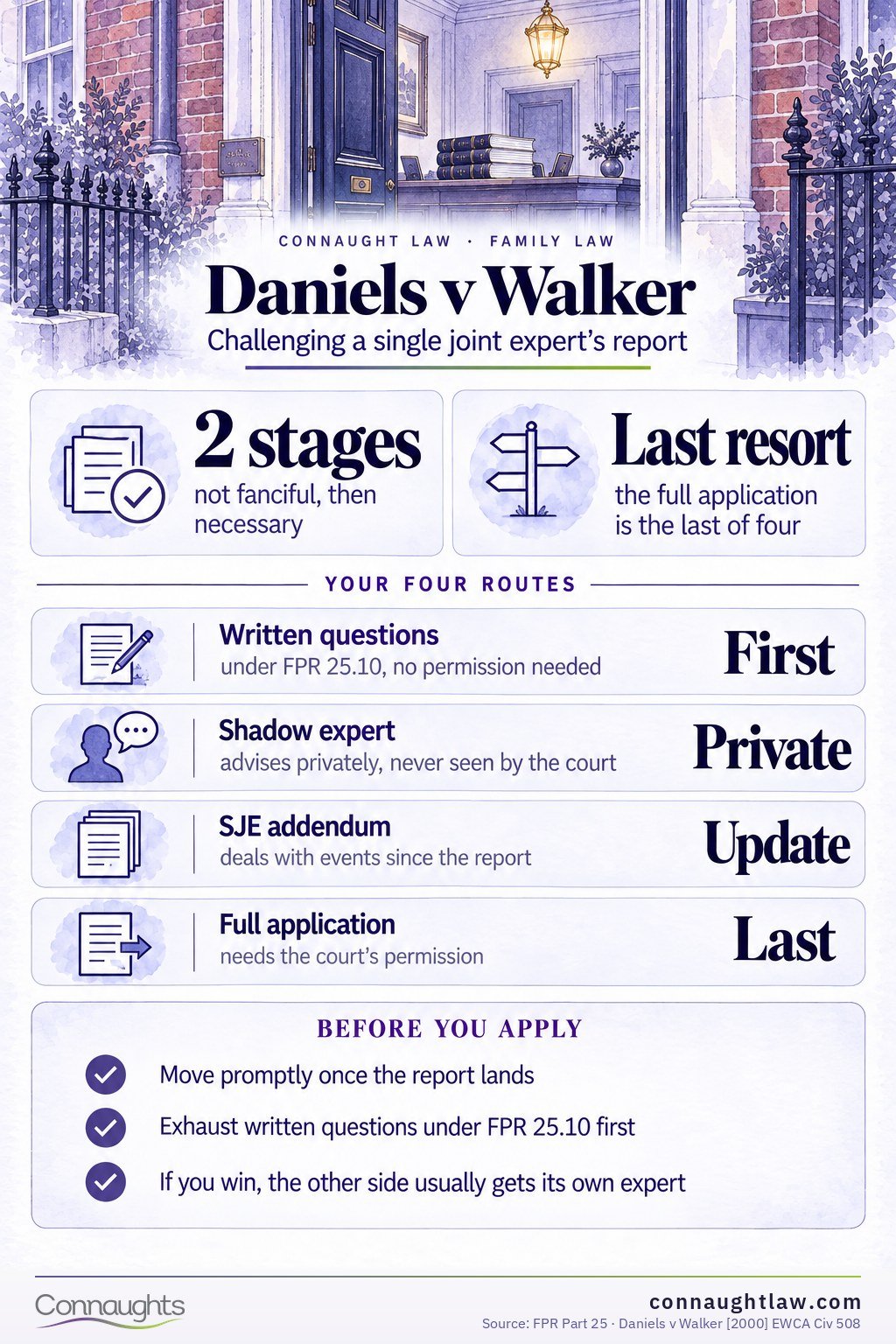
Understanding the Daniels v Walker Application UK 2026 in Financial Remedy Proceedings

Financial remedy proceedings following divorce frequently depend on expert valuations of property, businesses, pensions, and other complex assets. When both parties jointly instruct a single expert and the resulting report produces figures that fundamentally undervalue or overvalue the matrimonial estate, the consequences for settlement outcomes can be severe. The Daniels v Walker application UK 2026 provides a structured legal mechanism for challenging single joint expert evidence where legitimate grounds exist, subject to the court's discretion and the overriding objective of dealing with cases justly.

The July 2025 judgment in BY v GC [2025] EWFC 226 has reinforced the modern approach to these applications, confirming that meeting the "not fanciful" threshold alone is insufficient — applicants must additionally demonstrate that alternative expert evidence is necessary to resolve proceedings, not merely desirable. This analysis examines the current legal framework, practical considerations, and strategic approaches to Daniels v Walker applications in financial remedy cases, incorporating the latest case law developments and procedural requirements under FPR Part 25.

◆ Definition Single Joint Expert (SJE): An independent expert jointly instructed by both parties in financial remedy proceedings to provide valuation evidence on property, businesses, pensions, or other assets. FPR Rule 25.11 and Practice Direction 25D require SJE instruction "wherever possible," with the expert's overriding duty owed to the court rather than either party.
◆ Definition Daniels v Walker Application: A formal application under FPR Part 25 seeking court permission to adduce alternative expert evidence challenging a single joint expert's report. Named after Daniels v Walker [2000] 1 WLR 1382, in which Lord Woolf MR established that an SJE report is merely the "first step" and dissatisfied parties may seek further evidence for reasons that are "not fanciful."
⚠ Critical Timing Consideration: Daniels v Walker applications made close to final hearing dates face significantly greater judicial resistance. In GA v EL [2023] EWFC 187, Peel J refused an application made just three weeks before trial. In BY v GC [2025] EWFC 226, the court noted that granting permission would make adjournment "all but inevitable." Applications should be made promptly following receipt of the SJE report, ideally before or immediately after the FDR appointment.

What Is a Daniels v Walker Application in Financial Remedy Cases?

✦ Quick Answer A Daniels v Walker application UK 2026 is a formal request for court permission to introduce alternative expert evidence when a party has legitimate grounds for challenging the single joint expert's report. The court applies a two-stage test: first, whether the reasons are "not fanciful," and second, whether the evidence is "necessary" to resolve proceedings.

The legal framework originates from the Court of Appeal decision in Daniels v Walker [2000] EWCA Civ 508, where Lord Woolf MR established that agreeing to a single joint expert does not permanently bar a party from obtaining further expert evidence. The SJE report is properly characterised as the "first step" in expert evidence gathering, not the final word. Where a party has genuine, arguable concerns about methodology, factual assumptions, or conclusions, the court retains discretion to permit additional evidence.

In financial remedy proceedings, these applications most commonly arise in disputes involving business valuations, property assessments, pension sharing calculations, and forensic accounting evidence where the high-value matrimonial assets at stake justify forensic scrutiny of expert methodology. The procedural gateway is FPR Rule 25.4(3), which requires that any expert evidence put before the court must be "necessary to assist the court to resolve the proceedings." Peel J in GA v EL [2023] EWFC 187 clarified that "necessary" carries the connotation of the imperative — what is demanded rather than what is merely optional, reasonable, or desirable.

The Two-Stage Legal Test for a Daniels v Walker Application UK 2026

The modern test, refined through GA v EL and confirmed in BY v GC [2025] EWFC 226, operates in two stages. First, the applicant must demonstrate reasons for challenging the SJE report that are "not fanciful" — this means genuine, arguable concerns rather than mere disappointment with unfavourable figures or tactical manoeuvring. Second, even where non-fanciful reasons exist, the court must separately determine whether additional expert evidence is necessary applying the non-exhaustive Cosgrove factors and the overriding objective. This two-stage structure means that satisfying the "not fanciful" threshold is a necessary but not sufficient condition for success.

When Can You Challenge a Single Joint Expert Report?

✦ Quick Answer Courts assess Daniels v Walker applications against nine non-exhaustive factors from Cosgrove v Pattison [2001] CPLR 177, with "overall justice to the parties" as the overarching consideration. Timing, the amount at stake, proportionality, and the impact on the trial timetable are among the most influential factors in practice.

The Cosgrove factors, endorsed by Peel J in GA v EL [2023] EWFC 187 and applied by Nicholas Allen KC in BY v GC [2025] EWFC 226, provide the analytical framework courts use when exercising their discretion. Understanding these factors is essential for assessing whether a Daniels v Walker application UK 2026 has realistic prospects of success before incurring the costs of instructing an alternative expert.

The Cosgrove Factors Applied to Financial Remedy Expert Evidence

Cosgrove Factor Practical Application in Financial Remedy Cases
Nature of the issues Technical valuation disputes (business methodology, discount rates) carry more weight than disagreements over subjective judgment calls
Number of issues between parties Single-issue cases (e.g., business valuation only) may justify focused challenge; multi-issue cases risk disproportionate satellite litigation
Reason the new expert is wanted Methodological criticism supported by a "full and reasoned" alternative report succeeds more readily than generalised dissatisfaction
Amount at stake Larger valuation discrepancies relative to the total estate strengthen the application; a £7m difference on £27m assets (BY v GC) was still refused on other grounds
Effect on trial conduct Granting permission triggers equality of arms — the other party will inevitably seek their own expert, potentially leading to three experts and trial adjournment
Delay in making the application Applications made promptly after the SJE report succeed more readily; waiting until after pFDR may be reasonable if settlement was being explored (BY v GC)
Delay the new expert will cause New expert instruction from a "cold start" plus experts' meeting plus joint statement preparation creates cumulative delay that courts treat seriously
Special features Unilateral SJE-party communication, new information unavailable to SJE, or demonstrable errors in methodology strengthen applications
Overall justice to the parties The overarching consideration — courts weigh all factors holistically; this is "highly fact sensitive" (Peel J, GA v EL)

BY v GC [2025] EWFC 226: The Latest Judicial Guidance

The July 2025 decision in BY v GC [2025] EWFC 226 provides critical practical guidance for anyone considering a Daniels v Walker application UK 2026. In that case, PwC was jointly instructed as SJE to value 23 business interests across a substantial matrimonial estate. Following the private FDR, the husband instructed FRP Advisory, whose report valued two key companies at £7.1–£7.3 million less than PwC's figures — a significant discrepancy. Nicholas Allen KC accepted that the husband's reasons were "not fanciful" and that FRP's report was "full and reasoned," yet still refused the application because the alternative evidence was not "necessary" to resolve proceedings.

The judgment emphasised three critical principles. First, business valuations in financial remedy cases serve as a "broad, or even very broad, guide" to assist fairness — not to achieve mathematical accounting accuracy, which is "invariably no more than a chimera." Second, granting permission inevitably triggers equality of arms requirements, meaning the other party would need their own expert instruction from a "cold start," making trial adjournment "all but inevitable." Third, a proportionate alternative existed: directing the new management accounts be sent to PwC for an updated view, avoiding the need for a full second expert while still ensuring the court had a complete picture. This proportionate middle-ground approach represents a significant development for practitioners navigating contested divorce proceedings.

What Are the Options for Challenging Expert Evidence?

✦ Quick Answer Parties dissatisfied with an SJE report have four main options: submitting FPR 25.10 written questions to the SJE, instructing a shadow expert to assist with cross-examination, applying for the SJE to reconsider with updated information, or making a full Daniels v Walker application for permission to adduce alternative expert evidence. Each carries different cost, risk, and permission requirements.

Not every challenge to expert evidence requires a formal Daniels v Walker application UK 2026. Understanding the full range of procedural options allows parties to choose the most proportionate response, which courts increasingly expect. The spectrum runs from low-cost clarification mechanisms through to full replacement of expert evidence, with proportionality assessed at every stage. Where property ownership structures or complex business holdings are in dispute, the choice of approach can significantly impact both costs and outcomes.

Comparison of Expert Evidence Challenge Options

Option Court Permission Typical Cost Best Used When
FPR 25.10 Written Questions Not required £500–£2,000 Clarifying methodology, requesting consideration of additional data, addressing factual errors
Shadow Expert Not required £5,000–£20,000+ Sharpening cross-examination questions, drafting SJE instruction letters, preparing FPR 25.10 questions
SJE Addendum/Update May require direction £2,000–£10,000 New information has emerged since original report (as directed in BY v GC [2025])
Full Daniels v Walker Application Required (FPR 25.4) £15,000–£50,000+ Fundamental methodological disagreement, demonstrable SJE errors, significant valuation discrepancy affecting outcome

Peel J confirmed in BR v BR [2024] EWFC 11 that shadow experts can legitimately assist with drafting the joint letter of instruction, raising FPR 25.10 questions, and sharpening questions for cross-examination — all without requiring court permission. The shadow expert's report cannot be put before the court as evidence, but the insights gained can be deployed through questioning the SJE. Where the fundamental concern relates to property valuations or pension calculations rather than complex business methodology, FPR 25.10 written questions may resolve the issue without the cost and risk of a formal application.

What Are the Costs and Risks of a Daniels v Walker Application?

✦ Quick Answer Total costs typically range from £15,000 to £50,000 or more, including the alternative expert's report (often needed before the application is made), hearing costs, and potential adverse costs consequences if unsuccessful. The primary risk is the "cart before the horse" problem — instructing an expert whose evidence the court may not permit.

The financial exposure extends well beyond the application hearing itself. A party typically needs to obtain at least a compelling outline summary of the alternative expert's opinion before the application is made — as noted by practitioners, it is "inconceivable that a court may grant permission for a second expert without their evidence before the court." This creates the inherent risk of incurring significant expert instruction costs for evidence that may ultimately be excluded. Understanding these cost implications is essential when evaluating whether to pursue a Daniels v Walker application UK 2026 alongside the broader legal costs of financial remedy proceedings.

Cost Components of a Daniels v Walker Application

  • Alternative Expert Report: £5,000–£30,000+ depending on complexity, with business valuations at the higher end and property valuations typically lower
  • Application Hearing Costs: £3,000–£10,000 including counsel's fees, solicitor preparation, position statement drafting, and Form D11 filing
  • Equality of Arms Consequences: If successful, the other party will likely instruct their own expert (£5,000–£30,000+), followed by experts' meeting and joint statement preparation
  • Trial Adjournment Risk: Delay costs including extended hearing time, updated evidence requirements, and prolonged uncertainty affecting both parties and any child arrangement considerations
  • Adverse Costs Risk: Courts may reserve costs to the final hearing (as in BY v GC) or order immediate costs against an unsuccessful applicant, particularly where the application is deemed disproportionate or tactical

Courts are increasingly alert to Daniels v Walker applications being used as litigation tactics rather than genuine challenges to expert methodology. In the broader context of civil litigation principles, proportionality remains paramount — the cost of challenging expert evidence must bear a reasonable relationship to the amount at stake and the likely impact on the ultimate outcome.

How Does the Overriding Objective Apply to Expert Evidence Disputes?

✦ Quick Answer FPR Rule 1.1 requires courts to deal with cases justly, including ensuring proportionality, saving expense, and avoiding delay. In Daniels v Walker applications, the overriding objective operates as a counterweight to individual fairness — even where one party has legitimate concerns, the court must balance these against the overall conduct of proceedings and impact on all parties.

The overriding objective under the Family Procedure Rules requires courts to deal with every case justly, having regard to any welfare issues involved. Applied to a Daniels v Walker application UK 2026, this means the court must consider not only the applicant's legitimate concerns about expert evidence but also the impact on the other party, the court timetable, and the proportionate use of court resources.

BY v GC [2025] EWFC 226 demonstrates this balancing exercise in practice. Despite accepting the applicant's concerns as "not fanciful" and acknowledging a £7.1–£7.3 million valuation discrepancy, the court concluded that permitting a full second expert was disproportionate given the proximity to trial and the availability of a less disruptive alternative. The judgment cited Moylan J's observation in H v H [2008] 2 FLR 2092 that the purpose of valuations in financial remedy proceedings "is to assist the court in testing the fairness of the proposed outcome" — not to achieve perfect mathematical accuracy. Valuations remain a "broad, or even very broad, guide" within the court's assessment of fairness under Section 25 of the Matrimonial Causes Act 1973.

For parties considering applications in cases involving cohabitation agreements or clean break settlements, the court's approach confirms that the goal is overall fairness rather than forensic precision. Expert evidence serves the court's broader assessment of what constitutes a just outcome — it does not, by itself, determine the result.

☑ Evidence Checklist Before Making a Daniels v Walker Application
  • ✓ Identified specific methodological errors or flawed assumptions in the SJE report — not merely unfavourable conclusions
  • ✓ Obtained at least an outline report from an alternative expert demonstrating a substantive and reasoned critique
  • ✓ Exhausted lower-cost options first — FPR 25.10 written questions and shadow expert analysis
  • ✓ Assessed timing — sufficient time before final hearing for the other party to instruct their own expert and for experts to meet
  • ✓ Calculated cost proportionality — the valuation difference must justify the total costs of the application and its consequences
  • ✓ Prepared Form D11 application with draft order setting out proposed directions including expert timetable
  • ✓ Considered whether directing updated information to the existing SJE (the BY v GC approach) might be a proportionate alternative
  • ✓ Assessed whether the discrepancy is material to the Section 25 outcome — remembering that valuations are a "broad guide" to fairness
⊕ Key Takeaways
  • → The "not fanciful" threshold is necessary but not sufficient — courts separately assess whether further evidence is "necessary" under FPR 25.4(3)
  • → BY v GC [2025] confirms that even a £7m+ valuation discrepancy may not justify a full second expert where proportionate alternatives exist
  • → Shadow experts and FPR 25.10 questions offer lower-cost, lower-risk alternatives that do not require court permission
  • → Timing is critical — applications made close to final hearing face significantly greater resistance
  • → The court's approach focuses on overall fairness, not mathematical precision — valuations are a "broad guide" within the Section 25 exercise

Frequently Asked Questions

What is the legal test for a Daniels v Walker application UK 2026?

The court applies a two-stage test under FPR Rule 25.4(3). First, the applicant must demonstrate "not fanciful" reasons for challenging the SJE report — meaning genuine, arguable concerns about methodology or conclusions rather than mere dissatisfaction. Second, the court must be satisfied that alternative expert evidence is "necessary" to resolve the proceedings, assessed against the Cosgrove factors and the overriding objective. As confirmed in BY v GC [2025] EWFC 226, meeting the first threshold does not automatically satisfy the second.

Can I instruct my own expert without court permission in financial remedy proceedings?

You can instruct a shadow expert without court permission to assist with drafting SJE instruction letters, preparing FPR 25.10 questions, and sharpening cross-examination — this was confirmed by Peel J in BR v BR [2024] EWFC 11. However, the shadow expert's report cannot be put before the court as evidence without permission under FPR 25.4. To formally adduce alternative expert evidence, a Daniels v Walker application is required.

How much does a Daniels v Walker application cost?

Total costs typically range from £15,000 to £50,000 or more. This includes the alternative expert's report (£5,000–£30,000+ depending on complexity), application hearing costs (£3,000–£10,000 including counsel), and consequential costs if successful — the other party will likely instruct their own expert, followed by experts' meetings and joint statement preparation. Courts may also make adverse costs orders against unsuccessful applicants.

What happened in BY v GC [2025] EWFC 226?

Nicholas Allen KC refused the husband's Daniels v Walker application despite accepting his reasons as "not fanciful" and acknowledging a £7.1–£7.3m valuation discrepancy. PwC had been instructed as SJE to value 23 business interests. Following the pFDR, the husband obtained an alternative report from FRP Advisory. The court concluded the evidence was not "necessary" because valuations serve as a "broad guide" to fairness, granting permission would trigger equality of arms and inevitable trial adjournment, and a proportionate alternative existed — directing updated management accounts to PwC for reconsideration.

When is the best time to make a Daniels v Walker application?

Applications should ideally be made promptly after receiving the SJE report, before or immediately after the FDR appointment. In GA v EL [2023], an application made three weeks before trial was refused partly on timing grounds. In BY v GC [2025], the court accepted that waiting until after the pFDR was reasonable since settlement negotiations should take priority. The key principle is that sufficient time must remain for the other party to respond, for potential experts' meetings, and for the court to accommodate any additional evidence without necessitating trial adjournment.

What does "not fanciful" mean in a Daniels v Walker application UK 2026?

The "not fanciful" threshold, established by Lord Woolf MR in Daniels v Walker [2000], requires the applicant to demonstrate genuine, arguable reasons for challenging the SJE's evidence. This means substantive methodological concerns, demonstrable factual errors, or credible evidence of flawed assumptions — not merely disappointment with unfavourable figures or a tactical desire to delay proceedings. In BY v GC [2025], the alternative expert's "full and reasoned" critique of SJE methodology satisfied this threshold, though the application was still refused on necessity grounds.

What is the difference between a shadow expert and a second expert?

A shadow expert is instructed privately by one party to advise behind the scenes — helping draft SJE instruction letters, formulate FPR 25.10 questions, and prepare cross-examination strategy. No court permission is required, and the shadow expert's report is not placed before the court. A second expert, obtained through a successful Daniels v Walker application, formally provides evidence to the court and can be cross-examined. The second expert route requires permission under FPR 25.4 and will typically trigger equality of arms, entitling the other party to their own expert.

Can a Daniels v Walker application be used for property valuations in financial remedy cases?

Yes, Daniels v Walker applications can be made in relation to any type of expert evidence in financial remedy proceedings, including property valuations, business valuations, pension sharing reports, and forensic accounting evidence. However, property valuation disputes may sometimes be resolved through less disruptive mechanisms such as FPR 25.10 written questions requesting the SJE to consider comparable evidence or updated market data, without the cost and delay of a full application. The proportionality of the challenge relative to the property value and overall estate remains a critical factor.

Expert Financial Remedy Legal Guidance

✓ Expert Evidence Strategy

Strategic assessment of SJE reports, shadow expert coordination, and Daniels v Walker application preparation ensuring optimal evidence positioning in financial remedy proceedings

✓ High-Value Financial Remedies

Comprehensive representation in complex asset division cases involving business valuations, property portfolios, pension sharing, and multi-jurisdictional estates requiring forensic expert coordination

✓ Procedural Compliance

FPR Part 25 compliance, Form D11 preparation, costs budgeting, and strategic timing of applications aligned with court timetables and the overriding objective

Daniels v Walker applications require precise legal strategy balancing legitimate challenges to expert evidence against proportionality, timing, and the court's expectation that parties exhaust less disruptive options first. The distinction between "not fanciful" reasons and "necessary" evidence — reinforced by BY v GC [2025] EWFC 226 — demands expert legal assessment before significant costs are incurred.

For expert guidance on Daniels v Walker application UK 2026 and financial remedy expert evidence disputes, contact Connaught Law's specialist family law team. Our experienced solicitors provide strategic advice on challenging single joint expert reports, coordinating shadow expert evidence, and achieving fair outcomes in complex financial remedy proceedings.