
If you are separating, someone has probably told you to try mediation — this guide is for deciding whether they are right. Mediation is cheaper, faster and more private than court, and since April 2024 the rules push hard towards it. It is also non-binding until a judge approves the deal, dependent on honest disclosure, and unsafe where there is abuse. Here is the honest balance, route by route.
On This Page

A route that works brilliantly — for the right couple
For couples who can still negotiate, mediation is faster, far cheaper and leaves the decisions with the people who must live with them. Its limits are just as real: nothing binds until a court approves it, it depends on honest disclosure, and it is unsuitable where there is abuse or serious imbalance.
Mediation is not a soft option, and it is not a universal one. Success depends less on the process than on the two people in it: motivation to settle, a roughly equal footing, and honest figures on the table. Where those exist, mediation outperforms court on almost every measure a separating couple cares about. Where they do not, it wastes months and hands a tactical advantage to the less honest party.
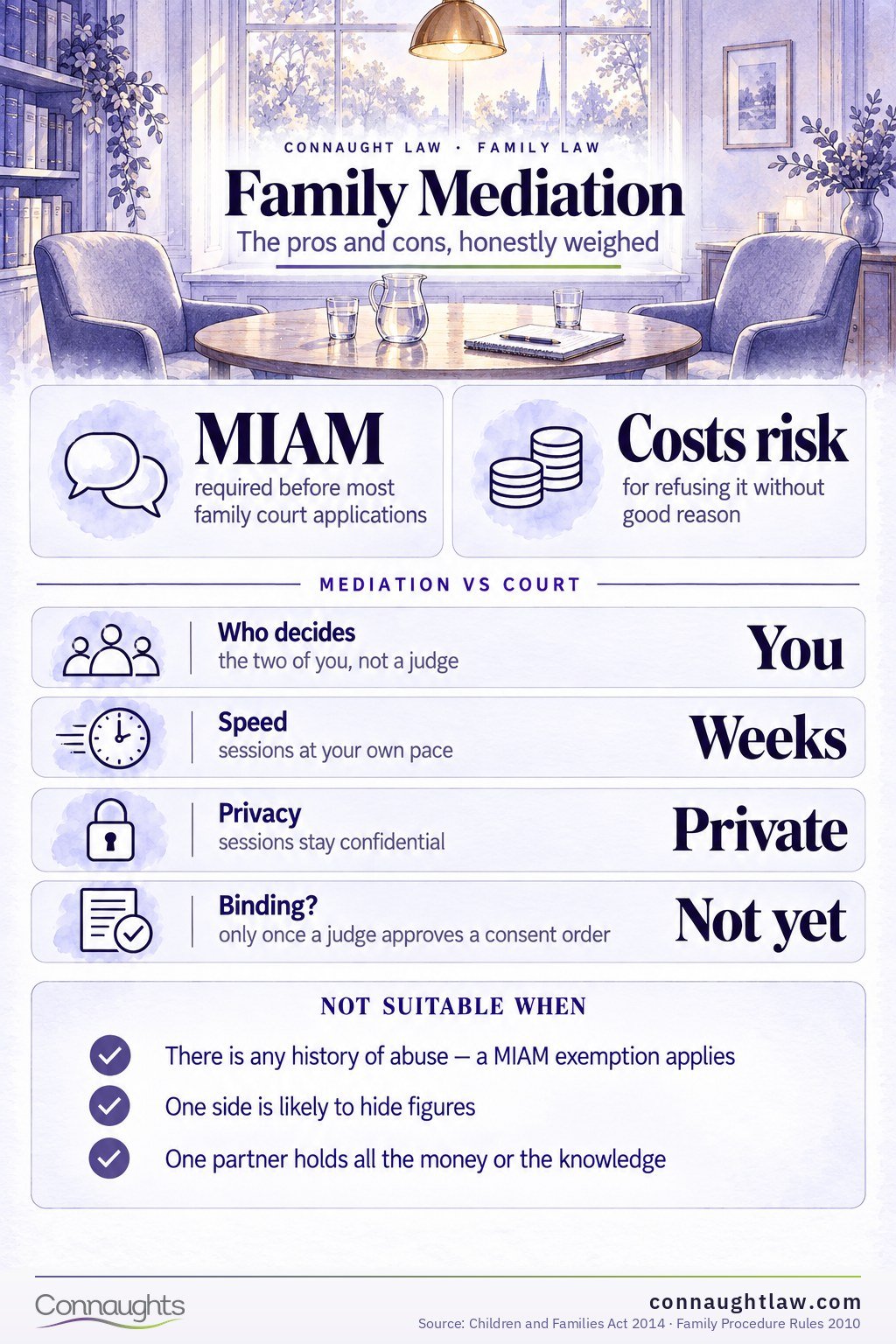
- Attending a MIAM before most family court applications is required by the Children and Families Act 2014, and the April 2024 rule changes tightened the exemptions.
- Non-court dispute resolution now expressly covers mediation, arbitration and collaborative law — and judges can pause proceedings for the parties to consider it.
- Refusing to engage without good reason risks a costs order under FPR 28.3(7): the court can make the refuser pay.
- In X v Y [2024] EWHC 538 (Fam) the High Court made clear that serious effort at non-court resolution is now expected, not optional.
The Advantages: Cost, Speed and Control
The financial case is structural. Mediation is typically charged at fixed session rates agreed in advance, there is no court application to issue, and the government's family mediation voucher — still open on gov.uk at the time of writing — contributes up to £500 towards child-arrangement cases without means-testing. Litigation builds cost through every hearing and every month of delay; the court service publishes solicitors' guideline hourly rates precisely because those costs need supervising.
Speed follows the same logic. A mediating couple books sessions at their own pace and can be finished in weeks; contested proceedings run to court timetables measured in months and sometimes years, with listing delays outside anyone's control. For parents, that difference is not administrative — children live the interim.
Cost and Control by Route
| Route | Who Decides | Court Fee to Start | Cost Profile |
|---|---|---|---|
| Family mediation | The two of you | None — no application | Lowest; fixed session rates, £500 voucher for child cases |
| Solicitor negotiation | You, with advice | None until an order is needed | Mid-range; driven by how much is contested |
| Children proceedings (C100) | The judge | £270 | Highest where contested, plus representation |
| Financial remedy (Form A) | The judge | £321 | Highest where contested, plus representation |
Beyond Money: Control and Co-Parenting
- You design the outcome: a judge imposes one from a limited menu, while mediation can build arrangements no court would order.
- Privacy: sessions are confidential, where proceedings generate records and, increasingly, published judgments.
- The relationship survives: parents who mediate keep talking — the skill co-parenting runs on for the next decade.
- Flexibility: mediated arrangements can be revisited by consent as children grow, without fresh proceedings.
The Disadvantages: Where Mediation Falls Short
The largest limitation is legal: nothing agreed in mediation binds anyone by itself. The mediator's Memorandum of Understanding records the deal; it becomes enforceable only when a solicitor converts it into a consent order and a judge approves it — the application carries a £62 court fee from 13 July 2026, plus drafting costs. Until that happens, either party can simply walk away from the terms.
Mediation also inherits the honesty of its participants. There is no disclosure order, no cross-examination and no judge testing the figures — a party minded to hide assets faces far less scrutiny than litigation would apply. And where one partner holds the confidence, the knowledge or the finances, a "voluntary" agreement can reproduce the very imbalance it was meant to resolve. Mediators screen for this; screening is not a cure.
Domestic Abuse: Safety Before Process
Where there is a history of abuse, mediation is not made safe by protocols — separate arrival times and video sessions manage logistics, not the dynamic that makes agreement unsafe. The MIAM exemption exists for exactly this: evidence such as police reports, protective orders or a healthcare referral takes you straight to court. No advantage of mediation outweighs safety. Our domestic abuse and non-molestation order pages explain the protective routes; a specialist solicitor, not a mediator, is the right first call.
Success Rates: What the Numbers Cannot Tell You
There is no official statistic measuring family mediation success across England and Wales, and the percentages quoted around the internet rarely arrive with a source attached — so this guide will not repeat them. What can be said honestly is that outcomes divide sharply by who walks in. The Family Mediation Council's professional framework exists because the variables below, far more than the process itself, decide whether you leave with an agreement, a partial agreement or a stalemate.
What Decides the Outcome
| Factor | Helps | Hinders |
|---|---|---|
| Motivation | Child-focused, willing to move | Blame-focused or tactical participation |
| Balance | Similar knowledge and confidence | Financial or informational asymmetry; any abuse history |
| Complexity | Clear assets, straightforward arrangements | Hidden assets, business valuations, cross-border elements |
| Disclosure | Full figures volunteered early | Reluctant, partial or suspect disclosure |
Financial Mediation and Disclosure
Mediation is not only for arrangements about children. Financial mediation covers the ground a court would — the house, pensions, savings, maintenance and debts — and the same full and frank disclosure duty applies. The Form E schedule is the usual way of meeting it; our Form E guide explains what it asks for and what happens when someone leaves something out.
Valuation disputes are the commonest sticking point — the family home above all, where our divorce valuation guide sets out the options — and cross-border assets add complexity a mediator cannot police; international divorce cases usually need advice running alongside. Whatever is agreed, the consent-order step described above applies to money with full force.
When Should You Use Family Mediation?
The suitability test is not about the size of the disagreement — substantial estates mediate successfully — but about the conditions underneath it. Mediation earns its place when both of you want a resolution more than a victory, neither is frightened of the other, the finances are honestly on the table, and any urgency is practical rather than protective. Child arrangements and routine financial division are its natural ground.
Situations Where Court Is the Right Call
Some cases belong in court from the outset: any history of abuse or intimidation; suspected hidden assets or fraud, where only disclosure orders have teeth; genuine urgency — a child about to be removed, an asset about to be dissipated — where injunctions rather than conversations protect; mental incapacity; and the party who simply will not engage. Choosing court in these situations is not a failure of reasonableness. It is what the court is for.
Legal Advice Alongside Mediation
Mediators are neutral: they manage the process and cannot advise either of you. Independent legal advice fills that gap — before mediation, to understand your entitlement on divorce; between sessions, to sanity-check proposals; and at the end, to convert the memorandum into a binding order. Used this way, a solicitor makes mediation safer without making it adversarial. Our family team prices this support as fixed stages rather than an open clock — see our fees page.
Frequently askedQuestions about cost, suitability and whether mediation binds you
What are the main advantages of family mediation?
Cost, speed, privacy and control. You pay for sessions rather than proceedings, finish at your own pace rather than the court's, keep your finances out of a courtroom, and design the arrangements yourselves. For child-arrangement cases, the government voucher contributes up to £500 without means-testing.
What are the disadvantages of family mediation?
Nothing binds until a judge approves a consent order, so a party can renege on the memorandum. There is no forced disclosure, which favours the less honest. And it is unsuitable where there is abuse, intimidation or serious imbalance — safety comes before every advantage.
How much does family mediation cost compared to court?
Mediation is charged at session rates with no court application needed; a MIAM costs around £120 per person where legal aid does not cover it. Court routes start at £270 for children applications or £321 for financial remedy from 13 July 2026 — before any legal costs at all.
When is family mediation unsuitable?
Where there is domestic abuse or intimidation; where assets may be hidden and only court disclosure powers will surface them; where urgent protective orders are needed; where a party lacks capacity; or where one side refuses to engage. The MIAM exemptions exist for these cases.
Do I need legal advice alongside family mediation?
It is strongly advisable. A mediator cannot advise you; a solicitor confirms your entitlement before you negotiate, checks proposals between sessions, and turns the final memorandum into an enforceable consent order. Advice used this way protects the agreement rather than undermining the process.
Are family mediation agreements legally binding?
Not by themselves. Mediation produces a Memorandum of Understanding — a record, not an order. It binds only when solicitors convert it into a consent order and a judge approves it; until then compliance rests on good faith. For finances especially, complete that step.
Tell us what you need to resolve and whether you can sit in a room with your ex. We will tell you honestly whether mediation fits or court protects you better.
Get Expert Advice