
Around 3.5 million UK couples now live together unmarried, yet the law gives cohabitants almost none of the protection married couples take for granted — and there is no such thing as common-law marriage, however long you stay together. A properly drafted cohabitation agreement records who owns what, who pays what, and what happens if you separate. This guide covers what to include, whether agreements bind, realistic costs, and where the June 2026 reform consultation stands.
On This Page

The legal gap every cohabiting couple lives with
The Office for National Statistics counted 3.5 million cohabiting couple families in 2024 — 17.7% of all UK families, up from 3.1 million a decade earlier. The law has not moved with the numbers. In England and Wales, a couple who live together acquire no maintenance rights, no automatic share of each other's property and no entitlement if a partner dies without a will, however long the relationship lasts.
When an unmarried couple separate, there is no divorce-style redistribution. Ownership follows the legal title and the strict rules of trust and land law under the Trusts of Land and Appointment of Trustees Act 1996: a partner claiming a share they do not hold on paper must prove contributions or a common intention, through evidence, in litigation. Fairness — the organising principle of financial remedy on divorce — is simply not the test. Our guide to unmarried couples' rights on separation explains what can and cannot be claimed.
A cohabitation agreement — sometimes called a living together agreement — closes that gap by contract. You decide, in writing, who owns what and in what shares, who pays what, and how you would unwind things if the relationship ended. The sections below cover what these agreements do, whether they bind, what they cost and how the government's live reform consultation could eventually change the landscape.
What a Cohabitation Agreement Actually Does
A cohabitation agreement is a written contract between partners who live together, or are about to. At its core it records the ownership of the home — whose name it is in, who provided the deposit, how the mortgage and improvements are paid, and in what shares the property would be divided on separation. Around that core, couples typically add the day-to-day money: joint accounts, bills, savings and debts.
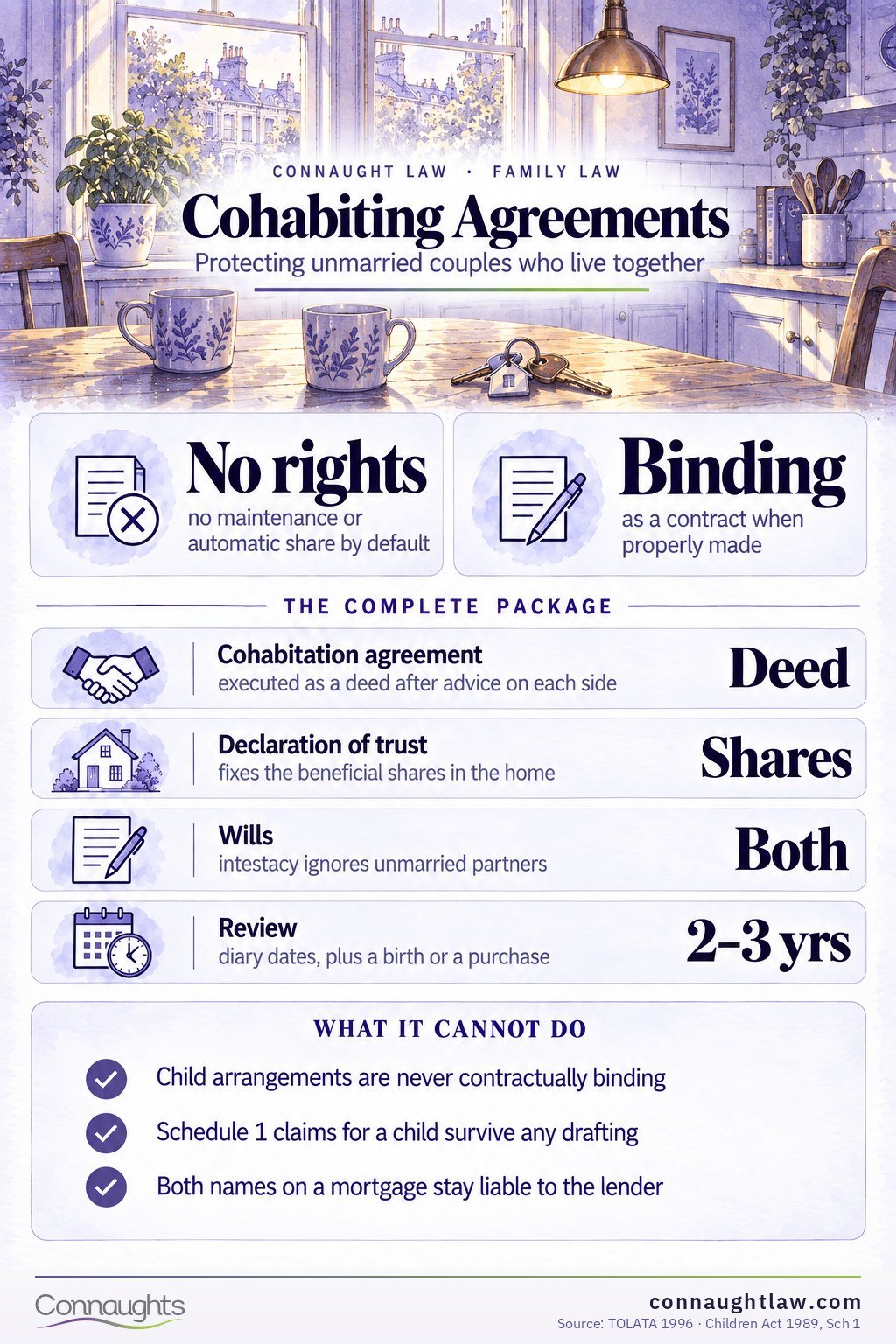
It rarely works alone. Where the home is owned, a declaration of trust fixes the beneficial shares against the registered title, and wills deal with death — intestacy ignores an unmarried partner entirely. The three documents are drafted as a package precisely because each covers a failure the others cannot reach.
The Common-Law Marriage Myth
The idea that living together long enough creates a "common-law marriage" is folklore: it has had no place in English law for centuries, yet House of Commons Library research records that a large share of the public still believes it. The myth does real damage. Couples who assume rights will accrue automatically make no arrangements at all, and discover the true position at the worst possible moment — separation, or a partner's death.
Are Cohabitation Agreements Legally Binding?
A cohabitation agreement made with full financial disclosure, independent legal advice on each side, no pressure and clear terms is enforceable as a contract in England and Wales. Executing it as a deed removes any argument about consideration. Terms about children are the exception — they are never contractually binding.
Courts historically refused to enforce agreements between unmarried partners on public-policy grounds; that era is long gone. A modern cohabitation agreement dealing with property and money is treated like any other contract: if the basics of contract formation are present and the agreement was entered freely, with each partner understanding its effect, there is no special family-law discretion to rewrite it.
That is the crucial difference from a prenup. A prenuptial agreement takes effect subject to the divorce court's overriding discretion — decisive weight rather than contractual force. Between cohabitants there is no equivalent jurisdiction: the contract is the law of the relationship.
Even where a technical defect prevents enforcement as a contract, a signed agreement is powerful evidence. In a TOLATA dispute the court's task is to establish what the parties intended, and a document both partners signed after advice is powerful evidence of exactly that.
What an Agreement Cannot Do
Three limits are fixed. Arrangements for children are never contractually binding: a court can always revisit where a child lives, and child maintenance follows the statutory scheme, not your agreement. Second, the court can make property orders for a child's benefit under Schedule 1 of the Children Act 1989 whatever the agreement says. Third, an agreement signed under pressure, or without honest disclosure, can be set aside like any other contract.
It also binds only the two of you. A mortgage lender is not party to it: if both names are on the mortgage, both remain liable to the bank regardless of what the agreement says about who pays. Internal fairness and external liability are different questions, and the agreement governs only the first.
How Much Does a Cohabitation Agreement Cost?
For a couple with one property and straightforward finances, a cohabitation agreement sits at the modest end of fixed-fee family work — most firms, ours included, will quote a fixed fee after an initial discussion rather than run an open-ended clock. Our fees page explains how we price this work.
The realistic comparison is not the drafting fee but the alternative. A contested TOLATA claim over an undocumented share means disclosure, expert valuation, counsel and a trial about years-old conversations; the costs routinely dwarf what a couple would ever pay to document their intentions at the start.
What Moves the Price Up or Down
Four things drive the quote: the number and complexity of assets — business interests, trusts or property abroad take longer than one flat and two salaries; whether the agreement is packaged with a declaration of trust and wills; whether each partner instructs a separate solicitor for independent advice, which strengthens enforceability but doubles the advice cost; and how much negotiation the terms need. Arriving with mortgage statements, valuations and account summaries keeps the drafting hours down.
Can You Write Your Own Cohabitation Agreement?
Contract law does not require a solicitor, so a home-drafted agreement can in principle bind. In practice they fail in predictable ways: execution formalities missed, terms too vague to enforce, or provisions that contradict the registered title — and a defective agreement can be worse than none, because it muddies the evidence of what you both intended.
The middle path works well: sketch what you have agreed using a template as a starting point, then have a solicitor draft and execute it properly — as a deed, signed by both partners with each signature independently witnessed, with disclosure schedules initialled and certificates of independent advice attached. You keep most of the saving and lose most of the risk.
What Should Be Included in a Cohabitation Agreement?
Start with the home, because that is where the money is: ownership and shares, the deposit and who provided it, mortgage payments, how improvements are treated, and a mechanism for one partner to buy the other out — or for the property to be sold — on separation, with notice periods so nobody is forced out overnight.
Then the day-to-day architecture: joint accounts and what they are for, bills, savings and — critically — debts. Joint borrowing, guarantees and credit cards can follow a partner long after separation, so record who is responsible for what. Specific assets earn their own schedule: cars, contents, valuables, business interests and pets — pet-nup style provisions decide who keeps the dog before a dispute does.
Finally, plan for the events nobody drafts for gladly. Pension death benefits usually pass by scheme discretion, so complete expression-of-wish forms naming your partner — trustees are not obliged to recognise an unmarried survivor otherwise. Life insurance can be written in trust. Lasting powers of attorney cover incapacity, and wills remain non-negotiable: intestacy leaves a cohabitant nothing.
The Complete Package
- Cohabitation agreement, executed as a deed after disclosure and independent advice on each side.
- Declaration of trust fixing the beneficial shares in the home against the registered title.
- Wills for both partners — the intestacy rules ignore unmarried partners entirely.
- Diary-dated review points, so the documents keep pace with the relationship they describe.
With children, record intended living arrangements and financial support as statements of intention. They will not bind a court — welfare is paramount, and Schedule 1 claims survive any drafting — but they are persuasive evidence of what you both regarded as right when things were calm.
Updating Your Agreement When Life Changes
An agreement describes the relationship as it stood on the day of signature; relationships move. Buying a home together, having a child, a significant inheritance or gift, one partner giving up work, or a business changing value can all leave the original terms describing a couple who no longer exist — and a court asked to enforce badly outdated terms will hear arguments that events have overtaken them.
Updating is straightforward: a new agreement or a deed of variation, executed with the same formalities as the original — disclosure, advice, witnessed signatures. Build review triggers into the document itself: diary dates every two or three years, plus defined events such as a birth, a purchase or reform legislation actually passing. An agreement that shows regular review is also far harder to attack as stale.
Cohabitation Law Reform: Where Things Stand
The Law Commission recommended a remedies scheme for cohabitants back in 2007; successive governments shelved it. That changed on 5 June 2026, when the Ministry of Justice opened a formal consultation, A fairer end to relationships, on giving qualifying cohabitants financial protections at the end of a relationship. The consultation closes on 14 August 2026 and is, at the time of writing, still open.
What the Government Proposes
The design is opt-out: protections would apply automatically to couples who have lived together for at least three years, or who live together and share a child, unless the couple chooses to opt out. Remedies would be needs-based and deliberately narrower than divorce — the starting point is that each person keeps what they legally own, maintenance would be confined to exceptional, time-bound circumstances, and clean breaks are favoured.
On death, the consultation proposes automatic intestacy rights for qualifying cohabitants and easier access to provision from a deceased partner's estate. For agreements, the significance is direct: an opt-out scheme makes the written agreement more important, not less — it becomes the instrument by which a couple who prefer their own arrangements disapply the default.
A consultation is not legislation. After responses close on 14 August 2026, the government must analyse them, publish a response, draft a bill and find parliamentary time — realistically years before anything commences. Scotland has had a more limited cohabitation scheme since 2006 without England and Wales following. Until commencement the current law applies in full: no common-law marriage, no automatic rights, and an agreement remains the only reliable protection.
Questions about cohabitation agreements and what they protect
Are cohabitation agreements legally binding in the UK?
Yes, when properly prepared. An agreement about property and money made with full disclosure, independent advice, no pressure and clear terms is enforceable as an ordinary contract, ideally executed as a deed. Terms about children are the exception: those always remain subject to the court and the child's welfare.
Do unmarried couples have the same rights as married couples?
No. There is no common-law marriage in England and Wales. However long you live together, you have no right to maintenance for yourself, no automatic share of your partner's property and no entitlement under the intestacy rules if your partner dies without a will.
What happens to our house if we separate without an agreement?
Ownership follows the legal title and trust law. A partner whose name is not on the title must prove a beneficial interest through contributions or a common intention — uncertain, expensive litigation under TOLATA 1996. An agreement and declaration of trust settle the same questions in advance for a fraction of the cost.
What happens if my partner dies without a will?
The intestacy rules give a surviving cohabitant nothing automatically, whatever the relationship's length. A partner who lived with the deceased for the two years before death can claim reasonable provision under the Inheritance (Provision for Family and Dependants) Act 1975 — but that means litigation. Wills remove the problem entirely.
How much does a cohabitation agreement cost in 2026?
Costs scale with complexity. One property and straightforward finances sits at the affordable end of fixed-fee family work; business interests, trusts or international assets increase the price. Independent advice for each partner adds cost but materially strengthens enforceability. We quote a fixed fee after an initial discussion.
Can we write our own cohabitation agreement?
You can, but home-made agreements commonly fail on execution formalities, vague terms or contradiction with the registered title — and a defective agreement muddies the evidence rather than settling it. Using a template to agree the outline, then instructing a solicitor to draft and execute it properly, captures most of the saving.
Does having children change what we should include?
Yes. Record intended living arrangements and financial support as statements of intention alongside statutory child maintenance. Be clear these cannot bind a court: welfare is paramount, and property orders for a child's benefit under Schedule 1 of the Children Act 1989 remain available regardless of the agreement.
Will the 2026 cohabitation reforms make agreements unnecessary?
No. The consultation is open until 14 August 2026 and any Act is years away. The proposed scheme is opt-out, so couples wanting their own arrangements would need a written agreement to disapply the defaults — reform makes documenting your intentions more relevant, not less.
Tell us whose name the property is in, how you split the outgoings and what each of you has contributed. We will tell you what an agreement should record and what it cannot do.
Get Expert Advice