
Are prenuptial agreements legally binding in the UK? Not automatically — but since Radmacher v Granatino the courts will normally hold a couple to a prenup freely made with disclosure and independent advice, unless it would be unfair. That makes a properly prepared agreement the most effective protection for pre-marital wealth, inheritances and business interests on divorce. This guide covers the requirements, what a prenup cannot do, Standish, and the June 2026 proposal to make agreements binding.
On This Page

Not automatically binding, rarely ignored
English law treats a prenuptial agreement as neither contract nor irrelevance. Unlike much of continental Europe, where marital property regimes bind automatically, England and Wales gives the divorce court a discretion over every financial outcome — and no private agreement can oust it. Yet since the Supreme Court's decision in Radmacher v Granatino, that discretion starts from the agreement: a prenup freely entered into, with a full appreciation of its implications, will be given effect unless holding the parties to it would be unfair.
The practical consequence is a two-tier world. A prenup prepared properly — disclosure given, advice taken, time allowed, terms that do not leave anyone in real need — is followed by the courts in the great majority of reported cases. One prepared badly is expensive paper. The difference lies almost entirely in the safeguards observed at the time of signing, which is why the preparation matters more than the drafting.
This guide explains when prenups are upheld, what they cannot contain, how Standish v Standish strengthened the case for signing one, what the June 2026 consultation proposes about making them fully binding, and the situations where an agreement earns its cost many times over.
Are Prenuptial Agreements Legal in England and Wales?
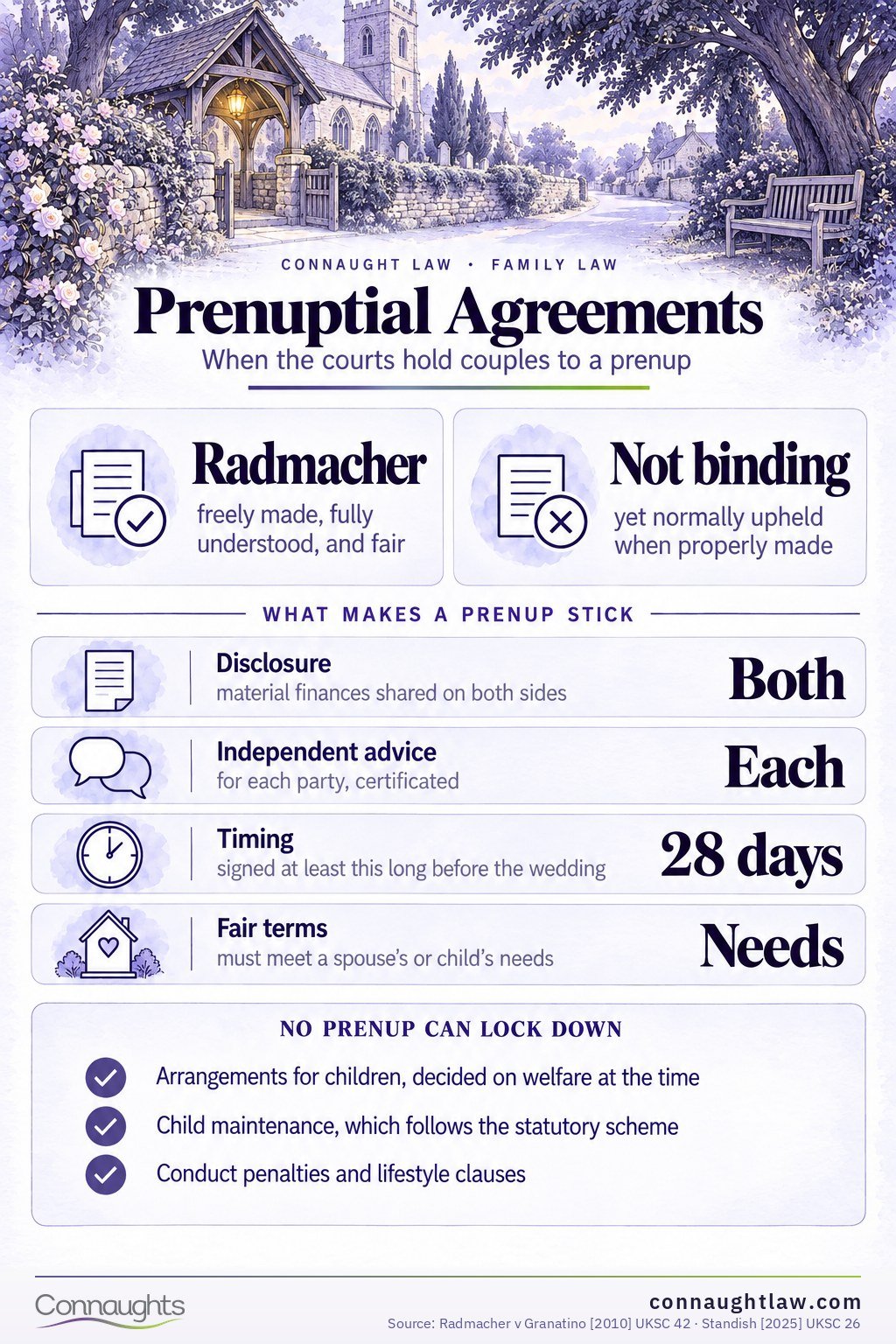
Prenuptial agreements are entirely legal in England and Wales. They are not automatically binding, but following Radmacher v Granatino a court will normally give effect to an agreement made freely, with disclosure and independent advice, unless it would be unfair — most often where it fails to meet a spouse's or child's needs.
The confusion comes from history. For a century, prenups were void as contrary to public policy — the law refused to countenance couples planning for divorce. Radmacher v Granatino [2010] UKSC 42 reversed that: the Supreme Court held that the court should give effect to a nuptial agreement freely entered into by each party with a full appreciation of its implications, unless in the circumstances it would not be fair to hold them to it.
- Material financial disclosure on both sides: the other party must know the broad picture — property, business interests, income and expectations.
- Genuinely independent legal advice for each party, certificated with the agreement.
- Time: signature at least 28 days before the ceremony, with the process started months earlier.
- Terms that meet needs — an agreement leaving one spouse in real hardship will not be enforced as written.
None of these is a statutory checklist — they are the ingredients of "freely entered into with a full appreciation". Miss one and the agreement does not automatically fail; it simply becomes easier to attack. Deliberate concealment of something significant is the fastest way to lose the agreement's protection, and last-minute signing invites arguments of pressure. If time has run out before the wedding, marry first and make a postnuptial agreement instead — the same principles apply.
Fairness: The Court's Safety Valve
Fairness is where prenups bend. The court will not enforce terms that leave a spouse — or, more importantly, a child — in real need, however cleanly the agreement was made: needs are assessed at the point of divorce, not the point of signature, as our guide to financial orders on divorce explains. What fairness does not do is rescue someone from a bad bargain. Radmacher itself enforced the agreement against the economically weaker party, while still funding his role as a father. A prenup that provides sensibly for needs is very hard indeed to dislodge.
Where Reform Stands: Binding Prenups Proposed
The Law Commission recommended statutory "qualifying nuptial agreements" as long ago as 2014, and its December 2024 scoping report on financial remedies set out four models for wider reform. In June 2026 the government moved: the Ministry of Justice consultation A fairer end to relationships proposes a "codification-plus" reform of financial remedies law and — directly for engaged couples — the introduction of qualifying nuptial agreements: binding financial arrangements on divorce, supported by safeguards to ensure the decision to sign is fully informed and freely made.
If enacted, a qualifying agreement meeting the statutory safeguards would bind the court on asset division, rather than carrying Radmacher weight subject to fairness. The consultation runs until 14 August 2026, and legislation would follow only after a government response and parliamentary time — realistically years. Until then Radmacher governs, and an agreement drafted to today's standards is exactly what would be expected to qualify tomorrow.
What Cannot Be Included in a Prenup
A prenup governs the couple's money; it cannot reach the questions the law reserves. The court's jurisdiction over financial remedy survives every drafting device, so an agreement purporting to exclude the court altogether fails at the first hurdle — the realistic aim is an agreement the court chooses to follow, not one it cannot review.
- Arrangements for children: residence and contact are decided on welfare at the time, never by pre-agreement.
- Child maintenance, which follows the statutory scheme regardless of what the couple signed.
- Terms leaving a spouse in real need — the fairness override applies at enforcement, not signature.
- Conduct penalties and lifestyle clauses: English courts disregard them.
Why More Couples Sign Prenups
No official register counts prenuptial agreements, and survey estimates vary — but family lawyers consistently report demand rising fastest among ordinary professional couples rather than the very wealthy. The drivers are demographic. First marriages happen later than a generation ago, so people arrive with a flat, a pension and savings already built. Second marriages, where protecting children's inheritances is the priority, account for a substantial share of weddings. And parental help with deposits adds a third driver: families increasingly want gifted money ring-fenced before it merges into the matrimonial pot.
Radmacher v Granatino and the Legal Evolution
Radmacher concerned a German heiress and a French husband who signed a German agreement providing that neither would benefit from the other's property. When the marriage ended in England, the husband — by then a research student, formerly a banker — sought full financial relief. The Supreme Court held him to the agreement, subject to provision for his role as father of the children. Two things decided the case: he understood the deal when he signed it, and holding him to it left no one in need.
The decision reversed a century of public-policy hostility and set the modern test in a single sentence: effect should be given to a nuptial agreement freely entered into with a full appreciation of its implications, unless it would not be fair. Everything in prenup practice since — the disclosure schedules, the certificates of independent advice, the 28-day timing convention borrowed from the Law Commission's blueprint — is engineering against that sentence.
Standish and the Sharing Principle: Why Prenups Still Matter
In Standish v Standish [2025] UKSC 26 the Supreme Court confirmed that the sharing principle applies only to matrimonial property: non-matrimonial wealth — pre-marital assets, gifts, inheritances — is not shared by default. Some read that as making prenups redundant. It does the opposite. Standish also confirmed that non-matrimonial property can become matrimonial through "matrimonialisation" where the couple treat it as shared over time — and that question is argued on evidence, years later, at full litigation cost.
A prenup answers the matrimonialisation question in advance: it records what stays separate, whatever account it sits in or name it carries. Where significant assets move between spouses — for tax planning, say, as in Standish itself — the agreement records what the transfer did and did not mean. Our guide to matrimonial and non-matrimonial assets explains the underlying distinction in detail.
International Prenuptial Agreements and Cross-Border Couples
International couples add a layer of complexity. Many civil-law countries treat marital property regimes as binding by default, so an agreement signed abroad may be decisive there and merely persuasive here — Radmacher itself involved a German agreement examined through English eyes. Where a couple might realistically divorce in either of two countries, the agreements should be drafted, or mirrored, to work in both, with jurisdiction clauses considered alongside the property terms.
The traffic runs both ways. Foreign templates often assume rules English courts do not apply, producing terms that are internally coherent abroad and meaningless here. Documents intended to protect assets in England need drafting against English principles — needs, fairness, full appreciation — whatever else runs in parallel.
Common Misconceptions About UK Prenups
"Prenups are not worth the paper they are written on" is twenty years out of date: since 2010 the reported cases run heavily in favour of upholding properly made agreements. "Prenups are only for the rich" inverts the reality — for the very wealthy a prenup is one tool among many, while for a couple whose main asset is one pre-owned flat it is often the only tool. And "asking for a prenup signals distrust" misreads what the document does: it is made when the couple agree, to avoid arguing when they do not.
The last misconception is that living together first gives protection anyway. It gives almost none — cohabitants acquire no maintenance rights and no automatic share of each other's property, which is why unmarried couples need a cohabitation agreement rather than a prenup.
When Prenuptial Agreements Make Financial Sense
The strongest candidates: one partner brings significantly more into the marriage — property, savings or a business stake; an inheritance is expected or already received; there are children from an earlier relationship whose inheritance needs protecting; a family business or farm must stay in the family; or parents are contributing a deposit they want protected. In each case the agreement designates what is non-matrimonial at the start rather than litigating it at the end — the same job ring-fencing assets does inside a marriage, done earlier and far more cheaply.
Frequently askedQuestions about prenups, timing and what the courts enforce
Are prenuptial agreements legally binding in the UK?
Not automatically. Following Radmacher v Granatino, a court will normally uphold a prenup made freely, with material disclosure and independent advice, unless holding the parties to it would be unfair — typically where needs are not met. The June 2026 consultation proposes making qualifying agreements fully binding.
How long before the wedding should we sign a prenup?
Aim to sign at least 28 days before the ceremony, and start the process months earlier. Last-minute signing invites arguments of pressure that undermine the agreement. If time has run out, marry first and make a postnuptial agreement instead — it is assessed on the same principles.
Can a prenup protect my house or inheritance?
Yes — this is the core use. The agreement designates pre-marital property, gifts and inheritances as non-matrimonial, and Standish v Standish confirmed the sharing principle does not reach non-matrimonial property. The protection holds provided the other spouse's needs, and any children's, are met.
What makes a prenup fail in court?
Missing disclosure, absent independent advice, time pressure near the wedding, or terms leaving one spouse in real need. Deliberate concealment of significant assets is the fastest route to losing protection. Failures rarely void the agreement outright — they hand the other side arguments for departing from it.
Can we include child arrangements or child maintenance in a prenup?
No. Arrangements for children are assessed by the court on welfare at the time, and child maintenance follows the statutory scheme. A prenup can record intentions, but no drafting binds either question in advance.
Are prenups only worthwhile for wealthy couples?
No. The commonest modern users protect a pre-owned flat, a parental deposit, a small business or children from an earlier relationship. Where assets are modest, avoiding contested litigation matters more, not less — the agreement is cheap insurance against a dispute that could consume the asset itself.
What is the difference between a prenup and a postnup?
Timing. A prenuptial agreement is made before the wedding, a postnuptial agreement after — sometimes to replace a rushed prenup, sometimes prompted by a windfall. Courts assess both under the same Radmacher principles: freely made, fully understood, fair.
Will prenups become automatically binding in the UK?
That is now the live proposal. The government's June 2026 consultation, A fairer end to relationships, proposes qualifying nuptial agreements that would bind couples on asset division, subject to statutory safeguards. Legislation is still years away; until then Radmacher weight, not automatic enforcement, is the rule.
Tell us what each of you is bringing to the marriage and the wedding date. We will tell you whether an agreement helps, what it should say, and the timetable that keeps it safe.
Get Expert Advice