
Ring-fencing is the art of keeping an asset out of the divorce settlement — an inheritance, a pre-marital property, a business built before the wedding. It is possible, it is conditional, and it is never absolute: protection depends on how the asset was held and used, and every fence gives way to needs. This guide covers what can be ring-fenced, what the argument must prove, the methods that work, and the mistakes that undo them.
On This Page
Keeping an asset outside the settlement
Non-matrimonial assets — inheritances, pre-marital wealth, third-party gifts — can be kept out of the sharing exercise, and since Standish v Standish they are not shared by default. But protection is earned by conduct: separate holding, clean records, no family use. And no fence survives the needs override.
Ring-fencing arguments have become the centre of gravity in wealth-heavy divorces precisely because the law now rewards them. The Supreme Court's decision in Standish v Standish [2025] UKSC 26 confirmed that the sharing principle applies to matrimonial property only, and that whether separate wealth has been matrimonialised depends on how the couple treated it over time. The fence, in other words, is built from behaviour — and this guide is about building it properly.
What Is Ring-Fencing in a Divorce?
Ring-fencing means persuading the court — or the other side — that a particular asset should not enter the pot divided between the spouses. It is not a procedure or a form; it is a classification argument, won or lost on evidence about where the asset came from and how it was treated during the marriage. Our guide to matrimonial and non-matrimonial assets sets out the underlying categories.
Legal Foundation: Classification, Not Magic
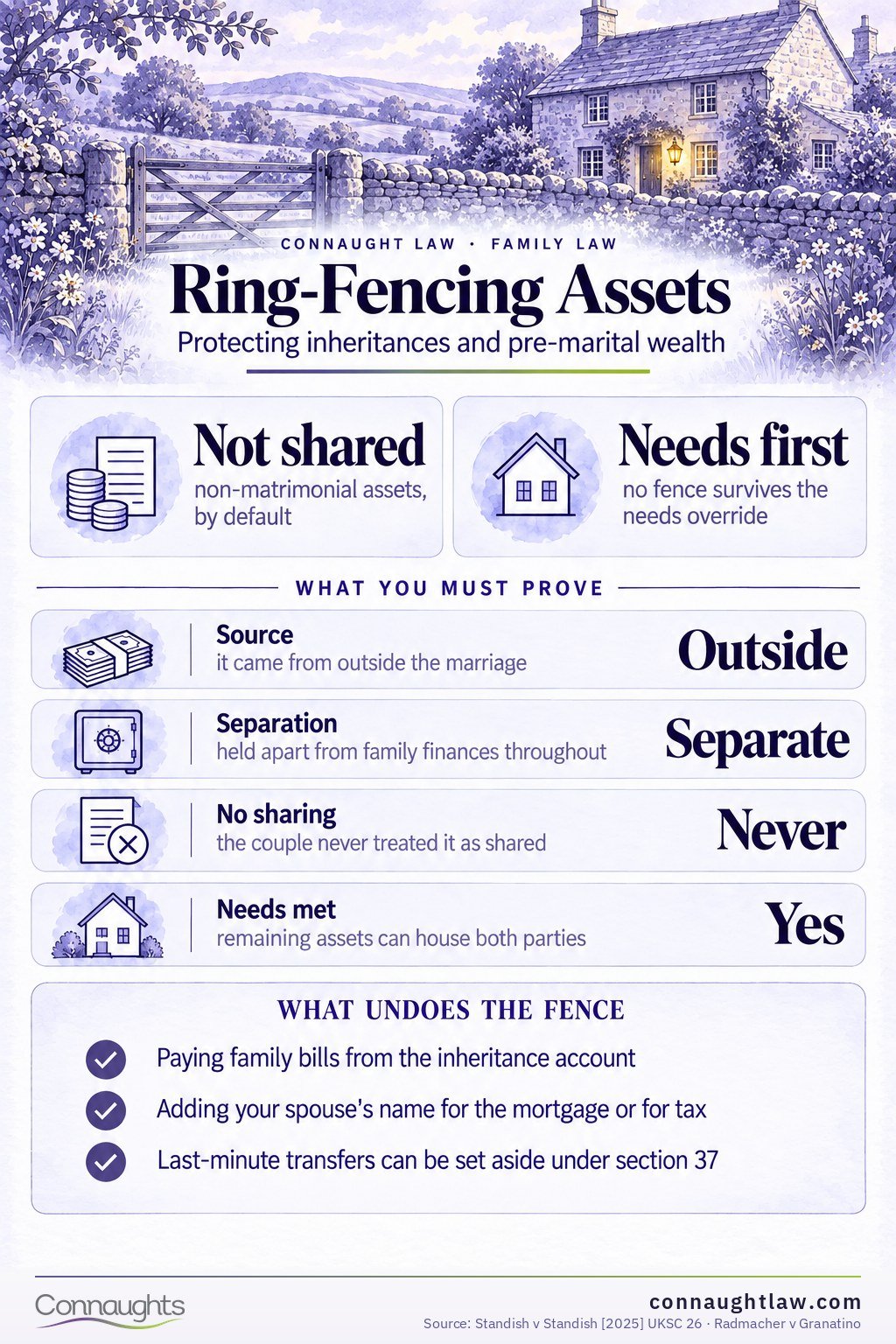
- Source: the asset came from outside the marriage — pre-marital endeavour, inheritance or gift, with documents dating its arrival.
- Separation: it was held and managed apart from family finances throughout, not merely renamed recently.
- No matrimonialisation: the couple never treated it as shared — no family spending from it, no joint improvements to it.
- Needs met elsewhere: the remaining assets can house and support both parties. Without this, the rest is academic.
Which Assets Can Be Ring-Fenced?
Pre-Marital Assets and Property
- Property owned before the marriage and never used as the family home.
- Businesses built before the wedding — though marital growth generates a shareable element.
- Investment portfolios kept in sole names and managed separately.
- Savings that never passed through the joint account.
Ring-Fencing an Inheritance
Inheritance is the strongest natural candidate — it arrives from outside the marriage, usually documented by probate, and often carries family significance the court respects. The protection rules are the same but the stakes are cleaner: keep inherited money in a separate account, keep an inherited property out of family use, and resist the instinct to "put it into the pot" for convenience. An inheritance expected but not yet received is generally ignored unless imminent.
The same thinking protects the next generation. If you want your share of a jointly owned home to reach your children rather than pass automatically to a spouse, severing the joint tenancy and directing your share by will — often through a trust — is the mechanism; intestacy does the opposite of what most parents intend. Estate planning and divorce planning meet at exactly this point, and they should be designed together.
Inherited Assets Compared
| Asset | Protection Potential | What Undoes It |
|---|---|---|
| Inherited property | High — unless it becomes the family home | Family occupation, joint improvements |
| Inherited business interests | High, with structure | Spouse contributions to growth |
| Inherited investments | High, separately managed | Income spent on family life |
| Trust interests | High, properly structured | Treated as a resource where needs demand |
| Heirlooms and chattels | Moderate | High value pulling them into the needs arithmetic |
Legal Requirements for Effective Ring-Fencing
Documentation and Formal Requirements
The evidence assembles itself only if you let it: completion statements and probate papers dating the asset's arrival, account records showing separate management year after year, and — where the protection is agreed — a properly executed agreement with disclosure and independent advice on both sides. Courts believe patterns, not assertions; the file you build during the marriage is the argument you make at the end of it.
Fairness and Needs Assessment
- Housing both parties, and above all the children, comes before any classification argument.
- Income needs: two households must actually function after the split.
- Where matrimonial assets cannot meet those needs, the court reaches into ring-fenced wealth — source notwithstanding.
- The practical consequence: the smaller the matrimonial pot, the weaker every fence around the rest.
Ring-Fencing Strategies and Methods
Prenuptial and Postnuptial Agreements
A prenuptial agreement is the most direct method: it records what each party brings in and how it is to be treated, converting a future evidence battle into a signed document. Postnuptial agreements do the same job mid-marriage — most valuably when an inheritance arrives and the couple can record, calmly, what it is and is not. Made with disclosure, advice and fair provision, both are now followed in the great majority of cases.
Trust Structures and Corporate Protection
Trusts and corporate wrappers can hold wealth a step away from the marriage — discretionary trusts especially, where no spouse holds an entitlement to distribute. The structural rules are constant: genuine purpose beyond divorce protection, independent governance, and creation well before marital difficulty. A court that finds an artificial arrangement treats it as the spouse's resource anyway, and in high-value cases will look straight through elegant paperwork to the reality of who benefits.
How Courts Approach Ring-Fencing Claims
Judicial Discretion and Assessment Criteria
The exercise remains discretionary under section 25 of the Matrimonial Causes Act 1973: asset origins, the marriage's length, each spouse's contributions — including to the growth of "separate" assets — the children's welfare and the adequacy of what remains all weigh in. Length matters most: the longer the marriage, the more origins fade and the harder separation is to maintain.
The Cases That Shaped the Law
The modern framework stacks four decisions. Miller; McFarlane [2006] UKHL 24 drew the matrimonial/non-matrimonial distinction into the mainstream; Charman v Charman [2007] EWCA Civ 503 confronted trust wealth and special contribution; Radmacher v Granatino [2010] UKSC 42 made properly prepared nuptial agreements decisive; and Standish — analysed in full in our Standish case guide — confined sharing to matrimonial property and made treatment over time the test. Each step has strengthened the well-documented fence and weakened the improvised one.
Common Challenges and Pitfalls
- Commingling is the classic self-inflicted wound: one season of school fees paid from the inheritance account can unravel years of separation.
- Transfers and trust creation on the eve of divorce read as dissipation, and section 37 lets the court set transactions aside.
- Adding a spouse's name "for the mortgage" or "for tax" invites the argument that you treated the asset as shared.
- Protection is built in calm years, not in the fortnight before Form E.
Spouse Contribution Recognition
Separate origin does not erase marital effort. A spouse who worked in the inherited business, project-managed the renovation of the pre-marital flat, or ran the home while the portfolio grew has contributed to the asset's current value — and courts recognise it, usually by treating the growth, if not the seed, as shareable. The cleaner the separation of effort as well as money, the stronger the fence.
Inadequate Matrimonial Provision
Ring-fencing fails most often for the simplest reason: there is not enough left. Where the matrimonial assets cannot house and support both parties, the court will invade non-matrimonial wealth without embarrassment — needs are the statutory priority, and no classification survives them. Realism about this at the negotiation stage saves the cost of learning it at trial.
International and Cross-Border Considerations
Foreign assets complicate every element: enforcement of English orders abroad, disclosure across borders, and jurisdictions whose regimes treat separate property differently. Where wealth or spouses span countries, jurisdiction — where the divorce runs — can matter as much as classification, and mirror advice in the other jurisdiction belongs at the start of planning, not the end.
Tax Implications
Protection and tax pull in different directions more often than expected: transfers that make sense for inheritance tax can create capital gains exposure, and the timing rules on separation change the arithmetic — our CGT on divorce guide covers the windows in detail. Structures also carry compliance costs of their own. Design the protection, the tax and the family law position together, or one will quietly undo another.
Frequently askedQuestions about protecting inheritances, businesses and pre-marital property
How does ring-fencing an inheritance work in practice?
Keep it demonstrably separate: its own account, no family spending from it, records from probate onwards. Treated that way, an inheritance is not shared by default. Folded into the family finances — or needed to house the other spouse — it comes back into play.
How can I protect assets from divorce in the UK?
In order of effectiveness: a properly made nuptial agreement recording what stays separate; genuinely separate holding and management sustained over years; and structures with real purpose created in calm times. All three together beat any one — and none ousts the needs jurisdiction.
Are premarital assets automatically protected in a UK divorce?
No. They start as non-matrimonial and stay protected only while kept separate — and only while the matrimonial assets can meet both parties' needs. Long marriages, family use and commingling all erode the protection; nothing about it is automatic.
What happens to property bought before the marriage?
It depends on what happened next. Kept in your sole name, never lived in as the family home and never improved with joint money, it has strong protection. Once it houses the family, it acquires matrimonial character — the clearest transformation in the case law.
Can ring-fencing protect the family home?
Almost never. The family home is treated as matrimonial in nearly every case, whatever its origin or title, because the family's housing needs are concentrated in it. Protection arguments do far better aimed at assets the family never lived in.
What are the main risks to pre-marital asset protection?
Commingling with family money, spouse contributions to the asset's growth, adding your spouse's name for convenience, artificial last-minute structures — and above all, a matrimonial pot too small to meet needs, which entitles the court to reach past every fence you built.
Tell us where the asset came from, how it has been held and what else the marriage owns. We will tell you how strong the fence is — and how to reinforce it while there is still time.
Get Expert Advice