
The UKVI credibility interview is where student visa applications are really decided: a short, recorded conversation testing whether you are a genuine student who understands your own course, funding and plans. Interviews have sharpened under the 2025–26 reforms, and a missed appointment or a memorised script can sink an otherwise strong application. This guide covers who gets interviewed, what is asked, and how honest preparation actually works.
On This Page

Twenty Minutes That Decide the Visa
The Student visa's paperwork checks what you have; the credibility interview checks who you are. An interviewing officer forms a view on whether the study plan is genuine — and under Appendix Student's genuine student requirement, that view can outweigh a perfect document bundle. Treating the interview as the application's centrepiece, rather than an administrative formality, is the single adjustment that most improves outcomes.
A 10–30 minute recorded conversation in English, usually by video, testing whether you are a genuine student: why this course and university, what it costs, whose money pays for it, and what comes after. Consistency with your application decides it — and missing the appointment is treated as refusal territory in itself.
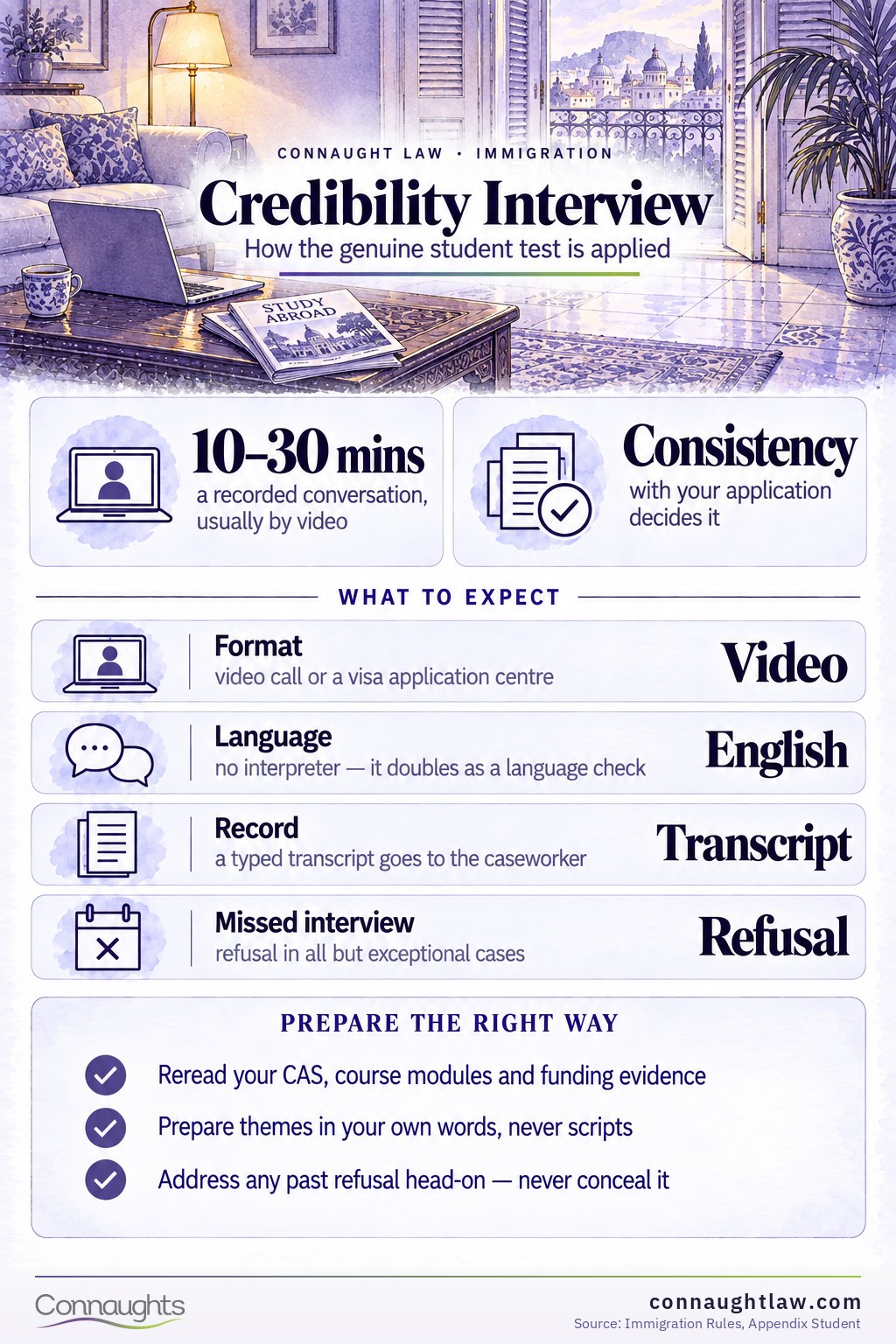
How Credibility Interviews Work
Who Requires an Interview
Not every applicant is interviewed — selection weighs risk factors: previous refusals or immigration history, gaps or sideways moves in study progression, funding that needs explaining, and profiles that fit patterns the Home Office is currently scrutinising. Assume you may be called, prepare as if you will be, and treat an interview invitation as routine rather than ominous — it is the process working, not an accusation.
Interview Format and Requirements
| Aspect | What to expect |
|---|---|
| Format | Video call, typically via Microsoft Teams, or at a visa application centre |
| Length | Usually 10–30 minutes, longer where answers raise questions |
| Language | English, without an interpreter — the interview doubles as a language check |
| Record | A typewritten transcript that follows the application to the caseworker |
| Test | The genuine student assessment: course, funding, plans, and consistency |
Current Procedures and Requirements
Attendance and the No-Show Policy
Missing a scheduled interview is treated as non-compliance and leads to refusal in all but genuinely exceptional cases — a documented medical emergency or a verified technical failure on the Home Office's side. The practical rules are unglamorous: test the technology the day before, sit somewhere quiet with identity documents to hand, and join early. No answer you could give is as damaging as not being there to give it.
Assessment Criteria
The officer is scoring consistency more than eloquence: does what you say about your course, funding and intentions match the application, the CAS and your documents? Contradictions are the killers — a stated budget that differs from the bank statements, a course description that does not match the CAS, career plans with no connection to the study. Fluency helps; coherence decides.
Preparation That Actually Works
Research and Document Review
Reread your own application the way the officer will: the CAS, the course modules, the fee and maintenance figures, your funding evidence and its sources. Interviewees are routinely undone not by hard questions but by their own paperwork — the applicant who cannot say what their course costs, or names modules from a different university's syllabus, has answered the genuineness question without meaning to.
Developing Your Answers
Prepare themes, never scripts. Officers hear memorised answers daily and discount them instantly; what persuades is specific, personal reasoning — why this course, this institution, this country, in your own words with your own details. If an agent has supplied polished answers, discard them: recycled scripts are themselves a documented refusal pattern, and the interview exists precisely to detect them.
Common Questions and How to Answer
Education and Course Choice
Expect the core cluster: why this course, why this university, why the UK rather than home or a cheaper country, how the course fits what you studied before, and what you plan afterwards. Where your history includes a subject change or a study gap, the officer will ask about it — a prepared, honest account of the reasoning turns the awkward fact into evidence of a considered plan.
Answering Course-Choice Questions
The strong answer pattern names specifics: modules that map to a career goal, the institution's ranking or facilities for the subject, comparisons you actually made with alternatives. "It is a good university" is filler; "its data science pathway includes the industry placement my target role expects" is an answer only a genuine applicant gives.
Finances and Funding Sources
You will be asked what the course costs, what you must show in maintenance, whose money it is and where it came from. Know the figures cold and describe the funding truthfully — sponsored family funds are fine when explained, and unexplained recent deposits are the classic problem the financial evidence guidance exists to police.
Money Rules and the Current Thresholds
Maintenance Fund Thresholds
The current maintenance figures are £1,529 a month for London courses and £1,171 outside London, each for up to nine months, plus first-year fees per the CAS — held for 28 consecutive days ending within 31 days of the application, with a 12-month lawful UK residence exemption. Quote your own numbers accurately at interview; an applicant who understates their required maintenance is handing the officer a genuineness point.
Acceptable Funding Sources
Own funds, parental funds with consent evidence, official scholarships and approved loans all work when documented; cash of uncertain origin does not. The interview tests the story behind the statements — who earns what, why the balance moved, and whether the family finances plausibly support the plan without the student working beyond permitted hours.
Complex Cases
Previous Refusals and History
A past refusal is survivable; concealing one is not. Officers see the history, so the working strategy is to address it head-on — what the refusal ground was, what has changed, and why the current application answers it. Where the history is tangled, advice before applying beats advocacy after refusal, which is where our student visa team earns its keep.
Study Gaps and Progression
Gaps, downgrades in level, and late-career returns to study all draw questions because they can indicate a visa-led rather than study-led plan. The honest explanations — work experience, family circumstances, funding delays, a genuine career pivot — succeed when told consistently and evidenced where possible. The unforgivable version is the gap the applicant cannot account for at all.
After the Interview
Decision Process and Timelines
The transcript joins your file and the caseworker decides against the whole picture — interview-flagged applications can run beyond the standard three-week entry clearance timetable, so build slack between application and course start. The reforms sharpening this whole area are tracked in our student visa changes guide.
Challenge and Reapplication Options
A refusal on genuineness usually offers no full appeal right — the realistic routes are administrative review for caseworking error, or a fresh application that squarely fixes the failed point, often with the appeals team's input where more is at stake. Reapplying with the same answers is the one strategy guaranteed not to work; the transcript of the first interview will be read alongside the second.
Frequently askedQuestions about the credibility interview
What happens if I miss my credibility interview?
Refusal, in almost every case — non-attendance is treated as failing to comply with the process. Only documented emergencies or verified technical failures are excused, so confirm the appointment, test the technology, and join early.
How much maintenance money do I need?
£1,529 a month for London courses or £1,171 outside London, for up to nine months, plus your first-year fees — held for 28 consecutive days ending within 31 days of applying. Know your own figures precisely; being unable to state them is itself a credibility problem.
Can I use an interpreter?
No — the interview is conducted in English, and your ability to hold the conversation is part of what is being assessed. If discussing your course in English feels difficult, that is a preparation signal to act on before the interview, not during it.
What is the genuine student rule?
The requirement in Appendix Student that you genuinely intend to study the course you applied for. It is assessed on your whole file plus the interview — course knowledge, funding coherence, plans and consistency — and it can defeat an application whose documents are otherwise perfect.
How long does the interview last?
Typically 10 to 30 minutes, by video call. Length is not a verdict — short interviews often mean quick satisfaction, longer ones mean the officer is giving you the chance to resolve doubts. Answer each question specifically and let the time take care of itself.
Can I challenge a refusal after a bad interview?
Genuineness refusals rarely carry full appeal rights — the routes are administrative review for clear caseworking error, or a corrected fresh application. Because your first transcript is read next time, fix the actual failure point rather than repeating the attempt.
Tell us your course, funding position and any refusal history. We'll run a preparation session against your actual file — the questions you will face, the figures you must know, and the honest answers that hold up.
Get Expert Advice