
If you are bringing an employment tribunal claim, one question matters above all others: what might you actually recover? The answer depends on the type of claim. Unfair-dismissal compensation is capped and built around your lost earnings; discrimination compensation is uncapped and adds an award for injury to feelings. This guide explains how tribunals calculate awards in 2026, the current Vento bands and statutory limits, what the published figures really show, and why most cases settle long before a hearing.
On This Page

How Employment Tribunal Compensation Works
It depends on the claim. For unfair dismissal, the award is a basic award (calculated like statutory redundancy) plus a compensatory award for your financial losses — but the compensatory award is capped at £123,543 or a year's gross pay, whichever is lower, from 6 April 2026. For discrimination, there is no cap: you can recover your full financial loss plus a separate award for injury to feelings set by the "Vento bands." That difference is why the largest reported tribunal awards are almost always discrimination cases.
Employment tribunal compensation is not a single figure or a lottery. It is built from defined components, and which components apply depends on what you are claiming. The two questions that decide the scale of an award are whether the claim is capped and whether it carries an injury-to-feelings element. The sections below work through both, set out the 2026 figures, and explain what the widely quoted statistics do and do not tell you. For the wider framework, see our UK employment law guide.
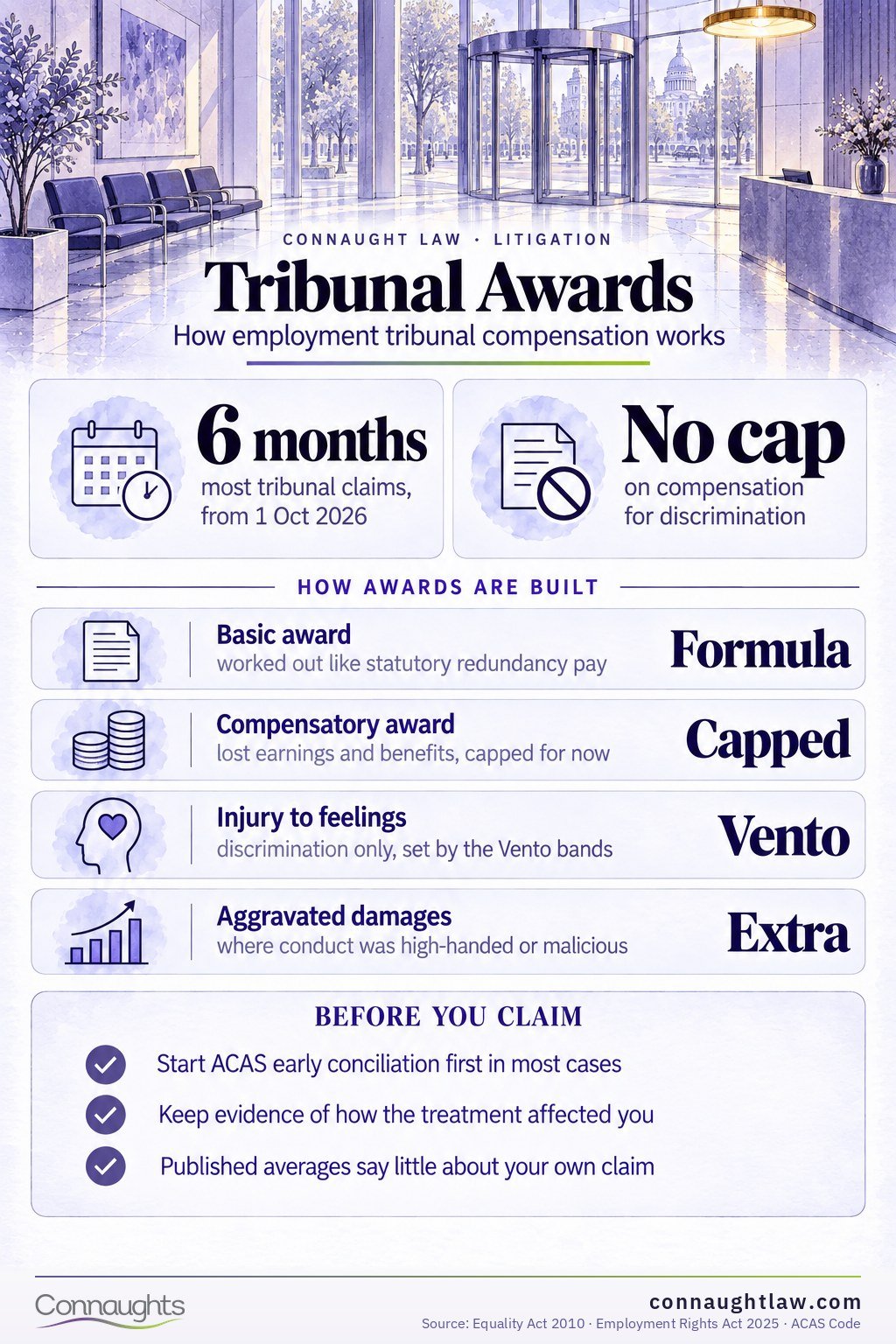
How Tribunal Awards Are Calculated
Most awards are made up of two parts. The first compensates financial loss — principally lost earnings, from dismissal or the discriminatory act up to the hearing and, where appropriate, into the future, together with lost benefits such as pension. The second, in discrimination cases, compensates non-financial harm: the injury to feelings caused by the unlawful treatment, and in serious cases any psychiatric injury. Tribunals also have limited powers to make additional awards, for example where an employer unreasonably failed to follow the ACAS Code.
Compensation for the hurt, distress and loss of dignity caused by unlawful discrimination, harassment or victimisation. It is separate from any award for lost earnings and is assessed by reference to the "Vento bands." It is available in discrimination claims under the Equality Act 2010, not in ordinary unfair-dismissal claims, which is one reason discrimination awards can be substantially higher.
Unfair Dismissal: A Capped Award
An unfair-dismissal award has two elements. The basic award is calculated in the same way as statutory redundancy pay — using your age, length of service and a week's pay, which is itself capped at £751 from 6 April 2026. The compensatory award covers your actual financial losses flowing from the dismissal, mainly lost earnings and benefits, and is where most of the value usually sits.
The compensatory award is subject to a statutory cap. From 6 April 2026 that cap is £123,543, or 52 weeks' gross pay if that figure is lower — so in practice the ceiling for many people is a year's pay rather than the headline maximum. This is a reminder that the very large sums sometimes reported are rarely ordinary unfair-dismissal cases.
Under the Employment Rights Act 2025, the cap on the unfair-dismissal compensatory award is due to be removed, with the change expected from January 2027. It is not yet in force, so the £123,543 cap still applies for now. When it goes, unfair-dismissal awards will in principle track actual loss without a fixed ceiling — a significant shift worth taking advice on if your losses are high.
Discrimination: Uncapped, With Injury to Feelings
Discrimination claims under the Equality Act 2010 work differently, and the difference is fundamental. There is no statutory cap on compensation. A tribunal can award your full past and future financial loss, however large, plus a separate sum for injury to feelings and, in serious cases, for personal or psychiatric injury. Where the employer's conduct has been high-handed or malicious, a tribunal may also make an award of aggravated damages.
This uncapped structure, combined with the injury-to-feelings element, is why the record-breaking figures that appear in the press are almost always discrimination cases — often involving career-long future loss for a high earner. It is important not to read those outliers as typical: they reflect exceptional facts, not the everyday value of a claim.
- No cap — full financial loss is recoverable, including long-term future loss of earnings
- Injury to feelings — a separate award under the Vento bands, on top of financial loss
- Psychiatric injury — a further award where the discrimination caused a recognised condition
- Aggravated damages — where the manner of the discrimination made the harm worse
The Vento Bands for Injury to Feelings
Injury-to-feelings awards are set by reference to the "Vento bands," three brackets updated each year by the Presidents of the Employment Tribunals. For claims presented on or after 6 April 2026, the bands are as follows.
Injury to Feelings Bands
| Band | Range | Typical use |
|---|---|---|
| Lower band | £1,300 – £12,600 | Less serious cases, such as a one-off or isolated incident |
| Middle band | £12,600 – £37,700 | Serious cases that do not merit an upper-band award |
| Upper band | £37,700 – £62,900 | The most serious cases, such as a lengthy campaign of harassment |
| Exceptional | Above £62,900 | The most exceptional cases only |
The band that applies turns on the seriousness and duration of the discrimination and its effect on you, not on how much you earn. A single act may fall in the lower band; a sustained campaign of harassment causing real psychological harm can reach the upper band or beyond. Because the assessment is fact-sensitive, well-documented evidence of the impact on you is central to securing an appropriate award.
What the Published Figures Show
The Ministry of Justice publishes employment tribunal award statistics, and they are widely quoted — but they need careful reading. The reported maximum, average and median awards are drawn only from the minority of claims that reach a full hearing and result in an award. They exclude the great majority of cases, which settle or are withdrawn, so they are not a reliable guide to what a typical claim is worth.
Two patterns are consistent year to year. First, discrimination awards, being uncapped and carrying an injury-to-feelings element, produce far higher maxima than unfair-dismissal awards. Second, the median is always well below the average, because a small number of very large awards pull the average upward. The honest takeaway is that averages flatter the typical outcome, and the real value of any individual claim depends on its own facts.
A reported "average" discrimination or unfair-dismissal award tells you almost nothing about your own claim. It is skewed by a handful of exceptional cases and drawn only from claims that went all the way to a decided award. Your likely outcome depends on your losses, the strength of the evidence, and how the claim is run — which is why a proper individual assessment matters more than any published figure.
Why Most Claims Settle
Most tribunal claims never reach a final hearing. Many are resolved through ACAS early conciliation — a step that is, in most cases, a required precursor to bringing a claim — or settled later by agreement, often recorded in a settlement agreement. Settlement lets both sides control the outcome and avoid the cost, delay and uncertainty of a hearing, and it is frequently the most sensible route even in a strong case.
Because a settlement figure reflects the risks and likely award if the case went the distance, understanding how compensation is calculated is exactly what allows a claim to be valued and negotiated properly. Whether you are considering a claim or responding to an offer, an early assessment of the components above puts you in a far stronger position.
Most employment tribunal claims must be started within six months of the act complained of, after going through ACAS early conciliation. The Employment Rights Act 2025 doubled the limit for acts on or after 1 October 2026; earlier acts keep the old three months less one day. Missing it can end an otherwise strong claim, so act promptly.
Questions about employment tribunal awards
How much compensation can I get at an employment tribunal?
It depends on the claim. Unfair-dismissal compensation is a basic award plus a compensatory award for lost earnings, with the compensatory award capped at £123,543 or a year's pay, whichever is lower, from 6 April 2026. Discrimination compensation is uncapped: you can recover your full financial loss plus a separate injury-to-feelings award under the Vento bands. Your actual figure turns on your losses and the strength of your evidence.
Is there a cap on discrimination compensation?
No. Compensation for discrimination under the Equality Act 2010 is not subject to a statutory cap. A tribunal can award your full past and future financial loss, plus a separate award for injury to feelings, and in serious cases awards for psychiatric injury or aggravated damages. This is why the highest reported tribunal awards are almost always discrimination cases rather than ordinary unfair-dismissal claims.
What are the Vento bands for 2026?
For claims presented on or after 6 April 2026, the injury-to-feelings bands are: a lower band of £1,300 to £12,600 for less serious cases; a middle band of £12,600 to £37,700; and an upper band of £37,700 to £62,900 for the most serious cases, with exceptional cases capable of exceeding £62,900. The band depends on the seriousness and duration of the discrimination and its effect on you.
What is the average employment tribunal award?
Published averages exist, but they are a poor guide to any individual claim. The Ministry of Justice figures cover only cases that reach a decided award, excluding the majority that settle or are withdrawn, and the average is pulled upward by a few very large awards. The median is always well below the average. Your likely outcome depends on your own losses and evidence, not on a national average.
What are my chances of winning an employment tribunal claim?
There is no reliable single success rate, because most claims settle or are withdrawn rather than being decided at a hearing. Prospects depend heavily on the facts, the documentary evidence, and whether the correct claim has been identified and brought in time. A realistic assessment of the merits and likely value at the outset is far more useful than any headline statistic about win rates.
How long do I have to bring a tribunal claim?
Generally six months from the act you are complaining about (three months less one day if it happened before 1 October 2026), after starting ACAS early conciliation, which can extend the deadline. The six-month limit, introduced by the Employment Rights Act 2025, has applied since 1 October 2026. Time limits are strict and can defeat a strong claim, so it is important to take advice quickly.
Tell us what happened, when it happened and what you earned. We’ll tell you which claim gives you the better outcome, what it is realistically worth, and how long you have left to start it.
Get Expert Advice