
A Part 36 offer is the most powerful settlement tool in civil litigation. Made under Part 36 of the Civil Procedure Rules, it puts the other side under real financial pressure: refuse it and do worse at trial, and you face heavy costs consequences even if you technically win. This guide explains how a Part 36 offer works, the cost consequences outcome by outcome, the tactics behind timing and level, and the recent developments every litigant should know.
On This Page
Understanding Part 36 Offers in the UK
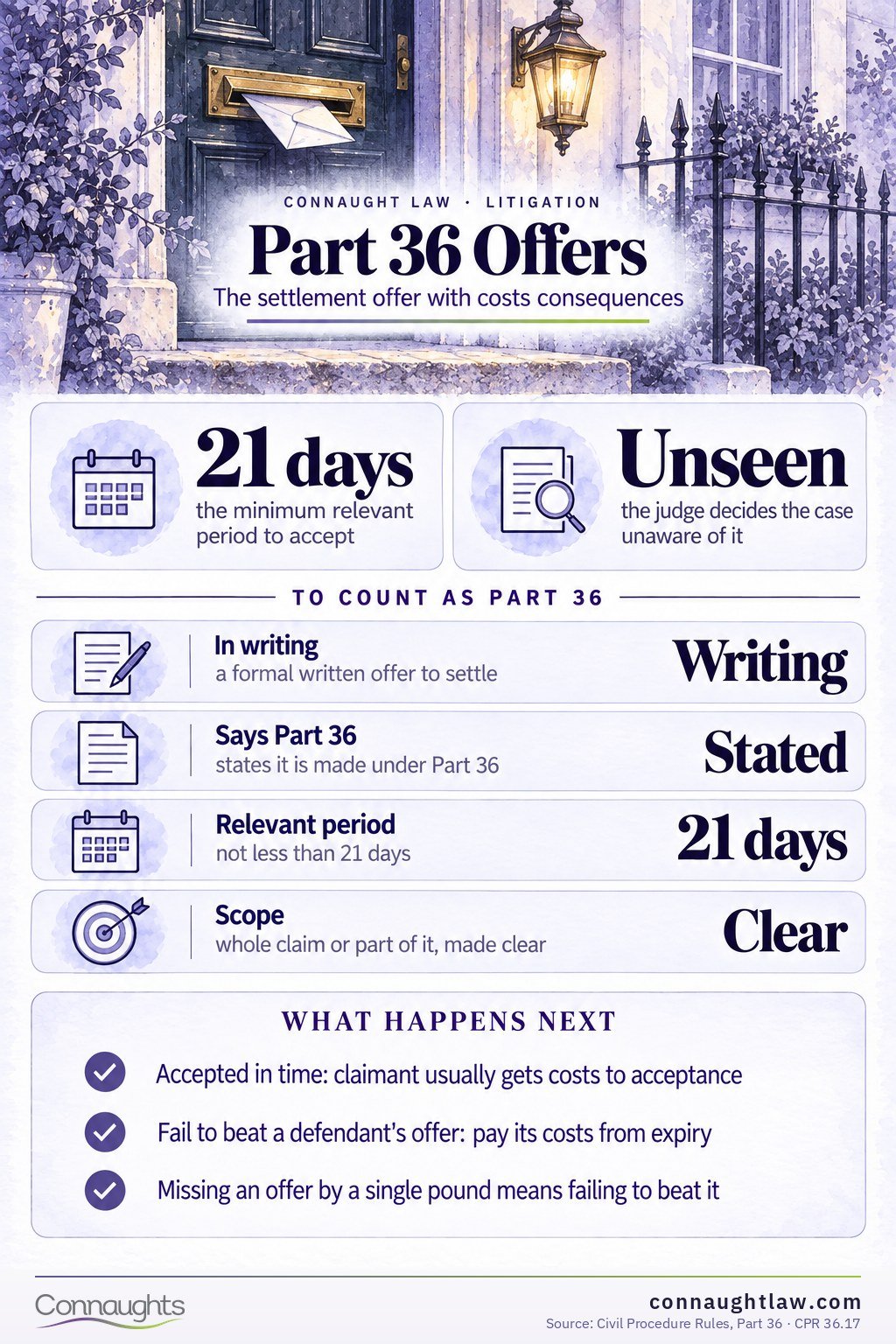
A Part 36 offer is a formal, written offer to settle made under CPR Part 36. It sets a "relevant period" of at least 21 days for acceptance. Its power lies in the automatic costs consequences: a party that refuses an offer and then fails to beat it at trial is penalised on costs — often heavily — even if it ultimately wins the case.
What a Part 36 Offer Is and How to Make One
Part 36 offers can be made by a claimant or a defendant, at almost any stage of a dispute, and even before proceedings are issued. To carry the Part 36 costs consequences, an offer must comply strictly with the rule's formalities: it must be in writing, state that it is made under Part 36, specify a relevant period of not less than 21 days, and make clear whether it relates to the whole claim or part of it. An offer that misses these requirements is just an ordinary offer and does not attract the automatic consequences.
A Part 36 offer is treated as "without prejudice save as to costs". That means the court does not see it while deciding the case — the judge rules on liability and quantum unaware of the offer — and it is only revealed at the costs stage, after judgment, when the court decides who pays what. That structure is deliberate: it lets a party make a realistic settlement offer without the offer being read as an admission of weakness.
The Relevant Period
The relevant period — a minimum of 21 days — is the window in which the offer can be accepted on the standard costs terms. It is the trigger for everything that follows: if the offer is not accepted within it, the costs consequences begin to run from its expiry. Getting the mechanics right matters, because a defective offer forfeits the very pressure the rule is designed to create.
The Cost Consequences, Outcome by Outcome
The whole point of Part 36 is what happens on costs, and the consequences differ depending on who made the offer and what the trial produced. Under CPR 36.17, the court must make these orders unless it considers it unjust to do so.
If an offer is accepted within the relevant period, the case settles on the offered terms and the claimant is normally entitled to costs up to the date of acceptance. If a claimant beats its own offer at trial — obtaining a judgment at least as advantageous as the offer it made — the court awards the claimant indemnity costs from the end of the relevant period, enhanced interest of up to 10% above base rate, and an additional amount. If a claimant fails to beat a defendant's offer, the claimant usually pays the defendant's costs from the expiry of the relevant period, plus interest on those costs — even though the claimant won the case.
The Claimant's Additional Amount
The additional amount is the headline sanction when a claimant beats its own offer. It is calculated as 10% of the damages awarded up to £500,000, plus 5% of any amount between £500,000 and £1 million, and it is capped at £75,000. Combined with indemnity costs and enhanced interest, this can add substantially to a defendant's bill and is precisely why a well-pitched claimant's offer concentrates the mind.
- Accepted in time: case settles; claimant normally recovers costs to the date of acceptance.
- Claimant beats own offer: indemnity costs, interest up to 10% over base, and an additional amount capped at £75,000.
- Claimant fails to beat defendant's offer: claimant pays the defendant's costs from expiry, with interest — despite winning.
Part 36 in the Headlines: Hugh Grant and Prince Harry
The starkest recent illustration came in April 2024, when Hugh Grant settled his phone-hacking claim against News Group Newspapers, the publisher of The Sun. As widely reported, Grant explained that he was advised to accept a settlement rather than go to trial because the newspaper had made a Part 36 offer: if he proceeded and was awarded even slightly less than the offer, he would have had to pay both sides' costs — a sum reported in the millions — despite establishing his case.
The episode put Part 36 on the front pages and captured its logic exactly. A defendant with deep pockets can use a high Part 36 offer to make trial financially reckless for a claimant, regardless of the merits. Prince Harry, by contrast, chose to continue his own litigation rather than accept a settlement, illustrating that the response to a Part 36 offer is a strategic decision that turns on appetite for risk as much as on the strength of the claim.
Recent Developments and Common Traps
Part 36 has to be read alongside the extension of Fixed Recoverable Costs, which applies to most civil claims valued up to £100,000 issued on or after 1 October 2023. Where the fixed costs regime applies, a claimant who beats its own Part 36 offer is generally entitled to a 35% uplift on the fixed costs from the end of the relevant period, rather than open-ended indemnity costs — a different, and capped, benefit that changes the tactical calculation in lower-value cases.
The common traps are procedural. An offer that does not comply with the Part 36 formalities loses its teeth. Withdrawing or changing an offer has its own rules and can forfeit the costs protection if done carelessly. And "beating" an offer is judged strictly — a claimant who recovers even £1 less than a defendant's offer is treated as having failed to beat it, with the full costs consequences that follow.
The court compares the judgment with the offer precisely. Missing a defendant's offer by a single pound counts as failing to beat it, triggering the costs shift from the end of the relevant period. This is why the level of an offer is a careful tactical judgement, not a round-number guess.
Timing, Pitch and Tactics
A Part 36 offer is a tactical instrument, and both its timing and its level are decisions. Made early, an offer starts the clock on costs protection sooner and signals confidence; it can shape the whole course of a dispute. Pitched realistically — close to the likely judgment — it is hard for the other side to ignore, because the risk of failing to beat it is real. Pitched too high or too low, it loses its force.
Because Part 36 rewards a well-judged offer and punishes a refusal that turns out badly, it rewards early, honest case assessment. It is one of the reasons alternative dispute resolution and settlement strategy sit at the centre of modern litigation. For the wider settlement landscape, see our guide to alternative dispute resolution, and for how procedure has evolved, our history of civil litigation. Complex commercial disputes are handled by our commercial litigation team.
Frequently askedQuestions about Part 36 offers and costs
What is a Part 36 offer?
A Part 36 offer is a formal written offer to settle made under CPR Part 36, specifying a relevant period of at least 21 days. Its significance is the automatic costs consequences that follow if the other side refuses it and then does worse at trial.
What happens if I accept a Part 36 offer within 21 days?
The claim settles on the offered terms and the claimant is normally entitled to its costs up to the date of acceptance. Accepting within the relevant period avoids the adverse costs consequences that arise once the period expires.
What happens if a claimant beats their own Part 36 offer?
The court normally awards indemnity costs from the end of the relevant period, enhanced interest of up to 10% above base rate, and an additional amount of 10% of damages up to £500,000 and 5% above that, capped at £75,000 — unless it would be unjust.
What if the claimant fails to beat a defendant's offer?
The claimant usually has to pay the defendant's costs from the expiry of the relevant period, plus interest, even though the claimant won the case. This is the risk that led Hugh Grant to settle his claim against The Sun's publisher in 2024.
Can a Part 36 offer be withdrawn or changed?
Yes, but the rules on withdrawing or varying an offer are specific, and doing so carelessly can lose the costs protection. Within the relevant period there are restrictions; after it, an offer can be withdrawn, but the timing has consequences and should be advised on.
Does the judge see the Part 36 offer during trial?
No. A Part 36 offer is "without prejudice save as to costs", so the trial judge decides liability and quantum without knowing about it. The offer is only revealed at the costs stage after judgment, when the court decides costs.
Do Part 36 offers work in small claims?
The full Part 36 costs consequences generally do not apply in the small claims track, where costs recovery is limited by design. In fast-track, intermediate and multi-track claims — including fixed recoverable costs cases — Part 36 has real force.
Should I make a Part 36 offer early?
Often, yes. An early, realistic offer starts the costs-protection clock sooner and puts pressure on the other side from the outset. The level must be judged carefully, because beating or failing to beat an offer is measured precisely.
Tell us the offer, the deadline and where the case stands. We’ll tell you what accepting or refusing is likely to cost you, and whether a counter-offer is the stronger move.
Get Expert Advice