
Modern civil litigation in England and Wales is the product of 150 years of reform. Every feature a litigant meets today — a single High Court, active case management, costs budgets, fixed costs, online claims — was an answer to a failure of the era before it. This timeline traces that evolution from the Judicature Acts of the 1870s to the digital court of the 2020s, and explains why understanding the history makes today's rules easier to navigate.
Understanding the Evolution of UK Civil Litigation
Quick Answer — The Shape of the History
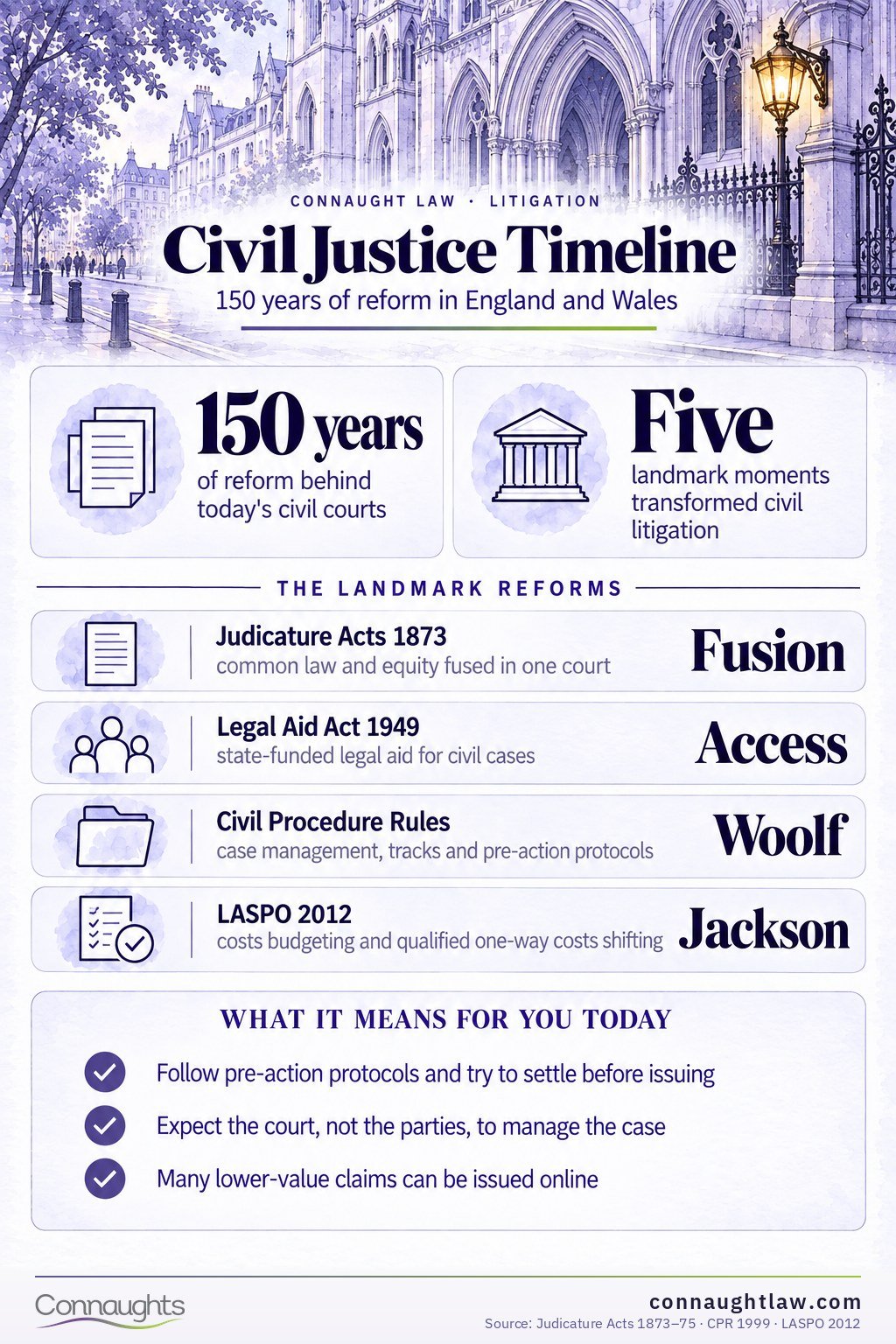
UK civil litigation was transformed by five landmark moments: the Judicature Acts of 1873–75 fused the common law and equity courts; the Legal Aid and Advice Act 1949 opened access to justice; the Woolf reforms produced the Civil Procedure Rules in 1999; the Jackson reforms and LASPO 2012 brought costs control; and the 2020s digital court added online claims, remote hearings and fixed recoverable costs.
The Judicature Acts and a Single Court (1873–1914)
Before the 1870s, England ran two parallel systems of justice: the common law courts and the courts of equity, each with its own rules and remedies, so a litigant could win in one and be defeated in the other. The Supreme Court of Judicature Acts 1873–1875 ended that division. They merged the old courts into a single Supreme Court of Judicature — comprising the High Court and the Court of Appeal — and provided that the same court could apply both common law and equity, with the rules of equity prevailing where the two conflicted.
This was the foundation of the modern structure. A unified court applying a single body of procedure replaced a patchwork that had grown unworkable, and the basic architecture the Acts created — a High Court of first instance and a Court of Appeal above it — remains recognisable today.
Interwar Modernisation (1919–1945)
The decades between the wars consolidated rather than revolutionised. The county courts, created in 1846 to handle lower-value claims cheaply, expanded their reach and became the everyday forum for ordinary disputes, easing pressure on the High Court. Administration of justice legislation tidied the rules and jurisdiction of the courts, and the specialist commercial jurisdiction that had emerged in the 1890s matured as trade disputes grew more complex.
The theme of the period was access and efficiency: making the courts usable for people and businesses of modest means, and separating routine work from the heavier litigation that needed the senior courts. These were incremental gains, but they set the direction for the access-to-justice reforms that followed the Second World War.
Legal Aid and the Welfare State (1946–1979)
The single most important post-war reform was the Legal Aid and Advice Act 1949, which introduced state-funded legal aid for civil cases. For the first time, people of limited means could obtain representation to bring or defend a claim, turning access to justice from a matter of private wealth into a public entitlement. It was part of the wider welfare-state settlement and reshaped who could realistically use the courts.
The same era saw the growth of specialised tribunals to handle the disputes generated by an expanding state — employment, social security, and more — diverting many matters from the ordinary courts into faster, more informal forums. The court system was no longer a single channel but a network, with the civil courts at its centre and tribunals handling defined areas alongside them.
Market Reforms and Funding Change (1980–1997)
The 1980s and 1990s brought market thinking to legal services. The Courts and Legal Services Act 1990 opened up rights of audience, loosening the monopolies over who could conduct and argue cases, and it introduced conditional fee agreements — the origin of "no win, no fee" litigation. As public legal aid came under pressure, these private funding mechanisms were promoted as an alternative route to justice.
Behind the scenes, the courts were also experimenting with active case management, the idea that a judge should take a grip on the pace and scope of a case rather than leaving it to the parties. Those experiments prepared the ground for the wholesale procedural reform that arrived at the end of the decade.
The Woolf Reforms and the CPR (1997–2010)
Lord Woolf's Access to Justice inquiry diagnosed a system that was too slow, too expensive and too adversarial, and his reforms produced the Civil Procedure Rules, which came into force in April 1999 and still govern civil litigation today. The CPR introduced an "overriding objective" of dealing with cases justly and at proportionate cost, put the court in charge of case management, and allocated claims to tracks — small claims, fast track and multi-track — according to value and complexity.
Pre-action protocols encouraged parties to exchange information and try to settle before issuing proceedings, and a new emphasis on alternative dispute resolution ran through the whole scheme. The Woolf reforms were the most significant change to civil procedure since the Judicature Acts, replacing the old rules with a single, managed, settlement-oriented system.
The Jackson Reforms and Costs Control (2010–2020)
If Woolf tackled delay, Sir Rupert Jackson's review tackled cost. His recommendations were largely implemented by the Legal Aid, Sentencing and Punishment of Offenders Act 2012, most of which took effect in April 2013. Recoverable success fees and after-the-event insurance premiums under conditional fee agreements were abolished, ending the arrangement by which a losing defendant paid the winner's uplift. Costs budgeting was introduced, requiring parties to set out and agree anticipated costs in advance.
The package also brought damages-based agreements, qualified one-way costs shifting to protect personal injury claimants, and a ban on referral fees. LASPO simultaneously withdrew civil legal aid from many areas, sharpening reliance on private funding. Together these changes made cost control, and the proportionality of spend to the value at stake, central to how litigation is run.
The Digital Court (2020 Onward)
The most recent chapter is digital. The COVID-19 pandemic forced the courts to hold hearings remotely almost overnight, and much of that shift proved durable: remote and hybrid hearings are now a normal part of civil practice. The wider HMCTS reform programme has moved routine work online, with Online Civil Money Claims letting many lower-value claims be issued and managed through a digital portal.
On costs, the fixed recoverable costs regime was extended on 1 October 2023 to most civil claims valued up to £100,000, introducing a new "intermediate track" and predictable, capped costs for a far wider range of cases. The direction of travel across 150 years has been consistent — towards a managed, proportionate and increasingly digital system — and understanding that arc makes the current rules, from costs budgets to online portals, far easier to use. For the tactics within that system, see our guides to Part 36 settlement offers and judicial review, or explore our wider litigation services.
Frequently Asked Questions
What were the most significant reforms in UK civil litigation history?
The five landmarks are the Judicature Acts 1873–75, which fused law and equity; the Legal Aid and Advice Act 1949; the Woolf reforms and the Civil Procedure Rules 1999; the Jackson reforms and LASPO 2012; and the 2020s digital court with online claims and fixed recoverable costs.
How did the Judicature Acts 1873 transform English civil courts?
They merged the separate common law and equity courts into a single Supreme Court of Judicature, comprising the High Court and Court of Appeal, and allowed one court to apply both bodies of law — with equity prevailing in any conflict. This created the modern court structure.
What impact did the Woolf reforms have on civil litigation?
They produced the Civil Procedure Rules, in force since April 1999, introducing the overriding objective, judicial case management, the small claims, fast and multi-track system, and pre-action protocols. They shifted civil litigation towards proportionate cost and early settlement.
What did the Jackson reforms and LASPO 2012 change?
From April 2013 they abolished recoverable success fees and ATE premiums, introduced costs budgeting and damages-based agreements, brought in qualified one-way costs shifting for personal injury claimants, and banned referral fees — placing cost control at the centre of litigation.
What is the fixed recoverable costs regime?
Extended on 1 October 2023, it sets predictable, capped costs for most civil claims valued up to £100,000 and created a new intermediate track. It is the latest major cost-control reform, building on the Jackson changes to make litigation spend more proportionate.
How has technology changed civil litigation?
The pandemic normalised remote and hybrid hearings, and the HMCTS reform programme has moved routine work online, including Online Civil Money Claims for lower-value disputes. Digital justice is now a standard feature rather than an experiment.
When was legal aid introduced for civil cases?
The Legal Aid and Advice Act 1949 introduced state-funded legal aid, allowing people of limited means to bring or defend civil claims. Its scope has since been narrowed, notably by LASPO 2012, but it marked the point at which access to justice became a public entitlement.
Why does the history of civil procedure matter today?
Every modern rule — costs budgets, pre-action protocols, online portals — answers a problem of an earlier era. Understanding why a rule exists makes it easier to apply, and shows the consistent direction of reform towards managed, proportionate and digital justice.
Expert Civil Litigation Support
Modern Procedure
We navigate the current rules — case management, costs budgets and fixed costs — so your claim is run efficiently and proportionately.
Strategic Advice
We use settlement tools and the tracks system to your advantage, keeping cost in step with what is at stake.
Clear Guidance
We explain where your case sits in today's system in plain terms, so you always understand the next step.
Whatever the dispute, the modern rules reward early, well-advised strategy — the litigation team at Connaught Law can guide your claim through today's civil courts and protect your position.
The information in this blog is for general information purposes only and does not purport to be comprehensive or to provide legal advice. Whilst every effort is made to ensure the information and law is current as of the date of publication it should be stressed that, due to the passage of time, this does not necessarily reflect the present legal position. Connaught Law and authors accept no responsibility for loss that may arise from accessing or reliance on information contained in this blog. For formal advice on the current law please don't hesitate to contact Connaught Law. Legal advice is only provided pursuant to a written agreement, identified as such, and signed by the client and by or on behalf of Connaught Law.
UK Civil Litigation History 1873-2026: Complete Legal Evolution Timeline
Modern civil litigation in England and Wales is the product of 150 years of reform. Every feature a litigant meets today — a single High Court, active case management, costs budgets, fixed costs, online claims — was an answer to a failure of the era before it. This timeline traces that evolution from the Judicature Acts of the 1870s to the digital court of the 2020s, and explains why understanding the history makes today's rules easier to navigate.
Understanding the Evolution of UK Civil Litigation
UK civil litigation was transformed by five landmark moments: the Judicature Acts of 1873–75 fused the common law and equity courts; the Legal Aid and Advice Act 1949 opened access to justice; the Woolf reforms produced the Civil Procedure Rules in 1999; the Jackson reforms and LASPO 2012 brought costs control; and the 2020s digital court added online claims, remote hearings and fixed recoverable costs.
The Judicature Acts and a Single Court (1873–1914)
Before the 1870s, England ran two parallel systems of justice: the common law courts and the courts of equity, each with its own rules and remedies, so a litigant could win in one and be defeated in the other. The Supreme Court of Judicature Acts 1873–1875 ended that division. They merged the old courts into a single Supreme Court of Judicature — comprising the High Court and the Court of Appeal — and provided that the same court could apply both common law and equity, with the rules of equity prevailing where the two conflicted.
This was the foundation of the modern structure. A unified court applying a single body of procedure replaced a patchwork that had grown unworkable, and the basic architecture the Acts created — a High Court of first instance and a Court of Appeal above it — remains recognisable today.
Interwar Modernisation (1919–1945)
The decades between the wars consolidated rather than revolutionised. The county courts, created in 1846 to handle lower-value claims cheaply, expanded their reach and became the everyday forum for ordinary disputes, easing pressure on the High Court. Administration of justice legislation tidied the rules and jurisdiction of the courts, and the specialist commercial jurisdiction that had emerged in the 1890s matured as trade disputes grew more complex.
The theme of the period was access and efficiency: making the courts usable for people and businesses of modest means, and separating routine work from the heavier litigation that needed the senior courts. These were incremental gains, but they set the direction for the access-to-justice reforms that followed the Second World War.
Legal Aid and the Welfare State (1946–1979)
The single most important post-war reform was the Legal Aid and Advice Act 1949, which introduced state-funded legal aid for civil cases. For the first time, people of limited means could obtain representation to bring or defend a claim, turning access to justice from a matter of private wealth into a public entitlement. It was part of the wider welfare-state settlement and reshaped who could realistically use the courts.
The same era saw the growth of specialised tribunals to handle the disputes generated by an expanding state — employment, social security, and more — diverting many matters from the ordinary courts into faster, more informal forums. The court system was no longer a single channel but a network, with the civil courts at its centre and tribunals handling defined areas alongside them.
Market Reforms and Funding Change (1980–1997)
The 1980s and 1990s brought market thinking to legal services. The Courts and Legal Services Act 1990 opened up rights of audience, loosening the monopolies over who could conduct and argue cases, and it introduced conditional fee agreements — the origin of "no win, no fee" litigation. As public legal aid came under pressure, these private funding mechanisms were promoted as an alternative route to justice.
Behind the scenes, the courts were also experimenting with active case management, the idea that a judge should take a grip on the pace and scope of a case rather than leaving it to the parties. Those experiments prepared the ground for the wholesale procedural reform that arrived at the end of the decade.
The Woolf Reforms and the CPR (1997–2010)
Lord Woolf's Access to Justice inquiry diagnosed a system that was too slow, too expensive and too adversarial, and his reforms produced the Civil Procedure Rules, which came into force in April 1999 and still govern civil litigation today. The CPR introduced an "overriding objective" of dealing with cases justly and at proportionate cost, put the court in charge of case management, and allocated claims to tracks — small claims, fast track and multi-track — according to value and complexity.
Pre-action protocols encouraged parties to exchange information and try to settle before issuing proceedings, and a new emphasis on alternative dispute resolution ran through the whole scheme. The Woolf reforms were the most significant change to civil procedure since the Judicature Acts, replacing the old rules with a single, managed, settlement-oriented system.
The Jackson Reforms and Costs Control (2010–2020)
If Woolf tackled delay, Sir Rupert Jackson's review tackled cost. His recommendations were largely implemented by the Legal Aid, Sentencing and Punishment of Offenders Act 2012, most of which took effect in April 2013. Recoverable success fees and after-the-event insurance premiums under conditional fee agreements were abolished, ending the arrangement by which a losing defendant paid the winner's uplift. Costs budgeting was introduced, requiring parties to set out and agree anticipated costs in advance.
The package also brought damages-based agreements, qualified one-way costs shifting to protect personal injury claimants, and a ban on referral fees. LASPO simultaneously withdrew civil legal aid from many areas, sharpening reliance on private funding. Together these changes made cost control, and the proportionality of spend to the value at stake, central to how litigation is run.
The Digital Court (2020 Onward)
The most recent chapter is digital. The COVID-19 pandemic forced the courts to hold hearings remotely almost overnight, and much of that shift proved durable: remote and hybrid hearings are now a normal part of civil practice. The wider HMCTS reform programme has moved routine work online, with Online Civil Money Claims letting many lower-value claims be issued and managed through a digital portal.
On costs, the fixed recoverable costs regime was extended on 1 October 2023 to most civil claims valued up to £100,000, introducing a new "intermediate track" and predictable, capped costs for a far wider range of cases. The direction of travel across 150 years has been consistent — towards a managed, proportionate and increasingly digital system — and understanding that arc makes the current rules, from costs budgets to online portals, far easier to use. For the tactics within that system, see our guides to Part 36 settlement offers and judicial review, or explore our wider litigation services.
Frequently Asked Questions
What were the most significant reforms in UK civil litigation history?
The five landmarks are the Judicature Acts 1873–75, which fused law and equity; the Legal Aid and Advice Act 1949; the Woolf reforms and the Civil Procedure Rules 1999; the Jackson reforms and LASPO 2012; and the 2020s digital court with online claims and fixed recoverable costs.
How did the Judicature Acts 1873 transform English civil courts?
They merged the separate common law and equity courts into a single Supreme Court of Judicature, comprising the High Court and Court of Appeal, and allowed one court to apply both bodies of law — with equity prevailing in any conflict. This created the modern court structure.
What impact did the Woolf reforms have on civil litigation?
They produced the Civil Procedure Rules, in force since April 1999, introducing the overriding objective, judicial case management, the small claims, fast and multi-track system, and pre-action protocols. They shifted civil litigation towards proportionate cost and early settlement.
What did the Jackson reforms and LASPO 2012 change?
From April 2013 they abolished recoverable success fees and ATE premiums, introduced costs budgeting and damages-based agreements, brought in qualified one-way costs shifting for personal injury claimants, and banned referral fees — placing cost control at the centre of litigation.
What is the fixed recoverable costs regime?
Extended on 1 October 2023, it sets predictable, capped costs for most civil claims valued up to £100,000 and created a new intermediate track. It is the latest major cost-control reform, building on the Jackson changes to make litigation spend more proportionate.
How has technology changed civil litigation?
The pandemic normalised remote and hybrid hearings, and the HMCTS reform programme has moved routine work online, including Online Civil Money Claims for lower-value disputes. Digital justice is now a standard feature rather than an experiment.
When was legal aid introduced for civil cases?
The Legal Aid and Advice Act 1949 introduced state-funded legal aid, allowing people of limited means to bring or defend civil claims. Its scope has since been narrowed, notably by LASPO 2012, but it marked the point at which access to justice became a public entitlement.
Why does the history of civil procedure matter today?
Every modern rule — costs budgets, pre-action protocols, online portals — answers a problem of an earlier era. Understanding why a rule exists makes it easier to apply, and shows the consistent direction of reform towards managed, proportionate and digital justice.
We navigate the current rules — case management, costs budgets and fixed costs — so your claim is run efficiently and proportionately.
We use settlement tools and the tracks system to your advantage, keeping cost in step with what is at stake.
We explain where your case sits in today's system in plain terms, so you always understand the next step.
Whatever the dispute, the modern rules reward early, well-advised strategy — the litigation team at Connaught Law can guide your claim through today's civil courts and protect your position.
Speak to UsDisclaimer:
The information in this blog is for general information purposes only and does not purport to be comprehensive or to provide legal advice. Whilst every effort is made to ensure the information and law is current as of the date of publication it should be stressed that, due to the passage of time, this does not necessarily reflect the present legal position. Connaught Law and authors accept no responsibility for loss that may arise from accessing or reliance on information contained in this blog. For formal advice on the current law please don't hesitate to contact Connaught Law. Legal advice is only provided pursuant to a written agreement, identified as such, and signed by the client and by or on behalf of Connaught Law.