Judicial review is the process by which the High Court checks whether a public body has acted lawfully. It is not an appeal on the merits: the court asks whether a decision was made properly, not whether it was the right decision. This guide explains what judicial review covers, the strict time limits, the grounds, the permission stage, the remedies available, and the recent reforms that have narrowed some routes — for civil and public-law challenges in England and Wales.
Judicial review is a High Court challenge to the lawfulness of a decision, action or failure to act by a public body. The court reviews how the decision was made — its legality, rationality and fairness — not whether it was correct. A claim must usually be brought promptly and within three months, after first using any other remedy such as an appeal or complaint.
What Judicial Review Is, and What It Is Not
Judicial review is a challenge to the way a public body has exercised its powers. It is available against government departments, local authorities, regulators, and other bodies performing public functions, where there is no other suitable route to challenge the decision. The court's role is supervisory: it polices the limits of a decision-maker's powers rather than substituting its own view of the merits.
That distinction is the single most important thing to understand. A claimant who simply disagrees with the outcome — a refused licence, a planning permission, a funding decision — does not have a judicial review claim on that basis alone. What is required is a legal flaw in how the decision was reached. If the flaw is made out, the usual result is that the decision is quashed and sent back to be taken again lawfully, not that the court orders the outcome the claimant wanted.
This post concerns civil and public-law judicial review. Immigration and asylum challenges follow their own specialised procedures and are dealt with separately; the principles overlap, but the forum and rules differ.
The Supervisory Jurisdiction
Because the jurisdiction is supervisory, judicial review is a remedy of last resort. The courts expect a claimant to have exhausted alternative remedies first — a statutory appeal, an internal review, a complaint to an ombudsman — and permission can be refused where a suitable alternative was not used. Understanding that threshold before issuing saves cost and avoids a claim being filtered out early; our judicial review solicitors assess that at the outset.
Time Limits and the Process Step by Step
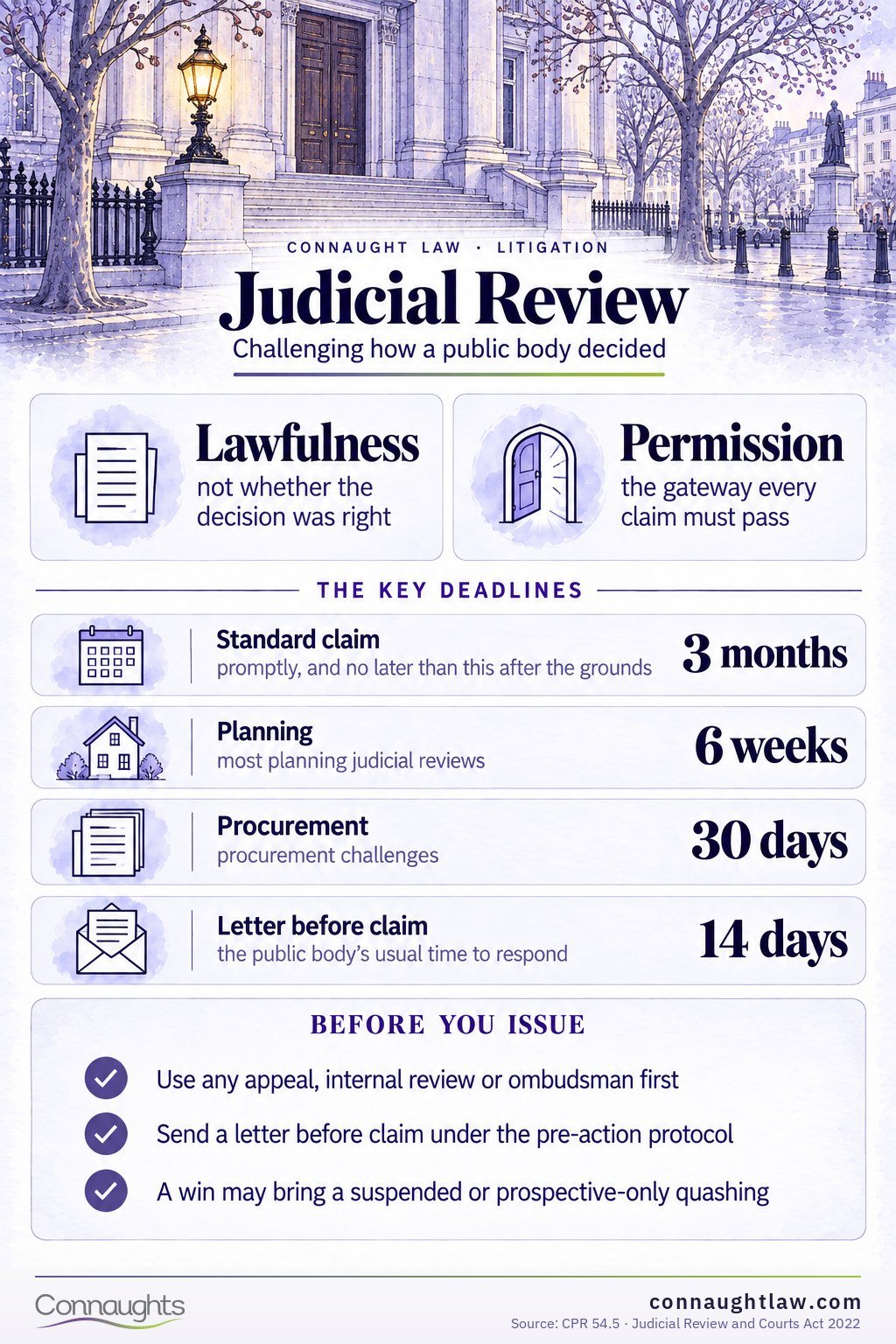
Time limits in judicial review are strict and short. Under Civil Procedure Rule 54.5, a claim must be filed promptly, and in any event no later than three months after the grounds first arose. "Promptly" is a separate obligation: a claim brought within three months can still be refused as too late if it could reasonably have been issued sooner. Two specialist limits are shorter still — six weeks for most planning judicial reviews and 30 days for procurement challenges.
The process begins before any claim is filed. The Pre-Action Protocol for Judicial Review expects the claimant to send a letter before claim setting out the challenge and giving the public body a chance to respond, usually within 14 days. If the matter is not resolved, the claim is issued and the court considers permission on the papers. Only if permission is granted does the claim proceed to a substantive hearing.
The Permission Stage
Permission is the gateway. A judge reviews the papers and decides whether the claim is arguable and whether the procedural requirements — time limits, standing, use of alternatives — are met. Unarguable or out-of-time claims are filtered out here. If permission is refused on the papers, the claimant can usually ask for the decision to be reconsidered at an oral renewal hearing.
What Actually Happens to Judicial Review Claims
Most judicial review claims do not reach a substantive hearing. The permission stage filters out a large proportion, and many others settle or are withdrawn once the public body reconsiders or concedes. A claim that survives permission has already cleared the main hurdle, because the court has accepted it is arguable — but even then success at the final hearing is far from guaranteed.
Reliable, current figures on volumes and outcomes are published quarterly by the Ministry of Justice in its Civil Justice Statistics. The practical point for a prospective claimant is that judicial review is a demanding remedy with a real attrition rate at each stage, so the strength of the legal grounds and the quality of the evidence matter far more than the underlying grievance.
Costs, Fees and Funding the Claim
Judicial review carries court fees at issue and, if permission is granted, at the substantive hearing stage. Beyond the fees, the significant financial exposure is the ordinary costs rule: the unsuccessful party generally pays the other side's legal costs, so a claimant who loses may face the public body's costs as well as their own.
Several mechanisms manage that risk. Legal aid may be available for those who qualify on means and merits, particularly in cases raising significant public-law issues. In environmental challenges falling under the Aarhus Convention, costs are capped to keep access to justice affordable. The court can also make a costs capping order in appropriate public-interest cases. Because the fee levels and thresholds change, they should be checked against the current guidance before issuing.
Recent Reforms: New Remedies and Narrower Routes
The most significant recent change is the Judicial Review and Courts Act 2022, in force from 14 July 2022. It reshaped both the remedies available and the routes into judicial review, and it remains the current framework.
On remedies, the Act inserted a new section 29A into the Senior Courts Act 1981, giving the court two additional tools alongside the traditional quashing order. A suspended quashing order lets the court delay when a quashing takes effect, giving a public body time to correct the defect. A prospective-only quashing order limits the effect of a quashing to the future, so past actions taken under the unlawful decision are not unwound. The court weighs a list of statutory factors when deciding whether to use these powers.
On routes in, the Act abolished so-called "Cart" judicial reviews — challenges to Upper Tribunal refusals of permission to appeal — by inserting section 11A into the Tribunals, Courts and Enforcement Act 2007. That closed off a category of challenge that had previously been available, and it is one reason to take early advice on whether judicial review is still the right route in a given case.
Why the Reforms Matter
Note — Remedies Are Now More Flexible
Since the 2022 Act, a successful claimant cannot assume a decision will be quashed with full retrospective effect. The court may suspend the quashing or make it prospective only, which changes the practical value of a win — a point worth weighing before litigation.
The Grounds for Review
A judicial review must be founded on a recognised legal ground, not simply dissatisfaction. The established grounds group under three broad headings, though they overlap in practice.
Illegality means the decision-maker misunderstood or exceeded its legal powers — acting outside its authority, misdirecting itself in law, taking irrelevant matters into account, or ignoring relevant ones. Irrationality (or "Wednesbury unreasonableness") means the decision was so unreasonable that no reasonable authority could have reached it — a high bar. Procedural unfairness means the process was flawed: a failure to consult where required, bias or the appearance of bias, or a breach of the duty to give a fair hearing. Legitimate expectation and breaches of the Human Rights Act 1998 also feature as grounds.
Grounds in Practice
Key Points — The Main Grounds
Illegality: the body acted beyond its powers, misapplied the law, or considered the wrong matters.
Irrationality: the decision was one no reasonable authority could have made.
Procedural unfairness: unfair process, bias, or failure to consult or give reasons.
Legitimate expectation: a clear promise or established practice was departed from unfairly.
Renewals, Appeals and Onward Challenges
If permission is refused on the papers, the usual next step is an oral renewal hearing, where the claimant can argue the point in person before a judge. If permission is refused again, or if the substantive claim fails, an appeal may lie to the Court of Appeal, and in cases of general public importance ultimately to the Supreme Court — subject to permission at each stage.
These onward routes are themselves governed by short deadlines and permission filters, so a claimant who wants to challenge a refusal must act quickly and take advice on the prospects. Given the cost exposure, the decision to renew or appeal should be made on a realistic assessment of the legal grounds rather than persistence alone.
Alternatives to Judicial Review
Because judicial review is a remedy of last resort, the alternatives are not a side issue — they are often the better route, and failing to use them can defeat a claim. A statutory right of appeal, where one exists, is usually the correct and cheaper path. Internal review or reconsideration procedures can resolve many disputes without litigation.
An ombudsman — such as the Parliamentary and Health Service Ombudsman or the Local Government and Social Care Ombudsman — can investigate maladministration and recommend a remedy, though ombudsman findings are not binding in the way a court order is. Complaints procedures, alternative dispute resolution, and direct negotiation with the public body should all be considered before issuing. For related civil-procedure tactics, our guide to Part 36 settlement offers explains how settlement pressure works in civil claims.
Frequently Asked Questions
What is judicial review in the UK?
Judicial review is a High Court process for challenging the lawfulness of a decision, action or failure to act by a public body. The court examines whether the decision was made legally, rationally and fairly — not whether it was the right decision on the merits.
What is the time limit for judicial review?
A claim must be brought promptly and in any event within three months of the grounds arising, under CPR 54.5. Shorter limits apply in some fields — six weeks for most planning challenges and 30 days for procurement. "Promptly" is a separate duty, so waiting close to three months can still be too late.
What are the grounds for judicial review?
The main grounds are illegality (acting outside legal powers), irrationality (a decision no reasonable authority could reach), and procedural unfairness (an unfair process, bias, or failure to consult). Legitimate expectation and breaches of the Human Rights Act 1998 can also form grounds.
How much does judicial review cost?
There are court fees at issue and at the substantive hearing, plus your own legal costs and the risk of paying the other side's costs if you lose. Legal aid, Aarhus cost caps in environmental cases, and costs capping orders can limit exposure. Check current fee levels before issuing.
What happens at the permission stage?
A judge reviews the papers and decides whether the claim is arguable and procedurally proper. Unarguable or out-of-time claims are filtered out. If permission is refused on the papers, you can usually renew the application at an oral hearing.
Can judicial review change the decision in my favour?
Usually the court quashes an unlawful decision and sends it back to be retaken lawfully, rather than ordering a particular outcome. Since the Judicial Review and Courts Act 2022, the court can also suspend a quashing order or make it prospective only, which affects the practical result of a win.
Is judicial review different for immigration cases?
Yes. Immigration and asylum judicial reviews follow specialised procedures, often in the Upper Tribunal, with their own rules and deadlines. This guide covers civil and public-law judicial review; immigration challenges should be taken with advice specific to that jurisdiction.
Should I try something else before judicial review?
Almost always. Judicial review is a remedy of last resort, so you should first use any statutory appeal, internal review, ombudsman or complaint procedure. Failing to exhaust a suitable alternative is itself a reason permission can be refused.
Expert Judicial Review Support
Early Assessment
We test whether you have arguable grounds and a viable route before the short time limits close off the option.
Permission and Hearing
We prepare the letter before claim, grounds and evidence to give the claim its best chance at the permission stage.
Realistic Advice
We tell you honestly where a claim stands, including whether an appeal or complaint would serve you better.
If a public body has made a decision that affects you, the time limits are short — the public law team at Connaught Law can assess your grounds quickly and advise on the right way forward.
The information in this blog is for general information purposes only and does not purport to be comprehensive or to provide legal advice. Whilst every effort is made to ensure the information and law is current as of the date of publication it should be stressed that, due to the passage of time, this does not necessarily reflect the present legal position. Connaught Law and authors accept no responsibility for loss that may arise from accessing or reliance on information contained in this blog. For formal advice on the current law please don't hesitate to contact Connaught Law. Legal advice is only provided pursuant to a written agreement, identified as such, and signed by the client and by or on behalf of Connaught Law.
Judicial Review UK 2026: Complete Legal Guide & Success Rates
Judicial review is the process by which the High Court checks whether a public body has acted lawfully. It is not an appeal on the merits: the court asks whether a decision was made properly, not whether it was the right decision. This guide explains what judicial review covers, the strict time limits, the grounds, the permission stage, the remedies available, and the recent reforms that have narrowed some routes — for civil and public-law challenges in England and Wales.
Understanding Judicial Review in the UK
Judicial review is a High Court challenge to the lawfulness of a decision, action or failure to act by a public body. The court reviews how the decision was made — its legality, rationality and fairness — not whether it was correct. A claim must usually be brought promptly and within three months, after first using any other remedy such as an appeal or complaint.
What Judicial Review Is, and What It Is Not
Judicial review is a challenge to the way a public body has exercised its powers. It is available against government departments, local authorities, regulators, and other bodies performing public functions, where there is no other suitable route to challenge the decision. The court's role is supervisory: it polices the limits of a decision-maker's powers rather than substituting its own view of the merits.
That distinction is the single most important thing to understand. A claimant who simply disagrees with the outcome — a refused licence, a planning permission, a funding decision — does not have a judicial review claim on that basis alone. What is required is a legal flaw in how the decision was reached. If the flaw is made out, the usual result is that the decision is quashed and sent back to be taken again lawfully, not that the court orders the outcome the claimant wanted.
This post concerns civil and public-law judicial review. Immigration and asylum challenges follow their own specialised procedures and are dealt with separately; the principles overlap, but the forum and rules differ.
The Supervisory Jurisdiction
Because the jurisdiction is supervisory, judicial review is a remedy of last resort. The courts expect a claimant to have exhausted alternative remedies first — a statutory appeal, an internal review, a complaint to an ombudsman — and permission can be refused where a suitable alternative was not used. Understanding that threshold before issuing saves cost and avoids a claim being filtered out early; our judicial review solicitors assess that at the outset.
Time Limits and the Process Step by Step
Time limits in judicial review are strict and short. Under Civil Procedure Rule 54.5, a claim must be filed promptly, and in any event no later than three months after the grounds first arose. "Promptly" is a separate obligation: a claim brought within three months can still be refused as too late if it could reasonably have been issued sooner. Two specialist limits are shorter still — six weeks for most planning judicial reviews and 30 days for procurement challenges.
The process begins before any claim is filed. The Pre-Action Protocol for Judicial Review expects the claimant to send a letter before claim setting out the challenge and giving the public body a chance to respond, usually within 14 days. If the matter is not resolved, the claim is issued and the court considers permission on the papers. Only if permission is granted does the claim proceed to a substantive hearing.
The Permission Stage
Permission is the gateway. A judge reviews the papers and decides whether the claim is arguable and whether the procedural requirements — time limits, standing, use of alternatives — are met. Unarguable or out-of-time claims are filtered out here. If permission is refused on the papers, the claimant can usually ask for the decision to be reconsidered at an oral renewal hearing.
What Actually Happens to Judicial Review Claims
Most judicial review claims do not reach a substantive hearing. The permission stage filters out a large proportion, and many others settle or are withdrawn once the public body reconsiders or concedes. A claim that survives permission has already cleared the main hurdle, because the court has accepted it is arguable — but even then success at the final hearing is far from guaranteed.
Reliable, current figures on volumes and outcomes are published quarterly by the Ministry of Justice in its Civil Justice Statistics. The practical point for a prospective claimant is that judicial review is a demanding remedy with a real attrition rate at each stage, so the strength of the legal grounds and the quality of the evidence matter far more than the underlying grievance.
Costs, Fees and Funding the Claim
Judicial review carries court fees at issue and, if permission is granted, at the substantive hearing stage. Beyond the fees, the significant financial exposure is the ordinary costs rule: the unsuccessful party generally pays the other side's legal costs, so a claimant who loses may face the public body's costs as well as their own.
Several mechanisms manage that risk. Legal aid may be available for those who qualify on means and merits, particularly in cases raising significant public-law issues. In environmental challenges falling under the Aarhus Convention, costs are capped to keep access to justice affordable. The court can also make a costs capping order in appropriate public-interest cases. Because the fee levels and thresholds change, they should be checked against the current guidance before issuing.
Recent Reforms: New Remedies and Narrower Routes
The most significant recent change is the Judicial Review and Courts Act 2022, in force from 14 July 2022. It reshaped both the remedies available and the routes into judicial review, and it remains the current framework.
On remedies, the Act inserted a new section 29A into the Senior Courts Act 1981, giving the court two additional tools alongside the traditional quashing order. A suspended quashing order lets the court delay when a quashing takes effect, giving a public body time to correct the defect. A prospective-only quashing order limits the effect of a quashing to the future, so past actions taken under the unlawful decision are not unwound. The court weighs a list of statutory factors when deciding whether to use these powers.
On routes in, the Act abolished so-called "Cart" judicial reviews — challenges to Upper Tribunal refusals of permission to appeal — by inserting section 11A into the Tribunals, Courts and Enforcement Act 2007. That closed off a category of challenge that had previously been available, and it is one reason to take early advice on whether judicial review is still the right route in a given case.
Why the Reforms Matter
Since the 2022 Act, a successful claimant cannot assume a decision will be quashed with full retrospective effect. The court may suspend the quashing or make it prospective only, which changes the practical value of a win — a point worth weighing before litigation.
The Grounds for Review
A judicial review must be founded on a recognised legal ground, not simply dissatisfaction. The established grounds group under three broad headings, though they overlap in practice.
Illegality means the decision-maker misunderstood or exceeded its legal powers — acting outside its authority, misdirecting itself in law, taking irrelevant matters into account, or ignoring relevant ones. Irrationality (or "Wednesbury unreasonableness") means the decision was so unreasonable that no reasonable authority could have reached it — a high bar. Procedural unfairness means the process was flawed: a failure to consult where required, bias or the appearance of bias, or a breach of the duty to give a fair hearing. Legitimate expectation and breaches of the Human Rights Act 1998 also feature as grounds.
Grounds in Practice
Renewals, Appeals and Onward Challenges
If permission is refused on the papers, the usual next step is an oral renewal hearing, where the claimant can argue the point in person before a judge. If permission is refused again, or if the substantive claim fails, an appeal may lie to the Court of Appeal, and in cases of general public importance ultimately to the Supreme Court — subject to permission at each stage.
These onward routes are themselves governed by short deadlines and permission filters, so a claimant who wants to challenge a refusal must act quickly and take advice on the prospects. Given the cost exposure, the decision to renew or appeal should be made on a realistic assessment of the legal grounds rather than persistence alone.
Alternatives to Judicial Review
Because judicial review is a remedy of last resort, the alternatives are not a side issue — they are often the better route, and failing to use them can defeat a claim. A statutory right of appeal, where one exists, is usually the correct and cheaper path. Internal review or reconsideration procedures can resolve many disputes without litigation.
An ombudsman — such as the Parliamentary and Health Service Ombudsman or the Local Government and Social Care Ombudsman — can investigate maladministration and recommend a remedy, though ombudsman findings are not binding in the way a court order is. Complaints procedures, alternative dispute resolution, and direct negotiation with the public body should all be considered before issuing. For related civil-procedure tactics, our guide to Part 36 settlement offers explains how settlement pressure works in civil claims.
Frequently Asked Questions
What is judicial review in the UK?
Judicial review is a High Court process for challenging the lawfulness of a decision, action or failure to act by a public body. The court examines whether the decision was made legally, rationally and fairly — not whether it was the right decision on the merits.
What is the time limit for judicial review?
A claim must be brought promptly and in any event within three months of the grounds arising, under CPR 54.5. Shorter limits apply in some fields — six weeks for most planning challenges and 30 days for procurement. "Promptly" is a separate duty, so waiting close to three months can still be too late.
What are the grounds for judicial review?
The main grounds are illegality (acting outside legal powers), irrationality (a decision no reasonable authority could reach), and procedural unfairness (an unfair process, bias, or failure to consult). Legitimate expectation and breaches of the Human Rights Act 1998 can also form grounds.
How much does judicial review cost?
There are court fees at issue and at the substantive hearing, plus your own legal costs and the risk of paying the other side's costs if you lose. Legal aid, Aarhus cost caps in environmental cases, and costs capping orders can limit exposure. Check current fee levels before issuing.
What happens at the permission stage?
A judge reviews the papers and decides whether the claim is arguable and procedurally proper. Unarguable or out-of-time claims are filtered out. If permission is refused on the papers, you can usually renew the application at an oral hearing.
Can judicial review change the decision in my favour?
Usually the court quashes an unlawful decision and sends it back to be retaken lawfully, rather than ordering a particular outcome. Since the Judicial Review and Courts Act 2022, the court can also suspend a quashing order or make it prospective only, which affects the practical result of a win.
Is judicial review different for immigration cases?
Yes. Immigration and asylum judicial reviews follow specialised procedures, often in the Upper Tribunal, with their own rules and deadlines. This guide covers civil and public-law judicial review; immigration challenges should be taken with advice specific to that jurisdiction.
Should I try something else before judicial review?
Almost always. Judicial review is a remedy of last resort, so you should first use any statutory appeal, internal review, ombudsman or complaint procedure. Failing to exhaust a suitable alternative is itself a reason permission can be refused.
We test whether you have arguable grounds and a viable route before the short time limits close off the option.
We prepare the letter before claim, grounds and evidence to give the claim its best chance at the permission stage.
We tell you honestly where a claim stands, including whether an appeal or complaint would serve you better.
If a public body has made a decision that affects you, the time limits are short — the public law team at Connaught Law can assess your grounds quickly and advise on the right way forward.
Speak to UsDisclaimer:
The information in this blog is for general information purposes only and does not purport to be comprehensive or to provide legal advice. Whilst every effort is made to ensure the information and law is current as of the date of publication it should be stressed that, due to the passage of time, this does not necessarily reflect the present legal position. Connaught Law and authors accept no responsibility for loss that may arise from accessing or reliance on information contained in this blog. For formal advice on the current law please don't hesitate to contact Connaught Law. Legal advice is only provided pursuant to a written agreement, identified as such, and signed by the client and by or on behalf of Connaught Law.