
Where can you travel on a UK Home Office travel document without a visa? Fewer places than most lists claim — and the honest answer changes by document type: the blue 1951 Convention refugee document opens the most doors, the black certificate of travel the fewest. This guide keeps three lists current — confirmed visa-free destinations, countries where the embassy must be asked first, and countries requiring visas — with the verification method that protects every trip.
On This Page

Why Any List Here Must Be Verified
No official public register states where UK travel documents are accepted visa-free — each destination sets its own policy, changes it without notice, and applies it differently by document type. The lists below are working intelligence, not law: the visa-free table reflects consistent recent practice, the verification table names countries whose position is genuinely unsettled, and every trip should be confirmed with the destination's embassy before booking. That discipline is the difference between a holiday and a refused boarding.
Document Types
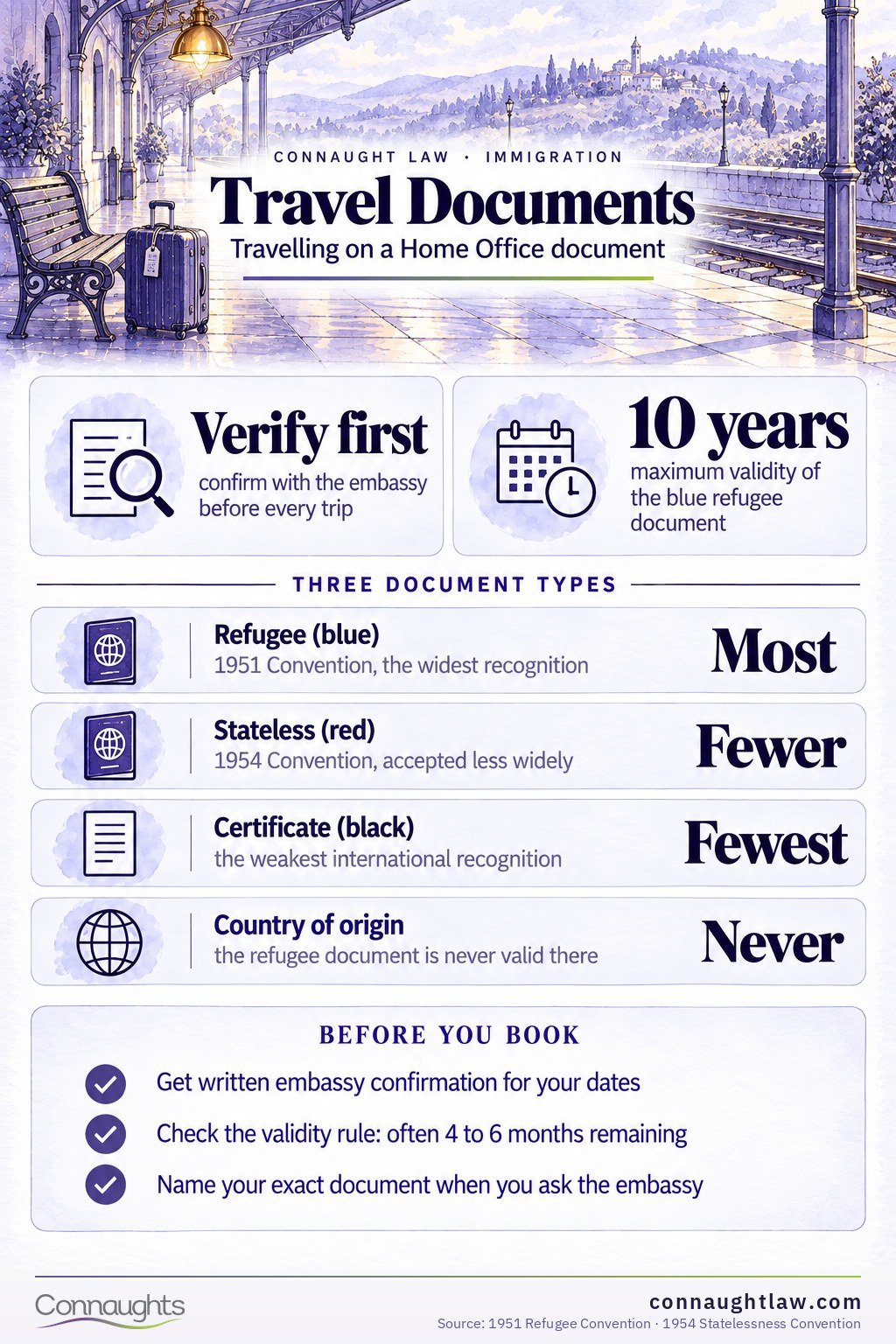
1951 Convention Refugee Document (Blue)
Issued to recognised refugees under the Home Office travel document scheme at £102 for adults and £66.50 for children, valid up to ten years with settled status. It is the most widely accepted of the three — the 1951 Convention's signatories built reciprocal arrangements around it, including the Council of Europe's 1959 visa-waiver agreement that still underpins several European policies. It is never valid for travel to your country of origin.
Stateless Person's Document (Red)
Issued under the 1954 Convention to those the UK recognises as stateless. Acceptance tracks the refugee document's map imperfectly — fewer states ratified the 1954 instrument — so the verification rule applies with extra force: name the document precisely when asking embassies, because "travel document" answers are worthless unless they answer for yours.
Certificate of Travel (Black)
Issued to those with leave to remain who cannot obtain a national passport but fall outside both conventions. It carries the weakest international recognition — several countries that admit refugee-document holders visa-free require certificate holders to obtain visas, Finland being a documented example. Certificate holders should treat every destination as verify-first.
Visa-Free Destinations
Where Refugee Document Holders Travel Visa-Free
Confirmed Visa-Free Entry
| Country | Embassy link | Stay duration | Requirements |
|---|---|---|---|
| Germany | German Embassy London | 90 days in 180 | Document validity 4+ months, valid UK residence status |
| Belgium | Belgian Embassy London | 90 days (verify first) | Embassy verification essential — policy can change |
| Bosnia and Herzegovina | Bosnian Embassy London | 90 days | Valid UK residence documentation required |
| Georgia | Georgian Embassy London | 90 days (verify current) | Confirm before travel — policy changes possible |
| Trinidad and Tobago | T&T High Commission | 90 days | Commonwealth country with traditional acceptance |
Even these five carry the verification caveat: Germany's position is the most stable, anchored in the 1959 agreement; the others have honoured visa-free entry consistently but publish little, which is why the embassy call before booking stays mandatory.
Verify-First Countries
Countries Whose Position Must Be Confirmed
| Country | Embassy contact | Status | Notes |
|---|---|---|---|
| Albania | Albanian Embassy London | Uncertain | Embassy verification essential |
| Andorra | Andorran Government | Unclear | Spain handles Andorran interests — ask both |
| Bulgaria | Bulgarian Embassy London | Post-Brexit changes | EU member — verify current policy |
| Croatia | Croatian MFA | Uncertain | Schengen member since 2023 — confirm requirements |
| Czech Republic | Czech Embassy London | Uncertain | Embassy verification required |
| Estonia | Estonian Embassy London | Post-Brexit changes | Verify current policy |
| Finland | Finnish Embassy London | Verification required | Certificate of travel holders need a Schengen visa |
| France | French Embassy London | Verification required | Major Schengen state — confirm before travel |
| Greece | Greek MFA | Uncertain | Embassy verification essential |
| Hungary | Hungarian Embassy London | Post-Brexit changes | Verify current requirements |
| Iceland | Icelandic Embassy London | Uncertain | Non-EU Schengen member — verify policy |
| Kosovo | Kosovo Embassy London | Disputed | Limited recognition — verification crucial |
| Latvia | Latvian Embassy London | Post-Brexit changes | Verify requirements |
| Liechtenstein | Swiss Embassy (represents) | Uncertain | Represented by Switzerland — verify policy |
| Lithuania | Lithuanian Embassy London | Post-Brexit changes | Embassy verification required |
| Luxembourg | Luxembourg Embassy London | Uncertain | Verify current policy |
| Malta | Maltese High Commission | Uncertain | Commonwealth and EU member — verify requirements |
| Moldova | Moldovan Embassy London | Uncertain | Embassy verification required |
| Monaco | French Embassy (represents) | Via France | Contact the French Embassy for Monaco requirements |
| Norway | Norwegian Embassy London | Limited acceptance | Accepts documents from specific issuing countries only |
| Poland | Polish Embassy London | Post-Brexit changes | Verify current requirements |
| Portugal | Portuguese Embassy London | Uncertain | Embassy verification essential |
| Romania | Romanian Embassy London | Post-Brexit changes | Verify current policy |
| Slovakia | Slovak Embassy London | Uncertain | Embassy verification required |
| Slovenia | Slovenian Government | Uncertain | Verify requirements |
| Spain | Spanish MFA | Verification required | Major Schengen state — confirm before travel |
| Sweden | Swedish Embassy London | Post-Brexit changes | Verify current policy |
| Switzerland | Swiss Embassy London | Verification required | Non-EU Schengen member — confirmation needed |
| Thailand | Thai Embassy network | Traditional acceptance | Historical visa-free access — verify current policy |
Visa-Required Countries
Confirmed Visa Requirements
Where a Visa Must Be Obtained First
| Country | Where to apply | Lead time | Notes |
|---|---|---|---|
| Italy | Italian Consulate London | 15–30 days | Schengen visa required since March 2017 |
| Denmark | Danish Embassy London | 15–60 days | Visa required for UK documents since Brexit |
| Netherlands | Netherlands Worldwide | 15–45 days | Embassy verification essential on category |
| United States | US Embassy London | 2–12 weeks | Interview required, extensive documentation |
| Canada | Canadian visa offices | 2–8 weeks | Online application, biometrics required |
| Australia | Australian Home Affairs | 1–4 weeks | Online visitor visa application required |
| United Arab Emirates | UAE Embassy London | 2–5 days | Does not accept refugee travel documents |
| Qatar | Qatari Embassy London | 1–3 days | Requires a national passport — travel documents not accepted |
Embassy Verification
The Verification Process
Verify in writing where possible — an email answer names its author and date, which matters at the airport. Contact the destination's London embassy two to four weeks before booking, state the exact document, and ask for the answer to be confirmed for your travel dates. Airline check-in staff apply their carrier's database, not the embassy's goodwill, so where practice and database disagree, the written confirmation is what argues your case.
Questions to Ask Embassy Staff
- Name the document precisely: 1951 Convention refugee document (blue), stateless person's document (red), or certificate of travel (black).
- Confirm your UK status: state your leave and its evidence — some countries require a valid UK residence permit alongside the document.
- State purpose and length: tourism, family or business, with dates.
- Ask the validity rule: many destinations require 4–6 months' remaining document validity.
- Ask about return requirements: onward tickets, funds evidence, insurance.
Post-Brexit Changes
The European Agreement Question
Much pre-2021 visa-free travel rested on the Council of Europe's 1959 agreement waiving visas for refugee-document holders between ratifying states. The agreement predates the EU and survives Brexit — but several states apply it only to documents issued by current parties in good standing, and administrative practice toward UK documents has diverged since withdrawal. That divergence, not any single rule change, is why so many European countries sit in the verify-first table.
Digitised Borders and What Comes Next
Schengen's borders are also digitising: the Entry/Exit System now registers all third-country travellers biometrically, and the coming ETIAS authorisation will screen visa-exempt travellers — developments we track in our ETIAS guide. Travel document holders should expect the automated layer to apply the written rules exactly, ending the informal tolerance some borders extended to familiar documents.
Travel Planning
Verification Timeline
Work backwards from departure: 90 days out, check document validity (six months' margin) and begin embassy verification; 60 days out, lodge any visa applications and arrange insurance that covers travel document holders; 30 days out, confirm everything in writing and copy every document; the final week, re-confirm with the embassy and prepare an emergency contact sheet. The rhythm exists because each step's failure is recoverable only while the previous one still has time left.
Documentation for the Journey
Carry the travel document with your UK biometric evidence of status, the embassy's written confirmation, insurance, and onward tickets — and carry copies separately from originals. Your UK immigration status is what anchors re-entry; keep its digital proof accessible, and know the recovery steps before you need them.
Emergencies Abroad
A lost travel document abroad is harder to replace than a passport — UK consulates can issue emergency travel documentation to residents in limited circumstances, and the Home Office replacement process runs from the UK. Report loss to local police immediately, contact the nearest British consulate, and expect the return journey to need patience. Refugees and stateless travellers with complex protection histories should take advice from our human rights and asylum team before travel, not after a border incident.
Frequently askedQuestions about travel document journeys
Which countries can I visit visa-free with a UK refugee travel document?
Germany is the most consistently confirmed, with Belgium, Bosnia and Herzegovina, Georgia and Trinidad and Tobago also honouring visa-free entry in recent practice — each for stays around 90 days. Verify with the embassy before every trip; policies change without notice.
Can I travel to France or Spain without a visa?
Treat both as verify-first: practice toward UK-issued documents has varied since Brexit, and the answer can differ by document type. Ask the embassy in writing for your specific document and dates, and book only on a confirmed answer.
Does my document type change where I can go?
Substantially. The blue 1951 Convention document carries the widest recognition; the red stateless document somewhat less; the black certificate of travel the least — some countries that admit refugee-document holders require certificate holders to obtain visas.
Can I visit my country of origin with a refugee travel document?
No — the document is not valid for travel there, and attempting it can put your protection status itself in question. Travel that engages your home country needs legal advice before any booking.
How much does a UK travel document cost?
The refugee (1951 Convention) document costs £102 for adults and £66.50 for children, valid up to ten years with settled status. Fees for the stateless document and certificate of travel are listed on the gov.uk application pages.
What if an airline refuses to board me despite the rules?
Carriers follow their own databases and err toward refusal. Written embassy confirmation naming your document and dates is your best tool at the desk; ask check-in staff to consult their carrier's own verification channels against it.
Tell us your document type, status and destination. We'll verify the position with the right authorities and paper your journey properly.
Get Expert Advice