
Eye injury compensation UK claims are valued with a gravity the law reserves for sight. Under the Judicial College Guidelines 18th edition (April 2026), awards run from £2,910 for transient injuries to around £355,020 for total blindness, before a penny of financial loss is counted. This guide sets out the current brackets — including loss of an eye, eyelid injuries and negligent eye surgery — the workplace and clinical negligence routes, the evidence that carries eye claims, and the time limits, including the short CICA window for assaults.
On This Page

Understanding Eye Injury Compensation UK 2026
Sight dominates how people work, move and connect, which is why its loss is valued so far above most injuries. The law grades that loss carefully: transient damage that heals, permanent impairment short of blindness, the complete loss of one eye, and the catastrophic loss of both are all separated in the Judicial College Guidelines, and any risk to the remaining eye moves an award sharply upward. The framework sits inside the ordinary rules our personal injury claims guide explains — negligence, limitation, funding — but the valuation is all its own.
Partial loss carries its own practical infrastructure. Certification as sight impaired or severely sight impaired by a consultant ophthalmologist unlocks local authority registration, rehabilitation support and concessions, and in a claim it doubles as authoritative, independent evidence of severity: the argument moves from whether the injury was serious to what life now costs.
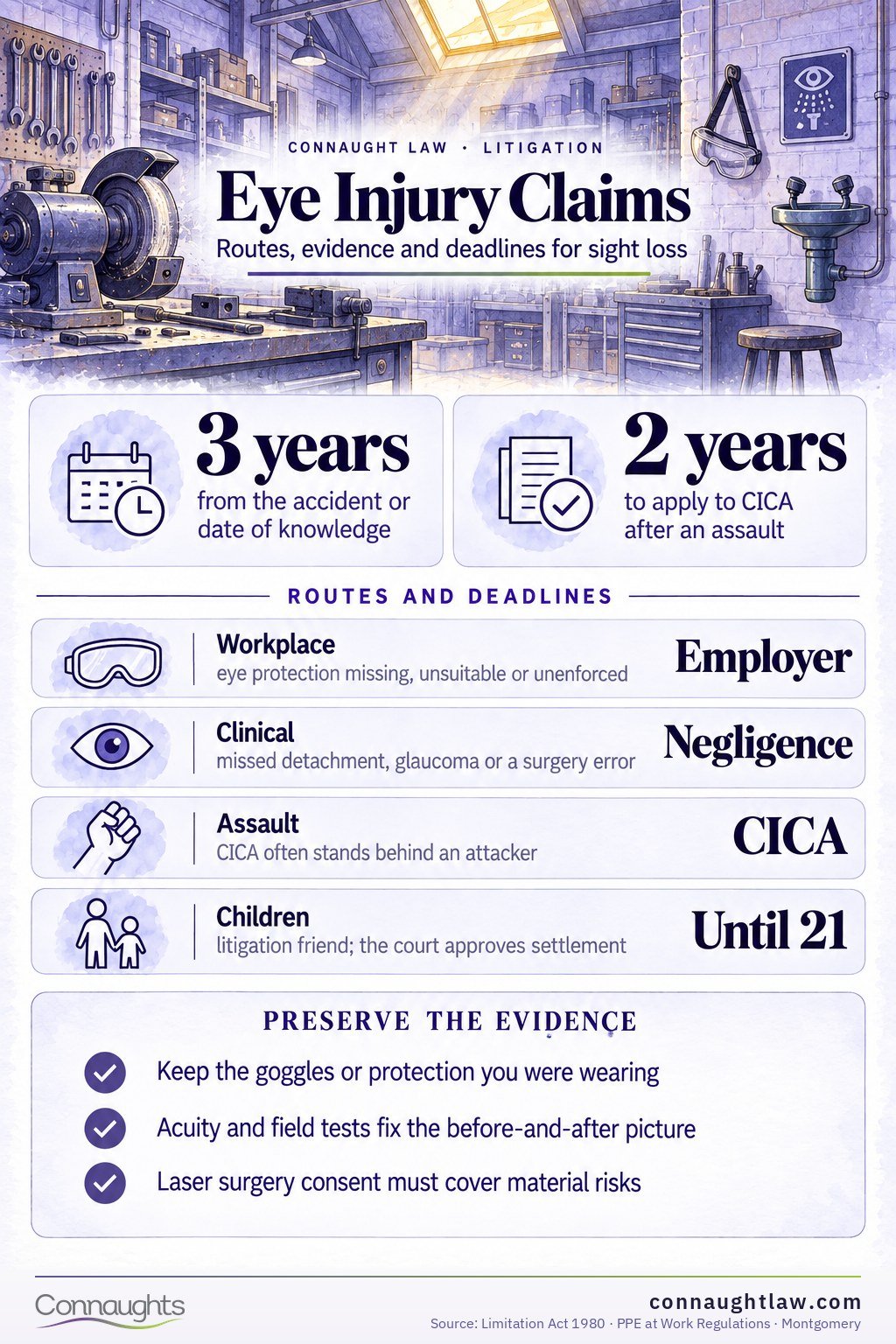
The claims arrive by three main routes: workplace accidents where eye protection failed or was never enforced, medical and optometric negligence where treatable conditions progressed, and assaults, where the Criminal Injuries Compensation Authority often stands behind an attacker who could never pay. Eye trauma also travels with wider injury — orbital fractures and brain trauma share the same accidents, and our head injury compensation guide covers that overlap. Each route has its own liability rules; the valuation framework below is common to all.
Eye Injury Compensation Amounts: The 2026 Brackets
Minor eye injuries attract £2,910 to £11,540, complete loss of sight in one eye £65,090 to £72,440, total loss of the eye itself £72,440 to £86,820, and total blindness sits in the region of £355,020. Lost earnings, care and prosthetics are claimed on top.
General damages follow the eye chapter of the Judicial College Guidelines, 18th edition, published in April 2026 with an inflation uplift of roughly 8.26 per cent. The ladder below is the current one — many online tables still carry superseded figures.
Eye Injury Brackets
| Injury | JCG 18th Edition Bracket |
|---|---|
| Transient eye injuries — full recovery within weeks | £2,910 – £5,220 |
| Minor eye injuries — pain and temporary interference with vision | £5,220 – £11,540 |
| Minor but permanent impairment of vision in one or both eyes | £12,040 – £27,720 |
| Serious but incomplete loss of vision in one eye | £31,290 – £51,990 |
| Complete loss of sight in one eye | £65,090 – £72,440 |
| Total loss of one eye | £72,440 – £86,820 |
| Loss of sight in one eye with reduced vision in the remaining eye | £84,490 – £237,510 |
| Total blindness | In the region of £355,020 |
The remaining-eye bracket splits in two. Where there is serious risk of further deterioration in the remaining eye, the range is £126,820 to £237,510; where the remaining eye has reduced vision or double vision without that additional risk, £84,490 to £140,020. Position within every bracket turns on function: acuity and field after treatment, double vision, light sensitivity, cosmetic effect, psychological consequences. Loss of a dominant eye, or of sight critical to the claimant's occupation, pushes an award up as a factor the evidence must prove.
The same bracket produces very different totals across lives. A 30-year-old HGV driver and a retired hobbyist who each lose an eye share the £72,440 to £86,820 bracket, but the driver adds a career's lost earnings and pension shortfall, the retiree care, aids and lost independence. The bracket is a floor plan; the losses are the building.
Honesty about the lower rungs serves claimants too. Most eye claims are corneal abrasions, foreign bodies and arc eye that heal completely and sit in the transient and minor brackets; stating them precisely, with follow-up records confirming recovery, settles them quickly and at full value.
Eye Injury Claims for Children
Children's eye claims run on a longer clock for good reason. A young visual system can deteriorate or partially adapt for years after injury, and prognosis is rarely final before the teens. Litigation friends conduct the claim, settlements need court approval, and no responsible advisor values a child's eye injury before the ophthalmic evidence is stable.
Psychological Impact of Sight Loss
Psychological evidence rounds out serious claims. Losing sight, or living with the fear of losing the other eye, produces diagnosable anxiety and depression, valued separately from the eye injury itself. Screening for them early is part of competent claim handling, not an optional extra.
- One-eyed claimants live one accident from blindness, and the Guidelines price that vulnerability into every bracket.
- Serious deterioration risk in the remaining eye lifts the award into the £126,820 to £237,510 range.
- Expert evidence on the surviving eye's condition is the core of the claim, not a refinement.
- Provisional damages keep the claim open where a defined deterioration risk is real.
Eyelid Injury and Facial Scarring Compensation
Eyelid injury compensation has its own logic, because the lid both protects the eye and frames the face. Lacerations from glass and dog bites, burns, post-traumatic ptosis (a drooping lid), ectropion and entropion (a lid turning outward or inward), and tear duct damage leaving a permanently watering eye are all claimable. Where lid damage affects vision or the eye itself, the eye brackets above apply; where the harm is chiefly cosmetic, valuation moves to the facial scarring ladder.
Facial scarring is bracketed by visibility and psychological effect: less significant scarring at £5,220 to £18,150, significant scarring at £12,040 to £39,750, and the worst burns and disfigurement reaching £39,340 to £128,590. A visible lid scar, a lash line that no longer closes evenly, or asymmetry that photographs under clinic lighting all move an award within those ranges — our scar compensation guide covers the full ladder and the evidence behind it.
Cosmetic eyelid surgery adds a consent dimension. Blepharoplasty that removes too much skin, leaving lids that cannot fully close and corneas that dry and scar, is a recurring private-clinic claim, and it runs down the clinical negligence route explained below.
Workplace Eye Injuries and Employer Liability
The workplace caseload is dominated by preventable mechanisms: grinding, cutting and drilling debris, chemical splashes, molten metal, nail gun ricochets, arc eye from unshielded welding, and branches or cables at eye height. The Personal Protective Equipment at Work Regulations require suitable eye protection where risks cannot be engineered away — provided free, maintained, and actually enforced — and HSE guidance treats eye protection as a last line of defence behind guarding, extraction and safe systems.
Liability arguments in these claims are usually short. Either suitable protection was provided, matched to the hazard and worn, or it was not: goggles that fog and get pushed up, safety glasses issued where a face shield was needed, visitors and supervisors walking unprotected through grinding areas. A culture of unworn protection condemns the employer rather than the worker, and contributory negligence for momentary non-use is argued down, not conceded.
Serious workplace eye injuries are reportable under RIDDOR, and the report, the accident book entry and any HSE correspondence become fixed early evidence. An employer that reported nothing has a different conversation ahead, with the regulator as well as the claimant.
Eye Protection That Matches the Hazard
Protection must also match the hazard, not merely exist. Impact-rated spectacles do nothing against a caustic splash; chemical goggles are the wrong answer to grinding sparks; a face shield over safety glasses is the standard for the worst combinations. Issuing DIY-grade eyewear for industrial processes, or one communal pair shared across a shift, is a breach dressed as compliance.
Aftermath provision matters too. Chemical injuries are won and lost in the first minutes, which is why eyewash stations and immediate irrigation are basic requirements where splashes are foreseeable; a burn made worse because the eyewash was empty, blocked or three rooms away is a second breach on top of the first.
The setting spreads wider than industry. Squash balls, paintball without enforced masks, fireworks at organised events and glassings in badly run venues all generate eye claims against occupiers and organisers under ordinary duties to manage foreseeable risks. A request to preserve CCTV and incident books, sent in the first days, can decide liability.
Medical Negligence and Lost Sight
Sight is also lost in clinics rather than workshops. The recurring claims are diagnostic: retinal detachment symptoms — the sudden floaters, flashes and curtain shadow — sent home without urgent referral; glaucoma progressing unmonitored; giant cell arteritis missed until the second eye was involved; wet macular degeneration left past its treatment window. The legal framework is the ordinary clinical negligence one set out in our medical negligence compensation guide: breach judged by responsible ophthalmic practice, causation judged by what timely treatment would have saved.
Causation is where these claims are decided, because untreated eye disease has a natural course. The expert question is concrete: with referral that day, or monitoring to guideline standards, what vision would probably have been preserved? Compensation then covers the difference, which in a working-age claimant losing driving vision can be a career, not just a bracket.
Claims Against Optometrists and Opticians
Optometrists are defendants more often than the public expects. The routine high street test screens for detachment, glaucoma, tumours and vascular disease, and professional guidance requires referral, urgent where indicated, when signs appear. A record showing raised pressures or disc changes filed without action is the archetypal optometric claim, and the optician's own scans usually prove it.
Emergency management claims complete the clinical set: intraocular foreign bodies missed because no one imaged for metal, orbital fractures discharged without ophthalmic review, chemical burns irrigated too briefly, contact lens keratitis dismissed as conjunctivitis. The competent pathway is well documented, which makes departures unusually provable.
Eye Surgery Compensation: Negligent and Laser Surgery Claims
Eye surgery compensation claims divide into negligent performance and negligent consent. Cataract surgery is among the most common operations in the NHS, and its recurring claims are concrete: the wrong lens implant calculated or fitted, a posterior capsule tear mismanaged, post-operative infection signs dismissed until the eye was beyond saving. Performance is judged against responsible ophthalmic practice — a recognised complication competently handled is not negligence, but a complication missed on review usually is.
Laser eye surgery claims — LASIK, LASEK, SMILE — and refractive lens exchange are different, because these procedures are marketed to healthy eyes. Montgomery consent bites hard: material risks — dry eye, halos, regression, the rare sight-threatening infection — and the alternative of simply staying in glasses must be genuinely explained, not buried in a signature pack. Accepting unsuitable candidates — thin corneas, large pupils, unstable prescriptions — is a breach before the laser ever fires.
Valuation uses the same brackets as any eye injury, applied to the vision actually lost against what the claimant would otherwise have had. A perfect operation on a patient who would have declined it, properly warned, is still a claim.
Medical Evidence in Eye Injury Claims
Eye claims are unusually measurable, and good claims use that. Visual acuity charts, visual field testing, tonometry and OCT scanning fix the before-and-after picture objectively; consultant ophthalmologists address diagnosis, causation, treatment and prognosis; and occupational evidence translates measurements into real-world consequence — licences lost, trades abandoned, screens unreadable. NHS guidance on eye injuries also fixes what competent early management looks like, which matters in delayed-treatment claims.
Function is measured against real standards, not impressions. The DVLA's vision requirements decide whether a claimant drives again, occupational health standards decide whether a trade continues, and screen-based work is assessed with the claimant's actual corrected vision. Where the evidence shows a licence or occupation lost, the earnings claim is built on that finding, and it frequently outweighs the injury bracket several times over.
Where the future is genuinely uncertain — deterioration risk in the surviving eye, late glaucoma after trauma, corneal graft failure — provisional damages keep the claim open for the defined risk, and interim payments fund treatment and retraining while the claim runs. The itemised losses follow: prosthetic eyes replaced through life, adaptations to home, vehicles and technology, care during adjustment, and lifetime earnings where driving or precision work becomes impossible. In serious cases these losses dwarf the bracket.
Time Limits for Eye Injury Claims
The standard Limitation Act 1980 rules apply: three years from the accident or date of knowledge, until 21 for children, no running limit where capacity is lacking. Negligence claims over delayed diagnosis often turn on knowledge — the date the patient learned the lost sight had been saveable — and those dates deserve professional analysis rather than assumption.
A worked example: a patient discharged from routine monitoring in 2022 learns in 2026 that pressure readings were abnormal all along and the field loss since was preventable. Time runs from the 2026 discovery, not the 2022 readings — but proving that turns on the records, so obtain them at the first suspicion rather than the last safe date.
Assault cases carry the trap: CICA applications must normally be made within two years of the incident, on a tariff lower than civil damages. Where a civil defendant exists — a venue, an employer, an organiser whose security failed — the civil claim is usually worth multiples of the CICA award, and both routes need weighing early.
Damaged goggles are discarded, defective guards repaired, CCTV overwritten and witnesses dispersed within weeks of an eye injury. Preserve the protection you were wearing, photograph the scene and the hazard, and get the incident recorded before the workplace quietly improves itself.
Questions about eye injury and sight loss claims
How much compensation do you get for an eye injury in the UK?
The Judicial College ladder runs from £2,910 for transient injuries, through £65,090 to £72,440 for complete loss of sight in one eye, to around £355,020 for total blindness — with earnings, prosthetics, adaptations and care claimed in addition.
How much is losing one eye worth?
Total loss of one eye is bracketed at £72,440 to £86,820, and complete loss of sight in one eye at £65,090 to £72,440. Where the remaining eye also has reduced vision, the bracket rises steeply, to as much as £237,510.
How much compensation for an eyelid injury?
Eyelid injuries affecting vision are valued under the eye brackets; chiefly cosmetic damage follows the facial scarring ladder, typically £5,220 to £18,150 for less significant scarring and £12,040 to £39,750 where scarring is significant.
Can I claim compensation for negligent laser eye surgery?
Yes, where performance fell below responsible practice or consent failed the Montgomery test — material risks and the option of staying in glasses not genuinely explained. Unsuitable candidates accepted for surgery are a recurring breach.
Can I claim if I was not wearing safety goggles?
Usually yes. The employer's duty is to provide suitable protection and enforce its use; a workplace culture of unworn goggles is evidence against the employer. Contributory negligence may modestly reduce an award, but it rarely defeats the claim.
Can I claim for a delayed diagnosis of retinal detachment?
Yes, where urgent referral was required and the delay cost vision that treatment would probably have saved. These are clinical negligence claims decided on causation evidence about what earlier surgery would have preserved.
What if my eye injury came from an assault?
Consider both routes: a civil claim where any defendant — attacker, venue, employer — can pay, and a CICA application, which must normally be made within two years. CICA tariff awards are lower than civil damages, so the civil route is assessed first.
Does compensation cover a prosthetic eye?
Yes. Custom prosthetics, fittings, polishing and lifetime replacement cycles are recoverable, alongside the psychological and cosmetic consequences of losing the eye, which the Guidelines expressly take into account.
What is arc eye and can welders claim for it?
Arc eye is corneal burn from unshielded welding flash: painful, usually temporary, and claimable where screens or curtains should have protected bystanders and trainees. Repeated episodes with lasting damage move up the ladder.
Tell us how it happened, what acuity and field testing has shown, and whether the other eye is affected. We’ll tell you which route applies — employer, clinical negligence or the criminal injuries scheme — and the deadline for each.
Get Expert Advice