
Head injury compensation UK claims span the widest valuation range in personal injury law, from £2,920 for a minor head injury with rapid recovery to £533,720 where very severe brain damage leaves someone dependent for life. Under the Judicial College Guidelines 18th edition (April 2026), the figure turns on function, not on how dramatic a scan looks: memory, concentration, personality, insight and the ability to work. This guide covers the full spectrum — concussion and minor brain injury through to catastrophic traumatic brain injury — with the 2026 brackets, the evidence that proves these claims, rehabilitation funding, and time limits.
On This Page

Understanding Head Injury Compensation UK 2026
Brain injury is the personal injury field where appearances mislead most. A person can walk, talk and pass a standard neurological examination while living with damage that has ended their career: exhaustion by early afternoon, a temper their family no longer recognises, plans that fall apart without a reason they can name. English law compensates that reality, but only when it is evidenced properly, which is why head injury claims are built as much on neuropsychology and the accounts of people who knew the claimant before as on scans.
The claims follow the ordinary structure: an award for the injury under the Judicial College Guidelines, and financial losses on top covering earnings, care, therapy, equipment and accommodation. In serious cases the financial side dominates and is often paid partly as periodical payments for life.
Two claims often run side by side. The injured person claims for their own injury and losses, and the family's contribution is claimed within it: the law values gratuitous care, so the hours a spouse or parent spends prompting, supervising and managing what the claimant once managed alone are costed and recovered. Recognising that early changes both the evidence gathered and the eventual award.
Types of Head Injury and Brain Damage
Clinicians grade traumatic brain injury by early markers: the Glasgow Coma Scale score at the scene, how long consciousness was lost, and above all the duration of post-traumatic amnesia, the period after the accident the injured person cannot later remember. A few minutes of confusion suggests concussion; post-traumatic amnesia measured in days or weeks marks a moderate or severe traumatic brain injury with lasting consequences, whatever the scans show.
Severe Brain Injury and Lifetime Consequences
At the serious end sit diffuse axonal injury from rotational forces, contusions and bleeds requiring neurosurgery, and hypoxic damage where breathing or circulation failed. Survivors may recover physically while cognition, behaviour and personality change permanently. Epilepsy risk, loss of smell and taste, fatigue and disinhibition all matter to valuation, and so does insight: the cruel feature of severe brain injury is that those with least awareness of their deficits often need the most protection.
Head Injury Claims for Children
Children are a special case within every severity band. A young brain's plasticity aids physical recovery, but frontal-lobe functions mature through adolescence, so deficits from an early injury can surface years later as planning, judgment and social behaviour fail to develop as expected. That is why children's head injury claims are rarely concluded quickly: prognosis has to wait for development, and the limitation rules give it room to.
Minor Brain Injury and Concussion Compensation
Minor brain injury compensation runs from £2,920 to £16,870 under the 18th edition. The bracket covers concussion and mild traumatic brain injury where recovery is complete or near-complete, and position within it depends on the severity of the initial injury, the length of recovery, and how far work or study were disrupted. An uncomplicated concussion resolving within weeks sits near the bottom; symptoms taking a year or more to settle push towards the top.
Minor head and brain injuries attract £2,920 to £16,870 under the 2026 Judicial College Guidelines, rising to £20,240 to £56,890 where post-concussion symptoms persist and intrude on working life. Lost earnings and treatment costs are claimed on top.
Post-concussion syndrome changes the analysis. Where headaches, fatigue, mood change and cognitive symptoms outlast the expected recovery window despite normal imaging, the claim can move into the less severe brain damage bracket of £20,240 to £56,890, which applies where a good recovery has been made but concentration, memory or mood problems persist and restrict working life. These claims are frequently disputed precisely because imaging is normal, so they stand or fall on credible, consistent medical records made while symptoms were live.
Brain Injury Compensation Ranges in 2026
General damages are set by the Judicial College Guidelines, 18th edition, published in April 2026 with brackets roughly 8 per cent above the previous edition. The head and brain injury brackets run as follows.
Brain Injury Brackets
| Severity | 2026 Bracket (JCG 18th ed) | Typical Picture |
|---|---|---|
| Minor head or brain injury | £2,920 - £16,870 | Concussion; full or near-full recovery, usually within months |
| Less severe brain damage | £20,240 - £56,890 | Good recovery but persisting concentration, memory or mood problems |
| Moderate brain damage (iii) | £56,890 - £119,860 | Reduced ability to work; concentration, memory and fatigue affected |
| Moderate brain damage (ii) | £119,860 - £198,320 | Greatly reduced or removed capacity to work; some dependence |
| Moderate brain damage (i) | £198,320 - £289,420 | Significant intellectual deficit, personality change, effect on senses |
| Moderately severe brain injury | £289,420 - £372,570 | Serious disability; constant professional and other care needed |
| Very severe brain damage | £372,570 - £533,720 | Little or no meaningful response to environment; full-time care |
| Post-traumatic epilepsy (established) | £72,440 - £198,320 | Valued under the separate JCG epilepsy chapter |
Position within a bracket depends on the degree of insight, life expectancy, physical and sensory limitation, personality change, epilepsy or its risk, and dependence on others. The moderate brackets cover the far larger group who work below their previous level, or cannot work at all, despite good physical recovery. Be wary of "average payout" figures: an average across claims spanning £2,920 to seven-figure lifetime packages describes nobody's case.
Why Serious Brain Injury Settlements Reach Seven Figures
Reported brain injury settlements of one million pounds and far above are not produced by the table. They combine the general damages bracket with lifetime financial losses: round-the-clock care and case management, therapies, adapted accommodation, equipment, and loss of earnings and pension calculated over an entire working life. Future losses are adjusted using the personal injury discount rate, set at plus 0.5 per cent in England and Wales, and the care element is often paid as index-linked periodical payments for life rather than a single lump sum.
- General damages for the injury itself peak at £533,720 — the rest is financial loss
- Lifetime care and case management are usually the largest head of claim
- Lost earnings and pension are projected over a full working life
- Adapted accommodation, equipment and therapies are costed and claimed in full
- Care costs are frequently structured as periodical payments for life
Provisional Damages, Epilepsy and Sensory Loss
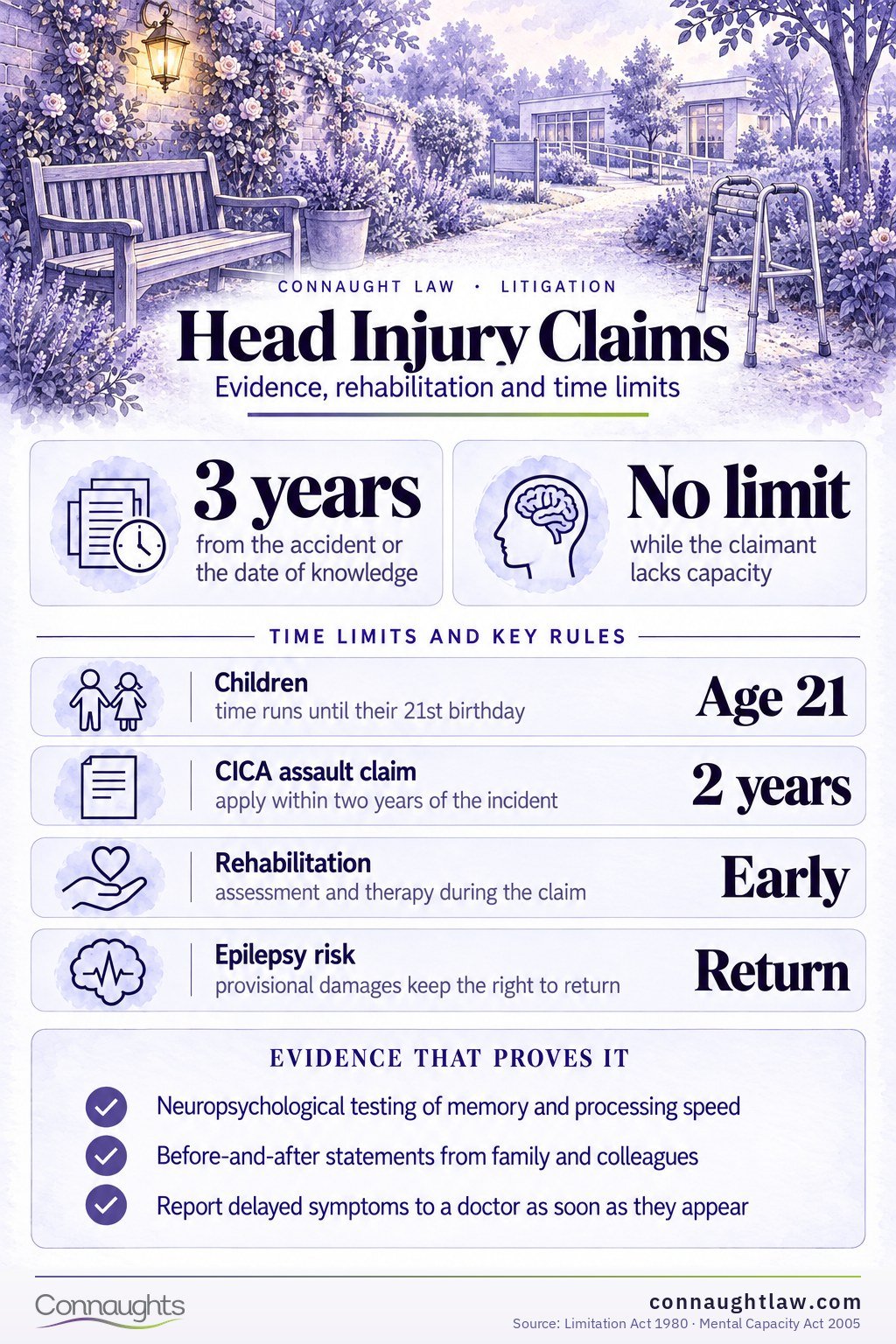
Some consequences carry their own valuation rules. Where medical evidence identifies a material future risk of post-traumatic epilepsy, the claim can be settled with provisional damages: the award is assessed as if the epilepsy will not develop, and the claimant keeps the right to return to court if it ever does. Established epilepsy is valued under its own Guidelines chapter, currently £72,440 to £198,320 depending on type, control and effect on life.
Head injuries rarely arrive alone. Skull and facial fractures can damage sight and hearing, each valued in its own right — see our guides to eye injury compensation and hearing loss compensation — and loss of smell and taste is a permanent sensory injury the Guidelines value separately. Where several injuries overlap, the court values the whole person's condition rather than simply adding brackets, and the brain injury usually leads that assessment because its consequences reach furthest.
Common Causes and Where Liability Falls
Road collisions produce the most serious claims, with motorcyclists, cyclists and pedestrians over-represented because nothing absorbs the impact for them. Liability follows ordinary negligence principles, and car accident compensation claims involving head injury sit outside the fixed-tariff world that governs whiplash: the brain injury is valued fully under the Guidelines.
Cyclists deserve a particular mention. Helmet arguments, where they arise, go to contributory negligence rather than defeating a bicycle accident compensation claim, and uninsured or hit-and-run drivers do not close the door: the Motor Insurers' Bureau compensates victims of uninsured drivers and, through its Untraced Drivers scheme, those injured by drivers never identified, provided incidents are reported promptly.
Falls are the other great source: from height on building sites, on unguarded edges, on stairs and wet floors. Employers and occupiers owe statutory duties to prevent exactly these accidents — risk assessment, guarded edges and scaffolding under the working at height regime, enforced helmet use, and safe systems for lone workers. Serious workplace head injuries are reportable under RIDDOR, and the report, the accident book entry and any HSE investigation become early, powerful evidence. Medical settings contribute too, through delayed diagnosis of bleeds and missed deterioration after admission.
Assault cases follow a different route. Where the attacker cannot realistically pay a judgment, compensation comes from the Criminal Injuries Compensation Authority, a statutory scheme with its own tariff, a two-year application window and reductions for the applicant's own record and conduct. CICA awards for brain injury are usually lower than civil damages, which is why a civil defendant is always considered first.
Sport and recreation sit at the boundary. Participants accept the ordinary risks of the game, but not a venue's missing crash mats, absent medical cover, or a return-to-play decision that ignored concussion protocols.
Evidence That Proves a Head Injury Claim
As in any personal injury claim, liability rests on a duty of care, a breach, and injury caused by it. The distinctive work in head injury litigation is on causation and extent, because defendants rarely dispute that a collision happened; they dispute what it did. A normal CT scan on the day proves only that no bleed needed surgery, and the argument moves to subtler ground.
The decisive evidence is usually functional. Neuropsychological testing measures memory, processing speed and executive function against the claimant's expected baseline; neurologists and neuropsychiatrists address organic injury, epilepsy risk and mood; and witness statements from family, friends and colleagues describe the before-and-after difference no test captures. Where deficits are severe, a formal capacity assessment under the Mental Capacity Act 2005 determines whether the claimant can litigate and manage money themselves, which shapes the entire claim.
Charity and clinical guidance also matter practically: Headway resources help families document day-to-day effects, and NHS guidance on head injury and concussion explains the red-flag symptoms that justify urgent reassessment. Contemporaneous GP attendances for ongoing symptoms are worth more to a claim than any retrospective account.
Work evidence deserves particular care in subtle cases. A claimant who returned to work and quietly failed — missed targets, dropped hours, was managed out — has objective corroboration that no examination provides. Performance records, occupational health referrals and the employer's own emails frequently prove what the claimant is too proud, or too unaware, to say.
The Claim Process and Rehabilitation
Serious head injury claims do not wait for settlement to help the injured person. Under the Rehabilitation Code, solicitors and insurers commission an immediate needs assessment, and defendants commonly fund case managers, neuro-physiotherapy, occupational therapy and vocational support long before liability is finally resolved. Early rehabilitation improves outcomes, and the courts expect both sides to engage with it.
Money follows the same logic. Interim payments fund care, housing adaptations and income gaps during the claim; the final award arrives as a lump sum, periodical payments, or both. Where the claimant lacks capacity, a litigation friend conducts the claim, any settlement requires court approval, and funds are managed through a deputy appointed by the Court of Protection, protecting the injured person for life.
Timescales are honest rather than fixed: straightforward claims with admitted liability can settle within months of prognosis becoming clear, while severe brain injury claims properly take years. Insurers make early offers precisely because prognosis is unclear, and a Part 36 offer carries costs consequences that need advice, not instinct. The safe rule is that no offer is accepted until the medical evidence supports a final view of the future; interim payments remove the financial pressure to break that rule.
The lump sum or periodical payments decision is taken late and on advice. A lump sum offers flexibility and finality but transfers investment and longevity risk to the family; periodical payments guarantee index-linked annual funding for care however long life lasts. Severe injury settlements commonly combine the two, matching the structure to the care regime.
Time Limits for Head Injury Claims
The standard Limitation Act 1980 rules apply: three years from the accident or from knowledge that a significant injury is attributable to it. Children have until their twenty-first birthday. Most importantly here, a claimant who lacks capacity to conduct proceedings faces no running time limit at all, which protects exactly the people severe brain injury leaves least able to protect themselves.
Two traps sit alongside the general rule. CICA applications for assault-related brain injury must normally be made within two years of the incident, far sooner than the civil deadline. And delayed-onset symptoms, common after apparently minor head injuries, can blur the date of knowledge, inviting limitation arguments that early legal advice avoids entirely.
Fatal head injuries change the claim's shape rather than its logic. The estate claims for the injury and losses before death, and dependants claim their financial and services dependency under the Fatal Accidents Act, together with the statutory bereavement award, currently £15,120, for the spouse or, for a child under 18, the parents. Inquest findings frequently decide these cases before civil proceedings begin.
CCTV is overwritten, vehicles repaired, workplaces changed and witnesses scattered within months of an accident. A head injury claim investigated in year one is a different, stronger claim than the same case picked up in year three.
Questions about head and brain injury claims
How much compensation do you get for a head injury in the UK?
Judicial College brackets for 2026 run from £2,920 for minor head injuries to £372,570–£533,720 for very severe brain damage. Financial losses — care, earnings, accommodation — are added on top and dominate serious claims.
How much compensation for a minor brain injury?
The minor bracket spans £2,920 to £16,870 depending on recovery time and severity. Persistent post-concussion symptoms can move a claim into the £20,240–£56,890 less severe bracket, plus lost earnings and treatment costs while symptoms lasted.
What is the average payout for a head injury?
No meaningful average exists: claims range from a few thousand pounds to seven-figure lifetime packages. Courts identify the bracket the medical evidence supports, then add documented financial losses — the only honest valuation method.
Can I claim on behalf of a relative with a brain injury?
Yes. Where the injured person lacks capacity, a family member usually acts as litigation friend to conduct the claim. Settlements are approved by the court and managed through the Court of Protection, protecting the injured person throughout.
What if symptoms only appeared days after the accident?
Delayed symptoms are medically common, particularly with slow bleeds and concussion. Report them to a doctor as soon as they appear: the record links them to the accident, protects your health, and prevents later causation arguments.
How are assault-related head injuries compensated?
Through a civil claim where the attacker or another party, such as a negligent venue, can pay, and otherwise through the CICA statutory scheme, which has a two-year application window and its own tariff, typically paying less than civil damages.
Does rehabilitation have to wait for the claim to finish?
No. Under the Rehabilitation Code, defendants commonly fund needs assessments, case management and therapy during the claim, and interim payments cover care and income needs long before final settlement.
How are head injury claims funded?
Most run under no-win-no-fee agreements with insurance against adverse costs, and some households already hold legal expenses cover or union funding. Funding is agreed before work starts, so a serious claim should never depend on paying fees up front.
How long does a head injury claim take?
Minor claims with admitted liability can conclude within months of a clear prognosis. Severe brain injury claims properly run for years, because the long-term care and earnings picture must be known first, with rehabilitation and interim payments meanwhile.
Tell us how it happened, what the hospital recorded and what has changed since — memory, concentration, mood, work. We’ll tell you what the claim covers and whether rehabilitation can be funded before it settles.
Get Expert Advice