
Loss of earnings compensation replaces the income an injury or dismissal has taken, and the calculation follows a settled method. Injury courts award the full net loss — past earnings averaged over the weeks before the accident, future loss projected through Ogden multipliers — with no statutory ceiling. Employment tribunals work within capped limits, uprated from 6 April 2026 to a £123,543 compensatory maximum and a £751 week’s pay, with the cap abolished for dismissals from 1 January 2027. This guide works through the calculation step by step, with a worked example, evidence requirements and the current tribunal figures.
On This Page

Understanding Loss of Earnings Compensation UK 2026
Earnings loss is usually the largest number in any serious claim, and the least understood. General damages for the injury are bracketed and predictable; earnings losses are personal arithmetic, built from payslips, tax returns and medical evidence about capacity, and two claimants with identical injuries can hold earnings claims an order of magnitude apart. The consolation is that the arithmetic itself follows a settled method, set out step by step below.
The forum question comes first. Injury and negligence claims run in the civil courts on full-compensation principles, without a cap. Dismissals and workplace treatment run in the employment tribunal within statutory limits and far shorter deadlines: three years under the Limitation Act 1980 for civil claims, generally six months through ACAS early conciliation for tribunal claims where the act complained of was on or after 1 October 2026 (three months less one day before then). The short clock, not the small print, is what defeats most workplace earnings claims.
How to Calculate Loss of Earnings: Step by Step
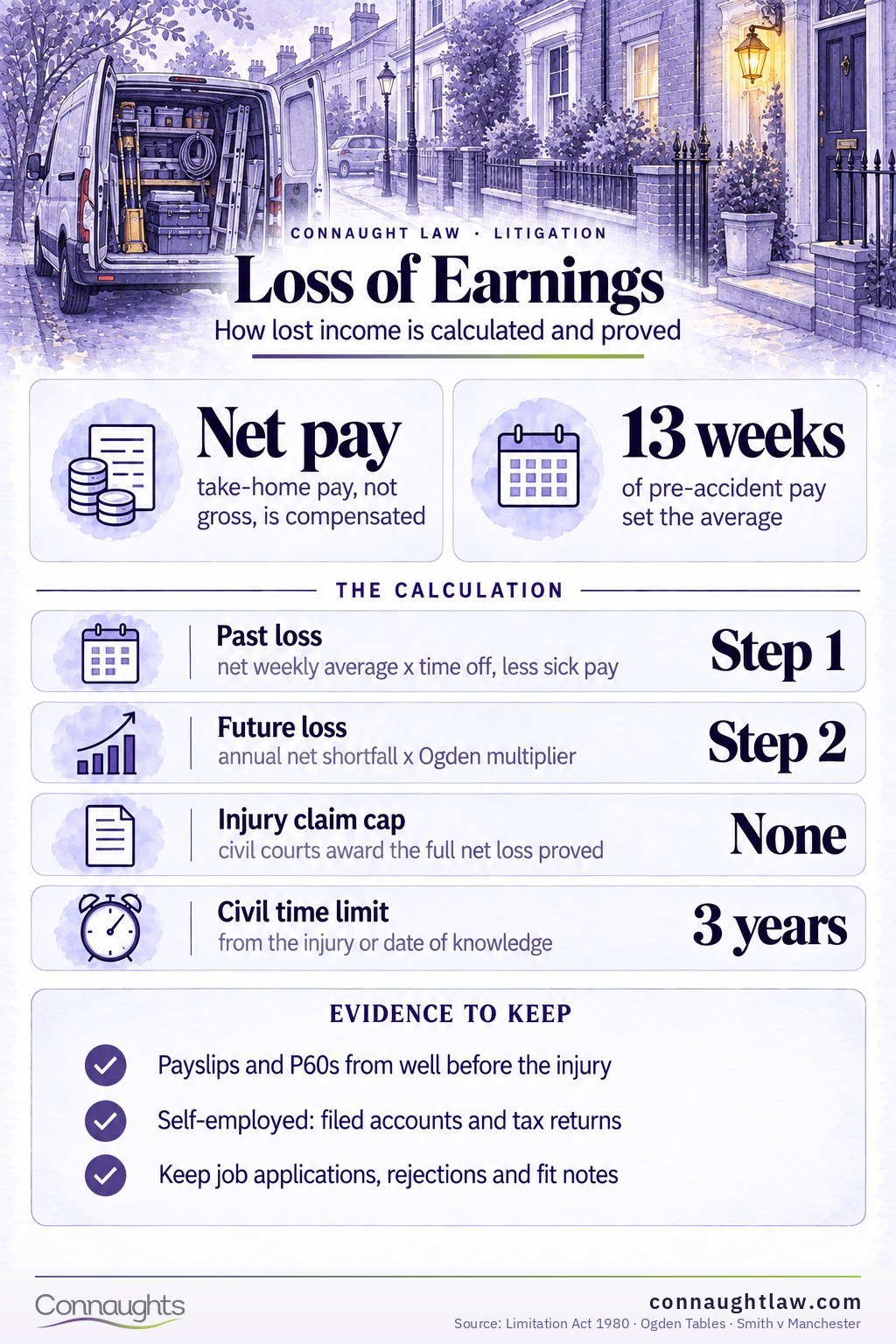
Past loss: average net weekly pay over the 13 weeks before the accident, multiplied by time off work, minus sick pay and other earnings received. Future loss: the ongoing annual net shortfall (the multiplicand) multiplied by an Ogden-table multiplier set at the +0.5% discount rate and adjusted for employment contingencies.
Step one: work in net figures, not gross. Courts compensate what the injury actually took — take-home pay after tax and national insurance — because personal injury damages are themselves received free of tax. Starting from gross salary is the commonest error in self-prepared calculations, and it overstates the claim substantially before a single document is checked.
Step two: establish the pre-accident average. Net earnings are usually averaged over the 13 weeks before the accident — long enough to smooth an unusually good or bad week, short enough to reflect current pay. Where earnings fluctuate with overtime, commission or seasonality, a longer period gives the truer picture; and where pay was about to change — a confirmed promotion, an agreed rise — the adjustment is evidenced, not asserted.
Step three: past loss is then arithmetic. Multiply the net weekly average by the period off work, then deduct everything actually received: statutory and occupational sick pay, earnings from lighter or part-time duties, and certain state benefits through the recoupment rules covered below. Interest is added on past losses, and the calculation is carried to settlement date rather than frozen at the letter of claim.
Worked Example of a Loss of Earnings Calculation
The example below is illustrative only — round numbers chosen to show the method working, not a prediction of what any real claim is worth.
The Calculation Steps
| Step | Illustrative figure |
|---|---|
| Average net weekly pay (13 weeks pre-accident) | £500 |
| Time off work | 26 weeks |
| Past earnings lost (26 × £500) | £13,000 |
| Less sick pay received | −£2,000 |
| Past loss of earnings | £11,000 |
| Ongoing annual net shortfall (multiplicand) | £5,000 |
| Ogden multiplier after adjustments (illustrative) | 20 |
| Future loss of earnings | £100,000 |
| Total loss of earnings claim | £111,000 |
Real cases move every line of that table: interest accrues on the past loss, pension contributions are added, the multiplier shifts with age, retirement date and the contingency adjustments discussed below, and the ongoing shortfall depends on medical evidence about what work remains possible. The method is fixed; the inputs are the litigation.
Why Online Loss of Earnings Calculators Mislead
A search for a loss of earnings calculator returns tools that take a salary and a period off work and produce a figure in seconds. Treat that figure as orientation, never valuation. Most calculators work from gross pay, ignore sick pay received and benefit recoupment, know nothing of pension loss or promotion trajectory, and apply no Ogden discounting or contingency adjustment to future loss — precisely the machinery that decides serious claims.
A genuine calculation needs the documents: thirteen weeks of payslips or several years of accounts, the sick-pay record, a medical prognosis on working capacity, and the current Ogden tables applied at the current discount rate. That is not a form field — it is a schedule of loss, and it is where undervalued claims get rescued.
Calculating Future Loss of Earnings
Future loss is calculated, not guessed, through multiplicand and multiplier: the annual net loss, multiplied by a factor from the Ogden tables — actuarial tables now in their 8th edition, last updated in January 2025 — which discounts for early receipt and mortality at the personal injury discount rate, +0.5% in England and Wales since 11 January 2025. A 40-year-old whose trade is finished does not receive 25 years of salary as a cheque; they receive its properly discounted present value.
The tables then adjust for employment contingencies through reduction factors reflecting age, qualification level, employment status and disability — and this is where injury bites twice, because the discount applied to an injured claimant's future employment prospects is materially heavier than for the uninjured. Arguing those reduction factors from evidence rather than accepting them by convention is routinely worth more than any other line in the schedule.
Where serious injuries remove earnings decades early — a head injury ending a professional career, a spinal injury finishing a trade — the career model becomes the claim's centre: the employer's own progression data, comparator colleagues, what the apprenticeship was worth at qualification, what the day rate compounds to. Building that model early is the difference between compensation for a job and compensation for a career.
Partial Capacity and Smith v Manchester Awards
Partial capacity cases use the same machinery on the difference: what would have been earned against what can now be earned, in the real labour market rather than a hypothetical one. Where the residual disadvantage resists precise calculation, courts award Smith v Manchester damages for handicap on the open labour market — a lump sum reflecting the reality that the injured candidate loses the tiebreak. A separate, modest award for loss of congenial employment may follow where injury ends work the claimant loved.
What Loss of Earnings Compensation Includes
The net-loss principle captures more than basic salary: overtime evidenced from patterns rather than asserted averages, bonuses and commission with a documented history, the value of a company car or health cover, lost promotion prospects evidenced by trajectory, and lost self-employed goodwill. Each head is claimed from real history — the shift-pattern records, the bonus statements, the comparator colleague whose path continued.
Pension loss deserves specialist arithmetic rather than a token line: defined-contribution loss is the missing contributions with growth; defined-benefit loss is actuarial and can rival the earnings claim itself in long-service careers. In both civil schedules and tribunal claims, this head is routinely undervalued by omission.
Fatal claims translate earnings into dependency: the household's share of the deceased's income and services, valued on the same net-loss and multiplier logic, with bereavement damages alongside. The documentation is identical — payslips, accounts, pensions — and early advice spares families reconstructing a working life from memory.
How to Claim Loss of Earnings
Loss of earnings is not a free-standing claim after an accident: it is claimed as special damages within a personal injury claim, alongside general damages for the injury itself. After a car accident, the earnings claim travels with the injury claim against the at-fault insurer — and even where the injury itself is fixed by the whiplash tariff, earnings loss is claimed in addition to the tariff figure.
The sequence is documentary from the first week: report and record the accident, seek medical attention that creates the causation record, preserve thirteen weeks of pre-accident payslips or the last accounts, and instruct advisers early enough for the schedule of loss to be built from documents rather than reconstructed from memory. The civil claim must be issued within three years of injury or knowledge.
Interim payments keep civil claims honest to their own timetable: where liability is clear, income can be bridged before settlement, so the claimant is not starved into a discount while future-loss evidence matures. State benefits received because of the injury are recouped by the Compensation Recovery Unit from specific heads of damages, so schedules and offers are read net of recoupment — accounting, not penalty.
Both courts and tribunals expect reasonable steps to reduce loss: engaging with treatment, attempting suitable work, applying realistically. Keep the applications, the rejections and the fit notes, because unexplained gaps become deductions, while a documented struggle to return becomes the strongest page in the claim.
Evidence That Proves Earnings Loss
Employed claimants prove loss with payslips and P60s spanning well before the injury, employer letters on pay, overtime, bonus and progression, pension statements, and occupational health and absence records. The trajectory evidence matters as much as the baseline: the promotion applied for, the shift-pattern history, the comparator whose path continued. HMRC employment histories fill gaps memory cannot.
Medical evidence then does the connecting: capacity, restrictions, prognosis and the honest answer to whether this claimant can do that job. Occupational experts translate restrictions into labour-market reality where the stakes justify it — what jobs, at what pay, with these restrictions, in this claimant's real geography. Optimistic residual-earnings assumptions are the defendant's favourite discount, and they are met with evidence, not indignation.
Serious earnings claims are living documents: earnings evidence refreshed before settlement, comparators' pay rises captured, the multiplicand updated rather than inherited from the letter of claim. Schedules built from documents settle; schedules built from adjectives get litigated.
Self-Employed Loss of Earnings
Self-employed losses are real but demand deeper proof: filed accounts and tax returns for the years before injury, the pattern of contracts and seasonality, what was turned away or subcontracted during recovery, and the difference between turnover and the profit the claim actually compensates. A quiet year before injury is context to explain, not hide, and honest accounts outperform optimistic reconstructions every time.
Company directors add structure: salary-and-dividend patterns, the company's lost profits versus the individual's lost income, and locum or replacement costs as an alternative measure of loss. Self-assessment records anchor these claims, and an accountant's letter explaining the figures is frequently the most persuasive page in the schedule.
Employment Tribunal Limits for 2026/27
Where the earnings loss flows from dismissal or workplace treatment rather than injury, tribunal awards are built from statutory components, uprated each April. For dismissals with an effective termination date on or after 6 April 2026, the figures are:
Tribunal Limits 2026/27
| Component | 2026/27 Figure | Notes |
|---|---|---|
| Week's pay (statutory cap) | £751 | Feeds basic awards and statutory redundancy |
| Maximum basic award / statutory redundancy | £22,530 | 30 weeks × capped week's pay |
| Unfair dismissal compensatory award cap | £123,543 or 52 weeks' gross pay | Whichever is lower; cap removed from 1 January 2027 |
| Discrimination and whistleblowing awards | Uncapped | Financial losses plus injury to feelings |
| Injury to feelings (Vento bands) | £1,300 – £62,900+ | Claims presented on or after 6 April 2026 |
Two structural points matter more than the numbers. The 52-weeks-of-gross-pay alternative bites earlier than most claimants expect, capping modest earners well below £123,543. And under the Employment Rights Act 2025, the compensatory cap is legislated to disappear for dismissals from 1 January 2027, converting unfair dismissal into a full-loss jurisdiction — a change already reshaping settlement negotiations. The April 2026 Presidential Guidance sets the current Vento bands, and discrimination, whistleblowing and health-and-safety dismissals recover full financial loss without ceiling.
- Dismissals effective on or after 6 April 2026: £751 week's pay, £22,530 basic award, £123,543 compensatory cap.
- Earlier dismissals keep the 2025/26 limits — £719 and £118,223.
- Vento bands follow the claim's presentation date, not the dismissal date.
- The compensatory cap is abolished for dismissals from 1 January 2027.
Workplace Injury Earnings Claims
Workplace injuries produce the classic dual-track situation: a civil claim against the employer's liability insurer for the injury and its uncapped losses, and sometimes tribunal claims for what followed — disability discrimination in the return-to-work, dismissal dressed as capability, or a stress at work claim where the employer's handling itself caused psychiatric injury. The claims interact, double recovery is not allowed, and sequencing them is tactical work.
Statutory sick pay softens little: from April 2026 SSP runs from day one at £123.25 weekly, or 80 per cent of average weekly earnings where lower, with the lower earnings limit gone — but it remains a floor, not an income, and the gap between SSP and real earnings is exactly what the civil claim recovers. Occupational sick pay, where it exists, is often repayable from damages under scheme rules.
Injury-then-dismissal sequences reward joined-up handling: the civil claim values the injury and its earnings consequences; the tribunal claim polices the process that followed — with its own conventions of credit for earnings received, Polkey deductions and ACAS-code uplifts — and settlement of one should never accidentally release the other. Reading every settlement agreement for its release clauses, before signature, is cheap insurance against an expensive surprise.
Frequently askedQuestions about loss of earnings claims
How do you calculate loss of earnings for a compensation claim?
Average your net weekly pay over the 13 weeks before the accident, multiply by time off work, and deduct sick pay and earnings received. Future loss is the ongoing annual net shortfall multiplied by an Ogden-table multiplier adjusted for employment contingencies.
Is loss of earnings calculated on gross or net pay?
Net. Courts compensate take-home pay after tax and national insurance, because personal injury damages are received tax-free. Lost pension contributions and benefits in kind are then added as separate heads.
Are online loss of earnings calculators accurate?
No — treat them as orientation only. Most use gross pay and ignore sick pay, benefit recoupment, pension loss and Ogden contingency adjustments, which is exactly the machinery that determines what serious claims are actually worth.
What are the Ogden tables?
Actuarial tables, now in their 8th edition, used to convert future annual losses into a lump sum. They discount for early receipt and mortality at the personal injury discount rate — +0.5% in England and Wales since January 2025.
Is loss of earnings in an injury claim capped?
No. Civil courts compensate the full net loss the evidence proves, past and future, including pension, benefits in kind and career trajectory, with no statutory ceiling.
Can I claim lost overtime and bonuses?
Yes, where history evidences them: overtime patterns, bonus records and employer confirmation convert them from hope into loss. The same applies to lost promotion prospects with credible trajectory evidence.
How do self-employed people prove loss of earnings?
Through filed accounts, tax returns, contract records and honest profit analysis, supported by an accountant's explanation. Turnover is not loss; profit forgone, or replacement labour costs, is.
What happens to benefits I received while off work?
Injury-related benefits are recouped from specific heads of damages through the Compensation Recovery Unit, so schedules and offers are read net of recoupment. It is accounting, not penalty.
What are the employment tribunal compensation limits for 2026?
For dismissals from 6 April 2026: a week's pay capped at £751, maximum basic award of £22,530, and a compensatory cap of £123,543 or 52 weeks' gross pay, whichever is lower. Discrimination and whistleblowing awards remain uncapped.
What deadlines apply to earnings claims?
Civil claims: three years from injury or knowledge under the Limitation Act. Tribunal claims: generally six months via ACAS early conciliation where the act complained of was on or after 1 October 2026; three months less one day for earlier acts. The tribunal clock is the one that catches people.
Tell us what you earned before, what you have received since, and how long you have been off. We’ll tell you what the past loss comes to and whether a future loss claim is realistically in play.
Get Expert Advice