
Ankle injury compensation is assessed under the Judicial College Guidelines 18th edition, published in April 2026, which value everything from a sprain that recovers in weeks to the rare injury that ends the joint's working life. Modest injuries — minor fractures, sprains and ligament damage — attract up to £18,150, moderate injuries £18,150 to £35,130, and severe and very severe injuries £41,370 to £92,090, with financial losses claimed on top. This guide covers the 2026 brackets, honest valuation of sprains and ligament tears, broken ankle and workplace claims, medical evidence, and time limits.
On This Page

Understanding Ankle Injury Compensation UK 2026
An ankle injury claim compensates two kinds of loss. General damages cover pain, suffering and loss of amenity, valued against the Judicial College Guidelines. Special damages repay what the injury has cost — lost earnings, physiotherapy, travel, and family care during the non-weight-bearing weeks — and both are recovered through a single personal injury claim. In working claims on a weight-bearing joint, the losses frequently exceed the injury award itself.
There is no reliable single average. Most ankle claims involve sprains and minor fractures that settle within the modest band of up to £18,150, while fractures with permanent problems resolve between £18,150 and £66,140, plus financial losses. The honest question is which Guideline category your medical evidence supports, not what an average suggests.
Falls cause more ankle injuries than any other mechanism: supermarket spillages, icy car parks, potholes, unlit steps and workplace floors, all covered in our slip and fall compensation guide. Road accidents supply the graver files — motorcyclists' feet trapped between machine and tarmac, pedestrians struck at bumper height — and sport contributes a steady stream of ligament damage.
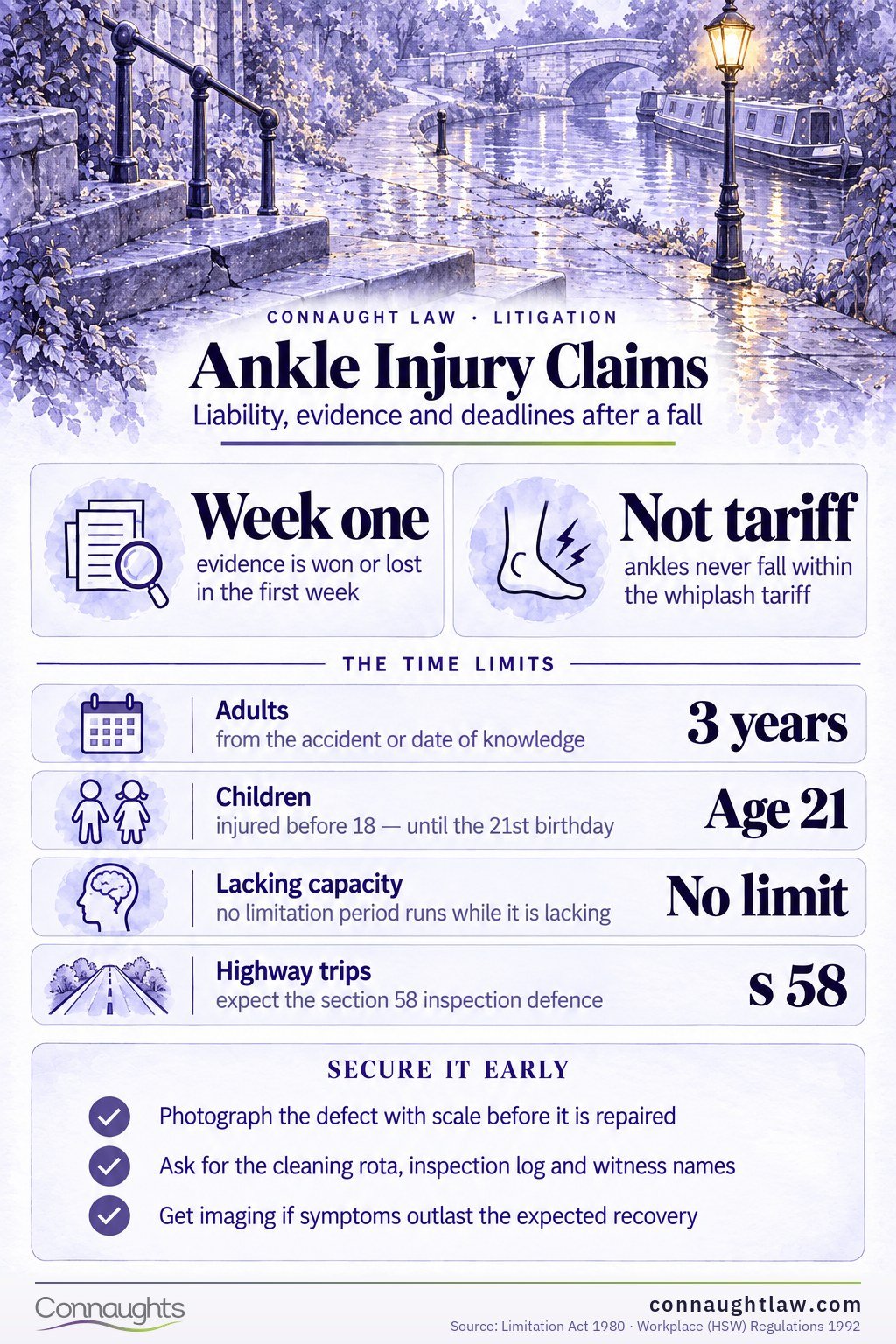
One boundary point matters for vehicle occupants: ankle injuries never fall within the whiplash tariff, which covers only neck, back and shoulder soft tissue. A fractured or sprained ankle suffered in a road accident is valued under the full Guidelines from the first conversation, whatever the insurer's portal letter implies.
Judicial College Guidelines 2026 Ankle Brackets
The 18th edition of the Guidelines, published in April 2026, values ankle injuries in four categories, replacing the lower figures of the April 2024 edition. The current brackets are set out below.
Ankle Injury Brackets
| Category | 2026 Bracket | What It Covers |
|---|---|---|
| Very severe | £66,140 – £92,090 | Rare and unusual injuries — transmalleolar fractures with extensive soft-tissue damage, deformity and lasting instability |
| Severe | £41,370 – £66,140 | Injuries needing plaster or pins and plates over a long treatment period, leaving permanent walking difficulty |
| Moderate | £18,150 – £35,130 | Fractures and ligament tears leaving some permanent problems — difficulty on uneven ground or standing for long periods |
| Modest | Up to £18,150 | Minor fractures, sprains and ligament injuries recovering completely or leaving only mild symptoms |
Searches for an average ankle injury payout have no honest single answer, because the distribution is bottom-heavy: sprains and undisplaced fractures vastly outnumber fusions, so the typical settlement sits in the modest band, while published averages are dragged upward by rare catastrophic awards. What positions your claim is medical evidence of outcome, not arithmetic performed on other people's injuries.
Position within a bracket follows familiar variables with an ankle-specific accent: whether surgery restored stability, whether metalwork stays or needs removal, residual stiffness and swelling on standing, and the documented risk of post-traumatic arthritis. Work matters too — scaffolders, carers on their feet all shift and delivery drivers do not hold the same claim as desk workers with the same X-ray.
- Completeness of recovery, and residual instability documented over time
- Surgery, metalwork, and any planned removal or revision
- Documented risk of post-traumatic arthritis, future fusion or replacement
- Physical demands of your work and any labour-market disadvantage
- Financial losses, which often exceed the injury award in serious claims
Where the same accident damages ankle and foot, or ankle and knee, the injuries are valued as one changed life rather than a stack of chapters — the adjacent frameworks are covered in our foot injury compensation guide and knee injury compensation guide. The schedule of losses then captures the combined effect, which is larger than either injury alone suggests.
Sprained Ankle Compensation
Sprained ankle compensation is the most searched and most misunderstood figure in this field. A grade one or two sprain that recovers fully within weeks sits at the bottom of the modest band — realistically a four-figure award rather than anything the headline of up to £18,150 implies — plus the earnings, treatment and travel costs of the recovery period. That is an honest claim worth pursuing without inflation.
The modest band is wide precisely because soft-tissue outcomes vary. A sprain that leaves months of aching, a limp through a season or nervousness on stairs justifies a higher placement within it; a complete rupture with lasting instability outgrows the label entirely and belongs in the moderate bracket. The valuation follows the recovery, not the word sprain on the triage note.
The practical caution is medical rather than legal: instability declares itself over months, and cartilage damage hides behind normal X-rays until an MRI looks properly. An offer accepted while the joint is still lying about its condition cannot be reopened, so persistent symptoms past the expected recovery window justify imaging and a specialist opinion before any figure is discussed.
Ankle Ligament Damage Claims
Compensation for ankle ligament damage turns on permanence. Complete ruptures, syndesmosis injuries and chronic instability — the ankle that gives way on stairs months after the accident — fall within the moderate bracket of £18,150 to £35,130 once some permanent problem remains, and reconstruction surgery with a good outcome sits in the same territory. Ligament injuries that heal fully remain modest claims, valued honestly as such.
Why Ligament Claims Get Undervalued
The recurring failure in ligament claims is early settlement on incomplete evidence. Insurers price the first diagnosis, not the outcome, and a claimant who accepts a sprain-level offer before instability has declared itself has sold a moderate claim at a modest price. Persistent giving-way, swelling after ordinary walking or pain on uneven ground months after the accident are the signals that the injury needs imaging, not a cheque.
Achilles tendon injuries carry their own Guideline entries alongside the ankle chapter: a rupture repaired but leaving weakness and a limp attracts £33,020 to £39,750, with partial ruptures and other significant tendon injuries at £16,640 to £27,830. The misdiagnosed rupture — sent home as a sprain without a squeeze test — is a recurring clinical negligence claim, because delayed repair costs function permanently.
Sport supplies steady ligament work, five-a-side, netball and trail running above all, and liability follows a familiar line: inherent risks are accepted, while unsafe surfaces, defective courts and negligent organisation are not. Venue claims turn on maintenance and inspection records, exactly like any occupier case.
Broken Ankle Compensation, Surgery and Recovery
Broken ankle compensation is graded by what the break did to the joint. An undisplaced malleolar fracture managed in a boot and recovering well settles in the modest or lower moderate range. Displaced and bimalleolar fractures fixed with plates and screws, leaving permanent walking difficulty, occupy the severe bracket of £41,370 to £66,140. Pilon and transmalleolar injuries — the crush and rotation catastrophes — press into the very severe range of £66,140 to £92,090 as fusion or replacement becomes the endgame.
Pricing Complications: Arthritis and Fusion
Complications deserve their own pricing rather than sympathy: non-union extending recovery by seasons, infection around metalwork, complex regional pain syndrome turning a fracture into a pain condition, and deep vein thrombosis from immobilisation. Each is a documented, claimable consequence that moves brackets and enlarges losses, provided the medical evidence names it. Probable future surgery is either priced into settlement or protected by provisional damages.
Rehabilitation is claimable as it happens rather than reimbursed later: the Rehabilitation Code funds private physiotherapy during the claim, and interim payments bridge the income gap while you cannot work. Early funded treatment shortens the very recovery the defendant will one day be paying for.
Recovery structure shapes the losses schedule: weeks non-weight-bearing, months of physiotherapy, a phased return that physical jobs cannot always offer, and for some a permanent change of duties. NHS guidance on broken ankles maps the clinical pathway; the claim funds the treatment, adaptations and income the pathway assumes but does not pay for, and our loss of earnings guide covers that evidence.
Settlement discipline mirrors the medicine: value the claim after the joint has declared itself, price any probable surgery in or keep the claim open for it, and treat early offers as what they are — a purchase of uncertainty at the claimant's expense. Part 36 offers and joint settlement meetings finish claims properly once the evidence exists; nothing finishes them properly before it.
Funding follows the personal injury standard: conditional fee agreements with adverse-costs insurance, household legal expenses cover checked first, and no fees to find while the ankle keeps you off work. Recoverable legal costs are benchmarked against the courts' guideline hourly rates, so fee anxiety should never triage a genuine injury.
Ankle Injury at Work Compensation
Ankle injury at work compensation rests on concrete duties: floors kept safe and unobstructed under the Workplace (Health, Safety and Welfare) Regulations 1992, spillage and inspection systems that actually run, suitable footwear where conditions demand it, and ladder and platform work planned under the height regime. HSE's slips and trips guidance treats these accidents as management failures, not bad luck, and so do courts.
Falls from height compress the whole subject into one mechanism: ladders footed by nobody, scaffold boards short of a guardrail, order pickers used as lifts. An ankle shattered by a two-metre drop is the classic severe-bracket claim, frequently accompanied by heel fractures that the foot chapter values separately — falls-from-height files that mention heel pain in passing usually contain a bigger claim than anyone has yet valued.
Footwear and Contributory Negligence Arguments
Footwear arguments repay attention on both sides: an employer who requires safety boots and enforces the rule is in a different position from one whose policy lives in a drawer, and a claimant working in inappropriate footwear against instruction may face a contribution argument. Momentary inattention, though, is foreseeable human behaviour, not a defence — at most it feeds a modest contributory negligence deduction, and usually not even that.
Older claimants deserve the eggshell reassurance: fragile bones do not weaken claims. A defendant takes the victim as found, so an osteoporotic ankle shattered by a fall that would have sprained a younger joint is compensated for the shattering, and the care and independence consequences — which age amplifies — are claimed in full. Children's ankle injuries involve growth plates, so settlement properly waits on a paediatric orthopaedic prognosis, under the usual court approval protections.
The evidence is won or lost in the first week: the accident book entry, RIDDOR report where one is required, photographs of the surface or defect before it is cleaned or mended, the cleaning rota and inspection log, footwear policy documents, and the names of colleagues who slipped on the same patch last month. The employer whose paperwork appears only after the accident is a recurring character in these files.
Medical Evidence in Ankle Claims
The evidence set is orthopaedic-standard: X-rays and, where symptoms outlast them, MRI; operation notes and hardware records; measured movement and stability testing over time; and a consultant foot-and-ankle specialist addressing causation, arthritis risk and any future fusion or replacement with dates and probabilities rather than adjectives. Weight-bearing X-rays and gait observations translate the injury into function, which is where ankle awards are actually decided.
Defendants run the usual themes — degenerate joints, old sporting sprains, symptom magnification — and the answers are the usual disciplines: chronology, contrast and consistency. An ankle that carried a working life without complaint until the accident speaks for itself, provided the records let it.
Function evidence positions the award: stairs and ladders tested against the job description, standing tolerance measured against a shift, a short diary of the days the ankle dictated, and family statements describing the school run surrendered or the walking holiday abandoned. Psychological consequences appear more often than the joint's size suggests — fear of stairs after a bad fall, driving anxiety after a crush — and diagnosed conditions are valued separately and treated alongside.
Time Limits for Ankle Injury Claims
The Limitation Act 1980 applies unchanged: three years from the accident or date of knowledge, until the 21st birthday for children injured before 18, and no running limit where capacity is lacking. Highway trip claims add the section 58 inspection defence to anticipate. None of the deadlines excuse waiting — surfaces are resurfaced, rotas shredded and witnesses scattered long before year three.
An ankle claim's best witness is the defect itself, and defects are repaired with suspicious speed once someone is carried off them. Photograph the surface with scale and context, note the lighting and weather, and report the incident in writing before the swelling has even settled.
Questions about ankle injury claims
How much compensation do you get for an ankle injury in the UK?
Under the Judicial College Guidelines 18th edition (2026): up to £18,150 for modest sprains and minor fractures, £18,150 to £35,130 for moderate injuries with permanent problems, £41,370 to £66,140 for severe fractures, and £66,140 to £92,090 for very severe injuries, plus financial losses.
What is the average payout for an ankle injury?
No honest single average exists. Most claims are modest sprains and minor fractures settling under £18,150, while surgical fractures with permanent problems settle higher. Published averages mix these extremes and predict nothing about an individual claim.
How much compensation for a sprained ankle?
A sprain that recovers fully is usually a four-figure award at the lower end of the modest band, plus lost earnings and treatment costs. A rupture leaving lasting instability moves into the moderate bracket of £18,150 to £35,130.
Can I claim compensation for ankle ligament damage?
Yes, where someone's negligence caused it. Ligament damage that heals is a modest claim; ruptures, syndesmosis injuries and chronic instability leaving permanent problems fall within the moderate bracket, with reconstruction and losses claimed on top.
What is a broken ankle claim worth?
Outcome decides it: an undisplaced fracture healing well sits toward the modest and moderate brackets, surgical fixation leaving permanent walking difficulty in the severe range, and joint-destroying injuries needing fusion or replacement in the very severe bracket.
Can I claim for an ankle injury at work?
Yes. Employers must keep floors safe, run genuine inspection systems and plan work at height. Claims are brought against their compulsory liability insurance, and dismissing or penalising you for claiming is unlawful.
I twisted my ankle on a pothole — who do I claim against?
The highway authority, under its statutory maintenance duty. It will defend by proving a reasonable inspection system, so the defect's documented history, prior complaints and photographs decide these claims. Report and photograph the pothole immediately.
Does compensation cover metalwork removal or future surgery?
Yes. Planned hardware removal, revision fixation and probable fusion or replacement are priced into the claim on expert evidence, or protected by provisional damages where a defined risk remains uncertain.
What is the time limit for an ankle injury claim?
Three years from the accident or date of knowledge, until the 21st birthday for children, unlimited where capacity is lacking. The practical deadline is evidential: photograph the defect and report the accident in week one, not year one.
Tell us how it happened, what the scans and treatment have involved, and what you still cannot do. We’ll tell you which bracket fits and what evidence is worth securing now.
Get Expert Advice