
Hearing loss compensation in the UK is assessed under the Judicial College Guidelines 18th edition, published in April 2026. Awards run from up to £9,260 for slight noise-induced hearing loss, through £19,680 to £39,250 for moderate cases, to £119,890 to £144,860 for total deafness — £185,840 where deafness prevents speech developing — with hearing aids, earnings and other losses added on top. The tables below set out every deafness and tinnitus bracket, then the guide covers industrial deafness claims against past employers, the noise regulations, the date-of-knowledge time limit and the audiological evidence that decides these cases.
On This Page
Understanding Hearing Loss Compensation UK 2026
Loud noise destroys the cochlea's hair cells, and they do not grow back. The damage is painless at the time, accumulates shift by shift, and typically surfaces years later as a television turned ever louder and conversations lost in background noise. NHS guidance treats gradual adult hearing loss as a routine referral; the law treats its noise-induced portion as an injury someone may be liable for.
Every claim recovers two kinds of loss. General damages compensate the injury itself, valued against the Judicial College tables below. Special damages repay what the injury costs — hearing aids for life, lost earnings, treatment and care — and both are recovered through a single personal injury claim, however many employers contributed to the damage.
Liability usually belongs to employers who ran noisy workplaces without measurement, control or protection, and it survives their disappearance: claims proceed against the employers' liability insurers of businesses that closed decades ago, traced through the Employers' Liability Tracing Office. The caseload persists because the damage outlives the industries — shipyards, mills and print works are gone, but the people who staffed them are reaching the ages at which noise damage and natural ageing compound each other.
Hearing Loss Compensation Tables: Judicial College Guidelines
The hearing loss compensation table below sets out every deafness and tinnitus bracket in the Judicial College Guidelines 18th edition (April 2026), the source every compensation table published in the UK ultimately derives from. Categories are graded by audiometric severity, the presence of tinnitus, and the age at which the loss bites — a younger claimant lives with it longer and loses more of working life to it.
Judicial College Brackets
| Injury Category | 18th Edition Bracket | What It Covers |
|---|---|---|
| Total deafness and loss of speech | £144,860 – £185,840 | Deafness in early childhood preventing normal speech development |
| Total deafness | £119,890 – £144,860 | Both ears; upper end where tinnitus or speech effects are present |
| Total loss of hearing in one ear | £41,370 – £60,160 | Upper end with associated headaches, dizziness or tinnitus |
| Severe tinnitus with NIHL | £39,250 – £60,160 | Severe tinnitus alongside noise-induced hearing loss |
| Moderate tinnitus and NIHL | £19,680 – £39,250 | Also moderate-to-severe tinnitus or NIHL alone |
| Mild tinnitus with some NIHL | £16,640 – £19,680 | Both present, each at the milder end |
| Mild tinnitus alone, or mild NIHL alone | Around £15,480 | One condition only, at mild severity |
| Slight or occasional tinnitus with slight NIHL | £9,720 – £16,640 | Both present but slight |
| Slight NIHL or slight tinnitus alone | Up to £9,260 | One slight condition without the other |
| Accelerated need for hearing aids | Around £6,610 – £12,820 | Aids needed earlier, or for a limited period of years |
Position within a bracket is argued from function: whether both ears are affected, how far the loss invades the speech frequencies, whether aids restore useful hearing or merely amplify distortion, and what tinnitus adds at night. The most severe cases involve cochlear implantation, whose surgical, processor-replacement and rehabilitation costs are claimed in addition to the bracket.
Compensation for Moderate Hearing Loss
Compensation for moderate hearing loss falls within the £19,680 to £39,250 bracket, which covers moderate tinnitus together with noise-induced hearing loss, and moderate-to-severe tinnitus or hearing loss appearing alone. It is the bracket most industrial deafness claims land in: hearing aids are usually needed, conversation in background noise is a daily struggle, and work involving telephones or meetings becomes harder.
Moderate hearing loss attracts £19,680 to £39,250 under the 2026 Judicial College Guidelines. Where it sits in that range depends on tinnitus, age and how far the loss invades everyday communication — and lifetime hearing aid costs are added on top.
Hearing Loss Compensation Calculator: Why Estimates Vary
Every hearing loss compensation calculator online maps a few answers onto the same published brackets above — no calculator can read an audiogram, separate noise damage from ageing, weigh what tinnitus does at 3am, or price decades of hearing aid replacement. Treat calculator outputs as orientation, not valuation. The real figure is built from the medical evidence: the bracket the audiogram supports, adjusted for age and tinnitus, plus every financial loss the damage causes.
Financial Losses Beyond the Brackets
Financial losses sit on top of the bracket and frequently exceed it. Digital hearing aids suited to noise-damaged hearing are bought privately and replaced on a cycle for life, batteries, fittings and reviews included; earnings suffer where communication-critical work becomes untenable. Age shapes both ends: a 45-year-old with moderate damage faces decades of aid dependence and workplace disadvantage, while an 80-year-old's claim is more modest but no less real.
Industrial Deafness and Noise-Induced Hearing Loss Claims
Industrial deafness is the classic occupational disease claim, and a noise-induced hearing loss claim follows the same route whether the exposure ended last year or in 1979. Employers have owed a common law duty to protect hearing since the early 1970s at the latest, so exposure in the factories, shipyards, mills, print halls and construction sites of that era still founds industrial disease claims in 2026.
High-Risk Industry Sectors
| Industry Sector | Typical Noise Sources | Common Claim Pattern |
|---|---|---|
| Construction | Pneumatic drills, breakers, power tools, plant | High-frequency bilateral NIHL, often multiple employers |
| Manufacturing | Presses, assembly lines, grinding equipment | Moderate bilateral loss with persistent tinnitus |
| Entertainment and music | Amplification, venues, studios, orchestra pits | Acoustic trauma, tinnitus, hyperacusis |
| Mining and quarrying | Drilling, blasting, ventilation, heavy vehicles | Severe bilateral loss, long exposure histories |
| Agriculture | Harvesters, chainsaws, chippers, tractor cabs | Moderate loss, often uninsured self-employment gaps |
| Armed forces | Gunfire, armour, aircraft | MoD claims for negligent post-1987 exposure; AFCS for service since 2005 |
Limitation and the Date of Knowledge
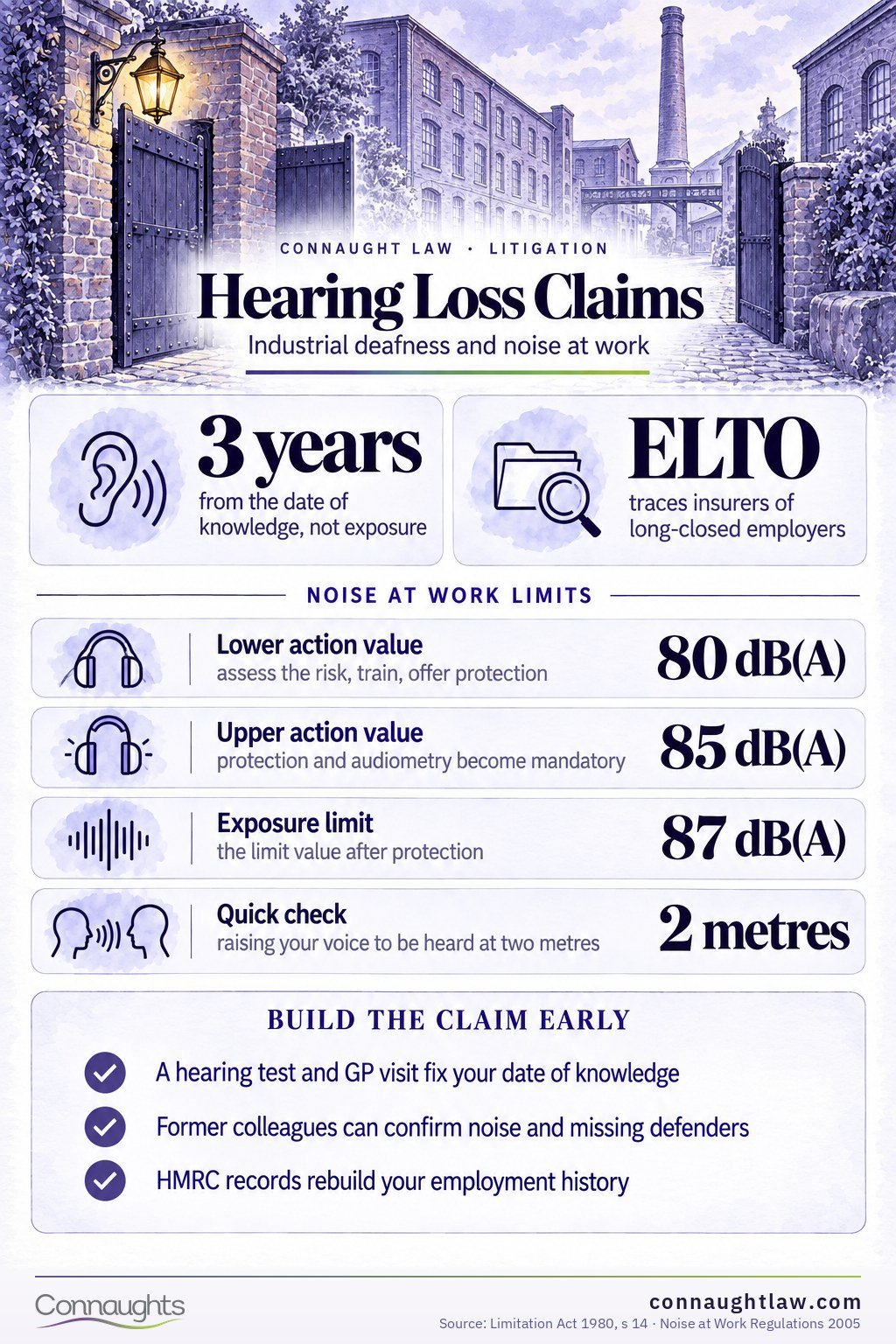
Limitation is the argument defendants reach for first. Under the Limitation Act 1980 the three years run not from exposure but from the section 14 date of knowledge — when the claimant knew, or ought reasonably to have known, that the hearing damage was significant and attributable to noise at work. A GP consultation that first links deafness to work, or an audiogram arranged by advisers, commonly marks the start; decades-old exposure is no bar where knowledge is recent, and the court keeps a section 33 discretion for late claims.
The exposure history is corroborated rather than merely remembered: HMRC employment schedules prove the jobs, union and pension records fill gaps, and statements from former colleagues describing the din, the absent ear defenders and the shouted conversations put evidential flesh on decibel levels nobody measured at the time. Two or three colleague statements routinely decide whether an insurer contests exposure at all.
Apportionment Across Employers
Where several employers contributed, the award is apportioned between their insurers according to each period of negligent exposure, and the system tolerates gaps: where an insurer cannot be traced or has failed, the Financial Services Compensation Scheme can stand behind compulsory employers' liability policies, so one missing insurer rarely sinks an otherwise sound claim.
- Employers' liability insurance has been compulsory since 1972; the insurer pays, not the company
- The ELTO database identifies insurers behind businesses wound up decades ago
- HMRC employment histories and payroll records rebuild the working-life timeline
- Former colleagues corroborate noise levels and missing hearing protection
- Liability is apportioned across every insurer on the exposure timeline
The Control of Noise at Work Regulations 2005
Modern exposure is governed by the Control of Noise at Work Regulations 2005: at the 80 dB(A) lower exposure action value, employers must assess the risk, provide information and training and make hearing protection available; at the 85 dB(A) upper action value, protection and health surveillance including audiometry become mandatory; and 87 dB(A) is the exposure limit value after protection. HSE guidance offers a working shortcut: if you must raise your voice at two metres, the environment probably needs assessing.
The regulations rank controls deliberately: noise is eliminated or reduced at source — quieter machinery, damping, enclosure, maintenance — before hearing protection is handed out, because protection depends on perfect, permanent use. An employer whose entire noise strategy was a box of foam plugs by the clock-in machine has not complied; it has documented its own breach.
Health surveillance obligations continue while exposure does: audiometry at intervals, results explained to the worker, and referral where deterioration appears. Surveillance that recorded decline nobody acted on is a recurring feature of successful claims, and its absence in a workplace above the action values is itself a breach worth pleading.
Noise Regulations Beyond Heavy Industry
The duties reach beyond heavy industry. Live music venues, orchestra pits, nightclubs, kitchens and high-volume call centres are all within scope, and agency workers, labour-only subcontractors and the nominally self-employed working under direction are owed the relevant duties by whoever controlled the noisy workplace. Who paid the wages matters less than who controlled the noise — and occupational health files are early disclosure targets, because a warning given years ago may also have started the limitation clock.
Tinnitus and Acoustic Trauma
Tinnitus — persistent ringing, buzzing or hissing — accompanies noise damage so often that the Guidelines assess the two together in combined brackets rather than as separate injuries: from around £15,480 where mild tinnitus appears alone to £39,250 to £60,160 where severe tinnitus combines with noise-induced hearing loss. Where tinnitus dominates the picture, or appears without measurable loss, the dedicated ladder in our tinnitus compensation guide applies.
Acoustic Trauma: The Single-Event Exception
Acoustic trauma is the single-event exception to the gradual rule: an explosion, a burst of feedback through a headset, a firearm discharged nearby. Damage is immediate, the causation argument is short, and limitation runs from the event itself rather than a drawn-out date of knowledge. Employers of headset workers and event staff owe the same regulatory duties as factory owners — a point settled against the Royal Opera House in the Goldscheider litigation, which confirmed that artistic output is no defence to the 2005 Regulations.
Noise damage also brings companions beyond tinnitus. Hyperacusis — painful sensitivity to ordinary sound — can be more disabling than the loss itself for musicians and teachers, and blast or pressure events sometimes disturb balance or accompany a head injury compensation claim where the same event strikes the skull. Each is pleaded and valued alongside the hearing injury rather than lost inside it.
Leisure noise, by contrast, is usually nobody's liability: the gigs attended, the headphones turned up, the motorcycling years. Defendants raise it to dilute causation, and honest claimants should expect the question and answer it plainly. Experts can and do separate occupational dose from recreational exposure, and a candid account preserves credibility where an evasive one destroys it.
Audiological Evidence That Wins Claims
Every claim stands on audiometry. Noise-induced loss produces a characteristic notch in the higher frequencies where speech consonants live, distinguishable from the smooth downward slope of age-related loss, and defendants routinely instruct experts to attribute everything to age. The battle is won with good baseline data, a credible exposure history and an ENT or audiovestibular expert who addresses the pattern honestly.
Audiometry and Related Tests
| Assessment | What It Establishes |
|---|---|
| Pure tone audiometry | Frequency-by-frequency thresholds; the noise notch that separates NIHL from ageing |
| Speech audiometry | Real-world communication impairment, which anchors loss of amenity |
| Tympanometry | Middle-ear function, excluding conductive causes unrelated to noise |
| ENT / audiovestibular report | Diagnosis, causation between noise and loss, prognosis and aid requirements |
| Engineering / occupational evidence | Reconstruction of workplace noise dose against the regulatory action values |
Expect three defence arguments in almost every case: ageing, that the loss is presbycusis rather than noise; de minimis, that the noise element is too small to be actionable; and limitation, that knowledge arrived years before the claim. Each is met the same way — audiogram analysis, a documented exposure history and a clear knowledge chronology — which is why those three documents are built before the letter of claim, not after the defence arrives.
Procedurally these run as disease claims rather than portal claims: a letter of claim to each insurer on the timeline, disclosure of noise assessments, occupational health and personnel files, and negotiation informed by apportionment. Funding is almost always no-win-no-fee, and Industrial Injuries Disablement Benefit for prescribed occupational deafness can be pursued in parallel, with offsets handled in the settlement schedule.
Claimants help themselves by getting tested promptly, keeping hearing aid receipts, and describing specific situations lost — the phone, the pub, the grandchildren — rather than offering a general complaint of "bad hearing". A spouse's account of fifteen years of louder televisions and withdrawn evenings is admissible, persuasive evidence of when loss became significant and how far it reaches.
If you suspect noise damage, arrange a hearing test and a GP attendance now. The test is quick and painless, the record fixes your date of knowledge on your terms, and a claim investigated while former colleagues are findable is worth more than the same claim five years later.
Questions about hearing loss claims and compensation
How much compensation do you get for hearing loss in the UK?
Under the Judicial College Guidelines 18th edition, awards run from up to £9,260 for slight noise-induced loss, £19,680 to £39,250 for moderate cases, £41,370 to £60,160 for total loss in one ear, and £119,890 to £144,860 for total deafness, plus financial losses.
How much compensation for moderate hearing loss?
Moderate hearing loss with tinnitus attracts £19,680 to £39,250 under the 2026 Guidelines. Hearing aid costs, replaced for life, and any earnings impact are claimed on top, so settlements often exceed the bracket figure.
Can I claim for hearing loss from a job I left decades ago?
Usually yes. Time runs from when you knew, or should have known, the loss was significant and noise-related, not from the exposure. Claims proceed against the old employer's insurer, traced through the ELTO database even where the company is long dissolved.
What noise levels make an employer liable?
Modern duties begin at 80 dB(A) daily average exposure, with mandatory protection and audiometric surveillance from 85 dB(A) and an 87 dB(A) limit value. Historic exposure is judged by the standards of its time, which required hearing protection from the early 1970s onward.
Is hearing loss from ageing claimable?
No, and defendants attribute as much as possible to age. The claim covers the noise-induced portion, identified by the audiogram pattern and expert analysis, which is why early, good-quality audiometry matters more than any other single step.
Is there an accurate hearing loss compensation calculator?
No calculator can value your claim. Online tools map answers onto the published brackets, but the figure depends on your audiogram, tinnitus, age and lifetime hearing aid costs — which is medical and legal analysis, not arithmetic.
What if I also have tinnitus?
Tinnitus and hearing loss are assessed together in combined brackets, and severe tinnitus moves a claim up the ladder significantly — to £39,250 to £60,160 alongside noise-induced loss. Tinnitus without measurable hearing loss is compensable in its own right.
Are hearing aids covered by compensation?
Yes. Awards routinely include private digital aids matched to the loss, replaced on a realistic cycle for life, with batteries, fittings and reviews. Lifetime aid costs often exceed the injury bracket itself for younger claimants.
Can I claim Industrial Injuries Disablement Benefit as well?
Occupational deafness is a prescribed disease for Industrial Injuries Disablement Benefit after sustained work in prescribed noisy occupations. It requires no proof of fault and can run alongside a civil claim, subject to benefit offsetting rules.
Tell us where you worked, roughly when, and what a hearing test has shown. We’ll tell you whether the claim is still in time and which employer or insurer is likely to pay.
Get Expert Advice