
Broken arm compensation in the UK is assessed under the Judicial College Guidelines 18th edition, published in April 2026, which set four brackets running from simple forearm fractures to severe injuries little better than amputation. The right award depends on which bone broke, whether surgery was needed, how fully function returned, and what the injury cost you financially. This 2026 guide explains the current brackets, realistic average settlements, workplace and road traffic claims, the medical evidence that matters, and the deadlines that apply.
On This Page

Understanding Broken Arm Compensation Claims
A broken arm claim compensates two kinds of loss. General damages cover the pain, suffering and loss of amenity caused by the fracture itself, valued against the Judicial College Guidelines. Special damages repay what the injury has cost you — lost earnings, treatment, physiotherapy, travel and care — and both are recovered through a single personal injury claim.
Arm fractures arise across every claim type this guide covers: workplace accidents, road traffic collisions, and slips and falls in public places. Whoever was responsible, the legal test is the same — the injury must have been caused by another party's negligence or breach of statutory duty, and the claim must be brought in time.
Judicial College Guidelines 2026: Broken Arm Compensation Brackets
Under the Judicial College Guidelines 18th edition (April 2026), the injury element of a broken arm claim is valued between £8,730 and £172,970 depending on severity. A simple forearm fracture with good recovery sits at the bottom of that span; awards rise steeply where disability is permanent, and financial losses are added on top.
The Judicial College Guidelines are the reference courts, insurers and solicitors use to value the injury element of a claim in England and Wales. The 18th edition, published on 9 April 2026, uplifted arm injury brackets by around 8.26% against the April 2024 edition to reflect RPI inflation. They are guidance rather than a fixed tariff — awards are placed within, and occasionally outside, the brackets on the medical evidence, consistent with the government's guidance on compensation after an accident.
The table below sets out the four arm injury categories in the guidelines with their current 18th edition figures. Each bracket appears once here; the sections that follow explain how individual fractures map onto these categories.
JCG Arm Injury Brackets
| JCG Arm Injury Category | 18th Edition Bracket | What It Covers |
|---|---|---|
| Severe injuries | £127,050 – £172,970 | Injuries falling short of amputation but leaving the person little better off than if the arm had been lost |
| Injuries resulting in permanent and substantial disablement | £51,750 – £79,080 | Serious fractures of one or both forearms with significant permanent residual disability |
| Less severe injury | £25,370 – £51,750 | Significant disabilities from which substantial recovery has taken place or is expected |
| Simple fractures of the forearm | £8,730 – £25,370 | Uncomplicated breaks of the radius or ulna with a good recovery |
Where a claim sits within its bracket turns on displacement and comminution, the number of operations required, whether the dominant arm was injured, the claimant's age, ongoing pain and the permanence of any restriction. Financial losses are then added, so total settlements regularly exceed the injury bracket alone.
What Is the Average Settlement for a Broken Arm?
There is no official average settlement for a broken arm, because most claims settle privately and outcomes are not centrally recorded. The guideline brackets above are the only published benchmark. In practice, the majority of uncomplicated fractures — treated in a cast and healing within a few months — resolve within the simple fractures of the forearm bracket, plus special damages.
Averages and online calculators also mislead because identical fractures produce different settlements. A self-employed roofer with a plated forearm loses far more income than an office worker with the same X-ray, and dominant-arm involvement, complications or slow rehabilitation all move the final figure. Treat any quoted average as orientation, not a valuation.
What Else a Broken Arm Settlement Includes
Special damages routinely form a large share of a broken arm settlement. Recoverable items include lost earnings and overtime during recovery, the cost of private surgery or physiotherapy where NHS waiting lists would delay rehabilitation, prescriptions, travel to appointments, and paid or gratuitous care — including help from family, valued at an hourly rate. Where the fracture leaves permanent restriction, future losses such as reduced earning capacity and later hardware-removal surgery are quantified and claimed in the same settlement.
Humerus Fracture Compensation and Surgical Requirements
The humerus — the single bone of the upper arm — produces some of the most serious broken arm claims. Proximal fractures near the shoulder joint can permanently restrict lifting and reaching, and often overlap with shoulder injury compensation assessments, while distal fractures at the elbow end risk stiffness and post-traumatic arthritis of the kind covered in our elbow injury guide. Displaced or comminuted breaks usually need open reduction and internal fixation with plates and screws, or intramedullary nailing.
The radial nerve wraps around the humeral shaft, so these fractures carry a recognised risk of nerve palsy causing wrist drop and weakened grip — a complication that can add a separate nerve damage element to the claim. The guidelines classify by outcome rather than bone: a humerus fracture that heals with little lasting restriction is generally valued within the less severe category, while permanent nerve injury, non-union or joint damage moves the claim into the permanent and substantial disablement bracket or above.
Complications That Increase Humerus Fracture Awards
Humerus fractures develop complications more often than most arm breaks, and each one lengthens treatment and strengthens the claim. Non-union — the bone failing to knit — may require bone grafting and revision fixation; malunion can need corrective osteotomy; avascular necrosis of the humeral head sometimes ends in shoulder replacement. Prolonged immobilisation also risks frozen shoulder and elbow stiffness. Because these outcomes convert a medium-term injury into a permanent one, medical evidence should not be finalised until the treating surgeon has ruled them out or confirmed their extent.
Forearm Fracture Compensation: Radius and Ulna Breaks
Fractures of the radius and ulna are the most common broken arm injuries, typically caused by falling onto an outstretched hand. A Colles' fracture of the distal radius sits at the wrist end of the forearm and is often assessed alongside wrist injury compensation, while both-bone forearm fractures almost always need surgical plating to preserve rotation.
The NHS advises that a broken arm or wrist usually takes six to eight weeks to heal, longer where the damage is severe. An uncomplicated break with that sort of recovery falls within the simple fractures of the forearm bracket in the table above. Residual problems — reduced grip, restricted rotation, or symptoms extending into the fingers — support placement in a higher category and may justify a linked hand and finger injury assessment.
Broken Arm at Work: Compensation and Employer Liability
Employers owe statutory and common-law duties under the Health and Safety at Work etc. Act 1974 to provide safe systems of work, adequate training, guarded machinery and effective fall protection. HSE statistics record 59,219 employer-reported non-fatal injuries under RIDDOR in 2024/25, with slips, trips and falls the largest single cause — the classic mechanism behind workplace arm fractures.
Falls from height, unguarded machinery, being struck by moving objects and same-level falls account for most workplace arm breaks. The claim is met by your employer's compulsory liability insurance rather than the business itself, and dismissing or penalising an employee for bringing an honest claim is unlawful.
Common Workplace Accident Scenarios
Falls from ladders, scaffolding and unguarded platforms on construction sites engage the Work at Height Regulations 2005 and produce the most serious fractures. Machinery entanglement in manufacturing points to guarding and maintenance failures under the Provision and Use of Work Equipment Regulations 1998, while struck-by accidents reflect poor exclusion zones and site management. Manual handling injuries in warehouses and care settings raise training duties under the Manual Handling Operations Regulations 1992. Identifying the specific regulation breached sharpens the negligence case and often shortens the argument over liability.
Strong workplace claims rest on contemporaneous evidence: the accident book entry, any RIDDOR report, photographs of the scene or equipment, witness details, and records showing what training and risk assessments were — or were not — in place before the accident.
Road Traffic Accident Broken Arm Compensation
Motorcyclists and cyclists suffer a disproportionate share of arm fractures, instinctively putting an arm out or taking direct impact in a collision. Vehicle occupants sustain them by bracing against the dashboard or door — a recognised injury pattern in car accident compensation claims.
The claim is normally made against the at-fault driver's insurer through the road traffic accident claims process, with the Motor Insurers' Bureau providing a route to compensation where the driver was uninsured or untraced. Because even the lowest arm fracture bracket exceeds the £5,000 small claims limit for road traffic injuries, broken arm claims proceed outside the fixed-tariff whiplash regime and legal costs are generally recoverable from the insurer.
Liability disputes in collision cases turn on evidence gathered early: dashcam and CCTV footage, independent witness details, police collision reports and photographs of vehicle damage. Where fault is shared — a cyclist without lights, a motorcyclist filtering at speed — compensation is reduced for contributory negligence rather than lost entirely, so a partial-fault accident is still worth assessing.
Medical Evidence Requirements for Broken Arm Claims
Every claim is valued on an independent medico-legal report from a consultant orthopaedic surgeon, prepared once recovery has plateaued. Settling before the long-term prognosis is clear risks accepting a bracket below the injury's true severity — an offer made early in rehabilitation cannot price complications that have not yet declared themselves.
- Imaging: X-ray series and CT scans documenting the fracture pattern, displacement and healing progress
- Operation notes: surgical records and fixation hardware details evidencing severity and future removal needs
- Prognosis: consultant opinion on permanence of restriction, arthritis risk and the likelihood of further surgery
- Function: range-of-motion and grip-strength testing comparing the injured and uninjured arms
- Losses: payslips, invoices and care records supporting the special damages claim
Functional evidence matters as much as the diagnosis. Two identical X-rays can justify different brackets where one claimant regains full use and the other cannot lift, rotate the forearm or grip normally — which is why dominance, occupation and daily-living impact must be recorded in the report.
Compensation for a Scar on Your Arm
Surgical incisions from fracture fixation and compound-fracture wounds often leave permanent marks, and scarring is valued as a distinct element of the settlement alongside the fracture itself. Awards reflect the scar's size, its visibility on the forearm in everyday clothing, and any psychological impact. Where scarring is significant — keloid change, skin grafting or genuine disfigurement — it deserves separate assessment under the brackets explained in our dedicated scar compensation guide.
Broken Arm Claim Process and No Win No Fee Funding
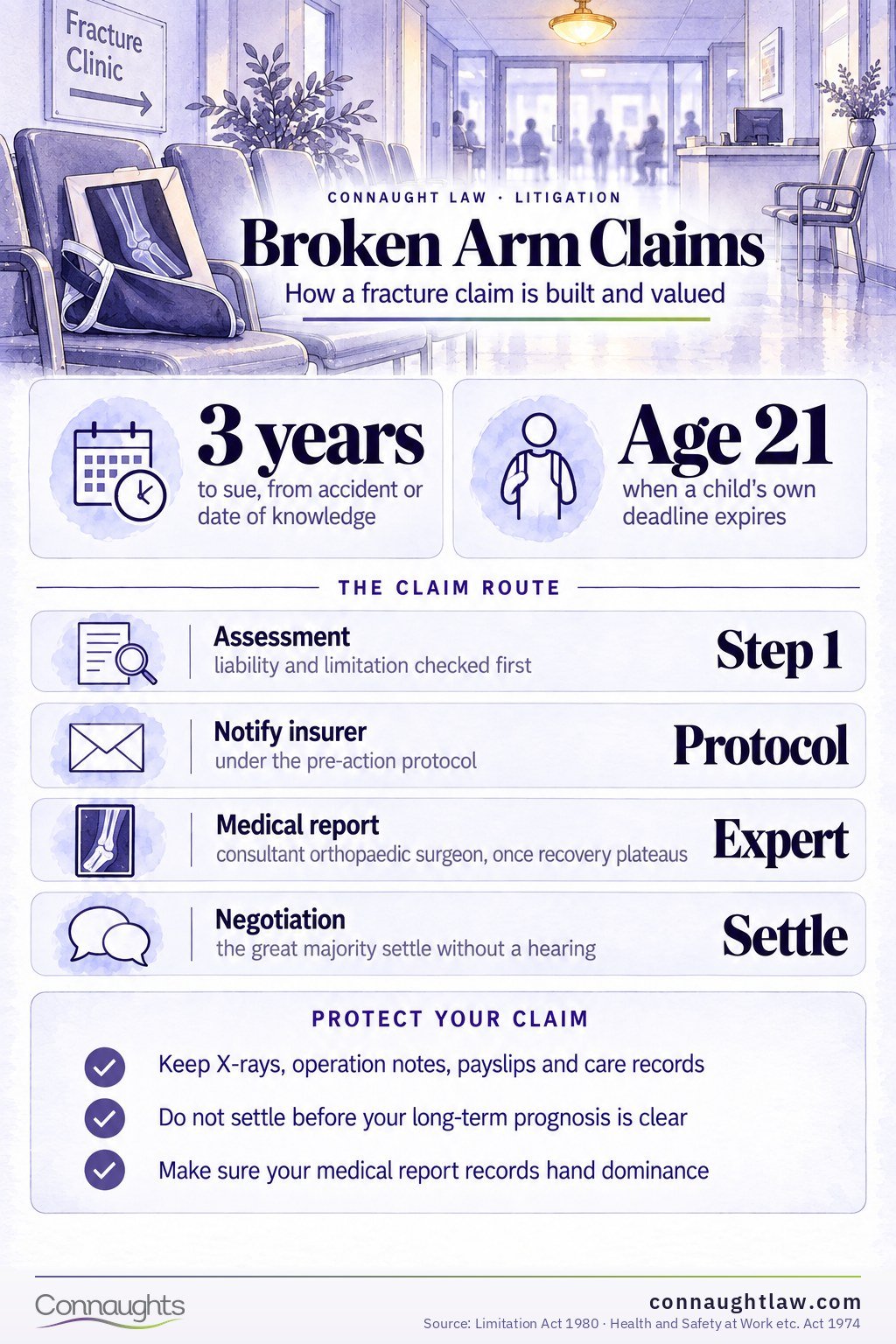
Most broken arm claims follow a structured route: an initial assessment of liability and limitation, notification to the defendant's insurer under the pre-action protocol, disclosure of medical evidence, then negotiation. The great majority settle without a court hearing.
Claims are typically funded through a conditional fee agreement, so you pay nothing upfront and a capped success fee only if the claim succeeds. Where hourly-rate work is charged, the courts' published solicitors' guideline hourly rates provide the benchmark. Interim payments can be requested once liability is admitted, easing treatment costs or income gaps before final settlement.
Time Limits for Broken Arm Compensation Claims
Section 11 of the Limitation Act 1980 gives three years to issue court proceedings, running from the accident or from the "date of knowledge" — the point at which you reasonably connected a significant injury to the defendant's fault, which matters where complications such as non-union emerge later. Courts hold a narrow discretion under section 33 to allow late claims, but it is never safe to rely on.
Children have until their 21st birthday, because the three years run from age 18, and a parent or litigation friend can claim on their behalf at any point before then. Time does not run against claimants lacking mental capacity. Assault-related fractures claimed through the Criminal Injuries Compensation Authority carry a shorter two-year application deadline.
Frequently askedQuestions about broken arm claims and compensation
How much compensation will I get for a broken arm in the UK?
The injury award is set by the Judicial College Guidelines 18th edition brackets in the table above, from simple forearm fractures to severe injuries, with financial losses added on top. Placement depends on surgery, quality of recovery and permanence of restriction.
What is the average settlement for a broken arm?
No official average exists because settlements are not centrally published. Most uncomplicated fractures resolve within the lowest guideline bracket plus lost earnings and treatment costs, while surgery, complications or permanent restriction push totals substantially higher.
Can I claim compensation for a broken arm at work?
Yes, where the fracture resulted from your employer's breach of duty — inadequate training, unguarded machinery, missing fall protection or unsafe premises. Claims are met by compulsory employers' liability insurance, and penalising you for an honest claim is unlawful.
How long does a broken arm claim take to settle?
Straightforward claims with admitted liability often settle within 9–12 months. Cases involving surgery, complications or disputed liability commonly take 18 months to two years, because settlement should wait until your long-term prognosis is medically clear.
Does it matter that I broke my dominant arm?
Yes. Dominant-arm injuries generally attract higher awards within the applicable bracket because writing, eating, personal care and most work tasks are harder to adapt. Your medical report should record hand dominance and its practical impact.
Can I claim if the accident was partly my fault?
Usually, yes. Contributory negligence reduces compensation by a percentage reflecting your share of responsibility rather than defeating the claim, so a claimant found 25% at fault still recovers 75% of the assessed value.
Can I claim on behalf of my child?
Yes. A parent or litigation friend can bring the claim at any time during childhood, and the child otherwise has until their 21st birthday to claim independently. Court approval of any settlement protects the child's interests.
Does compensation cover lost earnings and future treatment?
Yes. Special damages cover lost earnings, private treatment, physiotherapy, travel and care already incurred, while future losses — reduced earning capacity, hardware removal or later surgery — are quantified and claimed within the same settlement.
Will I have to go to court for a broken arm claim?
Very rarely. The overwhelming majority of broken arm claims settle through negotiation with the defendant's insurer under the pre-action protocol. Proceedings are issued mainly to protect limitation deadlines or where liability or valuation is genuinely disputed.
Can I get money before my claim finally settles?
Yes. Once the insurer admits liability, an interim payment can be requested to cover urgent needs — private surgery, physiotherapy or lost income — and is deducted from the final settlement rather than claimed in addition to it.
Tell us how the break happened, who you say was at fault and what treatment you have had. We’ll tell you whether there is a claim, which bracket the injury sits in and what else you can recover.
Get Expert Advice