
Wrist injury compensation is assessed under the Judicial College Guidelines 18th edition, published in April 2026, which value everything from a sprain that heals in weeks to complete loss of wrist function. Where an accident that was not your fault caused a scaphoid fracture, a distal radius (Colles') break, carpal tunnel syndrome or a TFCC tear, the award reflects how far function returned and what the injury cost you financially. This 2026 guide explains the current brackets, realistic settlement ranges, workplace claims, the medical evidence that matters, and the deadlines that apply.
On This Page

Understanding Wrist Injury Compensation Claims
A wrist injury claim compensates two kinds of loss. General damages cover the pain, suffering and loss of amenity caused by the injury itself, valued against the Judicial College Guidelines. Special damages repay what the injury has cost you — lost earnings, treatment, physiotherapy, travel and care — and both are recovered through a single personal injury claim.
Wrist injuries arise across every claim type this guide covers: workplace accidents, road traffic collisions, and slips and falls in public places. Whoever was responsible, the legal test is the same — the injury must have been caused by another party's negligence or breach of statutory duty, and the claim must be brought in time.
Judicial College Guidelines 2026: Wrist Injury Compensation Brackets
Under the Judicial College Guidelines 18th edition (April 2026), wrist injuries leaving some permanent disability are valued between £16,640 and £79,080 depending on severity. Fractures and soft tissue injuries that recover fully attract lower awards, and financial losses are claimed on top.
The 18th edition, published on 9 April 2026, replaced the April 2024 edition and raised awards by roughly 8 per cent in line with Retail Price Index inflation. Any figures you see quoted from earlier editions are now out of date. The Guidelines give a bracket for each level of wrist injury; where your injury sits within a bracket depends on the medical evidence, and individual factors can move an award up or down.
The table below summarises the wrist injury categories under the current edition.
Wrist Injury Brackets
| Judicial College category | 2026 bracket | What it covers |
|---|---|---|
| Complete loss of function | £62,910 – £79,080 | The wrist is effectively useless, typically after arthrodesis (fusion) |
| Significant permanent disability | £32,370 – £51,750 | Serious injury leaving major lasting disability, though some useful movement remains |
| Less severe, some permanent disability | £16,640 – £32,370 | Fractures or soft tissue injuries leaving persisting pain, stiffness or reduced grip |
| Full or near-full recovery | Lower awards | Fractures (including uncomplicated Colles' fractures) and sprains that heal — from the low thousands for recovery within a year to the low five figures where recovery takes longer |
What Is the Average Payout for a Fractured Wrist?
There is no official average payout for a fractured wrist — the published brackets value the injury, not the whole case. In practice, a broken wrist that heals fully within about a year attracts an injury award in the low thousands, rising into the low five figures where recovery takes closer to two years. Once permanent pain, stiffness or grip weakness remains, the £16,640–£32,370 bracket applies. Lost earnings, treatment and care costs are then added on top, which is why two identical fractures can settle for very different sums — see the government guidance on compensation after an accident.
Special Damages: What You Can Claim on Top
Special damages often exceed the injury award, particularly for manual workers. Recoverable losses include earnings during time off — with overtime, bonus and pension contributions counted — the cost of private physiotherapy or surgery where waiting would delay recovery, prescriptions, travel to appointments, and equipment or adaptations. Care and assistance provided free by family members is also claimable at a modest hourly value, and it is routinely overlooked. Where liability is admitted, interim payments can fund treatment before final settlement. Keep receipts, payslips and a simple diary of help received from the outset: contemporaneous records are far more persuasive than estimates reconstructed later.
Scaphoid Fracture and Distal Radius (Colles') Fracture Compensation
Most broken wrists involve one of two bones. The distal radius — the forearm bone's end at the wrist — is the most common fracture site, usually broken in a fall onto an outstretched hand; the NHS guidance on broken wrists explains diagnosis and treatment. The scaphoid, a small carpal bone at the base of the thumb, is the second most common site and is notorious for healing problems.
Distal Radius Fracture Compensation
Compensation for a distal radius fracture depends almost entirely on how well it heals. A fracture leaving lasting pain, stiffness or reduced grip strength typically falls within the £16,640–£32,370 bracket. Comminuted or intra-articular fractures fixed with plates and screws that leave significant permanent disability rise into the £32,370–£51,750 bracket. At the other end, a simple undisplaced fracture treated in a cast with full recovery is valued in the lower ranges, and the Guidelines give an uncomplicated Colles' fracture with a good outcome a benchmark award a little under £10,000.
Colles' fractures (displaced towards the back of the wrist) and Smith's fractures (displaced towards the palm) are the common subtypes. Where the break extends further up the forearm or involves both radius and ulna, the arm brackets may apply instead — our guide to broken arm compensation covers those. A fall onto an outstretched hand can also injure the joint above; see elbow injury compensation where damage extends beyond the wrist.
Scaphoid Fracture Compensation
The scaphoid has a limited blood supply, so non-union — the bone failing to knit — is a recognised risk, and the fracture is frequently missed on the first X-ray. A scaphoid fracture that unites with a cast or a single screw fixation and recovers well sits in the lower award ranges. Non-union requiring bone grafting, prolonged immobilisation or later wrist arthritis pushes the award into the £16,640–£32,370 bracket, and cases ending in significant permanent disability are valued above that.
- Fracture complexity: displacement, comminution and intra-articular involvement increase both surgical need and award level
- Surgery: open reduction and internal fixation, bone grafting or later hardware removal all raise valuation
- Complications: non-union, malunion, nerve involvement or post-traumatic arthritis lift a claim into higher brackets
- Residual function: measured range of motion and grip strength deficits are the core evidence of permanence
- Dominant hand: injury to the dominant wrist attracts a higher award within the bracket
- Occupation: manual workers, keyboard workers and musicians suffer greater vocational loss, increasing special damages
Wrist Injury at Work Compensation
Employers owe statutory duties that cover almost every way a wrist gets hurt at work. The Health and Safety at Work etc. Act 1974 requires a safe system of work; the Manual Handling Operations Regulations 1992 govern lifting tasks; the Display Screen Equipment Regulations require workstation assessments for keyboard workers; and machinery must be properly guarded. Musculoskeletal disorders remain one of the largest categories of work-related ill health in HSE's upper limb disorder guidance and statistics.
A wrist injury at work compensation claim succeeds where a breach of those duties caused the injury: no manual handling training before a lifting accident, an unguarded machine, an ignored request for a workstation assessment, or a wet floor left unmarked. Employers must report workplace wrist fractures under RIDDOR — fractures other than to fingers, thumbs and toes are specified injuries — and that report, the accident book entry and any risk assessments become key liability evidence.
Compensation follows the same brackets set out above, but workplace claims often carry heavier financial losses: weeks or months off work in a cast, permanently reduced capacity for manual roles, retraining costs and pension impact. Employers' liability insurance responds to the claim, and dismissing or disadvantaging an employee for claiming is unlawful. Gradual-onset injuries — repetitive strain rather than a single accident — are dealt with in the next section.
Road Traffic Accident Wrist Injuries
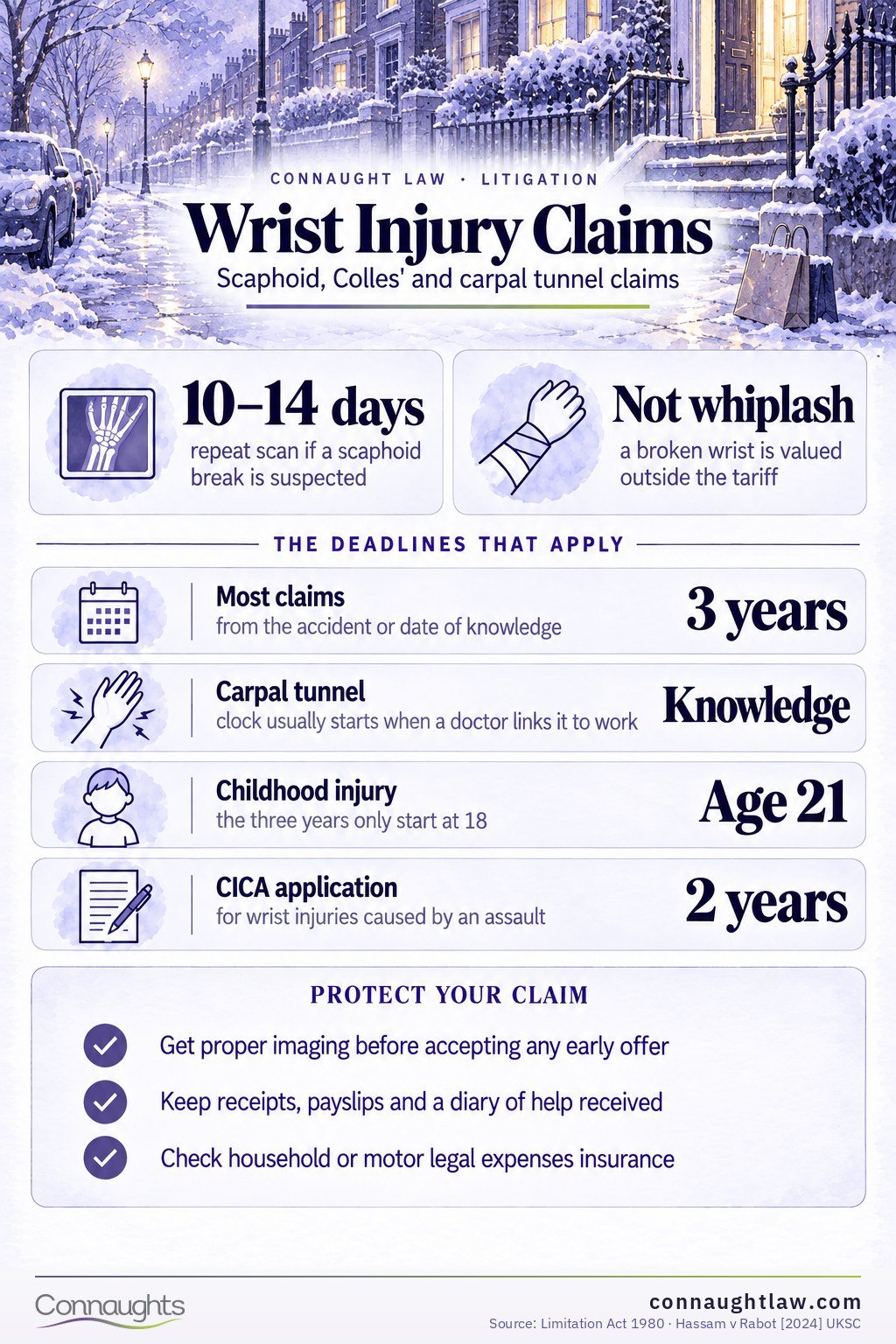
Wrist fractures are common in road traffic accidents — drivers bracing against the wheel, motorcyclists and cyclists breaking a fall. A broken wrist is not a whiplash injury, so the statutory whiplash tariff does not apply to it: the fracture is valued conventionally under the Judicial College brackets set out above. The tariff only covers soft tissue neck, back and shoulder injuries suffered by adult occupants of motor vehicles, and motorcyclists, cyclists and pedestrians fall outside it entirely.
Procedure depends on value. Where an adult occupant's injuries include whiplash, the claim usually starts in the Official Injury Claim portal, and following Hassam v Rabot [2024] UKSC the wrist fracture is valued separately from the tariff element, with an adjustment to avoid double counting. Claims where the injury element exceeds £5,000 — which most wrist fractures with any lasting symptoms will — proceed outside the small claims limit, meaning legal costs are recoverable and solicitor representation is realistic. Insurers know undiagnosed scaphoid fractures settle cheaply, so obtain proper imaging before accepting any early offer.
Carpal Tunnel Syndrome and TFCC Tear Compensation
Carpal tunnel syndrome — compression of the median nerve at the wrist causing numbness, tingling and grip weakness — is a common condition that can be caused or aggravated by repetitive work. Claims succeed where an employer failed to assess workstations, rotate repetitive tasks or act on reported symptoms. The Guidelines value these cases under work-related upper limb disorders: awards run from modest sums where symptoms resolve after surgery or activity change, to substantial five-figure awards for continuing, especially bilateral, disability affecting hand and finger function.
The triangular fibrocartilage complex (TFCC) stabilises the wrist on the little-finger side, and tears cause ulnar-sided pain, clicking and grip weakness — often alongside a distal radius fracture, and usually confirmed by MRI. Awards follow the wrist brackets: a tear repaired arthroscopically with good recovery sits in the lower ranges, while persistent instability, pain and weakness falls within the £16,640–£32,370 bracket, or higher where the disability is significant.
Medical Evidence Requirements for Wrist Injury Claims
The injury award turns on medical evidence, so the file must prove both diagnosis and permanence. X-rays document the fracture pattern and healing; MRI identifies ligament and TFCC damage that X-rays miss; CT maps complex intra-articular fractures. Because scaphoid fractures often fail to show on initial imaging, repeat X-rays or MRI after ten to fourteen days are standard where clinical suspicion persists — records showing that pathway support both diagnosis and any delayed-treatment argument.
An independent orthopaedic expert report is the cornerstone of valuation. It should record measured range of motion against normal values, grip strength compared with the uninjured side, ongoing symptoms, arthritis risk and prognosis. Physiotherapy and occupational therapy records evidence the recovery effort and remaining restrictions on work and daily living. The closer the report ties measured deficits to the Judicial College wording — persisting pain and stiffness, significant disability, useful movement remaining — the stronger the bracket placement.
Claim Process and Funding
A wrist injury claim follows a settled sequence. Your solicitor notifies the defendant or their insurer under the pre-action protocol, which triggers a deadline to admit or deny liability. An independent orthopaedic expert then examines you and reports — usually once healing has progressed far enough for a reliable prognosis, since settling before the outcome is clear is the most common way wrist claims are undervalued. Negotiation follows, with formal settlement offers carrying costs consequences for whichever side judges the value wrong. The great majority of claims settle without a court hearing.
Most claims are funded by a conditional fee agreement — no win, no fee — so you pay nothing upfront and nothing if the claim fails, with a capped success fee deducted only from recovered damages. Legal costs in litigated cases are assessed by reference to the solicitors' guideline hourly rates. Check household or motor legal expenses insurance too: a policy you already hold may cover the claim.
Limitation Periods and Claim Deadlines for Wrist Injuries
The Limitation Act 1980 gives three years to issue court proceedings, running from the accident date or from the date of knowledge — the point at which you reasonably knew the injury was significant and attributable to the defendant. Date of knowledge matters most in gradual-onset cases such as carpal tunnel syndrome, where the clock generally starts when a doctor connects the condition to your work, not when symptoms began.
Children have until their 21st birthday: the three years only start running at 18, and a parent or litigation friend can claim on their behalf before then. Time does not run against claimants who lack mental capacity. Criminal Injuries Compensation Authority applications for assault-related wrist injuries carry a shorter two-year deadline, and courts retain a discretion under section 33 to allow late claims in limited circumstances — none of which should be relied on in place of acting promptly.
Three years from the accident or date of knowledge for most claims; until age 21 for childhood injuries; two years for CICA applications after an assault. Evidence such as CCTV, accident book entries and witness memories degrades quickly, so early advice protects both limitation and proof.
Questions about wrist injury claims
How much compensation will I get for a wrist injury in the UK?
Under the Judicial College Guidelines 18th edition (2026), wrist injuries leaving permanent disability are valued between £16,640 and £79,080, with significant permanent disability at £32,370–£51,750. Injuries that recover fully attract lower awards, and financial losses are claimed on top.
What is the average payout for a fractured wrist?
There is no official average. A broken wrist healing within a year is typically worth a few thousand pounds for the injury alone; longer recoveries reach the low five figures; permanent pain, stiffness or grip weakness moves the award to £16,640–£32,370 or more.
How much compensation for a distal radius fracture?
A distal radius fracture leaving lasting symptoms typically falls within £16,640–£32,370, rising to £32,370–£51,750 where surgery still leaves significant permanent disability. An uncomplicated Colles' fracture with good recovery attracts a benchmark award a little under £10,000.
How much compensation for a scaphoid fracture?
A scaphoid fracture that unites and recovers well sits in the lower award ranges. Non-union needing bone grafting, prolonged treatment or resulting arthritis pushes awards into £16,640–£32,370, and higher where significant permanent disability remains.
Can I claim compensation for a wrist injury at work?
Yes, if your employer breached a duty — inadequate training, unguarded machinery, missed workstation assessments or unsafe floors — and that breach caused the injury. Claims are paid by employers' liability insurance, and you cannot lawfully be dismissed for claiming.
Does it matter that I injured my dominant hand?
Yes. The Guidelines and the courts treat dominant-hand injuries as more serious because writing, work tasks and personal care are harder to adapt, so the award sits higher within the applicable bracket than an identical non-dominant injury.
How long do I have to claim for a wrist injury?
Three years from the accident or from the date you knew the injury was significant and work-related. Children can claim until their 21st birthday, and CICA applications for assaults must normally be made within two years.
How long does a wrist injury claim take to settle?
Straightforward claims with admitted liability and full recovery often settle within about a year. Cases involving surgery, non-union or an uncertain prognosis take longer, because settling before the long-term outcome is clear risks undervaluing the claim.
Tell us how it happened, what the X-rays showed and whether surgery was needed. We’ll tell you which bracket your injury falls in and what you can claim for lost earnings and treatment on top.
Get Expert Advice