
Department for Transport figures record 14,549 pedal-cycle casualties in Great Britain in 2024 — 82 cyclists killed and 3,822 seriously injured, an average of 78 serious injuries every week. Cyclists absorb impact forces that vehicle occupants never feel, so a single collision, pothole or defective bike can cause life-changing harm. This guide explains how bicycle accident compensation works in 2026: the legal frameworks behind a claim, the Judicial College Guidelines brackets, the evidence that decides value, and the strict time limit that governs when you can act.
On This Page
How Bicycle Accident Compensation Works in the UK
A bicycle accident claim is worth the general damages for your injury plus every financial loss the accident causes. Under the Judicial College Guidelines (18th edition, April 2026), general-damages brackets run from a few thousand pounds for minor soft-tissue injuries to £372,570–£533,720 for very severe brain damage. Lost earnings, care, treatment and a replacement bike are added on top. The final figure turns on medical evidence and liability, never on an online calculator.
Compensation after a cycling accident is not a single entitlement but the product of several legal frameworks, each attaching to a different type of collision. A crash with a car engages one set of rules; a pothole engages another; a faulty hire bike a third. Identifying the right framework decides who you claim against, what you must prove, and how the injury is valued. The sections below set out each route, the brackets that fix general damages, and the evidence that separates a full recovery from an undervalued one.
What Legal Frameworks Protect Cyclists?
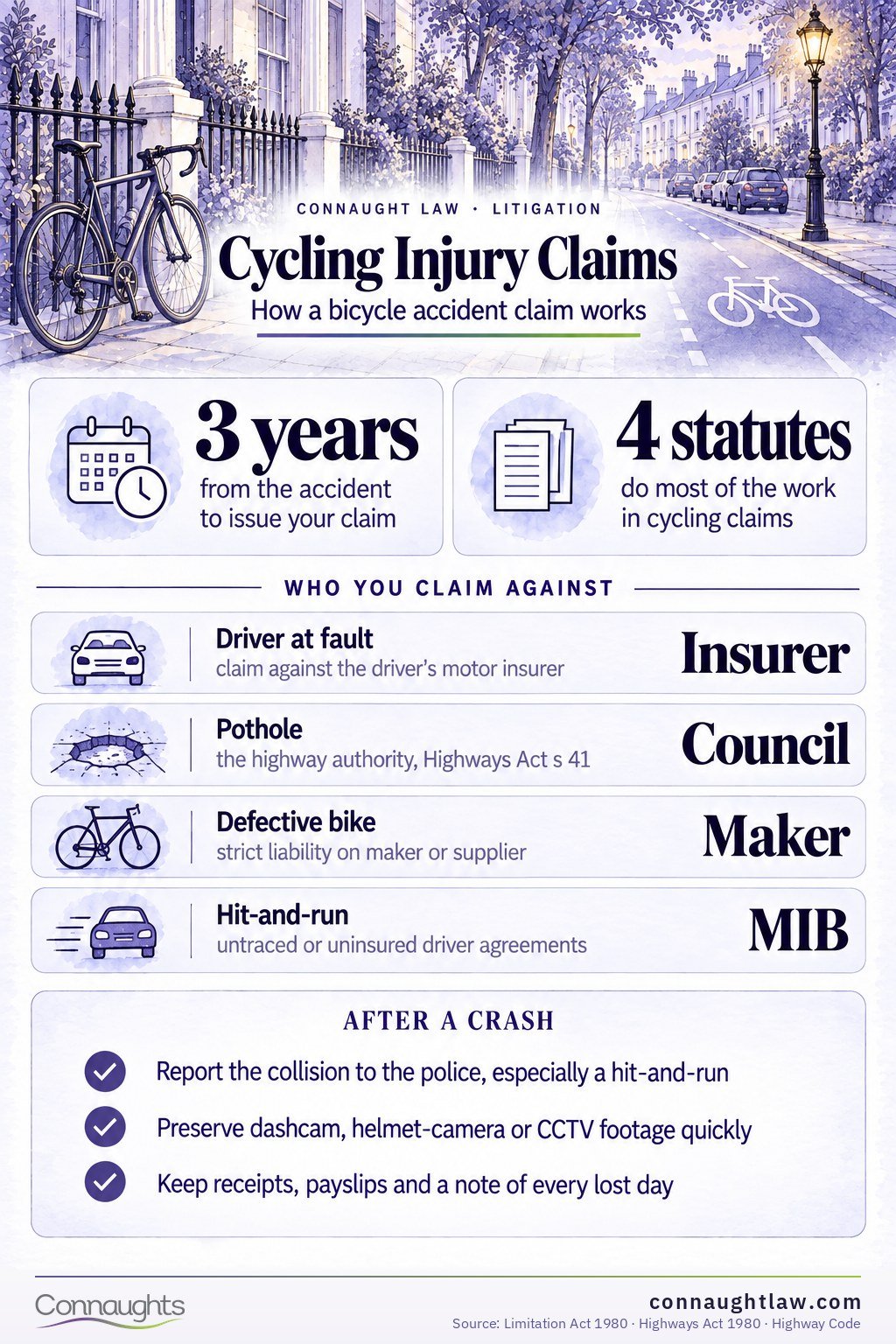
Four statutes do most of the work in cycling claims. Which one applies depends entirely on how the accident happened and who was at fault, so the first task in any claim is to classify the incident correctly.
Road Traffic Act 1988 and driver negligence
The Road Traffic Act 1988 requires every motorist to hold insurance covering injury to other road users, cyclists included. Where a driver's negligence caused or contributed to the collision, the injured cyclist claims against that driver's motor insurer — a reliable route to recovery. Typical grounds are failing to see a cyclist, overtaking too close, turning left across a cycle lane, and opening a door into a rider's path.
The Highway Code hierarchy of road users
The Highway Code introduced a hierarchy of road users placing the greatest responsibility on those able to cause the most harm. Drivers must leave at least 1.5 metres when overtaking at speeds up to 30mph, give way to cyclists going straight ahead at junctions, and use the "Dutch Reach" to open doors. These rules set the standard against which a driver's conduct is measured when negligence is disputed.
Highways Act 1980 and road-surface defects
Not every cycling accident involves a vehicle. The Highways Act 1980 makes the highway authority responsible for maintaining the road, and section 41 supports a claim where a pothole or broken surface causes a crash. Because narrow tyres and no suspension leave cyclists acutely exposed to defects, these claims are common — our dedicated guide to a pothole cycling accident claim explains the evidence and the council's statutory defence in full.
Consumer Protection Act 1987 and defective bikes
Where a bicycle, e-bike or component fails and causes injury, the Consumer Protection Act 1987 imposes strict liability on the manufacturer or supplier: you prove the product was defective and caused harm, without having to show carelessness. This matters most with rented machines, and our guide to e-bike and hire-bike accident claims covers liability across schemes such as Lime, Forest and Santander Cycles.
A principle that reduces compensation where your own actions partly caused the accident or worsened the injury — for example cycling without lights after dark or riding through a red signal. Not wearing a helmet is not unlawful in the UK, but an insurer may argue it increased head-injury severity. Reductions typically fall between 10% and 50% according to the degree of fault, and the other party's negligence must still be proven.
What Are the Compensation Brackets for Cycling Injuries?
General damages — the award for pain, suffering and loss of amenity — are set by reference to the Judicial College Guidelines. The 18th edition, published on 9 April 2026, raised the figures by roughly 8.26% to reflect Retail Prices Index inflation to August 2025. The brackets are starting points, not fixed prices; the award within a bracket depends on severity, treatment, recovery and long-term effect, all established through medical evidence.
General damages: the injury itself
| Common cycling injury | JCG 18th edition bracket |
|---|---|
| Shoulder — moderate | £10,420 – £16,870 |
| Wrist — less severe injury | £16,640 – £32,370 |
| Ankle — moderate fracture or ligament injury | £18,150 – £35,130 |
| Brain — less severe injury | £20,240 – £56,890 |
| Brain — very severe damage | £372,570 – £533,720 |
Collarbone and forearm fractures — among the most frequent cycling injuries as riders instinctively brace or land on a shoulder — are valued on the same basis, according to displacement, whether the bone unites cleanly, and any lasting restriction. An orthopaedic report, not a table, fixes the figure in an individual case.
Special damages: your financial losses
On top of general damages, a claim recovers the accident's financial consequences. These include repairing or replacing the bicycle — frequently £1,000 or more for a road, gravel or e-bike — along with damaged clothing and equipment, private treatment and physiotherapy, lost earnings during recovery, any long-term loss of earning capacity, and care provided by family. Keeping receipts, payslips and a record of appointments turns these losses from estimates into recoverable sums.
How a cycling settlement is calculated
Search results promise an "average" bicycle accident payout, but an average is a poor guide to any individual claim. A settlement is built from the ground up: general damages fixed by the Judicial College bracket for your specific injury, plus proven special damages, then adjusted for any split in liability. Two riders with an identical fracture can recover very different sums where one loses months of self-employed income and the other loses none. That is why an online calculator cannot value a claim, and why medical and financial evidence — not a headline figure — decides the result.
Common Cycling Accidents and Who Is Liable
Department for Transport data shows almost half of cyclist fatalities involve a car, while collisions with HGVs, though rarer, are far more likely to be fatal at 5.8%. Most serious incidents cluster in the weekday commuter peaks of 7–10am and 4–7pm. Understanding the usual scenarios points to the liable party and the framework that applies, whether the claim proceeds as a straightforward road traffic accident claim or a more complex multi-party dispute.
Motor-vehicle collisions
Driver negligence produces the largest group of claims. Dooring, left-hook turns across a cyclist's path, failures to give way at roundabouts and rear-end collisions each breach clear Highway Code duties. Being struck by a car is the single most searched cycling scenario, and our guide for a cyclist knocked off their bike covers liability, average payouts and part-fault situations in detail.
Untraced and uninsured drivers
Where the driver fails to stop or turns out to be uninsured, the Motor Insurers' Bureau provides compensation through its Untraced and Uninsured Drivers Agreements. These claims carry their own procedure and deadlines, distinct from an ordinary negligence claim — our guide to a hit-and-run cycling accident claim explains how the MIB route works and what evidence it demands.
Urban and city-centre cycling
Cycling risk concentrates in dense city traffic, where junctions, HGVs and heavy motor flow raise the odds of a collision. London carries the largest share of urban cycling in the country, and our London cycling accident claims guide looks at the boroughs where casualties cluster and how to report and evidence a city crash.
What Medical Evidence Strengthens a Claim?
Medical evidence decides value. The injury's severity, treatment and long-term prognosis place it within a Judicial College bracket, so the quality of that evidence — not the strength of the argument — determines the award. Cycling produces recognisable patterns: head injuries from impact, collarbone and shoulder fractures from landing, wrist fractures from bracing, and lower-limb injuries from pedal entrapment or vehicle contact.
- A&E and hospital records, including any Glasgow Coma Scale score for a head injury
- Imaging — X-rays for fractures, CT and MRI for brain and soft-tissue injury
- Specialist reports from an orthopaedic surgeon, neurologist or maxillofacial surgeon
- Physiotherapy notes charting range of movement and recovery
- Neuropsychological assessment where a brain injury is suspected
- Scene evidence — dashcam or helmet-camera footage, CCTV, photographs and witness details
Head injuries deserve particular care. Unlike a driver shielded by a vehicle and airbags, a cyclist absorbs impact directly, and a helmet reduces but does not remove the risk. The cognitive, emotional and behavioural effects of a brain injury can take months to emerge, so valuation should not be rushed. Where a child is hurt, the picture is more complex still, and our guide for parents on child cycling accident claims explains how injuries to a developing child are assessed and settled.
What Should You Do After a Cycling Accident?
The steps taken in the hours and days after a crash often decide whether a claim succeeds. Evidence is at its most complete at the scene and degrades quickly, so acting early protects both your recovery and your case.
- Get medical attention and make sure every injury is recorded, even those that seem minor
- Report the collision to the police, particularly where the driver failed to stop
- Photograph the scene, the vehicle or defect, your injuries and the damaged bike
- Take the driver's details and registration, and note any witnesses
- Preserve dashcam, helmet-camera or CCTV footage before it is overwritten
- Keep receipts, payslips and a note of every expense and lost working day
Cost need not be a barrier. Most cycling injury claims run on a conditional fee — a "no win, no fee" agreement — so there is nothing to pay upfront and nothing to pay if the claim does not succeed. Where a claim wins, the bulk of the compensation is protected for you, and any success fee and insurance premium are explained at the outset. The strength of your evidence, not the size of your budget, decides whether a personal injury claim is worth pursuing.
What Are the Time Limits for a Bicycle Accident Claim?
The Limitation Act 1980 sets a three-year limit for issuing a cycling injury claim, running from the date of the accident. Miss it and the right to claim is usually lost, whatever the merits, so early advice protects your position.
Three years sounds generous, but CCTV is overwritten within weeks, road defects are repaired, vehicles are sold and witnesses move on. The evidence that proves a claim fades long before the limitation period does, so the practical deadline for gathering proof is measured in days, not years.
Two exceptions matter. The date-of-knowledge rule delays the three-year clock where an injury — internal damage or a subtle brain injury — only later becomes apparent, starting time from when you knew, or should have known, it was significant and linked to the accident. For a child, time does not run until their 18th birthday, so a claim can be brought until they are 21, with any settlement approved by the court to protect their interests. Motor Insurers' Bureau claims carry their own notification deadlines, which is why untraced and uninsured-driver cases need early specialist handling.
Frequently askedQuestions about bicycle accident compensation
How much compensation can I get for a bicycle accident?
It depends on the injury and its financial impact. Judicial College Guidelines (18th edition, 2026) general-damages brackets run from a few thousand pounds for minor soft-tissue injuries to £372,570–£533,720 for very severe brain damage, with catastrophic cases exceeding that once lifetime care and earnings are added. Special damages for lost income, treatment, care and a replacement bike are claimed on top, so no two awards match.
Can I claim if I was partly at fault or not wearing a helmet?
Usually yes. Contributory negligence reduces an award rather than defeating it, typically by 10% to 50% depending on your share of the blame. Not wearing a helmet is not against the law, but an insurer may argue it made a head injury worse. The other party's negligence must still be established as a cause, and a proper assessment shows how any reduction affects your recovery.
What if the driver didn't stop or was uninsured?
You can still claim through the Motor Insurers' Bureau, which compensates victims of untraced (hit-and-run) and uninsured drivers under separate agreements. You must report the incident to the police and show reasonable efforts were made to trace the driver. The MIB process differs from an ordinary claim and carries its own deadlines, so specialist advice is worthwhile.
Can I claim for a pothole cycling accident?
Yes, where the highway authority failed to maintain the road to a reasonable standard and that failure caused your crash. You will need photographs with measurements, the location, and ideally council inspection or repair records. The council can defend the claim by proving an adequate inspection system, so the strength of a pothole claim rests on the evidence gathered at the scene.
Does compensation cover my damaged bicycle?
Yes. Repair or replacement of the bike, plus damaged helmet, clothing and accessories, forms part of special damages. High-specification road bikes and e-bikes can be valuable, so keep receipts, photographs and any pre-accident valuation. Recovery is usually assessed at the bike's pre-accident value, or purchase price for a recently bought machine.
How long does a bicycle accident claim take?
Straightforward claims with clear liability and minor injuries can settle within 12 to 18 months. Serious injuries, disputed liability or ongoing treatment typically take two to four years. A claim should not be settled before your medical recovery is understood, because premature settlement risks undervaluing consequences that only become clear with time.
Do I have to go to court to claim?
Rarely. The large majority of cycling accident claims settle by negotiation with the at-fault party's insurer, without a trial. Court proceedings may be issued to protect a limitation deadline or to apply pressure where liability or value is disputed, but even then most cases settle before a hearing. A claim involving a child does require brief court approval of the settlement to safeguard the child's interests.
Tell us how the collision happened and what injuries you have. We’ll tell you what the claim is likely to be worth and what evidence matters most right now.
Get Expert Advice