
London is the busiest cycling city in the country, with well over a million cycle journeys made every day — and that volume brings risk. In 2024, 9 cyclists were killed and 985 were seriously injured on the capital's roads. When a London cycling accident happens, the claim can lie against a driver, against a borough or Transport for London for a dangerous road, or against the Motor Insurers' Bureau. This guide explains who is responsible, how the borough and TfL road networks divide liability, and how to protect a claim.
On This Page
How Cycling Accident Claims Work in London
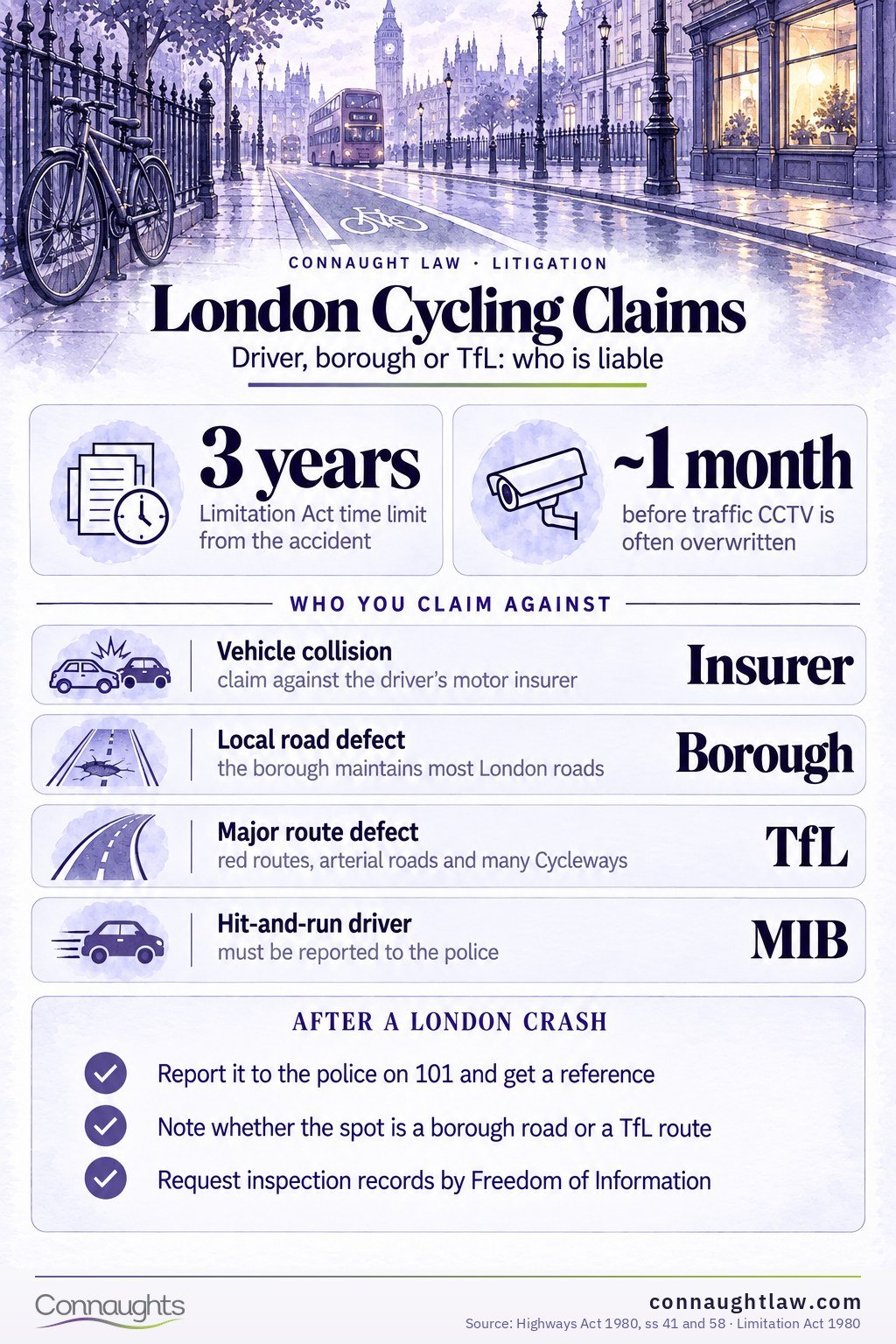
Who you claim against after a London cycling accident depends on what caused it. A collision with a vehicle is a claim against the driver's insurer; a crash caused by a pothole or broken road surface is a claim against the highway authority — the London borough for most roads, or Transport for London for major routes; and where a driver is uninsured or fails to stop, the Motor Insurers' Bureau provides a route. Identifying the right defendant is the first and most important step.
Cycling in London concentrates the risks that produce injury claims: dense traffic, heavy vehicles, complex junctions and a road network split between dozens of authorities. The reward is that fault is often clear once the right framework is applied. The sections below set out what the casualty figures show, how liability divides between drivers, boroughs and TfL, and the evidence a London claim depends on.
London's Cycling Casualty Picture
Transport for London's figures for 2024 record 9 cyclists killed and 985 seriously injured across Greater London. Overall road deaths and serious injuries reached their lowest level on record outside the pandemic years, yet cyclists remain heavily over-represented: 81% of everyone killed or seriously injured on London's roads is walking, cycling or motorcycling. For a mode with no protective bodywork, that imbalance is the reason cycling claims are treated with such care.
Where casualties cluster
Risk is not spread evenly. Casualty rates differ sharply between boroughs, with some outer boroughs recording several times the London average, reflecting differences in traffic, junction design and cycling infrastructure. The London Cycling Campaign publishes a regularly updated map of the capital's most dangerous junctions, drawn from years of collision data. Where a junction has been publicly flagged as dangerous for years and the responsible authority has not acted, that record can support an argument that the danger was foreseeable and should have been addressed.
Lorries and junctions
The deadliest London scenario is a cyclist caught alongside a turning lorry. Collisions with HGVs are far less common than car collisions but far more likely to be fatal, because a cyclist in a lorry's blind spot at a junction has almost no margin for error. Construction and tipper traffic makes this a particular city risk. Transport for London's Vision Zero policy — the aim of eliminating death and serious injury on the network — has driven junction redesigns and direct-vision lorry standards, and a failure to meet those standards can feature in a claim where junction design contributed to a collision.
Who Is Liable — Driver, Borough or TfL?
A London cycling claim usually follows one of three routes, and the first task is to identify which one — and, for road-defect claims, which authority is the correct defendant.
Claiming against a driver
Where a vehicle caused the crash, the claim is against the driver's motor insurer. The Highway Code hierarchy of road users places the greatest responsibility on drivers, and a breach — a close pass, a left-hook turn, or dooring — is strong evidence of negligence. Our guide for a cyclist knocked off their bike covers driver liability, payouts and part-fault arguments in full.
Claiming against the highway authority
Where a pothole or defective surface caused the crash, the claim lies against the highway authority under the Highways Act 1980. The catch in London is knowing which authority. Most roads belong to the borough, but Transport for London manages the Transport for London Road Network — a small share of roads that carries a large share of traffic, including major arterial routes and many Cycleways. Naming the wrong defendant can derail a claim, so our guide to a pothole cycling accident claim explains how the duty and the council's defence work.
Which authority manages the road
| Authority | Manages | Typical roads |
|---|---|---|
| London borough | Most local roads and cycle lanes | Residential streets, high streets, local routes |
| Transport for London | The TfL Road Network — a small share of roads carrying much of the traffic | Major arterial routes, red routes, strategic junctions, many Cycleways |
The statutory duty on a highway authority to maintain the road — including carriageways and cycle tracks — in a condition fit for ordinary traffic. A cyclist injured by a failure to maintain can claim under this duty. Section 58 gives the authority a defence if it can prove it ran a reasonable system of inspection and repair, which is why its inspection records are central to a road-defect claim.
Cycleways and segregated routes
London's growing network of Cycleways and protected lanes reduces conflict with traffic, but it does not remove the risk of a claim. A defect in a segregated lane surface, a poorly designed transition where a track rejoins the road, or an obstruction left in a protected route can all cause injury, and the authority responsible for that infrastructure owes the same maintenance duty. Because many Cycleways sit on the TfL network, a defect claim on one is often against Transport for London rather than the borough — another reason to fix the exact location early.
Untraced or uninsured drivers
If the driver cannot be traced or has no insurance, the Motor Insurers' Bureau provides compensation through its Untraced and Uninsured Drivers Agreements, provided the collision was reported to the police. This is common in city traffic where a driver leaves the scene, and our guide to a hit-and-run cycling accident claim explains the MIB route and its deadlines.
Proving a Highway-Authority Claim
A claim against a borough or TfL for a road defect turns on two questions: was the defect dangerous, and did the authority fail to maintain the road reasonably. The authority will rely on its Section 58 defence, producing inspection and repair records to show its system was adequate. That makes those records the battleground.
The strongest claims combine photographs of the defect with a measurement and location, a Freedom of Information request for the authority's inspection history, and any earlier reports of the same defect showing the authority knew or should have known about it. Where a junction or stretch of road has a documented history of collisions, that pattern reinforces the argument that the danger was foreseeable and the response inadequate — the heart of a highway-authority claim.
What to Do After a London Cycling Accident
Evidence in London disappears quickly — traffic CCTV is overwritten, defects are patched, and busy junctions change. Acting in the first days protects the claim as much as the medical record protects your recovery.
- Attend A&E or urgent care so every injury is recorded promptly
- Report the collision to the police on 101 and get a reference number
- Photograph the location, junction layout, road surface, any defect and your injuries
- Note the exact spot and whether it is a borough road or a TfL route
- Report a road defect to the borough or TfL to create a timestamped record
- Save helmet-camera or dashcam footage, and ask nearby businesses for CCTV within days
- Take witness details and, for a defect claim, request inspection records by Freedom of Information
Cost is rarely an obstacle: most cycling claims run on a "no win, no fee" basis, so whether to pursue a personal injury claim depends on the evidence rather than your budget. For the full picture of how cycling compensation is valued, see our complete guide to bicycle accident compensation.
Time Limits for Your Claim
The Limitation Act 1980 gives three years from the date of the accident to bring a claim. In practice the useful evidence runs out far sooner, which is why early action matters most in a city.
Traffic CCTV is often overwritten within about a month, road defects are repaired, and Freedom of Information requests for inspection records take weeks to return. Waiting risks losing the very material a borough or TfL claim depends on, long before the three-year limit is anywhere near.
The usual exceptions apply. For a child, the three years run from their 18th birthday, so a claim can be brought until they are 21, with any settlement approved by the court. Where an injured person lacks the mental capacity to conduct a claim, no time limit runs while that continues, and the date-of-knowledge rule can delay the start where a serious injury emerges later.
Frequently askedQuestions about cycling accidents in London
Is cycling in London dangerous?
London saw 9 cyclists killed and 985 seriously injured in 2024. Serious injuries remain a real risk, and cyclists are heavily over-represented in road casualties — 81% of everyone killed or seriously injured on London's roads is walking, cycling or motorcycling. That said, overall road casualties reached a record low outside the pandemic years, and risk varies sharply by route, junction and borough.
How many cyclists are killed in London each year?
Transport for London recorded 9 cyclists killed in Greater London in 2024, alongside 985 seriously injured. The figures fluctuate year to year, but cyclists consistently make up a disproportionate share of those killed or seriously injured relative to the number of journeys, which is why the law places heightened duties on drivers and highway authorities.
Can I claim against a London borough for a road defect?
Yes, where a pothole or defective surface caused your crash and the borough failed to maintain the road to a reasonable standard under the Highways Act 1980. The borough can defend the claim by proving an adequate inspection and repair system, so evidence such as photographs, the location, and its inspection records obtained by Freedom of Information is central. On major routes the correct defendant may be Transport for London rather than the borough.
How do I know if a road is managed by the borough or TfL?
Transport for London manages the TfL Road Network — a small share of London's roads that carries much of its traffic, including major arterial routes, red routes and many Cycleways. Local roads belong to the borough. TfL publishes maps of its network, and identifying the right authority matters because a maintenance claim must be brought against the correct defendant. Where a junction sits on the boundary, a claim against both may be appropriate.
How much compensation can I claim for a London cycling accident?
It depends on the injury and its financial impact. General damages follow the Judicial College Guidelines (18th edition, 2026), running from a few thousand pounds for minor injuries to £372,570–£533,720 for very severe brain damage, with lost earnings, treatment, care and a replacement bike claimed on top. Our bicycle accident compensation guide sets out the brackets in full.
What if a driver hit me and drove off?
You can claim through the Motor Insurers' Bureau, which compensates cyclists hurt by untraced (hit-and-run) or uninsured drivers under separate agreements. Report the collision to the police promptly and preserve any camera footage of the vehicle or registration. The MIB process has its own rules and deadlines, so early specialist advice helps.
What if I was hit by a lorry while cycling in London?
Collisions with lorries are less common than car collisions but far more likely to cause serious or fatal injury, often when a cyclist is caught in a blind spot at a junction. The claim is made against the driver's or operator's insurer, and evidence of the vehicle's direct-vision standard, mirrors and manoeuvre can be important. These are among the most serious cycling claims and warrant early specialist handling.
How long do I have to make a London cycling accident claim?
Three years from the date of the accident under the Limitation Act 1980, with the period running from a child's 18th birthday and no limit while an injured person lacks the mental capacity to claim. Because CCTV is overwritten within weeks and inspection records take time to obtain, it is best to take advice well within the limit.
Tell us the borough, the road and how the collision happened. We’ll tell you whether the claim runs against a driver or a highway authority, and what to secure now.
Get Expert Advice