
Being knocked off a bike by a car is the most common — and often the most serious — cycling accident, because a rider has no bodywork, airbag or seatbelt to absorb the impact. Department for Transport figures record 14,549 pedal-cycle casualties in Great Britain in 2024, with collisions involving motor vehicles behind most serious injuries. This guide explains who is liable when a driver knocks you off, how the Highway Code decides fault, what your claim is worth, and the deadline that governs it.
On This Page
How Compensation Works When a Driver Knocks You Off
Where a driver knocks you off your bike, they are usually liable and you claim against their motor insurer. The Highway Code hierarchy of road users places the greatest responsibility on drivers, so most collisions — left-hooks, close passes, dooring, junction failures — point to the driver. Compensation is the Judicial College bracket for your injury plus lost earnings, care and a replacement bike. If the driver was uninsured or failed to stop, the Motor Insurers' Bureau steps in.
A cyclist forced off their bike by a car absorbs the full force of the collision, and the fall into the carriageway often causes worse harm than the first impact. The law recognises that imbalance. The sections below explain how liability is decided, why the type of collision matters, what the claim is worth under the current guidelines, and how a driver's allegation that you were partly to blame actually works.
Who Is Liable When a Driver Knocks You Off?
Liability turns on negligence: did the driver fail to take the care the law expects? Since January 2022 the Highway Code has answered that question in the cyclist's favour more often, by setting out exactly what drivers must do around bikes.
A principle in the Highway Code that places those who can cause the most harm under the greatest duty of care. Drivers of cars, vans, buses and lorries must actively reduce the danger they pose to cyclists, pedestrians and horse riders. It does not give cyclists automatic priority, but it shapes how courts and insurers judge fault after a collision.
The Highway Code rules that decide fault
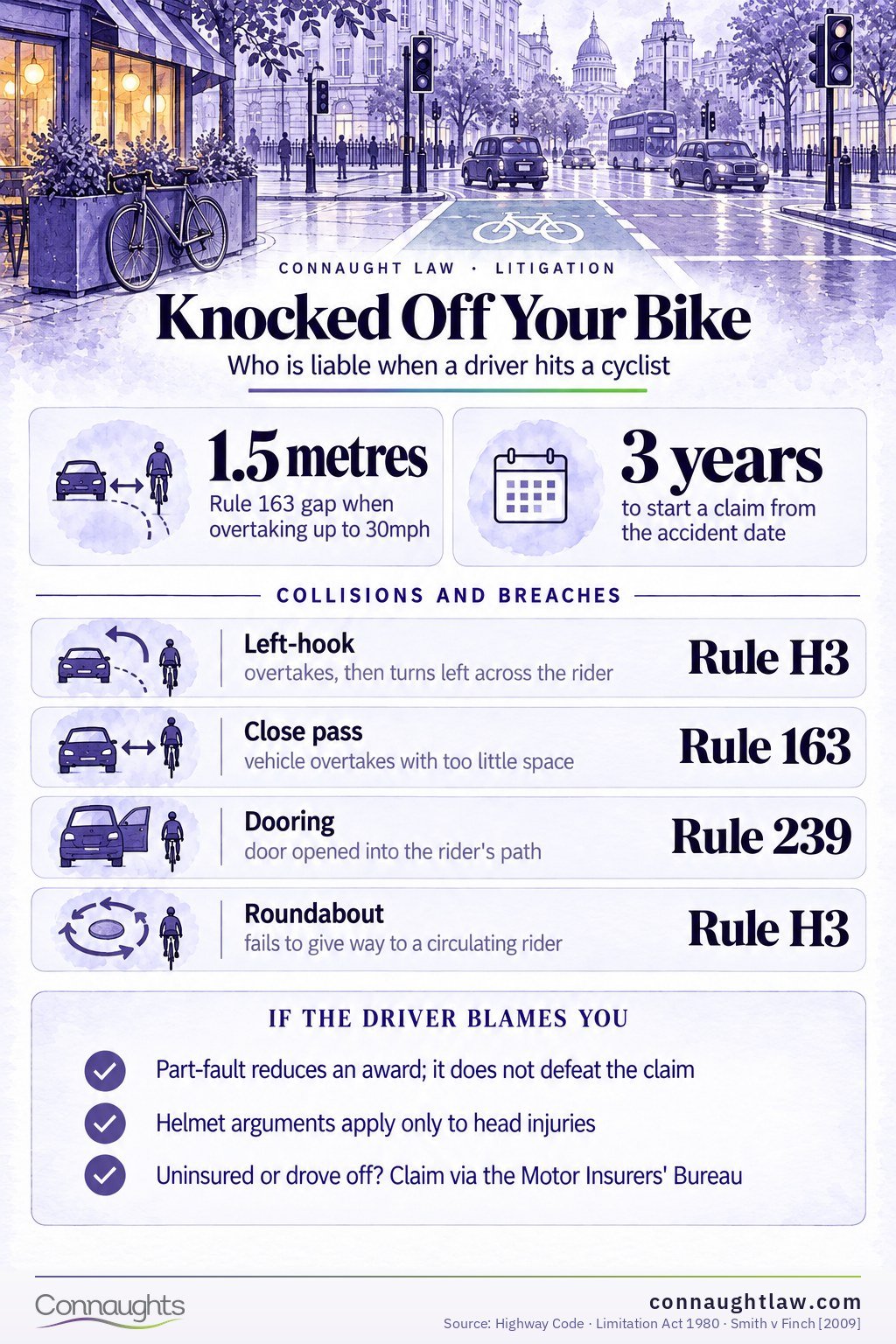
Rules H1 to H3, introduced in January 2022, sit at the centre of most knocked-off claims. Rule H1 puts the greatest responsibility on those in charge of the most dangerous vehicles. Rule H3 tells drivers not to cut across cyclists going straight ahead when turning at a junction, and to give way to riders on the road, at junctions and on roundabouts. Rule 163 requires at least 1.5 metres when overtaking at up to 30mph, and Rule 239 asks occupants to open doors with the "Dutch Reach". A breach of any of these is strong evidence of negligence.
When the driver was uninsured or failed to stop
A driver who has no insurance, or who drives off, does not end your claim. The Motor Insurers' Bureau compensates cyclists through its Uninsured and Untraced Drivers Agreements, provided the collision is reported to the police and reasonable efforts are made to identify the driver. The process differs from an ordinary insurer claim, so our guide to a hit-and-run cycling accident claim sets out the MIB route and its deadlines in full.
What happens to the driver who hit you?
A driver who injures a cyclist may face careless or dangerous driving charges, and failing to stop or report is a separate offence under section 170 of the Road Traffic Act 1988. These criminal outcomes run alongside your civil claim rather than replacing it: any compensation comes from the driver's insurer, not from a fine or a court order in the criminal case. A conviction, caution or fixed penalty is, however, strong evidence of negligence, and it is worth confirming what action the police have taken.
Common Collision Types and Who Is at Fault
Most knocked-off claims fall into a handful of recognised patterns, and each maps to a specific Highway Code breach that helps prove fault. Junction collisions cause the majority of serious injuries, but dooring and close passes are close behind, especially in traffic.
Common collisions and breaches
| Collision type | What happens | Highway Code breach |
|---|---|---|
| Left-hook | Vehicle overtakes then turns left across the rider | Rule H3 — must not cut across |
| Right-hook | Vehicle turns right across an approaching rider | Rule H3 — give way at junctions |
| Close pass | Vehicle overtakes with too little space | Rule 163 — 1.5m minimum |
| Dooring | Occupant opens a door into the rider's path | Rule 239 — Dutch Reach |
| Roundabout | Vehicle fails to give way to a circulating rider | Rule H3 — give way on roundabouts |
Left-hook and right-hook turns
These junction turns cause some of the worst cycling injuries. In a left-hook, a vehicle overtakes and then turns left across the rider going straight on; in a right-hook, it turns right into an approaching rider. Rule H3 now prohibits both, which makes liability far clearer than it once was. The severity usually reflects the rider's speed at impact, with shoulder, facial and pelvic injuries common where the cyclist strikes the side of the vehicle.
Dooring
Opening a vehicle door into a cyclist is a criminal offence under Regulation 105 of the Road Vehicles (Construction and Use) Regulations 1986, carrying a fine of up to £1,000. Because opening a door counts as use of the vehicle, the claim is made through the vehicle's motor insurance — and it makes no difference whether a driver or a passenger opened it. Dooring concentrates where parking sits alongside cycle routes, so our London cycling accident claims guide looks at how these city collisions are evidenced.
Close passes and roundabouts
A close pass need not involve contact to cause a fall — a rider forced to swerve or brake hard can be brought down without ever being touched, and Rule 163's 1.5-metre standard gives a clear benchmark for fault. Roundabouts are dangerous because drivers watch other vehicles and miss riders already circulating; Rule H3's instruction to give way to cyclists on roundabouts strengthens the claim where a driver enters without yielding.
How Much Compensation Can You Claim?
Compensation has two parts: general damages for the injury itself, set by the Judicial College Guidelines, and special damages for financial losses. The 18th edition of the Guidelines, published on 9 April 2026, raised the figures by roughly 8.26% for inflation. Our complete guide to bicycle accident compensation sets out the full range; the brackets below cover the injuries most common when a driver knocks a rider off.
Typical injury brackets
| Common knocked-off injury | JCG 18th edition bracket |
|---|---|
| Shoulder — moderate | £10,420 – £16,870 |
| Wrist — less severe injury | £16,640 – £32,370 |
| Ankle — moderate fracture or ligament injury | £18,150 – £35,130 |
| Brain — less severe injury | £20,240 – £56,890 |
| Brain — very severe damage | £372,570 – £533,720 |
An "average" payout figure is a poor guide to any individual claim. Two riders with the same fracture can recover very different sums where one loses months of self-employed income and the other loses none. On top of general damages you can claim lost earnings, private treatment and physiotherapy, care provided by family, and repair or replacement of the bike, helmet and clothing — so the total is built from your circumstances, not a headline number.
Serious injuries call for a different pace. Where a rider suffers a brain injury, a spinal injury or multiple fractures, the claim should not be settled until the long-term prognosis is clear, because the lasting effect on work and independence can take a year or more to establish. In the meantime, and where the driver's liability is admitted or strong, interim payments can be sought to fund treatment, adaptations and lost income before the claim concludes, so recovery is not held hostage to the timetable of the case.
What if You Were Partly at Fault?
Insurers routinely argue contributory negligence — that something you did contributed to the injury. Under the Law Reform (Contributory Negligence) Act 1945 this reduces an award in proportion to your share of the blame; it does not defeat the claim, and the driver's negligence must still be established.
The helmet argument
Helmet non-use is the most common allegation. Following Smith v Finch [2009], a court may reduce damages where medical evidence shows a helmet would have prevented or lessened the specific head injury — typically by 10% to 25%, and only for head injuries. There is no legal requirement to wear a helmet in the UK, and where the injuries are not to the head, the argument fails entirely.
Lights and riding position
Cycling without lights after dark breaches the Road Vehicle Lighting Regulations 1989 and, where it contributed to the driver not seeing you, can support a reduction. Allegations that you should have ridden nearer the kerb, by contrast, increasingly fail: the Highway Code now advises riding in the centre of the lane at junctions and on narrow roads, so a driver's complaint about your road position often runs against the Code itself.
What to Do After Being Knocked Off
What you do in the first hours frequently decides the claim. A driver has a legal duty under section 170 of the Road Traffic Act 1988 to stop and give details, and reporting the collision creates the record your claim is built on.
- Call 999 for anything needing an ambulance, or 101 to report a non-emergency to the police
- Take the driver's name, address, insurer and registration, and any witnesses' details
- Photograph the scene, the vehicle, the road layout, your injuries and the damaged bike
- Save any helmet-camera or dashcam footage to a separate device straight away
- Ask nearby businesses for CCTV within days, before it is overwritten
- Attend A&E or urgent care so the injuries are recorded, and keep the damaged bike and helmet
Where police prosecute the driver for careless or dangerous driving, or for failing to stop, that outcome is powerful support for your civil claim. Cost is rarely a barrier: most claims run on a "no win, no fee" basis, so whether to pursue a personal injury claim turns on the evidence, not your budget.
Time Limits for Your Claim
The Limitation Act 1980 gives you three years from the date of the accident to start a claim. Miss it and the claim is almost always barred, whatever its merits.
Three years is the legal limit, but the proof runs out far sooner — CCTV is overwritten within weeks, the vehicle is repaired or sold, and camera footage and witness memories fade. The practical window for securing what wins a knocked-off claim is measured in days, not years.
There are exceptions. For a child, time does not run until their 18th birthday, so a claim can be brought until they are 21, with any settlement approved by the court. Where an injured person lacks the mental capacity to conduct a claim, no time limit runs while that continues. And the date-of-knowledge rule can delay the clock where a serious injury only becomes apparent later.
Frequently askedQuestions about being knocked off your bike
How much compensation for being knocked off my bike by a car?
It depends on the injury and its financial impact. Judicial College Guidelines (18th edition, 2026) general-damages brackets run from a few thousand pounds for minor soft-tissue injuries to £372,570–£533,720 for very severe brain damage. Lost earnings, treatment, care and a replacement bike are added on top, so the total is built from your circumstances rather than an average.
Who is at fault if a car knocks a cyclist off?
Usually the driver. The Highway Code hierarchy places the greatest responsibility on drivers, and most collisions — left-hooks, close passes, dooring, failures to give way at junctions — breach a specific rule that proves negligence. Fault is decided on the evidence, but the framework starts from the driver's heightened duty towards cyclists.
Can I still claim if the driver says it was my fault?
Yes. An allegation that you were partly to blame is contributory negligence, which reduces an award in proportion to your share of the fault rather than defeating the claim. The driver's negligence must still be established, and unfounded blame — such as a complaint about your road position that contradicts the Highway Code — is often successfully challenged.
Does not wearing a helmet reduce my compensation?
Only where medical evidence shows a helmet would have prevented or reduced the specific head injury, following Smith v Finch [2009], and typically by 10% to 25%. There is no legal requirement to wear a helmet in the UK, and the reduction applies only to head injuries — not to a broken wrist, shoulder or leg sustained in the same fall.
What if the driver who knocked me off was uninsured or drove off?
You can claim through the Motor Insurers' Bureau, which compensates cyclists hurt by uninsured or untraced drivers under separate agreements. You must report the collision to the police and show reasonable steps were taken to identify the driver. The MIB process has its own rules and deadlines, so early specialist advice helps.
Can I claim if a passenger opened the door on me?
Yes. A dooring claim is made through the vehicle's motor insurance whether a driver or a passenger opened the door, because opening a door counts as use of the vehicle. Regulation 105 of the Road Vehicles (Construction and Use) Regulations 1986 makes it an offence to open a door so as to injure or endanger someone.
How long do I have to claim after being knocked off?
Three years from the date of the accident under the Limitation Act 1980. For a child the period runs from their 18th birthday, so a claim can be brought until they are 21, and there is no time limit while an injured person lacks the mental capacity to claim. Because evidence fades quickly, it is best to act well within the limit.
Tell us how the collision happened and what injuries you have. We’ll tell you who is likely to be liable, what the claim is worth and what evidence to secure now.
Get Expert Advice