
When a child is hurt cycling, the claim follows a different path from an adult's. A child cannot bring a claim alone: a parent or guardian acts as their litigation friend, the courts supervise any settlement to protect the child, and the time limit does not even start until the child turns 18. This guide for parents explains how a child cycling accident claim works — who runs it, how fault is judged far more gently for a child, why a judge must approve the settlement, and how the compensation is held safe until adulthood.
On This Page
How a Child Cycling Accident Claim Works
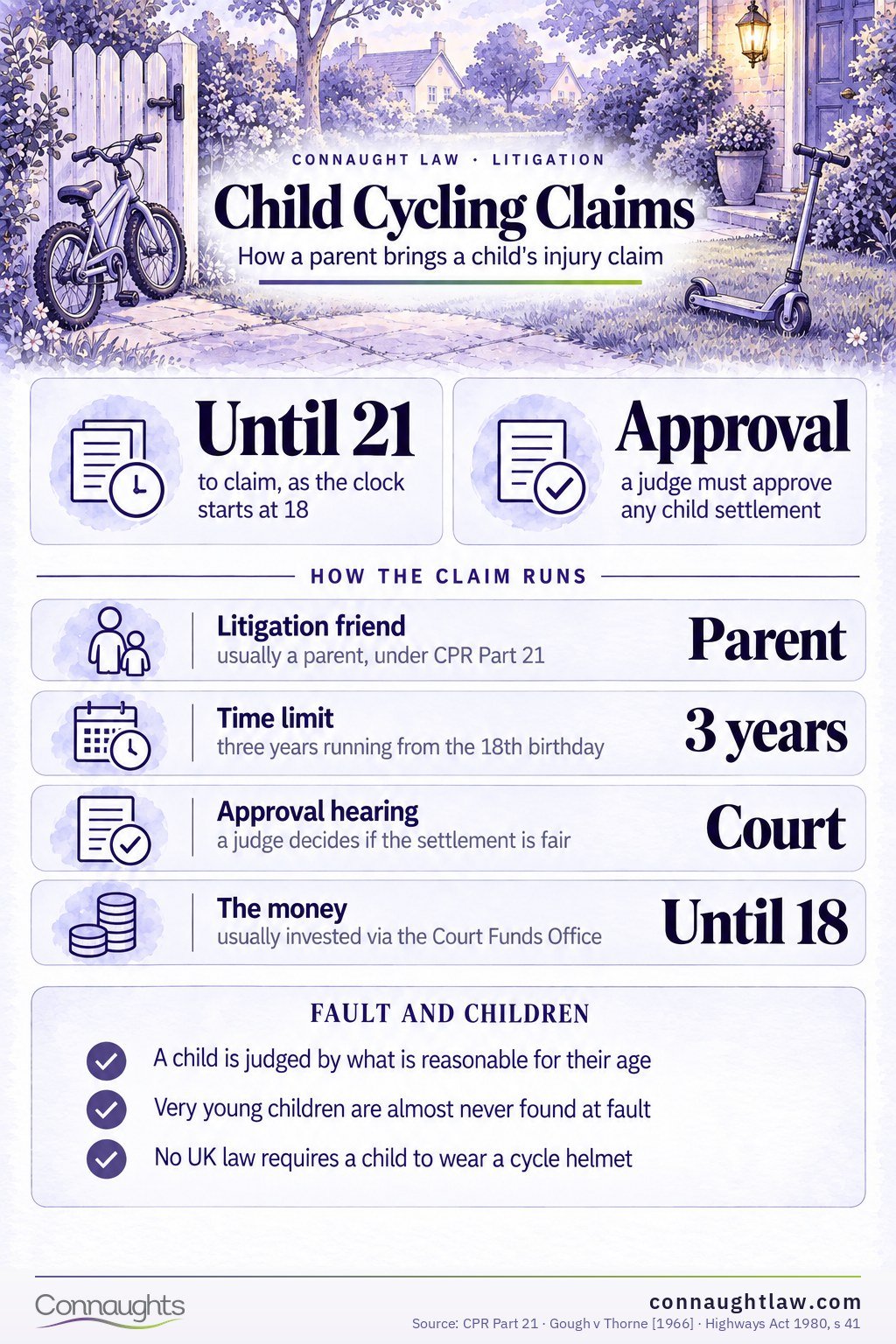
A child under 18 cannot run a claim themselves, so a parent or guardian acts as their litigation friend and instructs solicitors on their behalf. The three-year time limit does not start until the child's 18th birthday, so a claim can be brought until they are 21. Any settlement must be approved by a court to make sure it is fair, and the compensation is then held and invested until the child turns 18. Fault is judged by what is reasonable for a child of that age, not an adult.
Every part of a child's claim is shaped by one idea: the law protects children from decisions being made against their interests. That protection runs from who is allowed to conduct the claim, through how a court checks any settlement, to how the money is looked after until adulthood. The sections below take each stage in turn.
Who Brings a Child's Claim? The Litigation Friend
Under Part 21 of the Civil Procedure Rules, a child under 18 must have a litigation friend to conduct a claim. In most cases a parent or guardian takes the role, instructing the solicitor, approving the evidence and deciding — subject to the court — whether to accept a settlement. The litigation friend must be able to conduct the case fairly and competently, and must have no interest of their own that conflicts with the child's.
An adult appointed under Part 21 of the Civil Procedure Rules to conduct a claim on behalf of a child under 18, or an adult who lacks the mental capacity to litigate. The litigation friend makes the decisions in the claim in the child's best interests and must have no conflicting interest of their own. A parent usually fills the role in a child cycling claim.
That conflict rule matters where a parent was involved in the accident — driving the vehicle that struck the child, for instance, or where their supervision is said to have played a part. In those situations another relative, a family friend or a professional litigation friend can step in, so that whoever runs the claim is acting for the child alone.
Time Limits for a Child's Claim
A child's claim is not governed by the ordinary three-year deadline while they are still a child. A parent can bring a claim as litigation friend at any time before the child turns 18. If no claim is brought, the three years then run from the 18th birthday, so the young person can claim in their own right until they are 21.
A claim can be brought years later, but the proof cannot wait: CCTV is overwritten within days, the vehicle or road defect is gone within weeks, and witnesses move on. A medical record made close to the accident is also far more persuasive. Acting early protects the case even though the deadline is distant.
Fault and Children: The Gough v Thorne Standard
Children are judged far more leniently than adults when a driver or insurer alleges the child was partly to blame. The question is not what a careful adult would have done, but what could reasonably be expected of a child of that age and understanding.
The leading authority is Gough v Thorne [1966], in which Lord Denning held that a very young child should bear no contributory negligence at all, and that an older child should only be blamed if old enough reasonably to take precautions for their own safety — and then only where blame genuinely attaches. Courts have applied that principle ever since to child cyclists, recognising that developing judgment, limited hazard perception and impulsive behaviour change the picture entirely.
How age changes the standard
There is no fixed formula, but the pattern from the case law is clear: the younger the child, the less responsibility they carry. What counts as careless for an adult may be entirely age-appropriate for a child, so an allegation that a young cyclist "rode out without looking" often carries little weight.
- Very young children are almost never found at fault, whatever they did
- Primary-school-age children attract little or no reduction in most cases
- Around nine to twelve, a small reduction is possible where an obvious danger was ignored
- Teenagers face a progressively higher — but still not adult — standard, judged for their age
Who Is Liable for a Child Cycling Accident?
The liable party depends on how the accident happened, and a child's claim can involve more than one. A driver who hits a child cyclist is usually liable — and courts expect drivers to anticipate that children near schools, homes and parks may behave unpredictably. Where a road defect caused the fall, the highway authority may be liable, and where a child is hurt on school grounds or during supervised cycle training, the school or provider may share responsibility.
Defendants and the legal basis for each
| Possible defendant | Legal basis | Typical situation |
|---|---|---|
| Motor vehicle driver | Negligence; Highway Code hierarchy | Collision near a school, junction or home |
| Highway authority | Highways Act 1980, Section 41 | Pothole or defective surface on the route |
| School or training provider | Duty of care; occupiers' liability | School grounds or supervised cycle training |
Where a driver was at fault, the claim runs against their insurer just as an adult's would — our guide for a cyclist knocked off their bike covers how driver liability is proven. Where a pothole was the cause, the authority's duty and defence are the same as in any road-defect case, explained in our pothole cycling accident claim guide.
Court Approval and Managing the Money
The approval hearing
No settlement of a child's claim is valid without a court's approval, whatever the amount. At an approval hearing a judge reviews the medical evidence, the barrister's opinion on value, and the proposed figure, and independently decides whether it is fair. If the offer is too low, approval is refused and the parties must renegotiate or go to trial. This is the safeguard that stops a child being settled short before the full effect of an injury is known — and it is one reason a child's claim benefits from the same careful valuation as any personal injury claim.
How the compensation is held
The hearing also decides how the money is looked after until the child is 18. Larger awards are usually paid into court and invested through the Court Funds Office, then released when the child comes of age. In the meantime, a parent can apply for interim payments for specific needs — private treatment, therapy, educational support after time off school, home adaptations or specialist equipment. For substantial awards, a personal injury trust can be set up so the compensation does not affect entitlement to means-tested benefits.
Do Children Have to Wear Helmets?
There is no law in the UK requiring anyone to wear a cycle helmet, and that includes children. A child not wearing a helmet has broken no rule. As with adults, an insurer can only argue that the absence of a helmet made a head injury worse where medical evidence supports it — and because children attract such reduced contributory negligence in the first place, that argument rarely gains much traction in a child's claim. A helmet is sensible safety advice, not a legal requirement, and its absence does not bar a claim.
Frequently askedQuestions parents ask about a child’s claim
How long do I have to make a child's cycling accident claim?
As a parent you can bring a claim on your child's behalf at any time before they turn 18. If no claim is made, your child can bring one themselves between their 18th and 21st birthdays, because the three-year limit runs from their 18th birthday. Even so, early advice is best: CCTV is deleted within days, witnesses move on, and medical records made close to the accident carry more weight.
Can a child be blamed for their own cycling accident?
Only to a far lesser degree than an adult. Following Gough v Thorne [1966], a child is judged by what is reasonable for their age, not an adult standard. Very young children are almost never found at fault, and older children attract only limited reductions. Behaviour that would cut an adult's compensation often has little or no effect on a child's claim.
What is a litigation friend?
A litigation friend is the responsible adult — usually a parent or guardian — appointed under Part 21 of the Civil Procedure Rules to run a claim for a child under 18. They instruct the solicitor, approve the evidence and make decisions in the child's best interests, and must have no conflicting interest of their own in the claim.
Why does a court have to approve my child's settlement?
Court approval protects children from being settled short. A judge reviews the medical evidence, the value advice and the proposed figure, and independently decides whether it is fair. If the offer is too low, approval is refused and the parties renegotiate or go to trial. This prevents a settlement being accepted before the full effect of a child's injury is known.
Can I claim if my child was hurt during Bikeability cycle training?
Possibly. Where a child is injured during supervised cycle training, responsibility may fall on the training provider, the employing organisation or the school, depending on the supervision, route choice and risk assessment. If a motor vehicle caused the injury, the driver's insurer is primarily liable regardless of the training context.
How is my child's compensation managed until they are 18?
Larger awards are usually paid into court and invested through the Court Funds Office, then released to your child at 18. You can apply for interim payments for specific needs such as treatment, therapy, educational support or equipment. For substantial awards, a personal injury trust can protect entitlement to means-tested benefits.
How much compensation can a child receive for a cycling accident?
General damages follow the same Judicial College Guidelines (18th edition, 2026) as an adult's claim, from a few thousand pounds for minor injuries to £372,570–£533,720 for very severe brain damage, and our bicycle accident compensation guide sets out the brackets in full. Lost future earnings, treatment and care are claimed on top, and a child's award can be larger where an injury affects education, development and earning capacity over a whole working life.
Tell us what happened and how old your child is. We’ll explain who brings the claim, what the deadlines really mean for the evidence, and how the compensation is protected until they are 18.
Get Expert Advice