
UK employment law is changing more than it has in a generation. The Employment Rights Act 2025 is being phased in across 2026 and 2027, reshaping sick pay, family leave, unfair dismissal and more. This guide is our hub for the subject: a plain-English overview of where the law stands in 2026, what is already in force and what is still to come, with links through to our detailed guides on the issues that matter most to employees and employers.
On This Page

UK Employment Law in 2026: The Complete Picture
The Employment Rights Act 2025 is being rolled out in stages. From April 2026, statutory sick pay is payable from day one with no earnings floor, paternity and unpaid parental leave became day-one rights, and the National Living Wage rose to £12.71 for those aged 21 and over. Bigger changes are still to come: from January 2027 the unfair-dismissal qualifying period is due to fall from two years to six months (not day one), and the cap on unfair-dismissal compensation is due to be removed. Until then, the current rules still apply.
Employment law touches almost every working relationship, and 2026 is a year of transition. Some reforms have already landed; others are scheduled but not yet in force, which means the rules that apply to a dispute today are often not the ones in the headlines. This hub sets out the current position clearly, separates what is live from what is coming, and points you to our in-depth guides on specific issues.
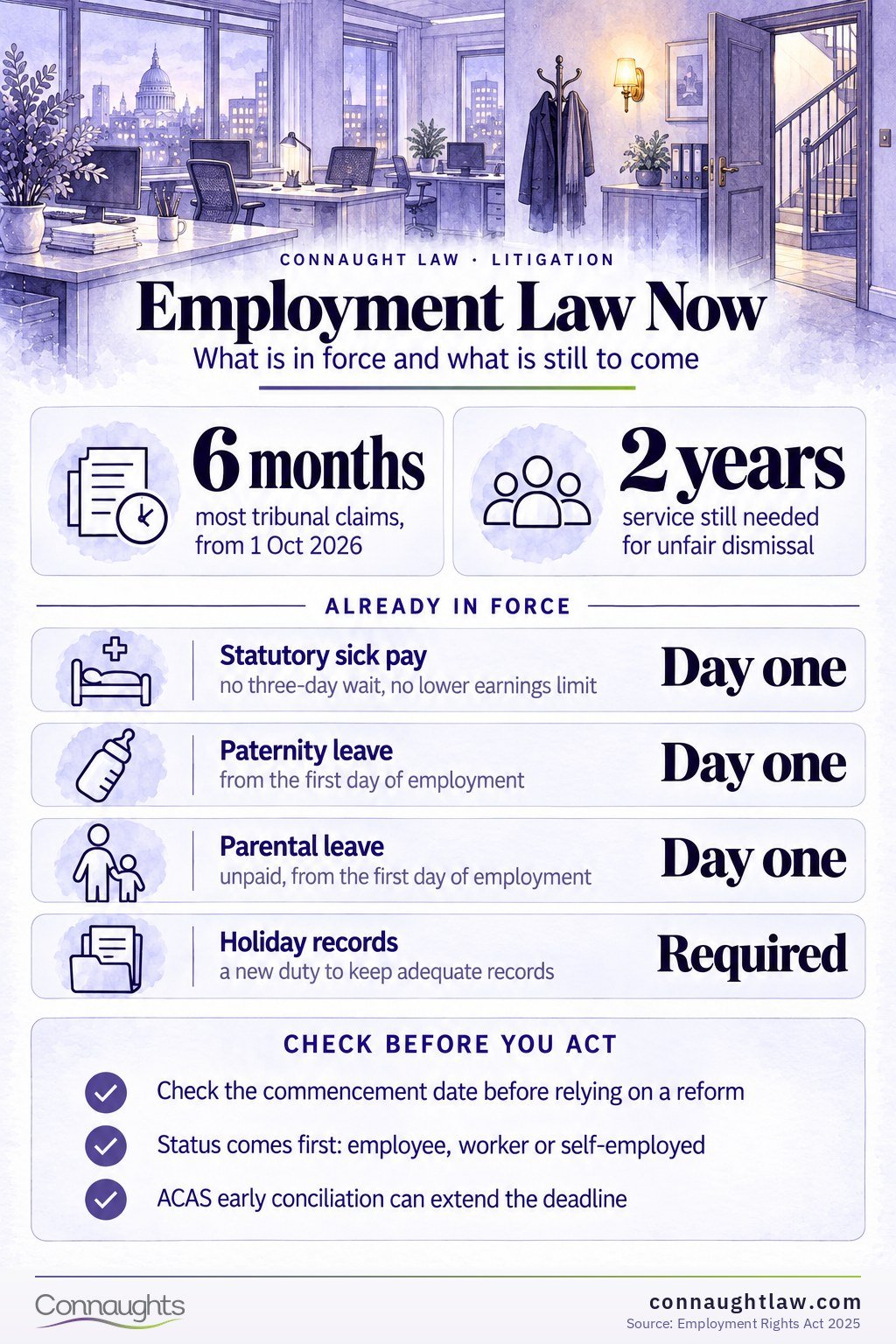
The 2026 Employment Law Landscape
The centrepiece is the Employment Rights Act 2025, the largest package of employment reform in years. Rather than commencing all at once, its provisions are being brought into force in phases through 2026 and 2027, with much of the detail filled in by regulations. Alongside it, the annual uprating of the National Minimum Wage and statutory limits continues as usual. The result is a moving picture, so the key skill in 2026 is knowing which rule is actually in force on the date that matters.
Many widely reported changes — "day-one unfair dismissal," a six-month tribunal deadline — are announced or legislated but not yet in force. A right that is "coming in 2027" does not help a dispute today. Always check the commencement date for the specific provision before relying on it, because the current rules continue to apply until each reform is switched on.
What Is Already in Force
A number of reforms took effect in April 2026 and apply now. Statutory sick pay changed significantly: the three-day waiting period and the lower earnings limit were removed, so more people are paid SSP from the first qualifying day of absence. Paternity leave and unpaid parental leave became day-one rights, and the maximum protective award for a failure to consult on collective redundancies was doubled. Employers also took on a new duty to keep adequate records of holiday entitlement and pay.
- Statutory sick pay — no three-day wait and no lower earnings limit, so SSP starts sooner and reaches more workers
- Day-one family leave — paternity leave and unpaid parental leave from the first day of employment
- National Living Wage — £12.71 an hour for workers aged 21 and over
- Collective redundancy — the maximum protective award for failure to consult doubled
What Is Still to Come
The most significant changes for dismissal disputes are scheduled for later. From January 2027, the qualifying period for ordinary unfair dismissal is due to fall from two years to six months — a major expansion of who can claim, though not the "day-one" right sometimes reported. At the same time, the cap on the unfair-dismissal compensatory award is due to be removed, so awards will in principle track actual loss. Separately, the time limit for bringing most tribunal claims doubled from three to six months for acts on or after 1 October 2026.
Because these are future changes, the present rules still govern: for now, ordinary unfair dismissal generally needs two years' service, the compensatory award remains capped, and most claims must be brought within three months less one day. Anyone weighing up a claim should take advice on the timing, as the rules can turn on the exact date of the event.
Core Rights and How They Fit Together
Employment protections depend heavily on your status — whether you are an employee, a worker or genuinely self-employed — because different rights attach to each. Employees have the fullest protection, including unfair dismissal and redundancy rights. Workers have core protections such as the minimum wage, paid holiday and protection from discrimination, but not ordinary unfair-dismissal rights. The genuinely self-employed have very few statutory employment rights. Getting status right is often the first question in any dispute.
On top of status sit the specific protections: against unfair or discriminatory dismissal, against detriment for raising health-and-safety or whistleblowing concerns, and around pay, working time and family leave. Our detailed guides below take several of these in turn, and our employment service pages explain how we can help with a claim.
Our Detailed Employment Guides
This hub links through to focused guides on the questions we are asked most often. Each explains the law as it stands in 2026 and what to do if you are affected.
- Gig economy worker rights — employee, worker or self-employed, and what the Uber and Deliveroo cases decided about status
- Employee suspension — when suspension is lawful, your right to full pay, and how to challenge an unfair suspension
- Refusing unsafe work or travel — the Section 44 right not to be penalised for refusing seriously dangerous work
- Employment tribunal awards — how compensation is calculated, the Vento bands, and what the published figures really show
Getting Advice
Whether you are an employee facing dismissal, discrimination or a change to your terms, or an employer trying to keep pace with reform, the right advice at the right time makes a real difference. Time limits are strict, the rules are shifting, and the correct claim is not always the obvious one. Our employment service pages set out how we advise on unfair dismissal, constructive dismissal and discrimination at work, and our wider employment law service covers the full range.
Frequently askedQuestions about the 2026 employment law changes
What is changing in UK employment law in 2026?
The Employment Rights Act 2025 is being phased in. From April 2026, statutory sick pay is payable from day one with no lower earnings limit, paternity and unpaid parental leave became day-one rights, the collective-redundancy protective award doubled, and the National Living Wage rose to £12.71 for those aged 21 and over. Larger dismissal reforms are scheduled for 2027, so many current rules still apply for now.
Is unfair dismissal becoming a day-one right?
Not quite. The qualifying period for ordinary unfair dismissal is due to fall from two years to six months from January 2027 — a significant change, but a six-month qualifying period rather than a true day-one right. It is not yet in force, so for now ordinary unfair dismissal generally still requires two years' continuous service. Certain automatically unfair dismissals, such as for health-and-safety reasons, already have no qualifying period.
What is the National Living Wage in 2026?
From 1 April 2026 the National Living Wage is £12.71 an hour for workers aged 21 and over. The 18-to-20 rate is £10.85, and the rate for under-18s and apprentices is £8.00. These rates are reviewed each year and change every April, so it is worth checking the current figure whenever a minimum-wage question arises.
Am I an employee, a worker or self-employed?
It depends on the reality of your working arrangement, not the label in your contract. Employees have the fullest rights, including unfair dismissal and redundancy. Workers have core rights such as the minimum wage, paid holiday and protection from discrimination, but not ordinary unfair-dismissal rights. The genuinely self-employed have few statutory rights. Our gig economy guide explains how tribunals decide status, and why it matters so much.
How long do I have to bring an employment tribunal claim?
Generally six months from the act you are complaining about (three months less one day if it happened before 1 October 2026), after starting ACAS early conciliation, which can extend the deadline. The six-month limit, introduced by the Employment Rights Act 2025, has applied since 1 October 2026. Time limits are strict, so it is important to take advice quickly rather than risk missing the deadline.
Where can I get advice on a specific employment problem?
Our detailed guides above cover common issues such as suspension, refusing unsafe work, gig-economy status and tribunal awards, while our employment service pages explain how we advise on unfair dismissal, constructive dismissal and discrimination. If you are unsure which applies, our employment team can identify the right claim and the applicable time limits, and set out your options.
Tell us what has happened and when. We’ll tell you which rights apply, what the tribunal deadline is in your case, and whether a claim is worth bringing.
Get Expert Advice