
You do not have to put yourself in danger to keep your job. If you reasonably believe a situation at work — or getting to it — is seriously and imminently dangerous, the law protects you from being punished for refusing. That protection is Section 44 of the Employment Rights Act 1996, and since 2021 it covers workers as well as employees. This guide explains what Section 44 protects, the "serious and imminent danger" test, how it applies to unsafe travel, and the important difference between the detriment and dismissal protections.
On This Page
How the Right to Refuse Unsafe Work Works
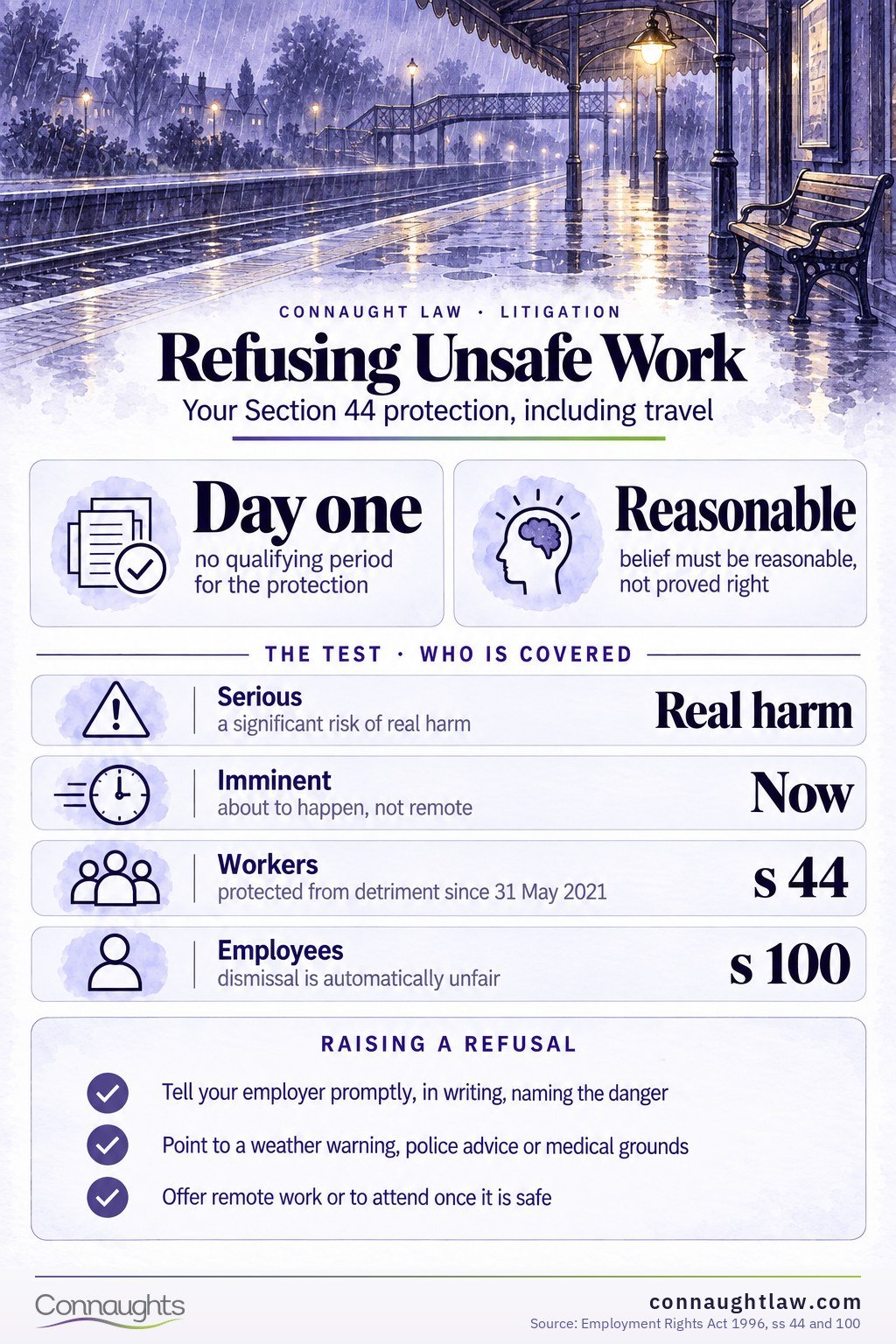
Yes. Under Section 44 of the Employment Rights Act 1996 you are protected from being subjected to a detriment — discipline, lost pay, or worse — if you leave, refuse to return to, or take steps to protect yourself in a workplace where you reasonably believe there is serious and imminent danger you cannot reasonably avoid. It is a day-one right with no qualifying period, and since 31 May 2021 it covers workers, not just employees. You need not prove the danger was real — only that your belief was reasonable.
Section 44 is one of the strongest protections in employment law because it does not depend on length of service and does not require you to be proved right after the event. It turns on what you reasonably believed at the time. The sections below explain the test the tribunal applies, who is covered, how it works for unsafe travel, and how to raise a refusal so the protection actually holds. For how this fits the wider framework, see our UK employment law guide.
What Section 44 Protects
Section 44 protects you from being subjected to any detriment by your employer because, in circumstances of danger you reasonably believed to be serious and imminent, you did one of several things: you left or refused to return to your workplace or a dangerous part of it, or you took (or proposed to take) appropriate steps to protect yourself or other people. "Detriment" is broad — it covers disciplinary action, withholding pay, being passed over, or any other disadvantage imposed because you exercised the right.
Being put at a disadvantage by your employer because of something you did — for example being disciplined, docked pay, demoted, denied opportunities, or treated worse than colleagues. Under Section 44 it is unlawful for an employer to subject you to a detriment because you reasonably refused to work or travel in the face of serious and imminent danger.
The "Serious and Imminent Danger" Test
The protection is not a general right to refuse anything you dislike. It is built around a specific test: danger you reasonably believed to be serious (a significant risk of real harm, not a trivial one) and imminent (about to happen, not remote), which you could not reasonably be expected to avert. The belief must be genuine and reasonable — judged by what a reasonable person in your position, with your knowledge, would have believed.
Crucially, you do not have to be right. If it later turns out the danger was less than you feared, you are still protected provided your belief was reasonable on the information available at the time. What matters is the reasonableness of the belief, not the accuracy of the prediction — which is why the facts you can point to, and what you were told, matter so much.
Workers, Employees and Dismissal
Two changes and one distinction are essential to get right. First, Section 44 originally protected only "employees"; from 31 May 2021 it was extended to cover workers as well — agency staff, many gig and zero-hours workers, and other atypical arrangements. That followed a High Court ruling that the UK had not properly implemented EU health-and-safety protections for all workers.
Second, the distinction between detriment and dismissal. Section 44 deals with detriment and covers both employees and workers. A related provision, Section 100, makes it automatically unfair to dismiss someone for the same health-and-safety reasons — with no qualifying period — but Section 100 applies to employees only. So a worker who is not an employee has strong protection against detriment, but does not have unfair-dismissal rights; an employee has both. Getting this right decides which claim is available.
If you are an employee and are dismissed for refusing genuinely unsafe work, that is automatically unfair from day one under Section 100. If you are a worker (not an employee), you are protected from detriment under Section 44, but you cannot bring an ordinary unfair-dismissal claim. Which protection applies depends on your employment status, so it is worth checking before you act.
Refusing Unsafe Travel to Work
Section 44 is most often discussed in the context of the workplace itself, but it can reach travel that forms part of the job or the way you are required to reach a dangerous situation. Ordinary commuting is generally the employee's own responsibility, and a strike or bad weather does not, by itself, hand you a right to stay home. The protection bites where the travel your employer requires would expose you to serious and imminent danger you reasonably could not avoid — not mere inconvenience, cost or delay.
In practice that means the strongest travel refusals rest on objective evidence: an official severe-weather warning advising against travel, police advice about a specific danger, or an employer insisting on a journey that is genuinely hazardous for you given a health condition, disability or pregnancy. The reasonableness test is individual — what is a manageable trip for one person may be a real danger for another — so a blanket "everyone must attend" instruction that ignores individual circumstances is where employers get into difficulty.
What to Do if You Need to Refuse
How you raise a refusal often decides whether the protection holds. The aim is to show a genuine, reasonable safety concern and a willingness to work as soon as it is safe — not a flat refusal.
- Tell your employer promptly and in writing, setting out the specific danger you are worried about
- Point to objective evidence — a weather warning, police or transport advisory, or medical grounds
- Explain any personal circumstances (health, disability, pregnancy) that increase the risk for you
- Offer a workable alternative, such as working remotely or attending once it is safe
- Keep copies of what you sent and how your employer responded, in case of later detriment
If you are then disciplined, docked pay or dismissed for having refused, that is where a Section 44 detriment claim — or, for an employee, a Section 100 automatic unfair dismissal claim — comes in. If instead your employer's response is to suspend you while it "reviews" the refusal, our guide to employee suspension explains your rights there. Because the protection turns on the detail of what you believed and how you raised it, early advice makes a real difference.
Under the Employment Rights Act 2025, most employment tribunal claims now have a six-month time limit where the act complained of was on or after 1 October 2026; earlier acts keep the old three-month limit. Detriment and health-and-safety dismissal claims are day-one rights with no qualifying period.
Questions about refusing unsafe work
Can I refuse to work or travel if I believe it is unsafe?
Yes, where you reasonably believe there is serious and imminent danger you cannot reasonably avoid. Section 44 of the Employment Rights Act 1996 protects you from detriment for leaving, refusing to return, or taking steps to protect yourself or others. It is a day-one right and, since 31 May 2021, covers workers as well as employees. You need not prove the danger was real, only that your belief was reasonable.
What does "serious and imminent danger" mean?
It means a significant risk of real harm that is about to happen, not a remote or trivial one, and which you could not reasonably be expected to avert. The test is about your reasonable belief at the time, judged by what a reasonable person in your position and with your knowledge would have believed — so objective evidence such as an official warning strengthens a refusal considerably.
Does Section 44 cover me if I am a worker, not an employee?
Yes for detriment. Since 31 May 2021, Section 44's protection from detriment covers workers, including many agency, gig and zero-hours workers, not just employees. But the separate protection against automatic unfair dismissal (Section 100) applies to employees only. So a worker is protected from being penalised, while an employee is also protected from being dismissed.
Do transport strikes or bad weather give me a right to refuse travel?
Not automatically. Ordinary commuting is generally your own responsibility, and disruption alone is not enough. Section 44 applies where the travel your employer requires would expose you to serious and imminent danger you reasonably cannot avoid — for example travelling against an official severe-weather warning, or where a health condition makes the specific journey genuinely dangerous for you.
Can my employer discipline me for refusing unsafe work?
Not where your refusal is protected under Section 44. Disciplining you, cutting your pay, or dismissing you because you reasonably refused work or travel in the face of serious and imminent danger is unlawful. An employee dismissed for such a reason can claim automatic unfair dismissal; a worker can claim for the detriment. If this happens, take advice quickly.
Is there a reasonable limit on how far I can be made to travel for work?
There is no fixed statutory distance. What travel is reasonable depends on your contract — including any mobility or place-of-work clause — and what is reasonable in the circumstances. A safety-based refusal is a separate question governed by Section 44; a dispute about being required to relocate or travel long distances is usually a contractual matter, and both are worth taking advice on.
How should I raise a safety refusal to stay protected?
Put it in writing promptly, set out the specific danger and the evidence for it, explain any personal circumstances that increase your risk, and offer a workable alternative such as remote working or attending once it is safe. Keep records of what you sent and how your employer responded. Raising it constructively, rather than simply not turning up, makes the protection far easier to rely on.
Tell us what the danger was, how you raised it and what your employer did next. We’ll tell you whether it meets the serious and imminent danger test, and whether your claim is detriment or automatic unfair dismissal.
Get Expert Advice