
Disclosure is where many criminal cases are won or lost. The prosecution must reveal material that could undermine its own case or assist the defence, and a failure to do so can render a conviction unsafe. This guide explains the disclosure duties under the Criminal Procedure and Investigations Act 1996, the role of the defence statement, how digital evidence has reshaped disclosure, and what can be done when the prosecution gets it wrong.
On This Page

Understanding Criminal Disclosure in the UK
In a criminal case the prosecution must disclose any material it holds that has not been used as evidence but which might reasonably undermine its case or assist the defence. This "unused material" duty runs from initial disclosure through to the end of the trial. Getting it wrong is a serious matter: undisclosed material has collapsed trials and overturned convictions.
Due Process and the Right to a Fair Trial
Due process is the principle that a person facing criminal charges is entitled to a fair procedure — the presumption of innocence, the right to know and test the case against them, and the right to a fair trial protected by Article 6 of the European Convention on Human Rights. Disclosure is a cornerstone of that fairness. A defendant cannot properly answer a case if the prosecution is sitting on material that helps the defence.
That is why the disclosure regime is not an administrative formality but a substantive right. The obligation exists precisely because the state, through the police and prosecution, gathers far more material than it uses, and some of that material may point away from guilt. Ensuring it is handed over is fundamental to a safe conviction.
Disclosure Duties Under CPIA 1996
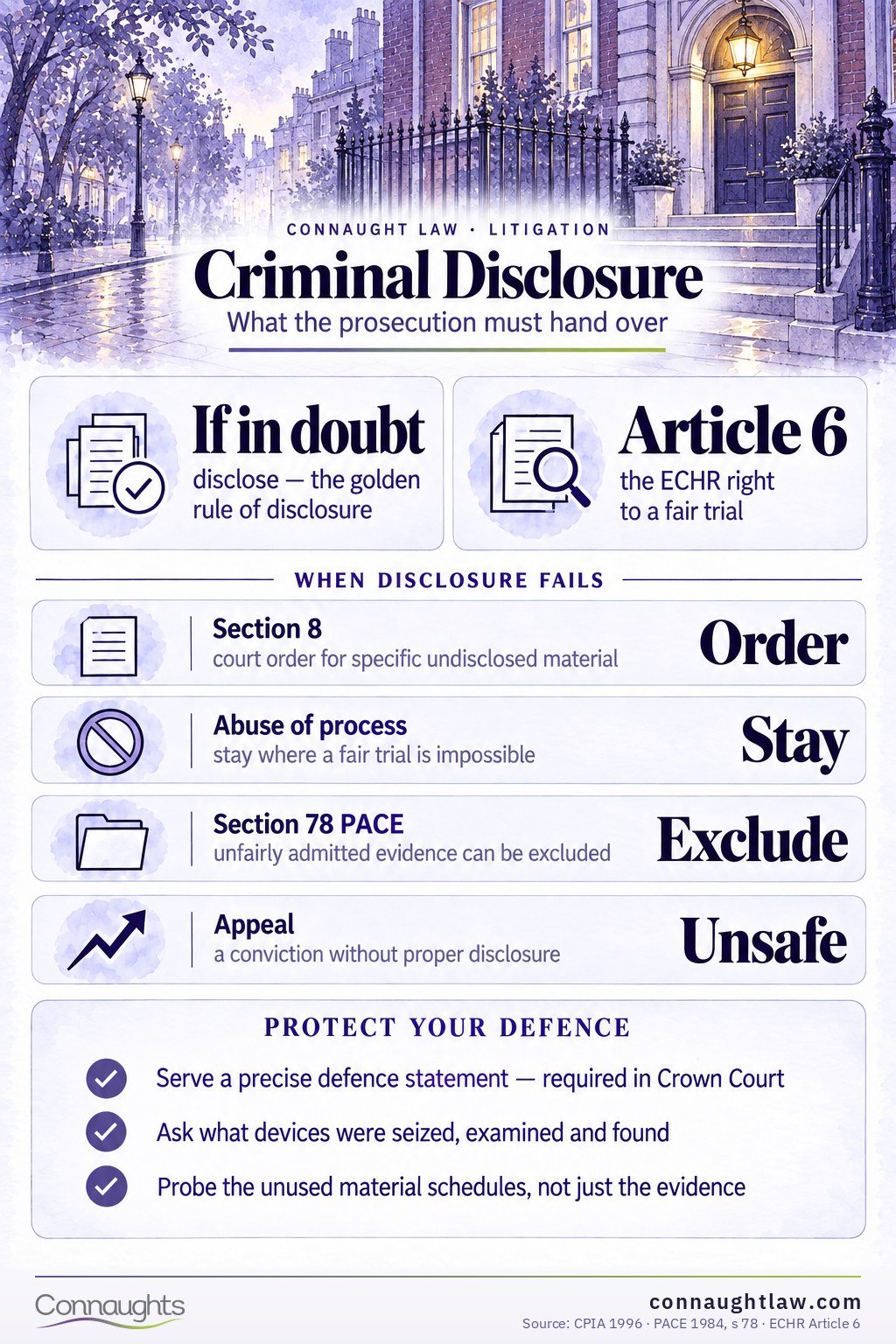
The framework is set by the Criminal Procedure and Investigations Act 1996, supported by the Criminal Procedure Rules and the Attorney General's Guidelines on Disclosure. Under the CPIA, the prosecution must make initial disclosure of any unused material that might reasonably be considered capable of undermining its case or of assisting the defence. This is often called the "golden rule": if in doubt, disclose.
The defence statement is the mechanism that drives the process forward. In the Crown Court the defence must serve a statement setting out the nature of the defence and the matters in issue; in the magistrates' court it is optional. A properly drafted defence statement triggers the prosecution's continuing duty to review disclosure in light of the issues raised, and it is the foundation for a section 8 application — a request to the court for specific material the defence believes exists but has not been disclosed.
The Unused Material Schedules
Behind disclosure sits a system of schedules. The police disclosure officer lists the unused material on schedules that the prosecutor reviews, deciding what meets the test for disclosure. Understanding that these schedules exist — and being willing to probe what sits on them — is often the key to uncovering material that should have been handed over. A defence that treats disclosure passively can miss what a rigorous approach would reveal.
Common Disclosure Failures and How to Challenge Them
Disclosure failures take recognisable forms. The most common is simply that undermining or assisting material is never disclosed — because it was not scheduled properly, not reviewed against the real issues, or wrongly judged not to meet the test. Late disclosure, arriving on the eve of or during trial, is another persistent problem, leaving the defence too little time to use it.
Challenging these failures is a matter of process and persistence. A precise defence statement narrows the issues and forces a targeted review. Where material is believed to exist but has not been produced, a section 8 application asks the court to order its disclosure. Robustly pursued, these tools shift disclosure from something done to the defence into something the defence actively drives.
Digital Evidence and Disclosure
Digital evidence has transformed disclosure. Phones, messaging apps, social media and cloud storage now generate vast quantities of material, and much of the recent difficulty in criminal cases has arisen from how that material is examined and disclosed. A single phone download can contain the message that undermines the whole prosecution — or that is never looked at.
The current Attorney General's Guidelines on Disclosure address digital material directly, built around the principle of pursuing "reasonable lines of enquiry" proportionately, rather than either ignoring devices or dumping everything on the defence. For a defendant, the practical point is to ask what digital material exists, whether it has been examined, and whether downloads have been disclosed in a usable form rather than as an impenetrable data set.
If your case involves phones, messages or online activity, ask specifically what digital devices were seized, whether they were examined, and what was found. Digital material is a frequent source of both wrongful non-disclosure and exculpatory evidence.
When Prosecutors Fail to Disclose: Your Options
When disclosure fails, the law provides real remedies. The court can be asked to order disclosure of specific material under section 8. Where a failure is serious enough to make a fair trial impossible, the defence can apply to stay the proceedings as an abuse of process. Improperly obtained or unfairly admitted evidence can be excluded under section 78 of the Police and Criminal Evidence Act 1984.
If a conviction has already followed a disclosure failure, that failure can be a ground of appeal, because a conviction reached without proper disclosure may be unsafe. The Court of Appeal has quashed convictions on exactly this basis. The common thread is that disclosure failures are not merely irregularities to be noted — they can be decisive, and they should be documented and pursued.
Disclosure Failures in Practice
The scale of the problem became national news in late 2017, when a series of rape and sexual offence prosecutions collapsed after it emerged that phone evidence undermining the allegations had not been disclosed. The case of Liam Allan, whose trial collapsed when messages on a complainant's phone were belatedly reviewed, prompted a joint review by the Crown Prosecution Service and the police and a renewed focus on disclosure across the system.
The lesson from that period endures: disclosure failures are systemic, not rare, and they most often involve unused and digital material. The response was revised guidance and closer scrutiny, but for any individual defendant the safeguard is the same — an active, informed approach to disclosure rather than reliance on the process working perfectly on its own.
How We Help
Effective disclosure work is detailed and proactive. It means drafting a defence statement that sharpens the real issues, scrutinising the unused material schedules, pressing for digital downloads in usable form, and making section 8 applications where material is being withheld. Where failures have occurred, it means building the abuse of process or appeal argument on a properly documented record. For related financial-crime and asset matters, our criminal defence and asset tracing team handles confiscation and proceeds-of-crime work, and our wider litigation services cover the full range of contested proceedings.
Frequently askedQuestions about criminal disclosure
What is due process in UK criminal law?
Due process is the right to a fair procedure when facing criminal charges — the presumption of innocence, the right to know and test the case against you, and the fair-trial guarantee under Article 6 of the European Convention on Human Rights. Proper disclosure is central to it.
What are my disclosure rights under CPIA 1996?
The prosecution must disclose unused material that might reasonably undermine its case or assist your defence, both at initial disclosure and as a continuing duty through trial. Serving a defence statement triggers a further review and lets you apply under section 8 for specific material.
How common are disclosure failures in criminal cases?
They are a well-documented, systemic issue rather than a rarity, as the collapse of several prosecutions in 2017–18 over undisclosed phone evidence showed. Failures most often involve unused material and digital evidence, which is why an active approach to disclosure matters.
What do the current disclosure guidelines say about digital evidence?
The current Attorney General's Guidelines on Disclosure require investigators to pursue reasonable lines of enquiry into digital material proportionately, rather than ignoring devices or handing over undifferentiated data. You are entitled to ask what was seized, examined and disclosed.
What remedies exist when prosecutors fail to disclose evidence?
You can apply under section 8 for an order to disclose specific material, ask the court to stay the case as an abuse of process where a fair trial is impossible, seek exclusion of evidence under section 78 PACE, or, after conviction, appeal on the basis that the conviction is unsafe.
Why do digital evidence disclosure failures occur so frequently?
The sheer volume of material on modern devices makes examination and disclosure difficult, and material that undermines the prosecution can be overlooked in large data sets. This is why defendants should ask specifically about digital devices, downloads and how they were reviewed.
Can disclosure failures lead to case dismissal?
Yes. A serious failure that prevents a fair trial can lead to proceedings being stayed as an abuse of process, and prosecutions have collapsed for this reason. After conviction, a disclosure failure can render the conviction unsafe and form a ground of appeal.
When should I instruct criminal disclosure solicitors?
As early as possible. Disclosure is most effective when the defence statement is drafted carefully at the outset and the unused material is scrutinised before trial. Early advice lets you shape the issues and pursue material while there is still time to use it.
Tell us the charge, the stage the case has reached and what has been served so far. We’ll tell you what should be on the unused material schedules and whether a section 8 application is the right move.
Get Expert Advice