
HM Land Registry now runs digital by default: 95% of applications clear within twelve months, straightforward updates complete in minutes, and from August 2025 a qualified electronic signature can replace the witnessed pen. This guide explains what the Digital Registration Service actually does for buyers and sellers, the real processing times by application type, the free expedite route most people never use, and where the digitisation programme goes next — including the switch-off of the legacy channels.
On This Page

HM Land Registry's Digital Transformation: Where It Actually Stands
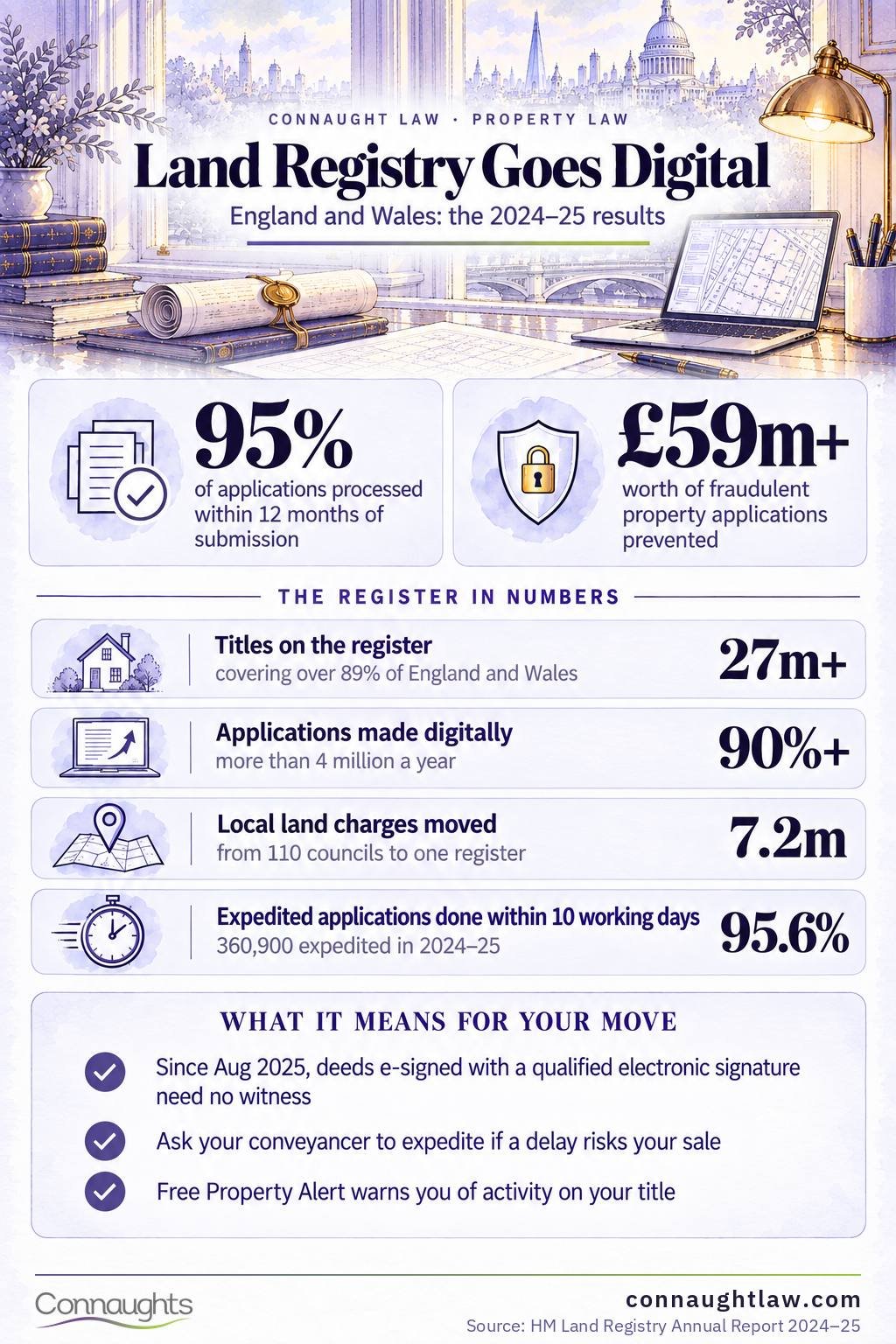
HM Land Registry holds 26.7 million registered titles covering 89% of the landmass of England and Wales — around £9 trillion of property — and the way it processes changes to them has been rebuilt over the past three years. The headline results, from its 2024–25 annual report: 95% of applications now clear within twelve months, automated updates complete in minutes, and requisitions — applications bounced back for correction — are down 25% on charge and transfer applications lodged digitally.
Straightforward register updates lodged through the Digital Registration Service can be processed automatically, end to end, in minutes. The portal handles around 8,000 users daily; Business Gateway APIs took 515,000 applications from nearly 1,300 customers in six months. The backlog problem has moved: it now lives almost entirely in complex casework — first registrations, subdivisions — not routine updates.
Digital by Default: What Changed at the Counter
"Digital by default", fully implemented through 2023–24, means most register updates must come through the Digital Registration Service rather than scanned paper forms. The difference is structural: instead of a PDF a caseworker reads, DRS takes structured data it can check — against the existing register, in real time, before the application is ever submitted.
What the DRS Actually Does
- Live validation: details checked against the register as they are entered — wrong title numbers and name mismatches surface immediately
- Automatic fee calculation: the fee is computed and added on lodgement, removing a classic requisition trigger
- Error trapping: incomplete applications cannot be submitted, which is where the 25% requisition drop comes from
- Straight-through processing: simple cases qualify for automated completion with no human caseworker at all
Qualified Electronic Signatures: The Witness Retires
Since August 2025, HM Land Registry accepts qualified electronic signatures — the highest tier under the eIDAS framework — on deeds, without a witness. The signature is cryptographically sealed, bound to a verified identity, and tamper-evident: legally the equivalent of the handwritten original, practically the end of chasing a neighbour to watch you sign a mortgage deed.
How It Works in Practice
The signer's identity is verified digitally once, a qualified certificate issues, and each signature then binds signer, timestamp and document integrity into one cryptographic record. For international transactions — a seller in Singapore, a buyer in Dubai — the change removes the single most awkward logistical step conveyancing had left.
E-Signing Step by Step
| Step | What Happens | What It Replaces |
|---|---|---|
| Identity verification | Digital ID check to eIDAS standard, done once | Passport certification rounds |
| Certificate issue | A qualified certificate binds signatures to the verified identity | Wet-ink specimen signatures |
| Signing | Cryptographic seal with signer, timestamp and document hash | Pen, paper and a witness |
| Verification | Any tampering after signing is mathematically detectable | Handwriting comparison |
Who Gains, and How Much
Buyers and sellers gain signing from anywhere with no witness choreography; firms gain a workflow without printing, posting and re-scanning; and completion timetables lose one of their quiet delay sources. The caveat is adoption: both sides of a transaction, and any lender, must be set up for it — which is why QES is spreading deal by deal rather than overnight.
Processing Times: The Honest Numbers
Published averages hide a split register. Automated digital updates: minutes. Standard register updates: half complete within around 19 weeks, most within 8 months. First registrations: averaging 10–14 months. Title splits and new leases: 7–13 months depending on how complete the application arrives. The official processing times page is updated monthly and is the figure to check before promising a client anything.
Why the Same Application Takes Ten Days or Ten Months
The variable is rarely the queue; it is the application. Complete applications with clean plans and consistent names flow through; anything requiring a requisition joins the slow lane. The registration gap this creates has real legal consequences for waiting buyers — our leasehold reform guide covers the sharpest example, where extension rights run from registration rather than completion.
The Free Expedite Service Most People Never Use
Where delay causes real hardship or jeopardises a transaction, HM Land Registry expedites applications free of charge — over 200,000 applicants used the route in 2025, and the vast majority of expedited cases complete within ten working days. It needs evidence of urgency, not eloquence: an exchange deadline, an onward chain, a lending condition. If your sale is stuck behind a registration, ask your conveyancer why an expedite request has not gone in.
AI on the Register: £59 Million of Fraud Stopped
Property is where the biggest frauds go, and the register is now defended computationally: machine-learning systems screen applications for document anomalies, signature failures and behavioural red flags, and prevented £59 million of fraudulent transactions in 2024–25. For owners, the practical takeaway is the free companion tool — Property Alert — which notifies you of any application against a registered title you monitor.
Property Alert is free, takes minutes to set up, and emails you whenever an application or official search hits a monitored title — the early warning that catches impersonation fraud while it can still be stopped. Empty properties, mortgage-free homes and rented-out houses are the prime targets; if you own one, set the alert today.
How the Screening Works
The systems compare each application against patterns learned from millions of genuine ones: documents that do not match authenticated examples, signatures inconsistent with those on file, application behaviour that fits known fraud profiles. Flagged cases route to human investigators — the machine narrows the haystack rather than making the final call.
Automation Behind the Counter
The same document-comparison tooling that screens for fraud also does routine verification — signatures, formatting, content against precedent — releasing caseworker time to the complex applications that actually need judgment. That reallocation, more than any single technology, is what moved the 12-month completion figure to 95%.
Why UK Transactions Still Drag — and Where Digital Helps
A property transaction in England now takes around 120 days on average to complete — roughly 60% longer than in 2007 — and about one in three sales falls through before it does, according to the government’s home buying and selling reform roadmap. Registration is no longer the main culprit: chains, council search backlogs, mortgage processing, leasehold information packs and plain communication failure are. Digitisation attacks the parts it can reach — local land charges are the proof, below — but the chain problem is structural, and no API fixes a buyer who has not sold.
What the Transformation Means for You
Buyers and Sellers
Faster registration after completion, automatic fee calculation, e-signing without witnesses, and instant local land charges searches in migrated areas. What has not changed: you still cannot safely skip the searches, the survey or the title review — the register being digital does not make its contents benign, as our boundaries guide demonstrates at £300,000 a lesson.
Local Land Charges: From Weeks to Instant
By March 2025, 110 local authorities had migrated 7.2 million local land charges to HM Land Registry's central digital register, converting a search that took days or weeks at some councils into an instant online result. The migration continues authority by authority — one of the few conveyancing delays being genuinely engineered out of existence.
What Comes Next
The forward programme — set out in the digital services roadmap and the Strategy 2025+ investment of £72 million in commercial partnerships — points at geospatial data, completed land charges migration and deeper API integration with conveyancing platforms. The direction is one register, machine-readable end to end, with the paper era formally closed behind it.
When Will the Legacy eDRS Be Switched Off?
HM Land Registry has answered this directly: once the remaining application types are added to the Digital Registration Service, it will begin decommissioning legacy channels such as eDRS from spring 2026, contacting remaining users beforehand. Firms still lodging through the older routes should migrate their workflows to DRS now rather than wait for the switch-off letter.
Frequently askedQuestions about Land Registry's digital services
How long does the Land Registry take to process applications?
Automated digital updates: minutes. Standard register updates: half within about 19 weeks, most within 8 months. First registrations: 10–14 months on average, with title splits similar. Check the official processing times page for the current month's figures — they move, and the split between simple and complex cases is enormous.
Can I expedite a Land Registry application for free?
Yes. Where delay causes hardship or puts a transaction at risk, the expedite service is free, needs evidence of the urgency, and completes the vast majority of expedited applications within ten working days. Over 200,000 applicants used it in 2025 — it is the most underused lever in conveyancing.
What is the Digital Registration Service and is it mandatory?
DRS is the structured digital channel for register updates — mandatory for most application types under digital by default. It validates against the register in real time, calculates fees automatically and blocks incomplete submissions, which is why digitally lodged applications draw 25% fewer requisitions.
How do qualified electronic signatures work on deeds?
Your identity is verified digitally once; a qualified certificate then lets you sign with a cryptographic seal recording signer, time and document integrity. Since August 2025 HM Land Registry accepts these on deeds without a witness — legally equivalent to wet ink, and tamper-evident in a way ink never was.
How does the Land Registry prevent property fraud?
AI screening compares every application against patterns from millions of genuine ones, flagging anomalies to human investigators — £59 million of fraudulent transactions were stopped in 2024–25. Owners should add the free Property Alert service, which emails you the moment anything is lodged against a monitored title.
Why do UK property transactions take so long?
Around 120 days on average, and about one in three sales falls through first — chains, council searches, mortgage processing and leasehold packs, far more than registration itself. Digitisation is removing the delays it can reach, like local land charges searches; the chain remains the structural problem no technology has solved.
How do I check the progress of my application?
Through the View Applications service in the HM Land Registry portal, or via your conveyancer's Business Gateway integration. Pair it with Property Alert on your own title, and you will know about every application — yours or anyone else's — as it happens.
Tell us what was lodged, when, and what the delay is holding up. We will tell you whether it qualifies for free expedition and what the application needs to clear without a requisition.
Get Expert Advice