
Two years after the Leasehold and Freehold Reform Act 2024 became law, one provision is in force, the valuation reforms are not, and marriage value is still being paid on every short-lease extension. This guide sets out what actually applies in mid-2026, where the freeholders' appeal stands, what the draft Commonhold and Leasehold Reform Bill changes — and the honest answer to when marriage value abolition will arrive.
On This Page

The Leasehold and Freehold Reform Act 2024: What Is Actually In Force
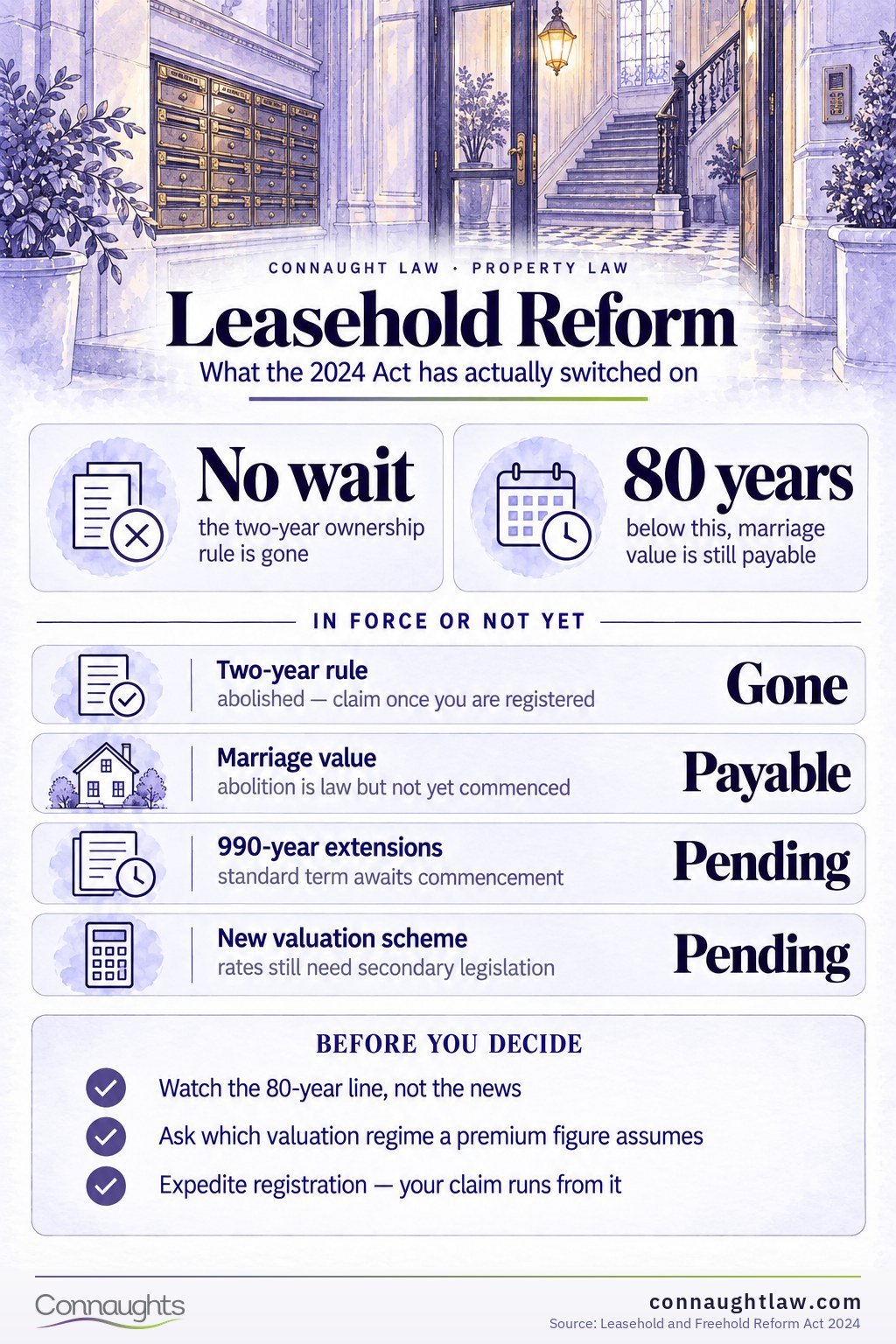
The Leasehold and Freehold Reform Act 2024 passed in the pre-election rush of May 2024 and has spent the two years since largely switched off. One headline change works today: the two-year ownership rule is gone, so a leaseholder can start a statutory extension or enfranchisement claim the day they complete. The changes people actually ask about — marriage value abolition, the new valuation rates, cheaper premiums — all await commencement, and cannot bite until secondary legislation sets the rates they depend on.
In force: abolition of the two-year ownership requirement (31 January 2025) and right to manage costs reforms (March 2025). Not in force: the new valuation scheme, marriage value abolition, the 990-year standard extension, and ground rent treatment in premiums. Every extension completing today is still valued under the old law.
Is Marriage Value Abolished? In Law Yes, In Practice No
The Act abolishes marriage value — the uplift shared with the freeholder when a lease falls below 80 years. But that section is not in force, so marriage value is still payable on every sub-80-year extension completing in 2026. Abolished on paper and payable in practice is an uncomfortable position, and it is exactly where leaseholders stand.
Yes. Section 8 of the 2024 Act removes marriage value from the premium, but it has not been commenced. Until the government brings it into force and lays the valuation regulations, every lease extension completing on a lease under 80 years is still priced with marriage value in it.
When Will Marriage Value Actually Be Abolished?
No commencement date exists. The government's valuation-rates consultation, promised for summer 2025, had still not been launched by mid-2026; the freeholders' litigation is heading to the Court of Appeal; and the government has said the valuation provisions need corrections it intends to make through the Commonhold and Leasehold Reform Bill. Reading those three facts together, commencement in 2027 is the optimistic case and 2028 the realistic one — and any adviser quoting a firm date is selling certainty that does not exist.
How We Got Here: From the 2021 Proposals to the 2024 Act
From Announcement to Statute, the Long Way
The reforms were announced in January 2021 with a promise that no leaseholder would pay marriage value again. Three years of drafting, consultation and parliamentary attrition later, the 2024 Act carried the promise into statute — but with its commencement, and the rates that give it monetary meaning, left for later. That deferral is the source of everything unresolved below.
What Survived and What Was Dropped
The Act kept marriage value abolition, standard 990-year extensions, and a prescribed-rates valuation model. It dropped the ground rent cap for existing leases that had been trailed, and it never attempted commonhold conversion — which is why a second bill was always coming.
The Two-Year Rule Is Gone — Use It
Who Can Claim Now
Since 31 January 2025, a leaseholder no longer needs two years' ownership before claiming a lease extension or freehold purchase. Buyers of short-lease flats — including at auction — can serve a claim notice immediately after registration, rather than sitting on a wasting asset for two years.
What That Changes in Practice
The strategic gain is control of timing. A buyer can now price a short lease, complete, and start the statutory clock at once — instead of negotiating an assignment of the seller's claim notice, the old workaround that regularly went wrong. Our lease extension team sees the difference most sharply on sub-85-year flats, where every year of delay used to cost real money.
The One Decision the Rule Change Sharpens
Extend now under the old valuation, or wait for the new scheme? Below 80 years, waiting means the lease keeps shortening and marriage value keeps growing while the commencement date stays unknown. Above 85 years, there is more room to wait. In the low 80s, the maths is genuinely finely balanced — run it with a valuer before the lease crosses the 80-year line, because that crossing is the expensive event. Our lease extension calculator gives the starting numbers.
Mind the Registration Gap
Why Land Registry Delays Matter Here
A buyer's right to claim runs from registration, not completion — and registration backlogs mean the gap between the two can run to months on some applications. For a short lease, that gap is not neutral: the lease shortens while the application queues.
Working Around the Gap
The practical answers are unglamorous: expedite the registration where grounds exist, take an assignment of a claim notice served by the seller where timing is critical, and never let a purchase straddle the 80-year line while relying on a registration date nobody controls.
Registration and the Claim Clock
| Stage | Who Controls It | Risk While It Runs |
|---|---|---|
| Completion to registration | HM Land Registry queue; expedition possible | Lease shortens; no claim can be served |
| Registration to claim notice | The leaseholder — immediately, since 31 Jan 2025 | None if served promptly |
| Claim notice to completion of extension | Statutory process between the parties | Valuation date is fixed by the notice — the protection |
The Freeholders' Challenge: Dismissed, Now On Appeal
What the Challenge Attacks
Freehold investors challenged the Act's valuation provisions — principally marriage value abolition and the capped treatment of ground rent — as an interference with their property rights under Article 1 of Protocol 1 to the European Convention. The argument is not that Parliament cannot reform leasehold; it is that doing so without compensation for the transferred value crosses the line.
Where the Litigation Stands
The High Court heard the claims in July 2025 and dismissed them in October 2025 on every ground. Permission to appeal was granted on 1 April 2026, with a Court of Appeal hearing expected late 2026 or early 2027 — and whatever the result, the prospect of a further reference to Strasbourg is real. The government has been unwilling to commence the contested provisions while the litigation runs, which makes the appeal timetable the single biggest input into the marriage value date.
What Turns on the Outcome
If the challenge ultimately fails, commencement becomes a political choice with the legal risk cleared. If any part succeeds, the valuation scheme has to be redesigned — most likely through amendments carried in the new Bill — and the timetable resets. Either way, no one buying or extending in 2026 should transact on an assumed outcome.
Valuation Uncertainty: Pricing a Moving Target
Why Premiums Still Include Marriage Value
Until commencement, statutory valuations follow the existing law — marriage value included below 80 years. Some sellers and agents market short-lease flats as if abolition had already happened; a buyer who pays a price built on the reformed law is donating the difference to the seller and carrying the entire commencement risk personally.
Where Professionals Disagree
Valuers currently differ on how much reform expectation to price into short-lease transactions — which is why two premium estimates for the same flat can sit thousands of pounds apart, each defensible on its own assumptions. Ask any valuer which regime and which assumptions their figure uses; a number without its assumptions is not advice, it is a guess with confidence.
You cannot time the commencement, but you can control three things: get a valuation that states which regime and which assumptions it uses, watch the 80-year threshold rather than the news, and remember the two-year ownership rule has already gone — a recent buyer can start today. Waiting costs money on a lease that keeps shortening; acting costs marriage value that may later be abolished. Price both before choosing.
What a Leaseholder Should Do With the Uncertainty
Treat the current law as the law, because it is. Extend when the lease's own arithmetic says extend — especially near the 80-year cliff — and treat any benefit from future reform as upside, never as the plan. A decision that only works if commencement lands by a particular date is a bet, and the last three years of delay are the argument against making it.
Still Missing: The Rates Consultation
The deferment and capitalisation rates that will drive reformed premiums require a consultation that was promised for summer 2025 and has still not appeared. Until those rates exist even in draft, nobody — government included — can say what a reformed premium will be.
The Next Wave: Commonhold and the New Bill
A Second Bill Carries the Fix
The draft Commonhold and Leasehold Reform Bill was published on 27 January 2026 and confirmed in the King's Speech on 13 May 2026. It carries the commonhold framework, and the government has indicated it will also carry the corrections the 2024 Act's valuation provisions need — which formally couples marriage value commencement to a second bill's progress.
Commonhold, Seriously This Time
The March 2025 White Paper set the direction: commonhold as the default tenure for new flats, with leasehold's structural conflict of interest removed rather than regulated. The open questions — conversion of existing blocks, lender appetite, management transition — are exactly the ones that stalled commonhold in 2002, and the Bill's committee stages will show whether the answers are better this time.
What to Watch Through 2026–27
Three markers, in order: the valuation-rates consultation finally launching; the Court of Appeal's decision; and the Bill's passage through committee. Marriage value commencement almost certainly sits behind all three — which is what makes 2027 optimistic and 2028 realistic.
Who Is Affected and How
Leaseholders
Winners today: recent buyers who can claim immediately. Waiting-room: everyone priced out by marriage value, for whom the reform is real but not yet cashable. The trap: leases drifting below 80 years while their owners wait for a commencement date nobody can give them.
Freeholders and Investors
Freehold values carry the litigation's outcome. Portfolios priced on ground rent income and marriage value receipts face a statutory haircut if the Act commences intact — which is precisely why the appeal is being fought this hard, and why settlement of the sector's pricing must wait for the courts.
Buyers, Sellers and Lenders
Short-lease transactions now need explicit reform-risk allocation: which valuation regime the price assumes, who benefits if commencement lands mid-transaction, and what the lender requires on lease length regardless of pending law. Our guide to purchasing leasehold property covers the buyer's side; for blocks acting together, collective enfranchisement has the same timing question at larger scale.
The Timeline, As Honestly As It Can Be Drawn
Dates That Exist
Royal Assent 24 May 2024. Two-year rule abolished 31 January 2025. Right to manage costs reforms March 2025. High Court dismissal October 2025. Permission to appeal 1 April 2026. Draft Bill 27 January 2026; King's Speech 13 May 2026. Those are the facts; everything beyond them is projection.
And the Dates That Do Not Exist Yet
The valuation consultation, the commencement order for marriage value abolition, the 990-year extensions, and the reformed premiums all lack dates. The gov.uk leasehold guidance and the Leasehold Advisory Service reflect commencement as it happens — a claim about the new law that cannot be traced to a commencement order is marketing.
The Coupling Problem
Because the corrections ride in the new Bill, the 2024 Act's most valuable provisions are now hostage to a second bill's parliamentary fortunes. That is the structural reason no honest adviser will give you a marriage value date — the answer depends on two courts and two statutes, only one of which exists.
Frequently askedQuestions about the 2024 Act and marriage value
Is marriage value abolished under the Leasehold and Freehold Reform Act 2024?
In the statute, yes; in force, no. The abolition provision awaits commencement, so marriage value remains payable on every extension of a sub-80-year lease completing now. Until a commencement order is made, the old valuation law is the law.
When will marriage value actually be abolished?
No date exists. Commencement sits behind three things: the valuation-rates consultation (promised summer 2025, still unlaunched), the freeholders' appeal (hearing expected late 2026 or early 2027), and the new Bill carrying the government's corrections. On those facts, 2027 is optimistic and 2028 realistic.
Can I extend my lease immediately after buying?
Yes — the two-year ownership requirement was abolished on 31 January 2025. The right runs from registration at the Land Registry rather than completion, so factor the registration queue into timing, and expedite where the lease length makes it urgent.
Should I extend now or wait for the new valuation rules?
Below 80 years, extending now usually wins: the lease shortens and marriage value grows while the commencement date stays unknown. Above 85, waiting is more defensible. In between, have the numbers run both ways — the decision should rest on your lease's arithmetic, not on optimism about commencement.
What is the registration gap?
The months between completing a purchase and being registered as owner at HM Land Registry. Extension rights run from registration, so the gap delays your claim while the lease keeps shortening — worth expediting, or bridging with an assignment of the seller's claim notice where timing is tight.
What happened to the freeholders' legal challenge?
The High Court dismissed it in October 2025, but permission to appeal was granted on 1 April 2026 and the Court of Appeal will hear it in late 2026 or early 2027. The government has shown no appetite to commence the contested valuation provisions while the litigation continues.
What further reforms are coming after the 2024 Act?
The draft Commonhold and Leasehold Reform Bill — published 27 January 2026 and confirmed in the May King's Speech — carries commonhold as the default tenure for new flats and the corrections the 2024 Act's valuation provisions need. Its progress is now the vehicle the 2024 reforms are riding on.
Does the 2024 Act apply to houses as well as flats?
Yes — the enfranchisement reforms cover leasehold houses and flats, and the two-year rule abolition applies to both. The marriage value question is mostly a flats issue in practice, because that is where short leases concentrate.
Tell us the unexpired term, the ground rent and whether you have completed your purchase. We will run the extend-now-or-wait arithmetic both ways and tell you which side of it your lease actually sits.
Get Expert Advice