
Around 4.8 million properties in England are leasehold — roughly one home in five — and buying one is not like buying a freehold. You are purchasing a term of years, a contract full of obligations, and a relationship with a landlord, all at once. The 2024 reforms changed some of the arithmetic and left more of it untouched than the headlines suggest. This guide covers what is actually in force, what the lease length and ground rent do to price and mortgageability, how long the purchase takes, and what it costs beyond the asking price.
On This Page

Buying a Leasehold Property: Where a Purchaser Stands in 2026
A leasehold purchase is priced by facts a freehold buyer never thinks about: how many years remain on the lease, what the ground rent clause does over time, what the service charge history looks like, and whether the building carries cladding or safety liabilities. Two identical flats on the same street can differ in value by tens of thousands of pounds on those facts alone — which is why the due diligence matters more than the survey.
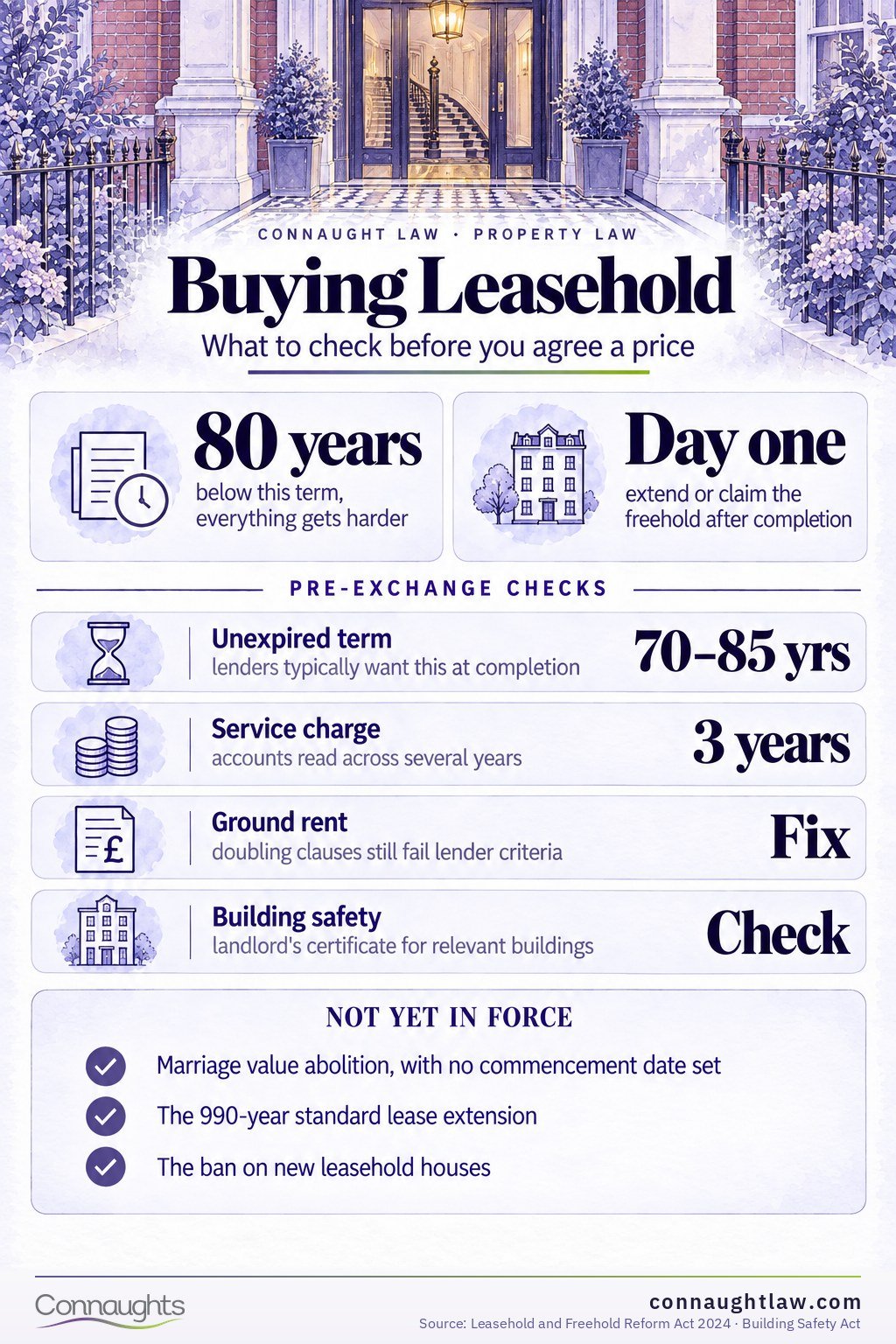
The unexpired term (everything gets harder below 80 years); the ground rent and its escalation pattern; the service charge, read across several years rather than one; and the building's safety status under the Building Safety Act. Agree the price after you know all four, not before.
What the 2024 Act Changes for Buyers — and What It Does Not Yet
The Leasehold and Freehold Reform Act 2024 is law, but most of its value to buyers is still switched off. What helps today: since 31 January 2025 there is no two-year ownership wait, so a buyer can start a lease extension or freehold claim the day after completion — and can require the seller to serve the notice and assign it, banking the timing. What has not arrived: the valuation reforms, including marriage value abolition. The freeholders' High Court challenge failed in October 2025, but commencement still needs a programme of secondary legislation, and no date is set.
Reform Status at a Glance
- In force: no two-year ownership requirement for extension or enfranchisement claims (31 January 2025).
- In force: right to manage for buildings up to 50% commercial, with each side generally bearing its own costs (3 March 2025).
- Not in force: marriage value abolition, the 990-year standard extension and the valuation caps — price every purchase on current law.
- Not in force: the ban on new leasehold houses — in the Act, commencement date still unannounced.
Share of Freehold Explained
"Share of freehold" is not a third tenure. You still buy a leasehold flat; alongside it you acquire a share in the company that owns the freehold. The lease still needs enough years on it, the service charge machinery still operates, and a badly run freehold company can be as obstructive as an external landlord — with the added twist that the obstructive party is your neighbour. The share is valuable mainly because extending the lease becomes a boardroom formality instead of a statutory claim.
Commonhold: The Direction of Travel
The government's stated destination is commonhold — freehold flat ownership without a landlord, run by an owners' association. The draft Commonhold and Leasehold Reform Bill was published on 27 January 2026 and confirmed in the King's Speech on 13 May 2026, proposing commonhold as the default tenure for new flats. Direction is not arrival: the housing minister conceded in April 2026 that the ban on new leasehold flats is unlikely to be switched on in this Parliament.
Nobody buying in 2026 is buying commonhold; there is nothing on the market to buy. The draft Bill changes no existing lease and sets no conversion date. A purchase decision that waits for commonhold is waiting for legislation with no timetable — buy on the law and the lease in front of you.
New-Build Leases in the Transition Years
New leases granted since 30 June 2022 already carry peppercorn ground rents under the Leasehold Reform (Ground Rent) Act 2022, which removed the worst new-build abuse. A buyer of a new flat today should still scrutinise the estate charges — which the 2022 Act does not touch — the service charge structure, and any event fees, because those are where developer economics migrated after ground rents closed.
The Leasehold Market in Numbers
The government's leasehold dwellings estimate puts the stock at around 4.8 million properties — about 19% of English housing — with roughly seven in ten being flats. The geography is uneven: London has the highest concentration, with over a third of its dwellings leasehold, and the North West follows — a legacy of leasehold houses around Manchester and Liverpool. In practical terms, a London or Manchester flat buyer is almost certain to face these questions; elsewhere, leasehold houses in the existing stock still change hands and deserve sharper scrutiny, not less.
Due Diligence: What to Check Before Exchange
- Unexpired term, checked against the mortgage lender's criteria, not just the 80-year line.
- Ground rent: amount, review pattern, and what it becomes in twenty years.
- Service charge accounts for at least three years, the current budget, reserve fund position and any planned major works — a section 20 consultation in progress is tomorrow's bill.
- Building safety: for flats in relevant buildings, the landlord's certificate and leaseholder deed of certificate under the Building Safety Act, and any outstanding remediation.
- Management: who runs the building, their fee schedule, and the pack of consents the lease requires for alterations, letting or pets.
Lease Length: The Decisive Variable
Lenders typically want 70 to 85 years unexpired at completion, and many require decades to remain at the end of the mortgage term — the bands we set out in our guide to what lease length lenders accept. Below 80 years, marriage value still inflates the cost of extending, because the reform abolishing it is not in force.
A flat with 76 years is not "about to get cheap to extend" — it is expensive to extend today, on valuation rules that remain in force, with no commencement date for the change. If the seller's price assumes reformed extension costs, the seller is asking you to carry the legislative risk. Either the price reflects current law or the lease gets extended as part of the deal.
Ground Rents: Fix Onerous Terms Before Exchange
Doubling clauses and aggressive RPI reviews still fail lender criteria, whatever else has been reformed — and the fix is cheapest while the seller needs the sale. A deed of variation capping the rent, negotiated as a condition of purchase with the freeholder's agreement, converts an unmortgageable flat into a mortgageable one. The old risk that a high ground rent made the lease an assured shorthold tenancy is gone — section 31 of the Renters' Rights Act closed it from 27 December 2025 — but lenders' commercial criteria on escalating rents survived it.
How Long Buying a Leasehold Takes
Budget for leasehold conveyancing to run several weeks longer than a freehold purchase — twelve weeks or more is common where the chain cooperates, longer where it does not. The extra time has one main cause: the management information pack (the LPE1), which only the landlord or managing agent can produce, on their own timescale and for their own fee. Enquiries then breed enquiries: the pack discloses planned works, so your solicitor asks about costs; it discloses consents, so the file needs the freeholder's paperwork.
A buyer can compress the timetable in two ways: have the pack ordered the day the sale is agreed, and instruct a solicitor who reads it the week it lands, not the week before exchange.
What Buying a Leasehold Costs
- SDLT at residential rates on the purchase price — first-time buyer relief applies to leasehold flats exactly as to freeholds.
- Legal fees and searches, running higher than freehold work because the lease, the pack and the management structure all need review.
- The seller's management pack fee, typically a few hundred pounds and currently uncapped — the 2024 Act's fee limits await commencement.
- Completion formalities the lease demands: notice of transfer and of charge to the landlord, a deed of covenant where required, share transfer in a residents' company.
- The first year's service charge and ground rent apportionments, settled at completion.
The recurring costs matter more than the one-off ones. Before exchanging, put the service charge, ground rent and any reserve fund contributions into your monthly arithmetic alongside the mortgage — and if you are weighing whether to buy the freehold later, our guide to buying your freehold covers that route.
Looking Ahead: The Honest Timeline
What can be said with dates: the valuation reforms need a programme of secondary legislation with none laid yet; the draft Commonhold Bill is in pre-legislative scrutiny with introduction to follow; and the leasehold flat ban is unlikely to operate this Parliament. What cannot be said honestly is when any of it bites — every confident year quoted for "cheap extensions" or "commonhold by default" so far has slipped. Buyers should assume the leasehold framework they buy into is the one they will live with for years.
Extend Now or Wait for Reform?
For a buyer, the question usually answers itself: if the lease is short enough that reform would matter, it is short enough to be a problem now — for your lender, and for your resale before any reform lands. The clean solutions are structural: require the seller to start a statutory claim and assign it to you at completion, negotiate the price down by the full current-law extension cost, or walk. Waiting works only for owners with long leases and no plans to move or remortgage; our implementation status guide tracks the moving parts.
Frequently askedQuestions about buying leasehold property
How long should a lease be when buying a flat?
Comfortably over 80 years — ideally 85-plus, so the lease is still mortgageable when you sell. Lenders typically want 70 to 85 years at completion, and below 80 marriage value makes extending materially dearer under the rules still in force. Shorter leases are buyable, but only at a price reflecting the extension cost.
How long does it take to buy a leasehold flat?
Usually several weeks longer than a freehold — twelve weeks or more is realistic. The main delay is the management pack, which only the landlord or agent can produce. Ordering it the day the sale is agreed is the single best way to shorten the transaction.
What does buying a leasehold cost beyond the price?
SDLT, legal fees and searches, the management pack fee, and the completion formalities the lease requires — notices, a deed of covenant, share transfer. Then the recurring costs: service charge, ground rent and reserve contributions, which belong in your affordability sums alongside the mortgage.
Can I still buy a leasehold house?
Existing leasehold houses trade normally, mostly in the North West and older estates. The 2024 Act's ban on selling new houses as leasehold is on the statute book but not yet in force — and it will not convert existing leasehold houses, whose owners keep their enfranchisement rights.
Is marriage value abolished yet?
No. The abolition is in the 2024 Act, and the freeholders' court challenge failed in October 2025, but the provision awaits commencement with no date set. Every extension premium today is calculated on the old rules — price any short-lease purchase accordingly.
Should I wait for commonhold instead of buying leasehold?
There is no commonhold stock to wait for. The draft Bill published in January 2026 proposes commonhold as the default for new flats, but ministers accept the leasehold flat ban is unlikely this Parliament. Buy on the law as it stands, with the lease terms doing the talking.
Send us the lease length, the ground rent clause and the service charge history before you agree the price. We will tell you what they do to value and mortgageability, and what to renegotiate before exchange.
Get Expert Advice