Can I Buy the Freehold of My Leasehold House UK 2026? Complete Guide

Buying the freehold of a leasehold house - enfranchisement under the Leasehold Reform Act 1967 - converts time-limited ownership into permanent ownership of the building and the land beneath it, ending ground rent and freeholder control in one transaction. The route became markedly more accessible when the Leasehold and Freehold Reform Act 2024 abolished the two-year ownership requirement on 31 January 2025, letting buyers claim from completion day. This guide explains who qualifies in 2026, what the premium really consists of while the 2024 Act's valuation reforms remain uncommenced, and how the process runs from first notice to registration.

Can I Buy the Freehold of My Leasehold House UK 2026? Complete Guide

For most owners of leasehold houses the answer is yes - and usually on compulsory terms the freeholder cannot refuse. The Leasehold Reform Act 1967 gives qualifying leaseholders of houses a statutory right to acquire the freehold at a price fixed by valuation rules, with the First-tier Tribunal settling disputes.

What changes over time is not the existence of the right but its cost and conditions, and 2026 sits in a transitional period: some of the 2024 reforms are in force, while the valuation changes that will eventually reshape premiums are not.

That timing matters for strategy. Leaseholders with short leases or high ground rents face a genuine judgment call - claim now under known rules, or wait for reforms whose commencement is realistically years away and whose final shape depends on secondary legislation still to come. The sections below set out the current law, the live costs, and the reform timetable as verified in July 2026, so that decision can be made on facts rather than headlines.

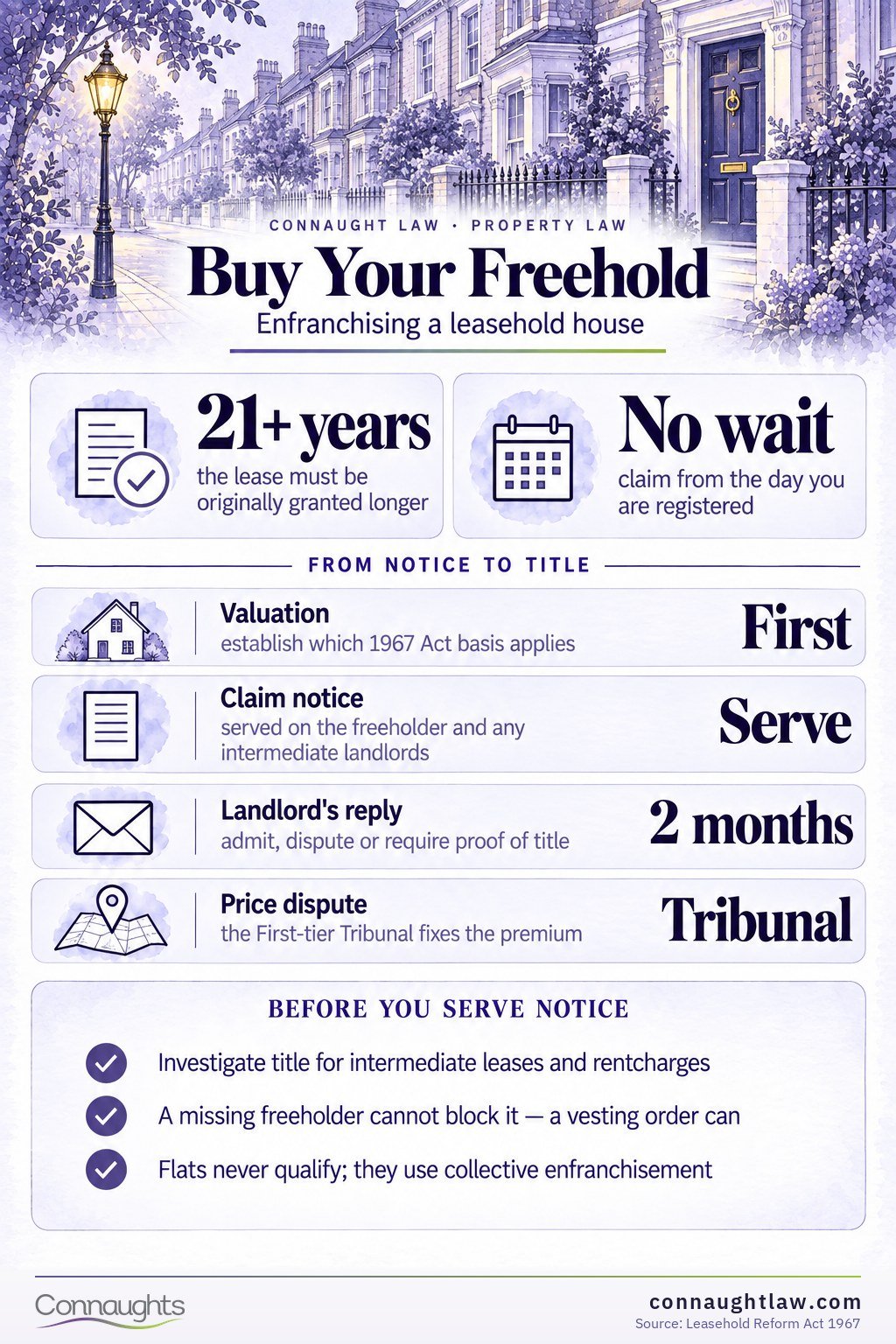
Buy The Freehold Of Your Leasehold House Uk Infographic — Qualifying Long Lease, The Abolished Two-Year Wait, Serving Notice, The Premium, And Extending Instead

Understanding Leasehold House Enfranchisement in 2026

Enfranchisement is the compulsory purchase of your landlord's interest in your house. Unlike a lease extension, which buys more time under the same structure, enfranchisement removes the structure altogether: no ground rent, no consent applications for alterations covered by the lease, no diminishing asset as the term runs down, and no freeholder at all. For houses - buildings reasonably so called, divided vertically from any neighbour - the 1967 Act route is long established and considerably simpler than the collective process flat owners must organise.

The wider context is explained in the government's leasehold property guidance, but the practical effect is easily stated: a freehold house is simpler to mortgage, simpler to sell, and free of the ground-rent terms that made parts of the leasehold house market notorious.

The right belongs to tenants under long leases, originally granted for more than 21 years, and since 31 January 2025 there is no minimum ownership period: a buyer can serve the claim notice on completion day. That change, one of the first parts of the Leasehold and Freehold Reform Act 2024 to commence, also removed the old two-year wait for lease extensions, and it has practical force for house purchasers who previously had to price two years of ground rent and uncertainty into their plans.

In Force vs Not in Force: the two-year ownership rule is gone (31 January 2025) and right to manage reforms followed in March 2025 - but the 2024 Act's valuation reforms, including marriage value abolition and the standard valuation method, are NOT yet in force in 2026. Premiums today are still calculated under the existing rules.

Eligibility Requirements to Buy Your Freehold

Qualification turns on three questions. Is the building a house? Is the lease long? Do any exclusions apply? A "house" for 1967 Act purposes means a building reasonably called a house, divided vertically from adjoining property - terraced and semi-detached houses qualify; flats do not, and mixed-use buildings generate most of the case law, with shops-with-flats-above capable of qualifying depending on the facts. A long lease means a term originally granted for more than 21 years, whatever now remains.

Exclusions and the Registration Gap

The historic thicket of low-rent and rateable-value tests has largely fallen away for ordinary claims, though it can still affect which valuation basis applies. Exclusions are narrow but real: certain National Trust and Crown properties, some shared ownership leases before final staircasing, and houses within charitable housing trusts' stock.

Business tenancies attract their own conditions. Where title has just changed hands, one practical constraint remains - the claim notice can only be served once the buyer is registered or entitled to be, and HM Land Registry backlogs create a registration gap that can delay otherwise immediate claims.

Shared ownership deserves its own note: leaseholders who have not yet staircased to 100% generally cannot enfranchise, because the provider's stake is protected, while those who have completed staircasing hold an ordinary long lease and can. Similarly, houses held through employment-linked or agricultural arrangements may face modified rights. None of these wrinkles is a reason to abandon a claim unexamined - most simply change the route or the timing rather than the destination.

Enfranchisement Costs and Premium Calculations

The premium compensates the freeholder for what they lose, and under the current rules it is built from three elements: the capitalised value of the remaining ground rent income, the value of the freeholder's right to the property when the lease expires (the reversion), and - where fewer than 80 years remain - marriage value, the uplift created when leasehold and freehold interests merge, split equally with the landlord under the present statute. Longer leases with modest ground rents therefore produce modest premiums driven by the reversion; short leases and escalating rents drive premiums up sharply.

Valuation Bases Under the 1967 Act

Which statutory valuation basis applies adds a further layer: the 1967 Act contains different formulas depending on the property's historic value bands, and for lower-value houses the original basis can produce strikingly favourable prices, while higher-value houses pay closer to open-market compensation. This is precisely why enfranchisement valuation is a specialist discipline rather than a spreadsheet exercise - the same street can contain houses on different bases, and choosing or arguing the right one changes the premium materially.

Figures quoted online as "averages" mislead because the inputs vary so widely - lease length, ground rent terms, property value and the valuation basis all move the number. A professional valuation from an enfranchisement surveyor is the only reliable starting point, and it doubles as the negotiating tool when the freeholder's counter-figure arrives.

Beyond the premium, budget for your own legal and valuation fees and, under the current law, the freeholder's reasonable legal and valuation costs, which the 1967 Act obliges the claiming leaseholder to cover. The 2024 Act will rebalance costs when its provisions commence, but that day has not arrived.

The 80-Year Threshold Still Bites: marriage value applies to leases under 80 years until the 2024 Act's valuation reforms commence - realistically 2027-28. A lease approaching the threshold is a reason to act, not to wait: crossing below 80 years under the current rules adds a marriage-value share that can dwarf any eventual reform saving.

The Enfranchisement Process: Timeline and Procedures

The claim starts with a formal notice of the tenant's claim served on the landlord (and any intermediate landlords), which fixes rights and obligations: from service, the leaseholder is contractually bound to proceed if the claim is admitted, and the landlord may require a deposit and evidence of title.

The landlord's reply can admit the claim, dispute qualification - the house test, the lease length, the claimant's title - or put the leaseholder to proof, and each path has its own timetable. From the notice onwards a costs clock also runs, which is another reason to serve with the valuation and evidence already assembled rather than improvising afterwards.

The landlord has two months to admit or dispute the claim in a notice in reply. Admitted claims move to valuation and negotiation; disputed figures go to the First-tier Tribunal (Property Chamber), which fixes the price on the statutory basis.

From Claim Notice to Completion

Most claims settle by negotiation between surveyors without a hearing. Once terms are agreed or determined, the conveyancing completes like a purchase: transfer of the freehold, discharge or apportionment of any landlord mortgage, registration at HM Land Registry, and the leasehold title closing or merging into the new freehold. Realistic end-to-end timescales run several months for a straightforward admitted claim and longer where valuation is fought or the landlord is passive; the tribunal route adds listing time but caps how long a freeholder can simply stall.

The Missing Landlord Procedure

Where the landlord cannot be found, the Act provides a missing-landlord procedure: the county court can make a vesting order and the tribunal fixes the price, which is paid into court. It is slower and more paper-heavy, but it means an absent freeholder does not block enfranchisement - a point worth knowing for older estates where ground rent demands stopped arriving years ago.

Intermediate leasehold structures - a head lease sitting between you and the freeholder - add parties and valuation layers but not a veto: the claim reaches through the chain and each interest is acquired or dealt with on statutory terms. Expect the timetable and the costs bill to grow with the number of interests involved, and insist early on a complete title picture so the notice names everyone it must.

Practical Considerations and Common Challenges

Mortgages complicate rather than prevent claims. Your own lender's consent is rarely an issue for acquiring the freehold, but any charge over the landlord's interest must be dealt with at completion, and lenders on intermediate interests add parties to the deed. Estate context matters too: houses on managed estates may remain subject to estate management schemes preserving design and maintenance obligations after enfranchisement, and modern freehold estates can carry their own service charges - enfranchisement ends the lease, not every obligation that runs with the land.

The ground-rent scandal supplies the sharpest motivation. Leases sold in the 2000s and 2010s with rents doubling every ten or fifteen years can render a house effectively unmortgageable as mainstream lenders apply stricter criteria, and enfranchisement extinguishes the problem at source - the doubling clause dies with the lease. For affected owners, the premium calculation should be read alongside the cost of not acting: failed sales, remortgage refusals and a shrinking buyer pool are real prices too.

The recurring avoidable failures are procedural: notices naming the wrong parties, served on the wrong entity in a chain of intermediate landlords, or abandoned informally in a way that triggers costs liability. Because the notice binds the leaseholder, valuation advice belongs before service, not after the counter-notice lands. Specialist support through our lease extension and enfranchisement service pairs the legal steps with surveyor-led valuation strategy, which is where premiums are actually won and lost.

Alternative Options: Lease Extensions

Not every house owner should enfranchise immediately. The 1967 Act offers houses a 50-year lease extension alternative, though on terms - a modern ground rent after the original term - that make it a poor cousin of enfranchisement in most cases. Owners of flats have no freehold-purchase equivalent for a single unit; their parallel is the statutory lease extension, covered in our lease extension process guide, or joining neighbours in collective enfranchisement of the building.

Voluntary negotiation with the freeholder is always available alongside the statutory route, and sometimes lands faster or cheaper - but it lacks the compulsion, the valuation discipline and the tribunal backstop of a statutory claim. The sensible pattern is to prepare the statutory claim, open a negotiation with that leverage visible, and let the freeholder choose which track concludes matters. When the 2024 Act's 990-year extension terms eventually commence, the calculus between extension and enfranchisement will shift again - which is why the reform timetable below belongs in any decision.

Future Developments: Reform Timetable

The Leasehold and Freehold Reform Act 2024 passed with the headline promise of cheaper, simpler enfranchisement: marriage value abolished, prescribed deferment and capitalisation rates, 990-year extensions at peppercorn rent, and each side bearing its own costs. In July 2026 those provisions remain uncommenced.

The High Court dismissed the freeholder groups' challenge to the Act in October 2025, but the Court of Appeal granted permission to appeal on 1 April 2026, with a hearing expected in late 2026 or early 2027 - and the government's consultation on the valuation rates, first promised for summer 2025, had still not launched by mid-2026.

Reform Timetable for Freehold Purchase Costs

Ministers maintain that implementation will proceed regardless of the litigation, with commencement of the valuation scheme realistically expected in 2027-28. Beyond the 2024 Act, the draft Commonhold and Leasehold Reform Bill published on 27 January 2026 and confirmed in the King's Speech on 13 May 2026 targets the flats market - banning new leasehold flats and reviving commonhold - as tracked by the House of Commons Library. House owners weighing a claim should treat reform timing as uncertain and price the cost of waiting: ground rent paid, leases shortening, and the 80-year threshold approaching are certainties; commencement dates are not.

Wait or Act? waiting suits long leases with trivial ground rents, where today's premium is small anyway. Acting suits leases nearing 80 years, escalating ground rents, or owners who need the freehold for lending or sale. Model both under current rules with a specialist valuer before deciding - the reform saving is hypothetical until commencement regulations exist.

Frequently Asked Questions

Can I buy the freehold of my leasehold house?

In most cases yes. The Leasehold Reform Act 1967 gives owners of houses held on long leases (originally over 21 years) a compulsory right to buy the freehold at a valuation-based price, subject to narrow exclusions such as certain National Trust and Crown properties. The freeholder cannot simply refuse a valid claim.

Do I still have to own the house for two years first?

No. The two-year ownership requirement was abolished on 31 January 2025 by the Leasehold and Freehold Reform Act 2024. A new owner can claim immediately, though the claim notice can only be served once the buyer's registration at HM Land Registry is in place or pending correctly.

How much does it cost to buy the freehold of a house?

The premium depends on your ground rent, remaining term, property value and valuation basis: capitalised ground rent plus the reversion, plus marriage value where under 80 years remain. Add your own professional fees and, under current law, the freeholder's reasonable costs. Only a specialist valuation gives a dependable figure for your house.

Has marriage value been abolished for house enfranchisement?

Not yet in practice. The 2024 Act abolishes marriage value on the statute book, but the valuation provisions were not in force as of mid-2026 - commencement is realistically expected in 2027-28 after consultation on the prescribed rates. Premiums today still include marriage value for leases under 80 years.

How long does buying the freehold take?

A straightforward admitted claim typically completes within several months: notice, two months for the landlord's reply, valuation and negotiation, then conveyancing and registration. Disputed premiums go to the First-tier Tribunal, which adds listing time but prevents indefinite stalling by the freeholder.

What if my freeholder cannot be found?

The missing-landlord procedure lets the county court vest the freehold in you, with the tribunal fixing the price and the money paid into court. Claims proceed despite an absent or untraceable freeholder - a common situation on older estates where ground rent collection lapsed long ago.

Is a lease extension better than buying the freehold of a house?

For houses, enfranchisement is usually the stronger outcome: it ends ground rent and freeholder control permanently, while the 1967 Act's 50-year extension carries a modern ground rent. Extension economics improve when the 2024 Act's 990-year peppercorn terms commence, but those provisions were not in force as of mid-2026.

Should I wait for the leasehold reforms before claiming?

Waiting only pays if your premium under current rules is already small. Leases sliding toward 80 years, escalating ground rents, and sale or remortgage plans all argue for acting now, because the current-law cost of delay is certain while the reform timetable - Court of Appeal hearing, rates consultation, commencement - is not.

Expert Enfranchisement Support
Claim Strategy and Valuation

Surveyor-led premium assessment and wait-or-act analysis under current rules, with the 2024 Act timetable priced into the advice

Notices and Procedure

Claim notices, landlord replies, deposits and intermediate interests handled so procedural slips never surrender leverage or costs

Tribunal and Completion

First-tier Tribunal representation on disputed premiums, missing-landlord vesting orders, and careful conveyancing through to completion and registration

Buying your freehold is usually a once-only transaction where preparation sets the price, for advice on eligibility, valuation and timing under current rules and coming reforms, contact the enfranchisement team at Connaught Law.

Contact Our Property Team

Disclaimer:

The information in this blog is for general information purposes only and does not purport to be comprehensive or to provide legal advice. Whilst every effort is made to ensure the information and law is current as of the date of publication it should be stressed that, due to the passage of time, this does not necessarily reflect the present legal position. Connaught Law and authors accept no responsibility for loss that may arise from accessing or reliance on information contained in this blog. For formal advice on the current law please don't hesitate to contact Connaught Law. Legal advice is only provided pursuant to a written agreement, identified as such, and signed by the client and by or on behalf of Connaught Law.