
Every lease extension is one of two bargains. The statutory route is compulsion on fixed terms: 90 extra years, peppercorn rent, price argued to a tribunal if needed. The voluntary route is consent on negotiated terms: faster and more flexible, but only as good as the deal struck — and constrained by the 2022 ground rent legislation more than many freeholders realise. This guide compares the routes from both sides of the table, with the 2025 reforms priced in.
On This Page

Statutory or Voluntary Extension: Two Routes, Two Bargains
Statutory means the leaseholder's terms on the freeholder's timetable objection notwithstanding; voluntary means whatever both sides agree, as fast as they agree it. Leaseholders use the voluntary route for speed and the statutory right as leverage; freeholders use the voluntary route to shape terms the statute would otherwise dictate. Understanding what each side can and cannot get is the whole negotiation.
The Legal Framework After the 2025 Changes
Changes That Shifted the Balance
Since 31 January 2025 any leaseholder can claim from day one of ownership — the two-year wait that once gave freeholders a negotiating window is gone. Marriage value abolition remains uncommenced (the court challenge failed in October 2025, but no start date exists), so sub-80-year premiums still carry it. Net effect: more statutory claims, sooner, against a valuation regime that has not yet softened — which is exactly the environment where voluntary deals get done.
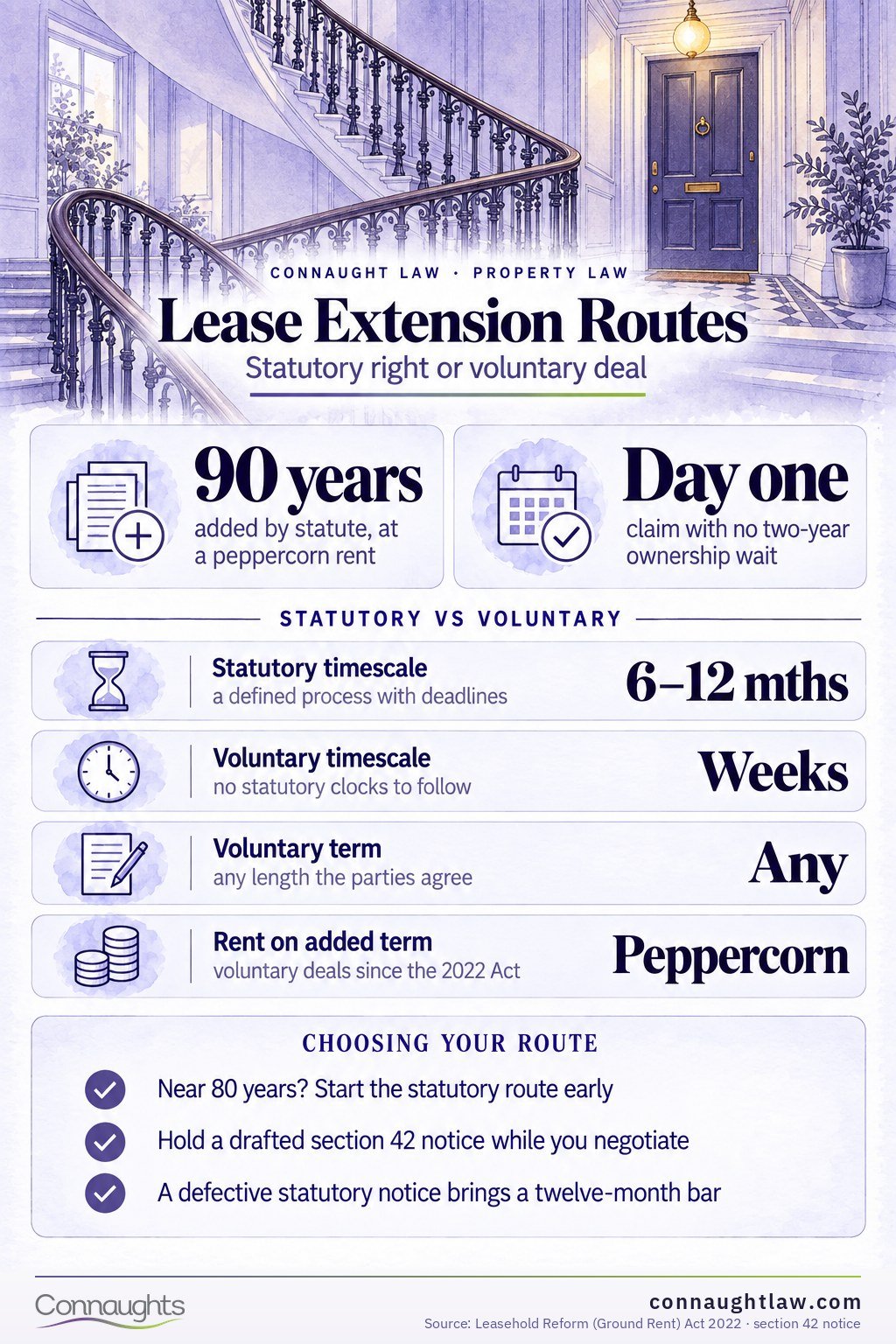
The Statutory Route
Certainties on Both Sides
What Statutory Gives You
For the leaseholder: 90 additional years, peppercorn rent, terms mirroring the old lease, and a tribunal to fix the premium. For the freeholder: a premium assessed on established valuation principles, recovery of reasonable costs under the current regime, and a process with defined deadlines. Nobody gets surprises; nobody gets creativity. The statute is a menu with one dish, properly priced.
Statutory Downsides
The route's rigidity cuts both ways. Leaseholders carry two sets of professional fees plus the freeholder's reasonable costs, and a process that runs six to twelve months. Freeholders lose the ground rent income permanently and cannot negotiate redevelopment interests, reversionary arrangements or portfolio-wide settlements inside a single statutory claim. And a defective notice or missed deadline punishes the leaseholder with a twelve-month bar — procedural risk that simply does not exist in a consensual deal.
The Voluntary Route
Why Parties Go Voluntary
- Speed: weeks rather than months, with no statutory clocks.
- Any term length the parties want — 90 years, 125, 999.
- Package deals: extension bundled with consent for works, arrears settlement, or several flats at once.
- Lower transaction costs where the freeholder is cooperative.
- For freeholders: timing receipts, managing a portfolio's claims in an orderly sequence, and preserving relationships in small blocks.
Voluntary Traps
The old freeholder play — grant years, keep the ground rent — is mostly dead: under the Leasehold Reform (Ground Rent) Act 2022, a voluntary extension granted since 30 June 2022 cannot reserve more than a peppercorn for the newly added term; monetised rent survives only for what remained of the original term. The leaseholder-side traps are subtler: terms quietly modernised against you, no tribunal backstop if talks collapse, and — for buyers relying on the deal — a lender review of the varied lease. Every voluntary offer should be priced against the statutory alternative before acceptance.
Costs and Who Recovers What
Component Costs and Recovery
What You Recover
- Statutory: the leaseholder pays the premium, both sides' valuation work in practice, and the freeholder's reasonable legal and valuation costs — the 2024 Act's own-costs reform awaits commencement.
- Voluntary: costs follow the deal — commonly each side bears its own, which is part of the route's price advantage.
- Either route: the premium dwarfs the fees, and the valuation advice that moves the premium is the money best spent.
- Freeholders should note the direction of travel — the costs regime tightens whenever the 2024 Act's provisions commence, which argues for settling books rather than banking on recovery.
Choosing the Route
Case-by-Case Criteria
- Lease near 80 years: statutory, started early — the marriage value cliff outweighs every other factor.
- Cooperative freeholder, straightforward flat: negotiate voluntary with a section 42 notice drafted — take the better of the two deals.
- Mid-sale: statutory notice served and assigned to the buyer preserves the valuation date; voluntary deals rarely survive a change of buyer.
- Hostile or absent freeholder: statutory is the only route that ends in a lease rather than a stalemate.
- Freeholder with a portfolio: structured voluntary programmes beat fighting serial tribunal claims.
Where This Market Is Heading
Working With Advisers
The reform pipeline — marriage value abolition, 990-year terms, the costs regime — will eventually make the statutory route cheaper and longer, which is precisely why freeholders have an incentive to do voluntary deals now and leaseholders should price any wait honestly: the lease keeps shortening while the commencement date keeps not existing. The adviser's job on either side is the same arithmetic — today's statutory premium, today's voluntary offer, and the real cost of delay — run with current numbers rather than reform hopes. Our statutory process guide and voluntary extension guide take each route in depth.
Frequently askedQuestions about choosing the route
What is the difference between statutory and voluntary lease extensions?
Statutory is a right: 90 years at a peppercorn on tribunal-backed terms the freeholder cannot refuse. Voluntary is a contract: any terms both sides agree, faster and more flexible, with no backstop if negotiation fails. Most good outcomes use the second negotiated in the shadow of the first.
Can a freeholder still keep ground rent in a voluntary extension?
Only barely. Since 30 June 2022 the added term must be at a peppercorn — monetised rent can survive only for the remainder of the original term. Voluntary offers that pretend otherwise are void on that point, and worth challenging.
Which route is cheaper?
Voluntary usually carries lower transaction costs — no statutory procedure, often each side bearing its own fees. Whether it is cheaper overall depends entirely on the premium and terms agreed, which is why every voluntary offer needs pricing against the statutory equivalent first.
Should I wait for the 2024 Act reforms instead of extending?
Waiting has a price: the lease shortens, marriage value still applies below 80 years, and the reforms have no commencement date — the court challenge failed in October 2025, yet the start date remains unset. If your lease is anywhere near 80, extend on today's law.
Can I switch from voluntary negotiation to the statutory route?
Yes — and the credible threat of doing so is the leaseholder's best negotiating asset. The professional pattern is a drafted section 42 notice held ready while voluntary terms are discussed, served the moment the deal drifts below the statutory baseline.
What should a freeholder do about extension requests now?
Engage early and structure deals, rather than defending serial statutory claims under a costs regime that will only tighten. A fair voluntary programme executed before the reforms commence beats a portfolio of tribunal fights after them.
Tell us the unexpired term, the ground rent and what has been offered or claimed. We will price both routes against each other and tell you which bargain is actually better on your numbers.
Get Expert Advice