
A voluntary lease extension is whatever you and the freeholder agree — which is its strength and its danger. Since June 2022 the law polices one term hard: the added years cannot carry a monetised ground rent, only a peppercorn. Everything else — the premium, the length, the modernised clauses — is negotiation, and should be priced against the statutory alternative before anything is signed. This guide covers the 2022 Act's effect, the honest comparison with the statutory route, the deed-of-variation alternative, and the extend-now-or-wait arithmetic.
On This Page

Voluntary Lease Extensions: The Negotiated Deal, Properly Checked
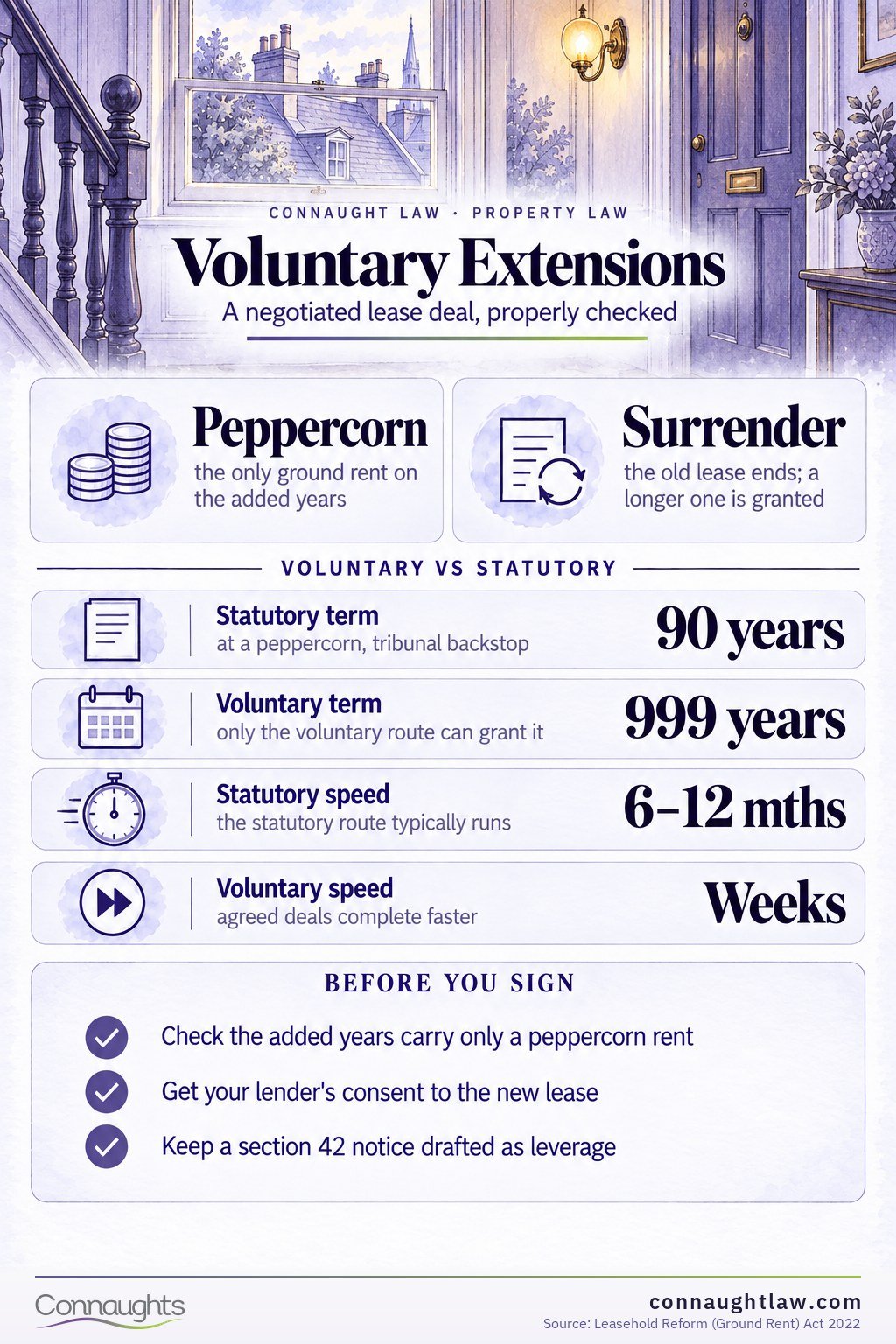
Legally, most voluntary extensions work by surrender and regrant: the old lease dies and a new, longer one is granted in its place. That mechanism matters — the new lease needs registering, your lender must consent and re-charge, and every clause is technically open for renegotiation. The freeholder's draft "on the same terms" deserves a line-by-line read precisely because nothing forces it to be.
The 2022 Ground Rent Act: The Rule That Reshaped Voluntary Deals
Where LRGA 2022 Bites
Under the Leasehold Reform (Ground Rent) Act 2022, a voluntary extension completed since 30 June 2022 is a regulated lease: the extended portion of the term can reserve only a peppercorn. The existing ground rent may run until the original term would have expired — but the old freeholder strategy of trading years for a fresh escalating rent is prohibited, and a term that tries is void with penalties behind it. Any voluntary offer still monetising the new years is either out of date or hoping you are.
Voluntary Against Statutory
The Comparison in Practice
- Certainty: statutory guarantees 90 years at a peppercorn with a tribunal backstop; voluntary delivers only what is agreed.
- Speed: voluntary deals complete in weeks; statutory runs six to twelve months.
- Flexibility: only voluntary can grant 999 years, bundle consents, or settle several flats at once.
- Cost: voluntary usually avoids the statutory procedure's fee stack — if the premium is genuinely fair.
- Leverage: the statutory right is why freeholders negotiate; keep a section 42 notice drafted even in friendly talks. Full route detail in our statutory process guide.
Deeds of Variation: The Third Option
What a Variation Can Fix
Where the problem is a single clause — an escalating ground rent failing lender criteria, an outdated repair provision — a deed of variation can cure it without touching the term, faster and cheaper than any extension. What it cannot do is add years, and a variation of the term itself operates as a surrender and regrant anyway. Use variations for defects, extensions for duration, and beware the halfway drafts that accidentally do both.
Timing the Decision
Market Factors in the Timing
Three clocks run at once: the lease shortens (and the premium grows) every year; the 80-year marriage value cliff prices a hard deadline into any lease approaching it; and the 2024 reform package — cheaper premiums, 990-year terms — still has no commencement date, with realistic expectations sitting in 2027–28. Sellers add a fourth clock: buyers discount short leases at the extension's full cost plus a margin for hassle.
Pricing the Deal
Every voluntary offer should arrive at your desk next to two numbers: the statutory premium a valuer would defend at tribunal, and the cost of the delay the voluntary route saves. Our lease extension calculator gives the starting range; a professional valuation turns it into negotiating power that repays its fee many times over.
Risk of Waiting
Extend Now or Wait?
Waiting for reform is a bet with a known stake and an unknown payout date: the premium rises as the term shrinks, marriage value bites at 80, and remortgages and sales stumble on short leases in the meantime. Owners with 90-plus years and no plans to move can afford patience; anyone under about 85 years, or planning a sale or remortgage, is paying real money for a commencement date nobody can name.
Planning Around the Reforms
Getting Reform-Ready
- Watch: commencement regulations for the 2024 Act's valuation package — the only event that actually changes premiums.
- Watch: your own unexpired term against the 80-year line — the deadline that exists today.
- Ignore: headlines promising imminent cheap extensions — the pattern since 2024 has been announcement, challenge, delay.
- Either route, keep the paperwork: a registered new lease, lender consent recorded, and the premium evidence filed for future CGT.
Questions about voluntary extensions
What is a voluntary lease extension?
A negotiated deal with the freeholder to grant a longer lease — legally a surrender and regrant — on whatever terms both sides accept. It can be faster, longer and cheaper than the statutory route, or quietly worse; the comparison against the statutory baseline is the whole discipline.
Can the freeholder keep charging ground rent on a voluntary extension?
Only until the original term would have ended. Since 30 June 2022 the added years must be at a peppercorn — a term reserving more is void and penalised. Offers still trading years for escalating rent belong in the bin.
Is a voluntary extension cheaper than the statutory route?
Often on fees, sometimes on premium — and sometimes it merely looks cheaper while modernised clauses or a soft premium give value back to the freeholder. Price the statutory alternative first; accept the voluntary deal only when it wins on the numbers.
Does my mortgage lender need to be involved?
Yes. The surrender-and-regrant mechanics replace the lease your lender's charge sits on, so consent and re-registration are part of every properly done voluntary extension. A deal completed without the lender is a title problem waiting for your remortgage.
Should I wait for the leasehold reforms instead?
Only if your lease is comfortably long and your plans are static. The valuation reforms have no commencement date — realistic estimates run 2027–28 — while your term shortens and the 80-year cliff approaches on today's rules. Waiting is a priced decision, not a free one.
Can a deed of variation extend my lease?
Not really — varying the term operates as a surrender and regrant, which is an extension by another name. Variations earn their keep fixing single defective clauses, ground rent above all. For added years, do an extension properly, voluntary or statutory.
Send us the offer, the lease and the unexpired term. We will price it against your statutory rights, check the ground rent term against the 2022 Act, and tell you which route wins on your numbers.
Get Expert Advice