
Vacant possession is the seller's promise that on completion day the property will be empty — of people, of belongings, and of anyone else's legal right to be there. Most residential sales are made on it; tenanted investments are deliberately sold without it; and failing to deliver it is a breach of contract with real remedies attached. This guide covers what the phrase means in law, how completion day tests it, what buying without it involves, and what a buyer can claim when the promise is broken.
On This Page
Vacant Possession: The Promise That Empties the Property
Two words in a contract carry the whole obligation: "with vacant possession" means the buyer takes the property free to occupy it immediately; "subject to tenancy" means the buyer takes it with the occupiers and their rights intact. Everything else in this area — the completion-day inspection, the tenanted discount, the damages claims — flows from which of those phrases the contract uses.
What Vacant Possession Means in Law
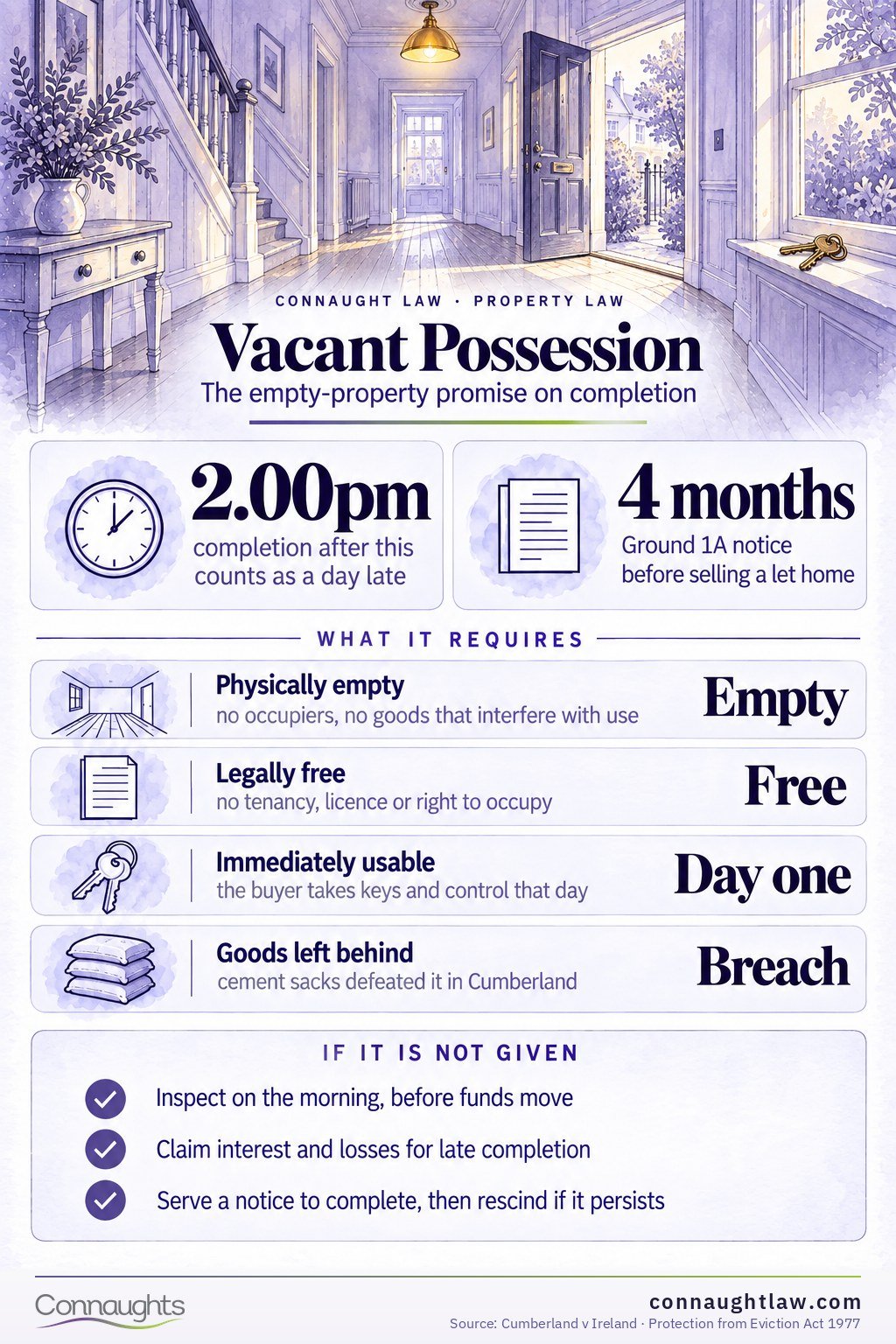
Vacant possession is the buyer’s right to take the property on completion empty of occupiers, empty of anything substantially interfering with its use, and free of any third-party right to occupy. It is a state of the property at the moment of completion, not a description of it during marketing.
- Physically empty: no occupiers and no goods left behind that substantially interfere with enjoyment of the property.
- Legally free: no tenancy, licence or other right entitling anyone else to occupy.
- Immediately usable: the buyer can walk in, take the keys and control the property that day.
The Cases That Define It
The classic authority is Cumberland Consolidated Holdings Ltd v Ireland [1946] KB 264: sacks of hardened cement left in the cellars defeated vacant possession — a seller cannot use the property as a dumping ground and call it empty. The modern bookend is Capitol Park Leeds v Global Radio Services [2021] EWCA Civ 995, where a tenant stripped a building so bare it handed back less than the premises: vacant possession is about people, chattels and interests — not about handing back a shell. Between them the cases mark both failure modes: too much left behind, and too little handed back.
Vacant Possession on Completion
Completion Day: What Must Be True by Two O'Clock
Under the standard conditions of sale, completion after 2.00pm is treated as a day late — so by early afternoon the property must be empty, the occupiers gone and the keys releasable. Sellers still moving out at 4pm are not "cutting it fine"; they are in breach, and the interest and costs consequences start running.
Checking on the Day
Buyers, or their agents, should inspect on the morning of completion where anything suggests risk: a seller who was still occupying at exchange, a tenancy that was supposed to end, a property full of furniture at the final viewing. Ten minutes at the door before funds move is worth more than any remedy after they have.
Freehold With Vacant Possession: What the Phrase Adds
"Freehold with vacant possession" is the cleanest thing an estate agent can write: outright ownership of the land, delivered empty. It is the default for owner-occupied house sales and the assumption behind every residential mortgage offer — lenders lend against properties their borrower can occupy, which is why a tenancy discovered late in a purchase can collapse the mortgage rather than merely complicate the contract.
Price and Control: The Trade
Tenanted properties sell at a visible discount to vacant-possession value, and the gap tracks the tenancy's terms: the rent against market, the tenant's record, and — since every tenancy became periodic under the Renters' Rights Act — the fact that possession follows statutory grounds, not the calendar. The discount is not a bargain or a penalty; it is the price of the control the buyer is not getting.
Sold With Vacant Possession: The Buyer's Position
Rights the Phrase Gives a Buyer
A buyer purchasing with vacant possession is entitled to immediate occupation, full control over works and use, and freedom to grant tenancies on their own terms. The phrase also allocates risk: if occupiers or their goods remain at completion, the seller is in breach — the buyer did not buy a problem to manage but a promise to enforce, which is what the remedies section below is for.
Buying Without Vacant Possession: The Tenanted Purchase
Why Investors Buy Tenanted
Buying subject to tenancy delivers income from day one, skips a void, and prices below vacant-possession value — which is why so many tenanted lots reach the market through auction, where the legal pack does the work a survey would. Since 1 May 2026 it also means stepping into a periodic assured tenancy exactly as the seller held it — rent, obligations, deposit and history included. The purchase is as good as the tenancy: a reliable tenant at a sensible rent is an asset; an arrears history and an expired gas certificate are liabilities sold at a discount for a reason.
Due Diligence on a Tenanted Purchase
- The tenancy agreement, the rent schedule and the arrears position, verified against bank evidence.
- Deposit protection certificate and prescribed information — the penalties transfer with the building's problems.
- Gas, electrical and EPC compliance, current on the day you complete.
- Any notices served either way, and anything suggesting a dispute.
- The PRS database position once registration reaches the area — an unregistered predecessor is your compliance job on day one.
Getting a Property to Vacant Possession Lawfully
A seller who has promised vacant possession must end the occupation lawfully first: for a tenanted property that now means Ground 1A — four months' notice, a tenancy at least twelve months old and a genuine sale — followed by court proceedings if the tenant stays. Locks may not be changed, belongings may not be dumped, and pressure is a criminal offence under the Protection from Eviction Act 1977. Contracts should never promise vacant possession on a date the lawful process cannot deliver.
The Statutory Backdrop
Three statutes shape the obligation: the Housing Act 1988 as rewritten by the Renters' Rights Act governs how residential occupation lawfully ends; the Protection from Eviction Act 1977 criminalises the shortcuts; and the contract itself — usually on the standard conditions — fixes what was promised and when. Squatters are the one class owed no notice, but even their removal runs through the courts, not the seller's own hands.
When Vacant Possession Is Not Given: Remedies
Failure to give vacant possession on completion is a breach of a condition the whole contract turns on. The response depends on scale: a van-load of abandoned furniture is a costs claim; a tenant still in residence is a failed completion.
Damages, Rescission and the Clock
- Delayed completion: contractual interest and losses for each day late — accommodation, storage, wasted removals.
- Damages: costs flowing directly from the breach, including clearing goods left behind and lost rental income where letting was the plan.
- Notice to complete: the formal step that makes time of the essence and opens the door to termination.
- Rescission: where the breach persists, the buyer can walk away with the deposit back and losses claimed.
- Act on the day: inspect, document with photographs, and put the breach in writing before funds are released wherever possible.
Questions about vacant possession
What does vacant possession mean?
That on completion the property will be empty of occupiers, clear of goods that interfere with using it, and free of anyone else's right to live there — so the buyer can take immediate control. It is the standard basis for owner-occupier sales.
What does "freehold with vacant possession" mean on a listing?
Outright ownership of the property and land, delivered empty at completion — no landlord above you and no tenant inside. It is the cleanest form of residential title and the assumption behind standard mortgage lending.
What happens if the seller fails to give vacant possession on completion?
They are in breach: the buyer can claim interest and losses for late completion, the costs of clearing anything left behind, and — where the failure persists after a notice to complete — rescind and recover the deposit. Inspect on the morning and document everything.
Do a few items left behind break vacant possession?
Minor oddments do not; goods that substantially interfere with enjoying the property do — the cellar full of cement sacks in the leading case defeated it. The practical test is whether the buyer can move in and use the property without first dealing with the seller's leavings.
Can I buy a property without vacant possession?
Yes — that is a tenanted purchase, priced at a discount, with rent from day one and the tenancy inherited exactly as it stands under the periodic regime. The value lives in the tenancy's paperwork, so the due diligence is on the tenant file as much as the title.
How does a seller get a tenanted property to vacant possession?
Lawfully only: Ground 1A notice (four months, tenancy at least a year old, genuine sale), then court proceedings if needed — a timeline the sale contract must respect. Self-help eviction to hit a completion date is a criminal offence, not a shortcut.
Tell us what the contract promised, who is in occupation and what was left behind. We will tell you what you can claim, or what the tenancy you are inheriting is really worth.
Get Expert Advice