
Buying your first home means running a legal process you have never seen before, with your largest-ever sum of money moving through it. The mechanics are learnable: five stages from instruction to keys, searches that cost a few hundred pounds and exist mainly for your lender, stamp duty relief worth up to £10,000 if the price sits under £500,000, and government schemes that only help if you check them before you instruct anyone. This guide walks each part in the order you will meet it.
On This Page

Your First Purchase: What the Legal Work Actually Does
Conveyancing is the legal transfer of ownership — but for a first-time buyer it is really three protections running at once: proving the seller owns what they are selling, finding the problems that would hurt you or your lender before your money moves, and registering the property in your name at the end. First-time buyers returned to the market in force in 2024 — around a third of a million completions on lender analyses, up nearly a fifth on the year before — and most of what slows their purchases down is avoidable.
Your solicitor's task is to make sure that what you think you are buying, what the seller is legally able to sell, and what your lender is willing to lend against are all the same property on the same terms — and to move the money only when all three line up.
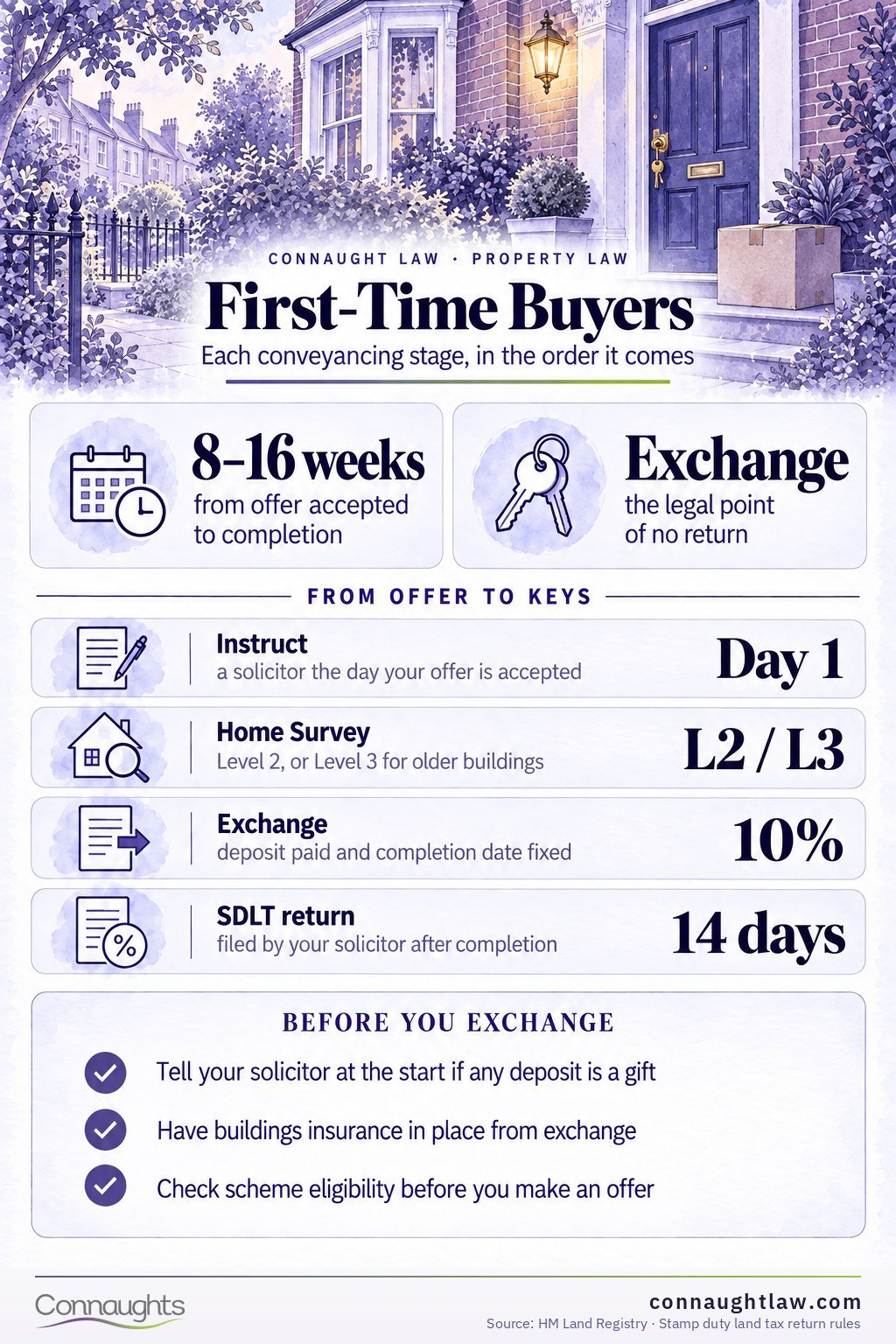
What Happens at Each Stage
Allow eight to sixteen weeks from offer acceptance to completion — chain-free purchases at the fast end, leasehold flats and long chains at the slow one. The single biggest thing a buyer controls is speed of response: identity documents, signed forms and survey decisions returned in days rather than weeks compound across every stage.
Stage One: Instruction and Identity
Instruct a solicitor the day your offer is accepted, not when the agent chases. The opening round is administrative — client care letter, identity and source-of-funds checks, and a payment on account (commonly £250–£450) that funds the searches. If any of your deposit is a gift, say so now: lenders and solicitors have a process for it, covered in our gifted deposit guide, and late disclosure is a classic completion-delayer.
Stage Two: Searches and the Draft Contract
Your solicitor orders the searches and receives the seller's draft contract with title documents and property forms. Enquiries flow from what comes back — planning conditions, boundary oddities, missing building regulations sign-off — and this stage sets the transaction's pace, because local authority search turnaround varies from days to weeks by council.
Stage Three: Mortgage Offer and Survey
The lender values the property and issues the formal offer; your solicitor checks its conditions. The lender's valuation protects the lender, not you — a Home Survey at Level 2 (commonly £300–£600) or Level 3 for older or altered buildings (£500–£1,500) is the report that tells you what you are buying, and its findings are negotiating material while you can still walk away.
Stage Four: Exchange of Contracts
Exchange is the legal point of no return: you pay the deposit — typically 10% — completion is fixed, and withdrawal after this point forfeits the deposit and invites a damages claim. Nothing is binding before exchange, however advanced things feel; everything is binding after it. Buildings insurance on the property should be in place from exchange.
Stage Five: Completion and Registration
On completion day your solicitor sends the balance, the seller's solicitor confirms receipt, and the keys release. Two duties follow: the stamp duty return within 14 days, and registration of your ownership at HM Land Registry — the step that makes you the legal owner on the public record.
Searches: What They Check and What They Cost
Searches answer questions the seller's paperwork cannot: what the council knows, what runs under the ground, and what the environment has in store. For a mortgage-funded purchase the core set is not optional — the lender requires it.
Each Search, Its Cost and Its Job
Search Types and Costs
| Search | Typical Cost | What It Reveals |
|---|---|---|
| Local authority | £50–£250 | Planning history, building regulations, road schemes, enforcement |
| Water and drainage | £45–£100 | Mains connections, public sewers, sewer flooding |
| Environmental | £30–£80 | Contaminated land, flood risk, radon |
| Mining (area-dependent) | £30–£150 | Historic workings, subsidence risk |
| Chancel repair | £20–£30 | Historic church repair liability |
Search costs quoted by solicitors sometimes exclude VAT, which explains why two quotes for "searches" can differ by 20% for the same council. The statutory LLC1 element of a local search carries no VAT; the CON29 enquiries and most personal and environmental searches do. Ask for the bundle price including VAT and compare like with like.
How Much Conveyancing Costs a First-Time Buyer
The realistic all-in range for legal work on a first purchase is £1,400–£2,500 — the legal fee plus the pass-through costs — with leasehold flats towards the top because the management pack and lease review add work. London and South East firms typically quote above national averages. For our own pricing, see our fees page; what matters when comparing any quotes is that they itemise the same things.
Legal Fees: What Sets the Figure
Fees track complexity, not just price: leasehold adds the lease and management layer, gifted deposits add verification, schemes like shared ownership add their own documentation. A quote materially below the market usually recovers the gap through add-ons — "dealing with mortgage" or "completing SDLT return" charged as extras — so judge quotes on the total, itemised figure.
Disbursements: The Costs That Pass Through
- Searches: £200–£400 the bundle, VAT included.
- HM Land Registry registration: scale fee by price band — £100–£295 for most first purchases.
- Bank transfer fees: £20–£50.
- Identity and anti-money-laundering checks: a few pounds per person.
- Bankruptcy and pre-completion searches: a few pounds per name.
- Lifetime ISA withdrawal handling, where used: commonly around £50 plus VAT.
Government Schemes Worth Checking First
Every scheme has conditions that bite at completion: the Lifetime ISA's £450,000 price cap, First Homes' income limits, shared ownership's staircasing rules. Confirm eligibility before you offer on a property, because discovering a breach mid-transaction costs you the bonus, the discount — or the purchase.
Lifetime ISA: The 25% Bonus
Save up to £4,000 a year and the government adds 25% — up to £1,000 annually — for buyers aged 18 to 39 at opening. The catches: the account must be open twelve months before use, the property must cost £450,000 or less — a cap unchanged since 2017 that excludes a growing slice of London stock — and a non-qualifying withdrawal loses 25% of the pot, which is more than the bonus. Your solicitor handles the redemption paperwork with the ISA manager; see the official LISA rules.
First Homes: The Discounted Route
First Homes sells selected new-build plots at a 30–50% discount to first-time buyers with household income under £80,000 (£90,000 in London), with the post-discount price capped at £250,000 (£420,000 in London). The discount attaches to the property forever — you resell with the same percentage off to another eligible buyer — which is the trade-off to price in from the start.
Shared Ownership: Part Buy, Part Rent
Buy an initial share — commonly 10% to 75% — pay rent on the rest, and staircase upwards over time. The legal work is heavier than a standard purchase: it is a leasehold structure with a housing provider landlord, service charges and staircasing mechanics that need reading before you commit, not after.
Stamp Duty for First-Time Buyers in 2026
The thresholds set in April 2025 remain in force: first-time buyer relief gives a nil band to £300,000 and 5% on the slice to £500,000 — and disappears entirely above £500,000, where standard rates apply to the whole price. Most first purchases still complete below the £300,000 line and pay nothing; the pain sits in the £300,000–£500,000 band, and sharpest just above £500,000, where £1 of price can add thousands in tax.
The Relief, Band by Band
First-Time Buyer SDLT Bands
| Price | Rate | Example |
|---|---|---|
| Up to £300,000 | 0% | £300,000 home — £0 |
| £300,001 – £500,000 | 5% on the excess | £400,000 home — £5,000 |
| Over £500,000 | Relief lost; standard rates on the whole price | £550,000 home — £17,500 |
- At £450,000 the bill is £7,500 with relief — £6,250 more than under the pre-April-2025 thresholds, so budget on current law, not older guides.
- At £500,000 relief saves £10,000 against standard rates; at £500,001 it saves nothing.
- Both buyers must be first-time buyers for the relief to apply on a joint purchase.
- The return and payment are due within 14 days of completion — your solicitor files it.
Questions about first-time buyer conveyancing
How long does conveyancing take for a first-time buyer?
Eight to sixteen weeks from offer acceptance is realistic — chain-free freeholds at the fast end, leasehold flats and chains at the slow one. The biggest levers you control are instructing early and returning documents within days.
How much are solicitor fees for buying a house in 2026?
Budget £1,400–£2,500 all-in for a first purchase: the legal fee plus searches, registration and transfer costs, with leasehold at the upper end and London quotes above national averages. Compare itemised totals, not headline fees — cheap quotes usually grow.
How much stamp duty does a first-time buyer pay?
Nothing up to £300,000; 5% on the portion between £300,000 and £500,000; and above £500,000 the relief vanishes and standard rates apply to the whole price. A £400,000 purchase pays £5,000. Joint buyers must both qualify.
Do I really need a survey as well as the mortgage valuation?
Yes. The valuation exists to protect the lender's security and may involve no inspection at all. A Level 2 or Level 3 Home Survey is what tells you about the roof, the damp and the wiring — and its findings can renegotiate the price while you are still free to walk.
What happens at exchange of contracts?
Your 10% deposit is paid, the completion date is fixed, and the deal becomes legally binding on both sides. Pulling out afterwards forfeits the deposit and risks a damages claim — so every question you have must be answered to your satisfaction before exchange, not after.
Can I use my Lifetime ISA on any property?
No — the property must cost £450,000 or less, be bought with a mortgage as your home, and the account must have been open at least twelve months. Withdrawing outside the rules costs 25% of the pot, so check the cap against your target price before offering.
Tell us the price, whether it is freehold or leasehold, and how your deposit is made up. We will tell you the realistic timetable, the full cost picture and anything about the property that should change your offer.
Get Expert Advice