
Naturalisation has hard arithmetic: no more than 450 days outside the UK in the five qualifying years — 270 on the three-year spouse route — and no more than 90 in the final twelve months, counted backwards from your application date. The calculator below totals every trip against both limits for your route. Around it, this guide explains the counting rules, the discretionary thresholds and the mistakes that cost application fees.
· Regulated by the Solicitors Regulation Authority · Legal 500 · Lexcel
Calculator & Absence Rules

The Calculator
Enter your planned application date and every trip outside the UK. The calculator totals your absence days across the qualifying period and the final twelve months, and checks both against the Home Office limits for your route.
0
Your Figures Against The LimitsHow the Limits Work
The requirements come from Schedule 1 to the British Nationality Act 1981 and run backwards from the application date: a total-absence limit across the whole qualifying period, and a stricter 90-day limit in the final twelve months that applies to every route. The final year is where most failures happen — a long autumn assignment abroad can sink an application whose five-year total is comfortably fine. There is also a rule with almost no forgiveness in it: you must have been physically in the UK on the exact day five years (or three) before the application is made. Check that date before anything else.
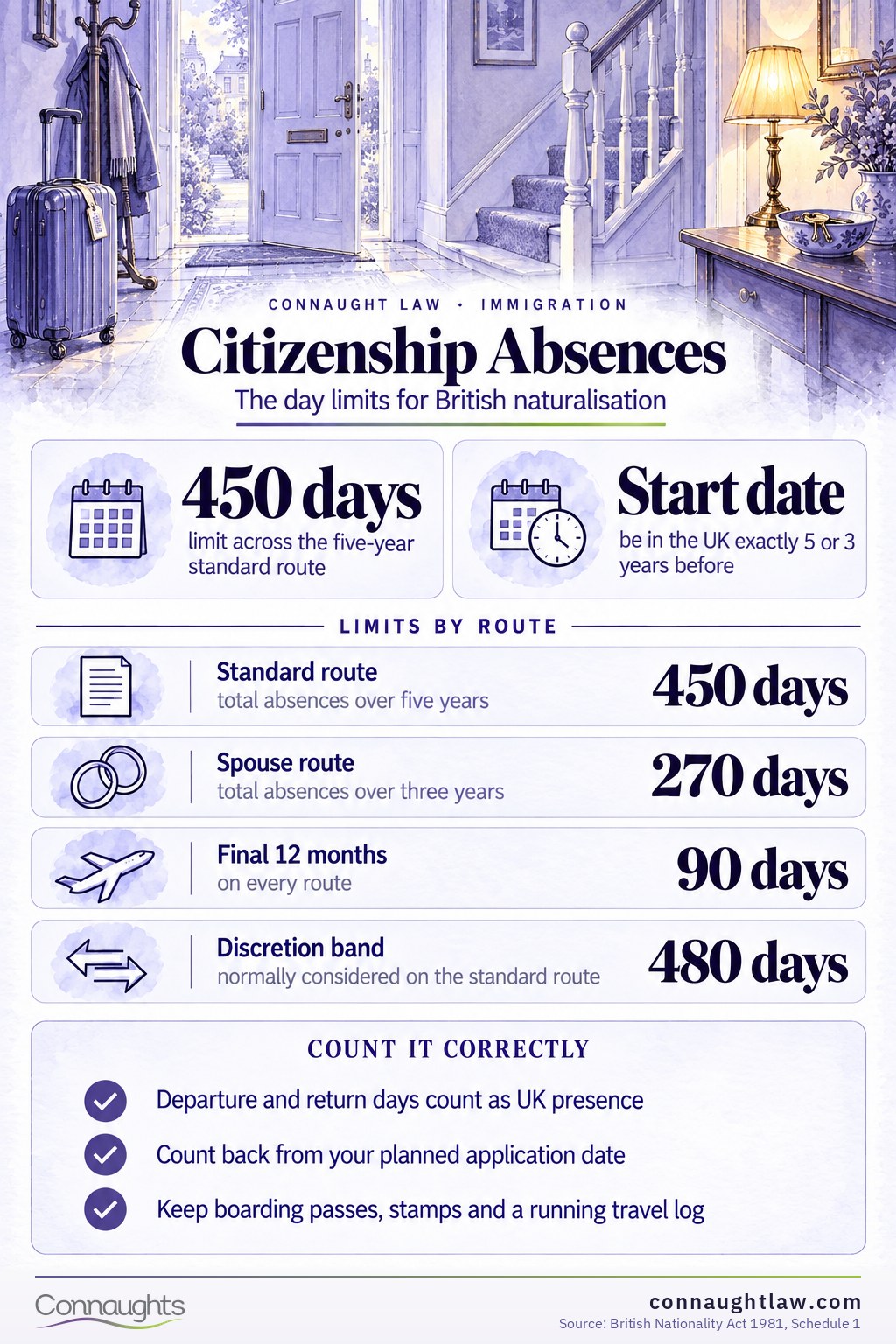
Limits by Route
| Route | Qualifying period | Total absence limit | Final-year limit |
|---|---|---|---|
| Standard naturalisation | 5 years | 450 days | 90 days |
| Spouse or civil partner of a British citizen | 3 years | 270 days | 90 days |
The spouse route trades two fewer qualifying years for a tighter allowance — 90 days a year on average against the standard route’s 90. Which route you use follows your circumstances on the application date, and the citizenship clock is separate from the ILR one: settlement’s rolling 180-day rule, covered in our ILR absence guide, measures different periods in a different way, so passing one test says nothing about the other.
Counting the Days
Departure and return days count as presence, so a trip contributes only the whole days between them; applying the ILR method to citizenship, counting from the wrong anchor date, forgetting the final-year total is a separate test, and reconstructing travel from memory instead of passport stamps and airline records are the four errors that appear in refusal letters again and again.
The method itself is short: fix the intended application date, list every trip since the qualifying period began, count the whole days abroad for each, then compare the two totals against the limits — which is exactly the sequence the calculator automates. What it cannot automate is the record-keeping: keep boarding passes, stamps and a running log, because the Home Office can ask you to evidence every date you declared.
Over the Limit: Discretion
| Route | Standard limit | Discretion normally considered up to | Beyond that |
|---|---|---|---|
| Standard naturalisation | 450 days | 480 days | Exceptional grounds only |
| Spouse route | 270 days | 300 days | Exceptional grounds only |
Modest excesses — up to 480 days on the standard route, 300 on the spouse route — are normally considered without special argument under the naturalisation guidance. Above those bands, discretion must be earned: Crown or designated service abroad, postings where the applicant maintained a UK home and family base, and genuinely exceptional circumstances such as serious illness abroad. The common thread is evidence that the UK remained home — an unexplained spreadsheet of long absences persuades no one.
Common Scenarios
The recurring cases have recurring answers. Frequent short business trips usually survive the totals but ambush the final year — schedule the quiet year deliberately. Long caregiving absences for a dying parent abroad are classic discretion territory: document the reason contemporaneously, not retrospectively. Academics and researchers with fieldwork or fellowship years abroad often cannot fit the standard limits at all, and should plan the application date around the calendar rather than argue discretion they could have designed out. In every case the cheapest fix is the same: apply later, with clean figures.
Character and Fees
Absences are only one gate. Since 10 February 2025, the good character guidance normally refuses citizenship to applicants who entered the UK illegally or made a dangerous journey to reach it, however long ago — the framework in our good character guide — and the wider settlement reforms proposed in the immigration white paper remain proposals to watch rather than rules to apply.
The fee arithmetic makes checking everything first worthwhile: naturalisation costs £1,839, it is not refunded on refusal, and an application filed one clean year later costs nothing extra. Our settlement and citizenship team reviews the whole position — absences, character, timing — before the fee is spent, alongside tools like our maintenance calculator for the family routes.
Why Connaught Law
The tool counts the days; solicitors judge the discretion, the evidence and the date that makes the problem disappear.
The limits, the guidance and the good character rules move — the calculator and the advice move with them.
Citizenship applications are handled by our experienced immigration team directly, from the first count to the certificate.
If a later application date is the better answer, we say so — the fee is not refunded on refusal.
Frequently Asked Questions
How many days can I be outside the UK for citizenship?
450 days across the five qualifying years on the standard route, 270 across three years on the spouse route — and no more than 90 days in the final twelve months on either. All periods count backwards from your application date.
Do travel days count as absences?
No — the day you leave and the day you return both count as presence in the UK. A trip therefore contributes only the whole days in between, which is how the calculator above counts it.
What if I am slightly over the limit?
Up to 480 days total on the standard route, or 300 on the spouse route, discretion is normally considered without exceptional argument. Above those bands you need strong evidenced grounds — or a later application date with clean figures, which is usually the better answer.
Is the 90-day rule separate from the total limit?
Yes — it is a second, independent test on the final twelve months before the application. Applicants comfortably inside the five-year total fail on the final year more often than on anything else.
Are citizenship absence rules the same as ILR rules?
No — ILR uses a rolling 180-days-per-year test during the qualifying leave; citizenship uses fixed totals counted back from the application date, plus the final-year limit and the requirement to be in the UK on the day the period starts. Run both separately.
Do I have to be in the UK on a specific date?
Yes — you must have been physically present in the UK exactly five years (or three, on the spouse route) before the date your application is made. It is one of the few requirements with effectively no flexibility, so verify that date before choosing when to apply.
Send us the calculator’s result and your travel reasons. We’ll tell you whether discretion is realistic, what evidence it needs — or the application date that makes the problem disappear.
Get Expert Advice