
Good character is naturalisation's broadest requirement and its least forgiving: a sentence-based test for convictions, a ten-year lens on immigration conduct, financial probity checks — and since February 2025, a default bar on applicants who entered the UK illegally, however long ago. Disclosure decides more outcomes than the conduct itself. This guide covers what is assessed, the refusal periods, the illegal entry policy, evidence, and the routes after refusal.
On This Page

A Requirement Without a Definition
The British Nationality Act demands good character of every naturalisation applicant but never defines it; Home Office guidance does, applied to the whole record, declared and discovered alike. Since the fixed refusal bands were withdrawn, a custodial sentence of twelve months or more normally refuses whenever it occurred, and lesser matters refuse unless the caseworker is satisfied on the balance of probabilities. Non-disclosure decides more refusals than the conduct behind it.
How the Requirement Works
The Statutory Framework
The British Nationality Act requires applicants to be of good character but Schedule 1 never defines it — the content lives in the Home Office's good character guidance, which caseworkers apply and courts police for rationality. The practical consequence: the guidance is the law as applicants experience it, and every application is judged on the whole record, declared and discovered alike.
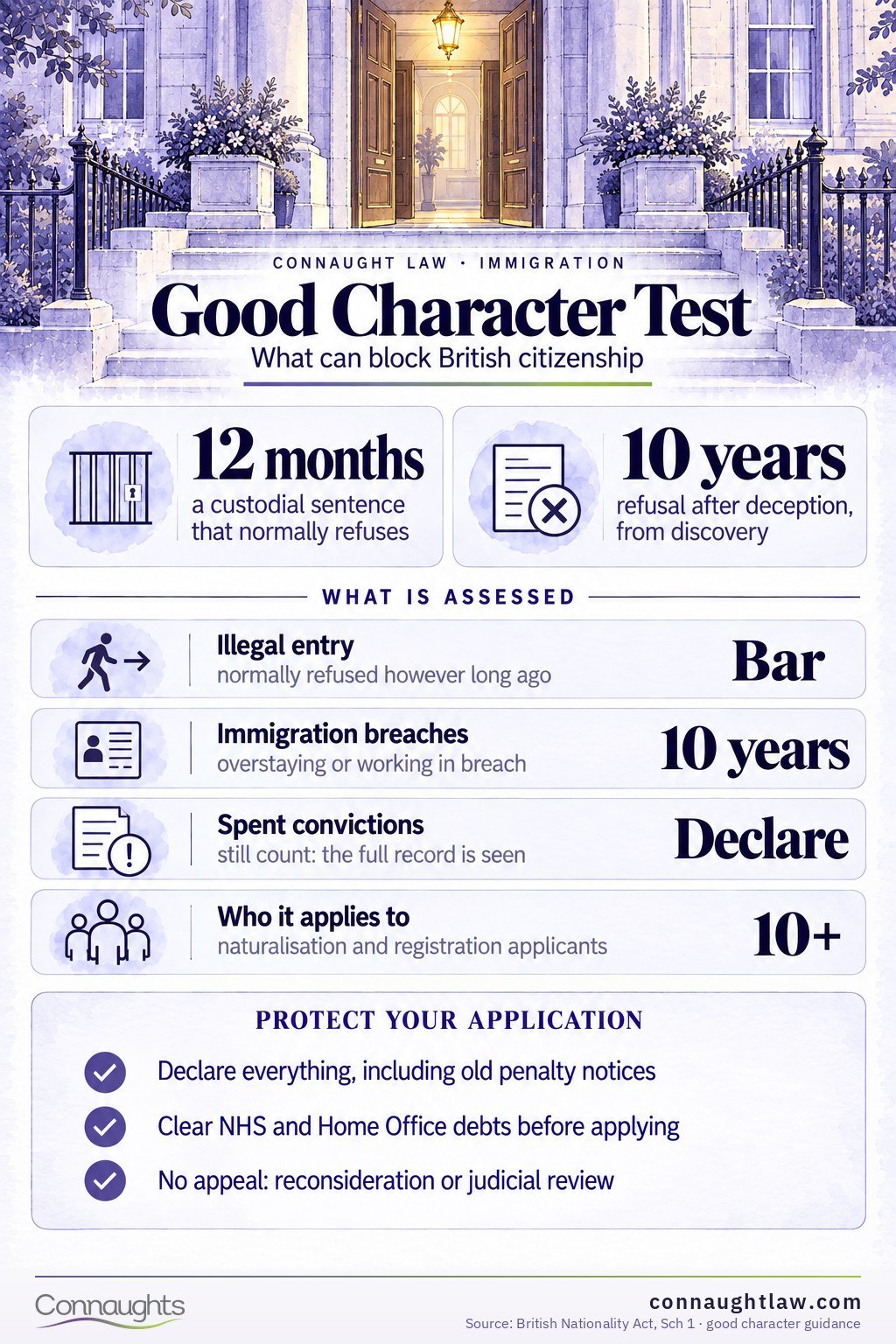
What Is Assessed
The Assessment Categories
- Criminality: convictions, cautions and out-of-court disposals, UK and overseas.
- Immigration conduct: illegal entry, overstaying, breaches and deception, mostly within a ten-year lens.
- Financial soundness: tax affairs, NHS and litigation debt, fraud-adjacent conduct.
- Notoriety and conduct: behaviour falling short of criminality that offends the public good.
- Deception in the application itself — the accelerant that worsens everything.
- War crimes, terrorism and extremism as absolute territory.
Guidance in Practice
Discretion exists throughout, but it is structured: the thresholds set the "normally refuse" position and the applicant's job is either to fall outside them or to present the exceptional circumstances that displace them. Silence is not a strategy — the checks reach police records, immigration files and HMRC without your help.
Convictions
Sentence Thresholds Since 2023
The framework changed on 31 July 2023 and the old fixed refusal bands are gone. Under version 7.0 of the guidance (30 April 2026), a custodial sentence of twelve months or more — or consecutive sentences totalling twelve months — normally refuses an application whenever it occurred.
A sentence under twelve months, a non-custodial sentence or an out-of-court disposal on the record must be refused unless the caseworker is satisfied, on the balance of probabilities, that the applicant is nonetheless of good character. There is no longer a fixed period after which the conviction stops counting. Rehabilitation-era "spent" status does not bind the assessment: nationality decisions see the full record, which surprises applicants advised by reference to employment law.
Out-of-Court Disposals
Cautions, warnings and fixed penalties sit in that same balance-of-probabilities assessment and must be declared — including the penalty notice paid and forgotten a decade ago. Motoring matters follow the same logic, with the drink-driving and totting-up patterns examined in our driving offences guide.
Failure to Disclose
Non-disclosure is the requirement's real killer: an undeclared minor matter becomes a deception finding, refusing the application on honesty grounds and shadowing every future one — and citizenship obtained by concealment can be stripped later, as our deprivation guide sets out. Declare everything and argue context; never curate.
Immigration Conduct
The Illegal Entry Bar
Since 10 February 2025 the guidance directs that applicants who entered the UK illegally — particularly by dangerous journeys such as small boat crossings — are normally refused citizenship regardless of how much time has passed or what status they later obtained. It is a default with discretion at the margins, not a statute, and it is already reshaping strategy for refugees and regularised families: settlement remains reachable, the passport may not be, as our regularisation guide maps.
Other Immigration Breaches
Overstaying, working in breach and absconding within the ten-year lookback ground refusal unless properly excused — with 39E-protected gaps and pandemic-era disruption the recognised mitigations. Time the application so the lookback is clean rather than arguing through it.
Finances and Honesty
Financial Issues and NHS Debt
Unpaid NHS charges above the referral threshold, outstanding litigation debt to the Home Office, benefit fraud and deliberate tax evasion all engage the requirement — bankruptcy alone does not, where honestly incurred and managed. Tax discrepancies carry their own jurisprudence and procedure, covered in our tax discrepancy guide: resolve with HMRC first, apply second.
Deception
Dishonesty in any dealing with the Home Office — this application or any before it — normally refuses for ten years from discovery. It is the harshest position short of criminal custody, which is the arithmetic behind every disclosure decision.
Proving Character
Building the Evidence
Where the record is imperfect, character is argued, not asserted: the conviction disclosed with its context and rehabilitation evidence, references from people who know the history, community and employment records, and a covering representation placing the conduct against the guidance's own discretion factors. The application should read like the caseworker's file review already done — favourably.
Special Circumstances
Mitigation tied to health, coercion or age at the time of the conduct needs contemporaneous evidence and belongs in the application, not the reconsideration. Where a condition affected both the conduct and the ability to explain it, clinical evidence does double duty.
After Refusal
Reconsideration
Citizenship refusals carry no appeal; the first route is the Home Office's paid reconsideration process, which succeeds where the refusal misapplied the guidance or overlooked evidence actually submitted. It cannot rescue an application that deserved to fail on its own disclosure.
Fresh Applications
Where a refusal turned on a sub-twelve-month or non-custodial matter, the strategy is evidence rather than calendar: time since the conviction is now one factor in the balance-of-probabilities judgment, not a bar that simply expires, so a fresh application must show what has changed. The fee is lost on refusal, which makes evidence discipline cheaper than optimism.
Judicial Review
Irrational refusals — guidance misapplied, relevant evidence ignored, the discretion never engaged — are judicial review territory, run by our judicial review team with pre-action correspondence resolving the clearest cases. The refusal notice's reasoning, or its absence, decides whether the challenge exists; our refusal solicitors and citizenship team read it first.
Frequently askedQuestions about good character
What is the good character requirement?
The statutory requirement that naturalisation and registration applicants aged 10 or over be of good character — defined in practice by Home Office guidance covering criminality, immigration conduct, finances and honesty across the whole record.
How long after a conviction can I apply for citizenship?
There is no fixed waiting period since 31 July 2023. A sentence of twelve months or more normally refuses whenever it occurred. Spent status does not shorten these periods.
Do I have to declare spent convictions and old cautions?
Yes — nationality applications see the full record, and the form asks accordingly. Non-disclosure converts a minor matter into a ten-year deception problem; disclosure with context is how minor matters stay minor.
What is the illegal entry citizenship bar?
Guidance in force since 10 February 2025: applicants who entered the UK illegally, especially by dangerous journeys, are normally refused citizenship regardless of time passed. Discretion exists only at the margins, and settlement is unaffected.
Can I appeal a citizenship refusal on character grounds?
There is no appeal — the routes are the paid reconsideration process for misapplied guidance, a fresh application built on better evidence, or judicial review where the decision was irrational. The right choice depends on what the refusal letter actually says.
Does NHS debt really block citizenship?
Significant unpaid NHS charges can, alongside Home Office litigation debt and dishonest tax conduct. Clear the debts and document the payment before applying — financial issues resolved in advance rarely refuse applications.
Tell us everything — dates, sentences, penalties, the lot. We'll place it against the bands, time the application to the calendar that works, and build the disclosure that protects you.
Get Expert Advice